A Cost Lever the CFO Cannot Measure Is One the CFO Will Cut.
The design function has never put a dollar figure on its precision. That’s why it’s the first budget cut.
A Cost Lever the CFO Cannot Measure Is One the CFO Will Cut.
The design function has never put a dollar figure on its precision. That’s why it’s the first budget cut.
Enterprise Experience Architecture presents: The Specification Economy — Article 2 of 4
The call came on a Thursday afternoon in March.
A product design director at a global energy trading firm — commodity position tracking across four regions — reached out through a mutual connection. Her function had been reclassified as delivery overhead in Q4. She wanted a second opinion on whether the case could be remade. I told her to send me the deck she had presented before the cut.
I scrolled through it twice.
Everything she built was the right argument for 2022. Adoption velocity. Component reuse rates. Engineering velocity gains from the consolidated token library. Design system coverage across the product suite. Solid numbers, clean story, clearly sourced. The deck would have landed in any budget review before agents entered the pipeline.
I called her back. First question: what does any of this say about the AI inference spend?
A pause longer than it should have been.
“That’s an engineering cost.”
For most of her career, that answer was correct. The moment AI agents entered the delivery pipeline and started metering every specification gap — automatically, continuously, in real time — it stopped being true. Not because she made a mistake. Because the accountability model changed two years ago and nobody sent her the memo.
The CFO who cut her function was not wrong. He was given nothing to count. Not a competence failure. A translation failure.
This article is the translation.
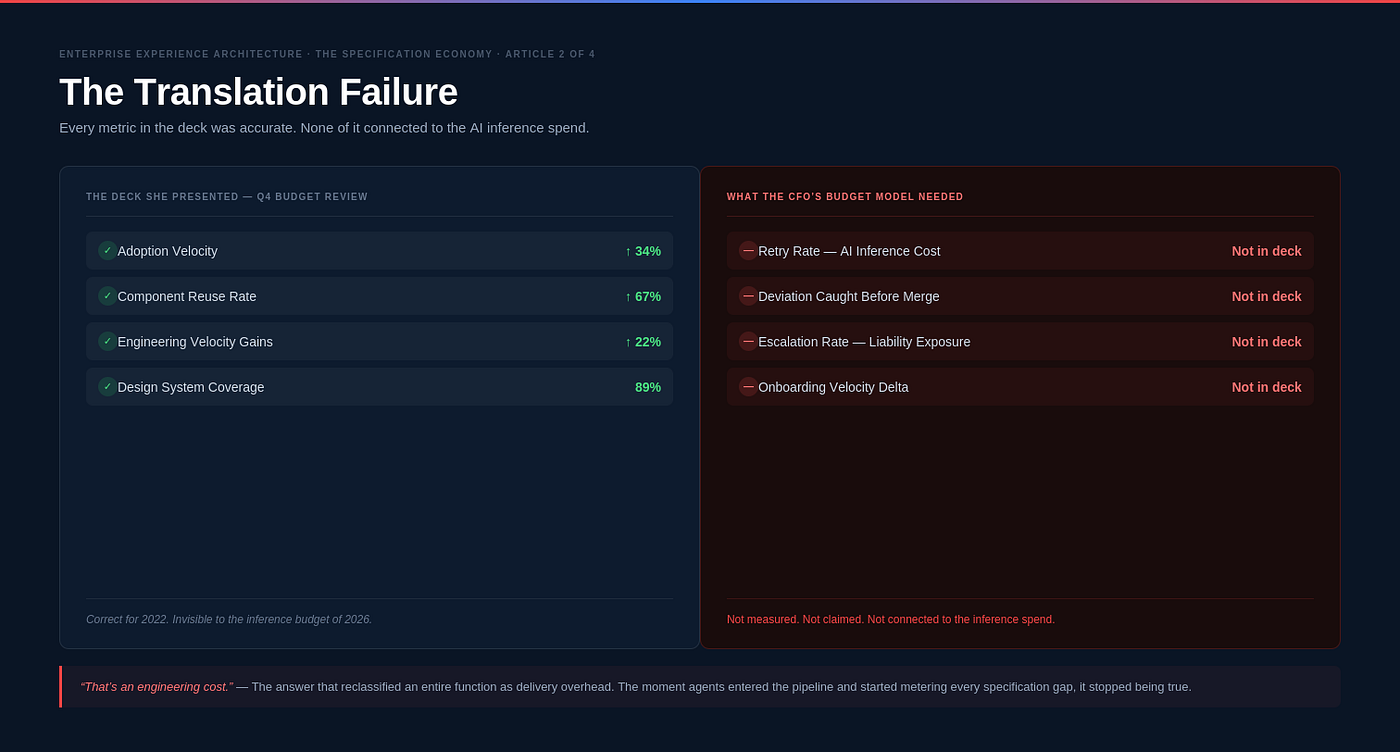
Every metric in the deck was correct for the pre-agent accountability model. None of it was legible to the CFO’s cost model for 2026. The gap between those two models is where the design function gets cut.
The New Accountability
Article 1 of this series established the mechanism: AI inference costs — the computational fee the enterprise pays every time an agent runs, metered per token — are exploding even as per-token prices collapse. And the single largest controllable variable on that bill is not the model, not the infrastructure, not the prompt compression strategy. It is the quality of the specification the agents execute against.
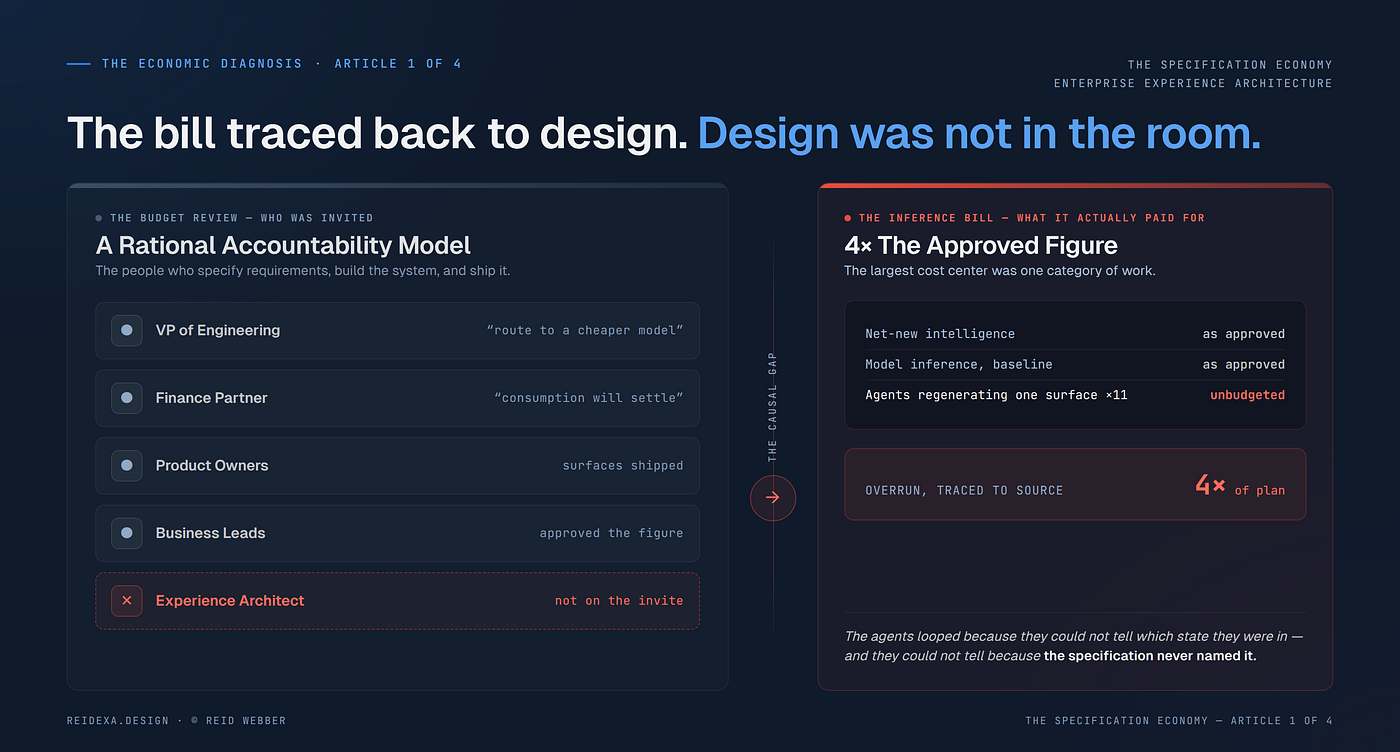
The Retry Tax is the metered cost of ambiguity. When an agent encounters a state the specification never defined, it loops — regenerating the surface, resending the full conversation history as context, failing validation, repeating. An agent grinding through ten correction cycles can burn up to fifty times the tokens of a single clean pass. That delta is not a malfunction. It is what the enterprise pays, automatically, every time a specification gap exists.
Read the full case for what the Retry Tax actually costs — including the math against a single ungoverned component generating forty-four thousand dollars a month in avoidable cost — in Article 1. That article establishes the diagnosis. This one builds the meter.
What has changed since Article 1 is the framing of who owns this cost. The Experience Architect is now the author of the largest controllable variable in the enterprise AI budget. This accountability did not exist before agents entered the pipeline. It is not inherited from twenty years of design practice. It arrived with the agents, and the design function that has not yet claimed it is not negligent — it is behind on a model that changed in the last two years.
The director who sent me that deck had not done anything wrong. She had been optimizing against the correct accountability model for 2022. The model changed. The meter started running. Nobody updated the argument she was making.
The P&L case for the Agentic Constitution is not “design quality improves.” It is the rework that currently sits buried in sprint capacity across every product line, surfaced and eliminated at the source.
Until a dollar figure attaches to the Retry Tax, the design function reads as aesthetic overhead in the eyes of the board. The language of the boardroom is liability and margin. The design function that argues for automation efficiency will lose. The one that argues for cost avoidance — with numbers — earns the room.
Two Failure Modes, One Source
Before building the measurement, it is worth naming exactly what gets measured. A specification gap does not produce one failure mode. It produces two — and only one of them shows up on the current inference invoice.
Failure Mode One: The Retry Loop. The agent encounters an unnamed state. It cannot determine the correct output. It resends the full conversation history, regenerates the surface, fails internal validation, and tries again. Up to fifty times the tokens of a clean pass, per session, automatically metered. Shows directly on the AI inference costs. Traceable, visible, already on this quarter’s invoice.
Failure Mode Two: The Silent Render. The agent encounters the same unnamed state. But instead of looping, it resolves with a best-guess output. Passes internal validation. Ships confident. Ships incorrect. A lapsed member surfaced as active. A closed account status cleared for routing. Wrong output against real user data. This one does not show on the inference invoice at all — it shows at the compliance incident, on the income statement, in the claims event.
The industry has discovered Failure Mode One. It appears on the bill, so it has attracted the FinOps attention and the prompt-compression strategies. What the industry has largely missed is that Failure Mode Two is the more dangerous reading. The Retry Loop is expensive. The Silent Render is a liability.
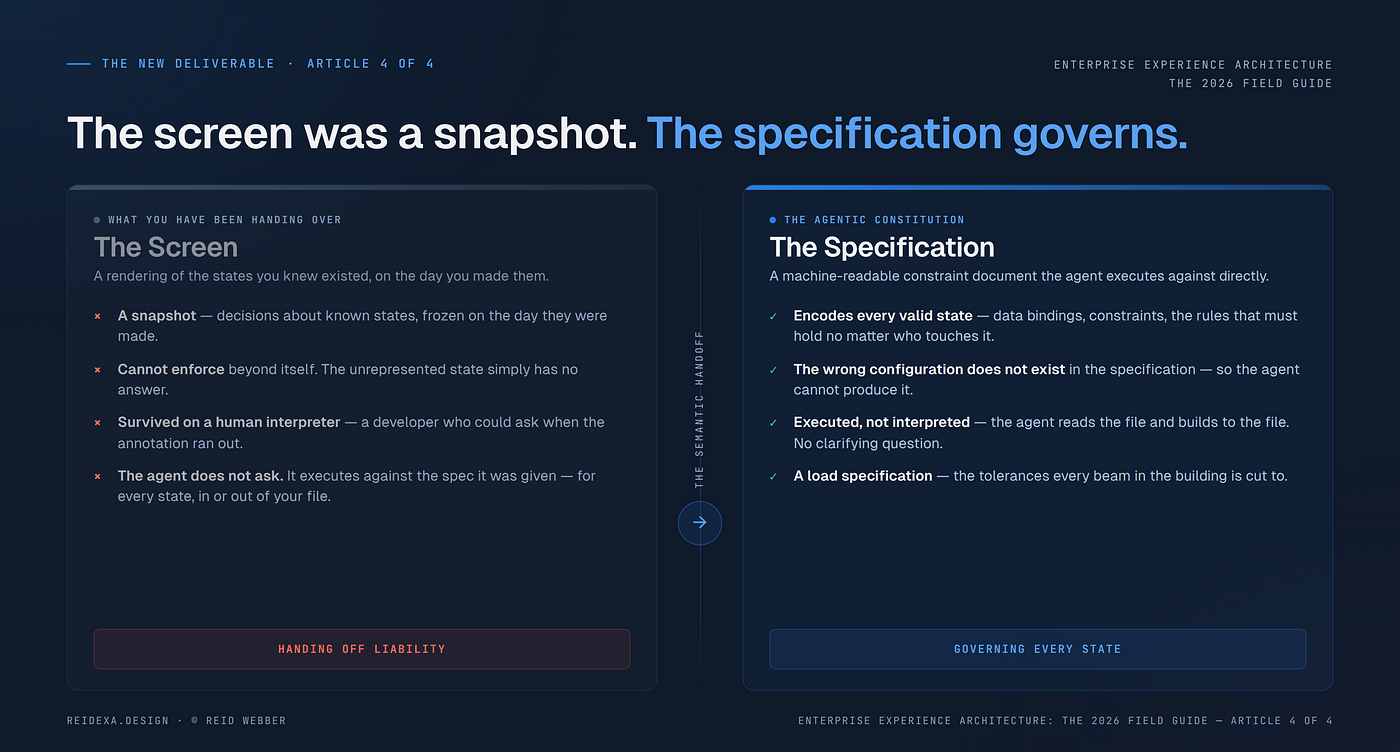
The Agentic Constitution — the machine-readable constraint file that governs what agents build and what they do when they encounter an unnamed state — forecloses both. The Retry Loop: by naming every state so the agent never loops. The Silent Render: by forbidding the guess when a state is unnamed and routing the gap to the architect instead.
Engineering’s Spec-Driven Development frameworks — GitHub Spec Kit, AWS Kiro, Cursor, BMAD — govern code correctness: syntax, test coverage, API contracts. This framework governs experience correctness: the states an enterprise carries liability for when they render wrong. One missed token binding is a linting error. One missed eligibility state is a claims liability. The engineering constitution does not know what a Medicaid redetermination state is — and it was not designed to. The two constitutions, authored by different people against different consequences, are what a governed agentic enterprise actually looks like.

The Retry Loop is visible — it shows on the inference invoice. The Silent Render is invisible — it shows at the compliance incident. Both trace to the same source: a state the specification never named. The Agentic Constitution forecloses both.
The P&L of Precision
Both failure modes produce a cost. Neither cost is currently assigned to a line item any design leader owns. That is the gap — not the value, but the legibility of the value.
The engineering world has arrived at this insight for code quality: it now has code review gates, static analysis, automated test suites. Finance has the forecast and the budget model. The design function has the specification — and no instrument that makes its quality legible to the people who sign the budget.
The Specification Scorecard is that instrument.
It is not a telemetry dashboard. It is not an engineering code-quality proxy. It is four metrics, each one translated directly into the dollar cost of not having it — expressed in the language finance already uses to evaluate investment in any operational function.
The design leader who walks in with a Retry Rate, a deviation-catch delta, and an escalation-rate liability number is not asking for a budget. They are presenting the cost-control instrument the CFO has been hunting for, and looking in the wrong department to find.
The scorecard metrics are not new operational requirements. They are new names for costs the enterprise is already paying — currently buried in sprint capacity, inference overruns, and production incidents, where they look like engineering problems rather than specification failures.
Retry Rate measures the average agent retry cycles per governed surface in a production session. Dollar translation: cost per token loop × cycles avoided = dollar value of specification precision. The 50× token multiplier holds at any contract rate.
Deviation Caught Before Merge measures logic errors caught at the specification layer versus errors found in QA or production. Dollar translation: engineering sprint cost avoided by upstream catch, versus the full remediation cost of a production discovery.
Escalation Rate measures governed specification gaps surfaced upstream versus gaps first discovered in production against real user data. Dollar translation: liability exposure of an ungoverned state reaching production. One missed eligibility condition is a claims liability — not a QA ticket.
Onboarding Velocity measures weeks for a new product squad to reach productive output in a governed versus ungoverned architecture. Dollar translation: time-to-productivity delta converted directly to sprint capacity recovered and ramp overhead eliminated.

Four metrics that translate architectural precision into the language finance already speaks. Each one prices a dimension of specification quality as the dollar cost of not having it. The design leader who walks in with these four numbers is not asking for a budget.
The Worked Example
Three product squads. Same organization. Same quarter. Each one built the same override — a variant of a component state that wasn’t in the governed specification, so they approximated it independently.
In an ungoverned system, this looks like three inconsistency tickets in engineering’s backlog. Each squad writes a slightly different approximation. Someone eventually notices the divergence during a QA cycle. Three separate remediation sprints. Three separate engineers. The fix is three rounds of work resolving what was never a code problem — it was a specification gap.
With the Specification Scorecard operational, the signal surfaces differently. The Deviation Caught Before Merge metric registers the same override appearing across three squads in one quarter. That is not a style preference. That is a structural signal: a state the Agentic Constitution never named, now surfacing in production through three independent improvised solutions. One constitutional amendment. Resolved at source, before the inference layer ever encounters it, with a concrete dollar figure attached to the sprint capacity that did not have to be spent.
The Scorecard does not require access to actual token cost agreements — finance silos those numbers. The fifty-times multiplier holds at any contract rate. More importantly, a design leader who approaches the CTO to run the Retry Rate calculation against actual cost data is not asking for a bigger budget. They are presenting a cost-control hypothesis the CTO’s own data can validate. That conversation lands on the CTO’s budget line, not design’s. It converts a resource request into a diagnostic collaboration.
The Number the Scorecard Cannot See
The Specification Scorecard’s four metrics measure specification quality — how well the Agentic Constitution governs the states it attempted to govern.
What it cannot measure is the states it never knew existed.
I ran the same telecommunications engagement years ago that surfaces in every EXA project in some form. I was sitting across from the head of sales operations at one of the largest carriers in the world, reviewing a platform designed to unify the global sales intelligence view. When he asked what happened when two subsidiaries were in active merger review while one was simultaneously mid-provision on a new contract, I did not have a screen for that. No one had told me that state existed. He had eleven more.
A Dark State is an enterprise condition that exists operationally but has never been named, mapped, or encoded in the specification. The most expensive category of specification failure: you cannot govern what you have not named, and you cannot name what you do not know exists. Dark states are not missing requirements — they are requirements that were never discovered. The agent encounters a state the constitution has no instruction for and either guesses, loops, or renders incorrectly. The cost arrives in production. The source was in the specification. The origin was in the discovery process that never happened.
An organization can post a low Retry Rate on every named state while carrying enormous Specification Debt in states it never discovered. The scorecard reports clean. The debt is invisible and accruing at production cost. That is the most dangerous reading on the instrument.
The fifth signal — the ratio of dark states first discovered in production versus those named upstream — is what Article 3 of this series builds the instrument to measure. The State Inventory is the instrument that intercepts Specification Debt before it reaches the inference layer. Article 2’s job is to name the gap. Article 3 builds the tool that closes it.
The Cost-Control Function the CFO Is Missing
The design director who called me in March went back to her CFO three weeks later with a different deck.
Not a deck about design. A deck about cost. A Retry Rate against the three highest-token-volume surfaces in the product suite. A Deviation Caught Before Merge delta across one quarter of sprint data. An Escalation Rate mapped to two production incidents from the prior year that the compliance team had already costed. An Onboarding Velocity comparison between a governed surface and an ungoverned one, run against actual squad data.
The CFO had not been given anything to count. She gave him four things to count.
The conversation was different.
This is what the Specification Scorecard is for. Not to prove that design is valuable in some abstract, craft-adjacent sense — that argument has been made, and it is not landing in budget reviews. To prove that the design function is the author of a quantifiable cost variable the enterprise is currently paying for invisibly, and that a senior specification function — funded, staffed, reporting in — converts that cost from a default to a decision.
A cost lever the CFO cannot measure is a cost lever the CFO will cut.
The Agentic Constitution is not a quality argument. It is a cost-control instrument. The specification function that runs it earns a seat at every budget review where AI inference costs are on the table — not because it made a compelling case for craft, but because it showed up with numbers the CFO already knows how to act on.

The meter already exists. The design function has not built it yet.
The design function that cannot prove it governs nothing. The one that brings the measurement earns the room, the budget, and the authority to run the instrument that protects both.
The Specification Scorecard tells you how well the Agentic Constitution governs the states it knows about. The harder question — how many states it does not know about, and what each one is accruing invisibly in Specification Debt — requires a different instrument and a permanent function to run it. Article 3 builds that function: the Logic-Review Gate, the State Inventory, and the amendment protocol that keeps the specification more precise every quarter. Not a project with a ship date. A discipline. The function the org chart is currently missing.
Series One established the architectural foundation this argument builds on: why the static design system is obsolete and why AI needs a constitution, not a better library.
Enterprise Experience Architecture presents: The Specification Economy — Article 2 of 4. Explore the full EXA framework at reidexa.design/exa.
← Article 1: Good Enough Is the Most Expensive Thing You Will Ever Ship
메타데이터
- post_id
- 0c136df3cd46
- slug
- the-unit-economics-of-intent-0c136df3cd46
- url
- https://medium.com/enterprise-experience-architecture/the-unit-economics-of-intent-0c136df3cd46
- canonical_url
- https://medium.com/enterprise-experience-architecture/the-unit-economics-of-intent-0c136df3cd46
- author_url
- https://medium.com/@reidw918
- status
- ok
- fetched_at
- 2026-06-22 05:41:33