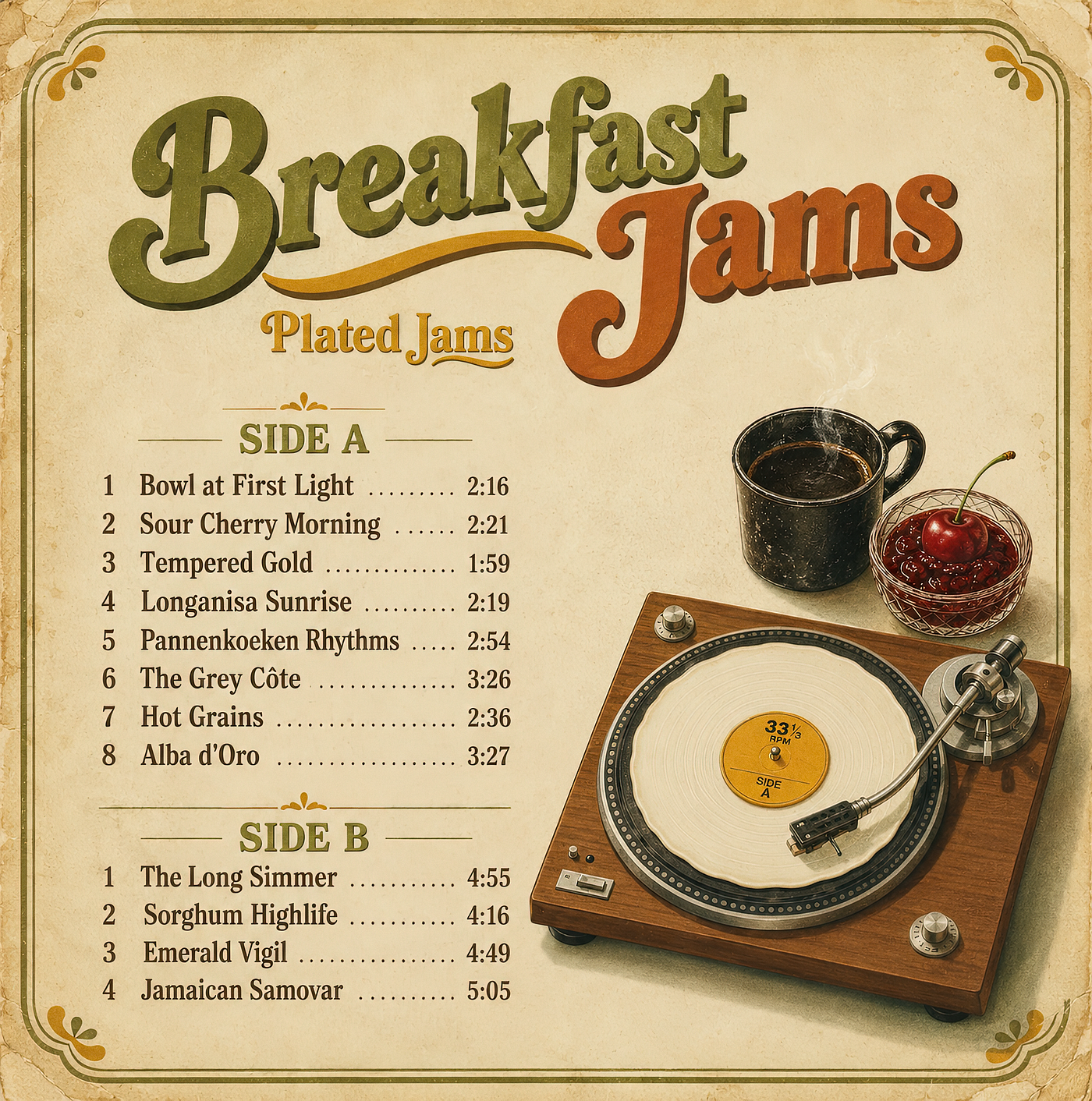
I Thought I Was Planning a Solo Food Podcast. I Ended Up Making an Album.
A paused podcast, a few AI music tools, and my own poems became Breakfast Jams, the album I never planned to make.
I Thought I Was Planning a Solo Food Podcast. I Ended Up Making an Album.
A paused podcast, a few AI music tools, and my own poems became Breakfast Jams, the album I never planned to make.
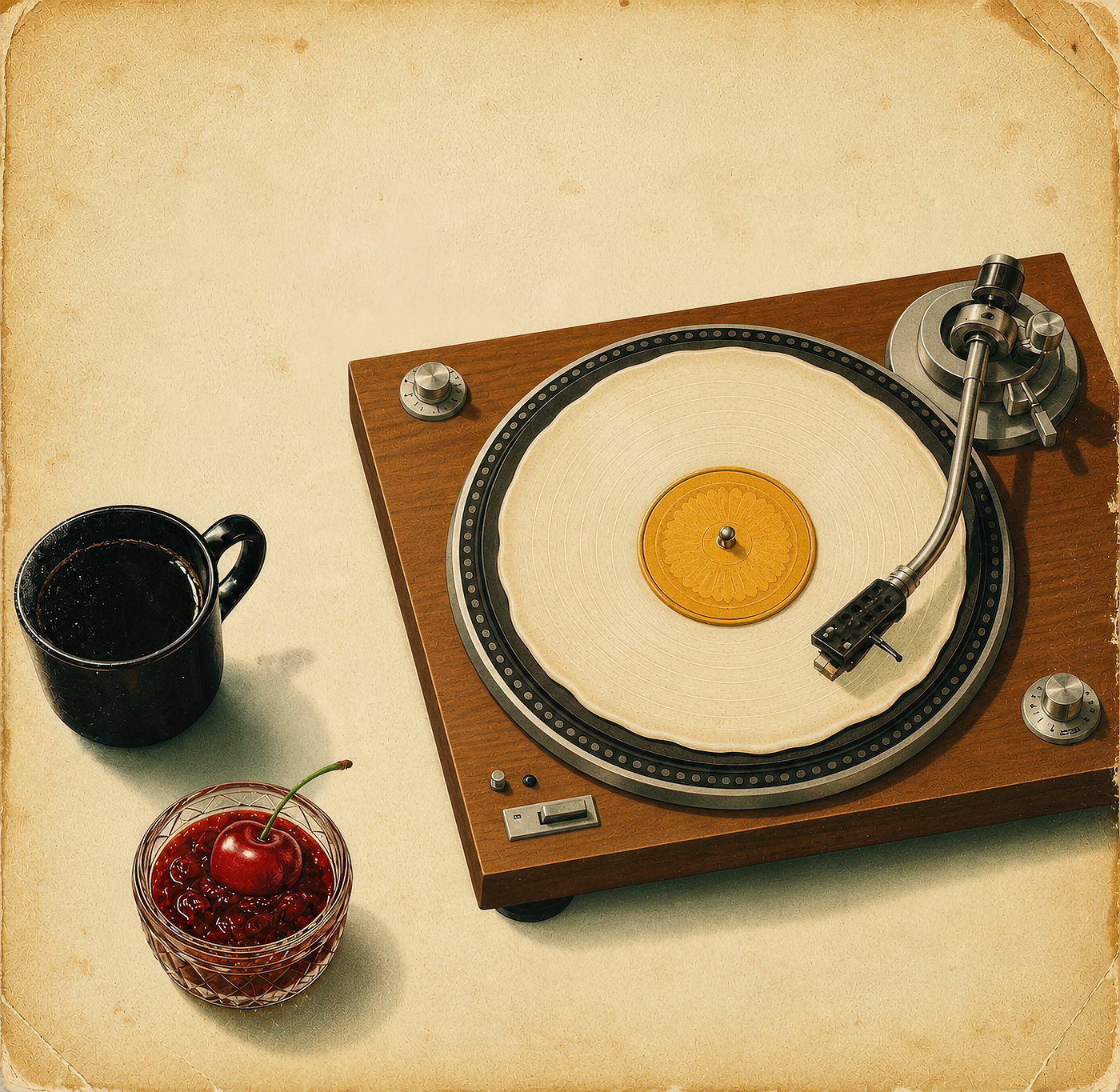
The visual world of Breakfast Jams begins at the breakfast table.
I have spent most of my life cooking, and a good part of it finding ways to talk about why cooking matters. I write. I take photographs. For a while, the place where all of that came together was a food podcast called A Seasoned Friendship, which I made with my friend and co-host, Lori. The idea behind it was not complicated. Two people who care about food sit down, talk, remember, and follow the conversation wherever it goes.
When Lori and I decided to take a hiatus from the show, I did not immediately think, “Now I should make an album.” That would make the story much cleaner than it was. At the time, I thought I was looking for the next version of a food conversation.
The podcast had given me something I value deeply: a collaborative space where cooking was not just instruction, not just recipe delivery, and not just another person talking into a microphone. It was conversation. It was memory. It was the pleasure of two people circling around food and finding ideas neither one would have reached alone.
So when the show paused, I felt the opening. I do not mean that in a dramatic or resentful way. Creative lives have seasons. Projects pause. People move toward new needs and new rhythms. But the pause still left me with a question I did not know how to answer. What was I going to do with all this food energy?
I have never been someone who sees cooking as only what happens between prep and cleanup. Cooking, for me, has always been a way to think. It is how I test culture, memory, improvisation, generosity, appetite, thrift, pleasure, and sometimes stubbornness. I wanted to keep evangelizing that. I wanted to keep saying, in one form or another, that cooking matters because it touches more of life than people often allow it to.
My first assumption was that I would continue as some kind of solo podcast. That seemed obvious enough. I started doing what I usually do when a creative problem appears: I began building possible containers. I thought about names. I thought about show formats. I thought about topics. I thought about how to make a solo food show feel like more than a person talking to himself about dinner.
That last part mattered. I can talk. That was not the problem. The problem was that I love collaboration. I like the friction of another mind in the room. I like being surprised by someone else’s memory or objection or excitement. A solo show could preserve my voice, but I worried it might lose the part of the work that had made the podcast feel alive.
At the same time, my cooking work had already begun to involve AI in serious ways. Not as a shortcut and not as a gimmick, but as a collaborator in recipe development, testing ideas, widening associations, and forcing me to explain what I thought I knew. I had already seen how AI could participate in the cooking process without replacing the cook. It could suggest, challenge, combine, and provoke. The actual judgment still had to be mine.
That gave me one possible direction for a solo show. Maybe the show could examine cooking through AI collaboration. Maybe it could ask what happens when a human cook works with tools that do not taste, do not smell, do not stand at the stove, and yet can still become strangely useful in the creative process.
But even that did not feel quite large enough. If I was going to do a solo show, I wanted it to connect cooking to a broader creative world. I started wondering who else was working with AI in ways that felt genuinely artistic. That is when I began thinking about music.
At first, the idea was simple: maybe I could invite AI music creators onto the show. I knew very little about that world. I was hearing that there might not be many people doing serious work there, but that made it more interesting to investigate, not less. If my show was going to be about food, process, and AI collaboration, why not talk to people who were trying to make sound with these new tools? That was the podcast idea. Interview people, ask questions, learn in public, keep cooking at the center, but let the conversation stretch.
Then I did what I do when I write investigative pieces: I started pulling threads. I looked into AI music creators. I looked into the tools. I tried to understand whether this was a brand-new artistic frontier or simply a noisy corner of the internet. At first, it seemed mysterious. Then, very quickly, it became less mysterious and more practical. There were tools. There were workflows. There were people experimenting. There were arguments about authorship, ownership, taste, skill, copyright, and whether any of it counted. That did not discourage me. It made the whole thing more concrete. If others were trying to create music with these tools, why couldn’t I at least try it myself?
That question was not the same as deciding to become a musician. I was not a songwriter. I had no ambition to pretend I was one. I did not read the situation as, “Now I can replace years of musical training with prompts.” That would have been ridiculous. What interested me was whether my existing creative languages could cross into sound. Could cooking become musical direction? Could a recipe suggest rhythm, texture, tempo, instrumentation, and mood? Could flavor become a way of describing sound? Could a dish carry enough emotional weather to become a song? At the beginning, I did not know. I only knew that the question was interesting enough to test.
So I started tinkering. I tried several AI music tools, mostly with the humble goal of seeing whether I could make anything that sounded like an intentional piece of music rather than a novelty. I was not yet thinking about an album. I was not yet thinking about Plated Jams. I was trying to understand the territory.
Eventually, I settled on Suno because it felt like the easiest and most complete tool for continued testing. That is not a romantic statement. It was practical. I needed something I could keep working with, something that would let me test language, mood, genre, instrumentation, and voice without needing to build an entire production studio around the experiment. Even then, I had no real idea where I was headed.
The first stage was just learning how to ask. That may sound simple, but it was not. A vague prompt gives vague music. A crowded prompt gives confused music. A clever prompt does not necessarily give a good song. I was learning, slowly, that the tool did not relieve me of decision-making. It multiplied the decisions.
The more I tested, the more I realized that the work could not be worthwhile unless there was meaningful human involvement at the center of it. That became the next question. If I was going to make music this way, what part of it was truly mine? The obvious answer was language. I did not want AI to write lyrics from nothing. I did not want generic words draped over a machine-made melody. If there was going to be a human spine inside the work, the lyrics had to come from me. That realization did not fully solve the problem, but it pointed me toward something I already had: my own poems.
The tool did not relieve me of decision-making. It multiplied the decisions.
And that is where the story began to shift. At first, I had been trying to imagine a solo food podcast. Then I considered interviewing AI music creators. Then I investigated the tools. Then I started asking whether I could make food enter music directly. Now the question became more personal. What would happen if my cooking, my poems, and these new music tools were not separate experiments, but parts of one process?
That was the beginning of Breakfast Jams, though I did not know it yet. It did not arrive as a finished concept. It arrived as a strange pressure, a question that would not leave me alone. I was still a cook trying to keep a food conversation alive. I was still a writer trying to use language that belonged to me. I was still a photographer thinking visually. I was still someone who missed collaboration and was trying to find another form of it.
The album came later. First came the question: what if I could cook my way into a song? That question carried me back to my own poems, then into twelve breakfast recipes, and finally into a record I had never set out to make. Everything hard came after it. Making the songs was its own long problem. Turning the food into images was another. Turning any of it into a release I could put into the world would be the hardest part of all. This is where that story begins.
© 2026 Robert Arthur Meyers Jr. All rights reserved.
메타데이터
- post_id
- 0c178e6fe7a4
- slug
- i-thought-i-was-planning-a-solo-food-podcast-i-ended-up-making-an-album-0c178e6fe7a4
- url
- https://medium.com/cognicuisine/i-thought-i-was-planning-a-solo-food-podcast-i-ended-up-making-an-album-0c178e6fe7a4
- canonical_url
- https://medium.com/cognicuisine/i-thought-i-was-planning-a-solo-food-podcast-i-ended-up-making-an-album-0c178e6fe7a4
- author_url
- https://medium.com/@robertmeyerslussier
- status
- ok
- fetched_at
- 2026-06-23 03:48:11