Whose AI Takes Are Worth Your Time?
Most AI takes are disposable. Here’s how to find the ones that aren’t.
Whose AI Takes Are Worth Your Time?
Most AI takes are disposable. Here’s how to find the ones that aren’t.
If you often read about AI, you’ve likely found that a lot of the advice isn’t very helpful.
I don’t mean it is all wrong. Many are based on real reports, surveys, and company examples.
The problem is not just that there is now 74.2% of content online that is either pure AI or AI-assisted, but also the incentive misalignment and lack of thought.
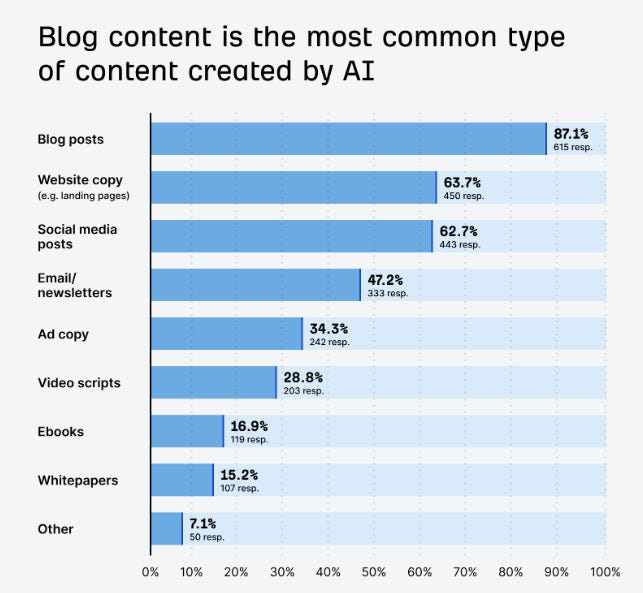
Very often, a report or survey is published with all the clean, polished data on AI adoption and agentic use cases. Then in the next 24 hours, you’ll guarantee seeing someone turn the chart and headline number into a short article, a LinkedIn post, or a “five takeaways” newsletter.
You found them because you cared about the topic, but I bet more often than not, all you found is fluff.
More and more, I feel my time isn’t respected.
The reason is that the majority of this information wasn’t designed to help you at all. But the sole purpose is to get your attention.
If you’re trying to figure out where AI fits in your work and life, reading the wrong things at best wastes your time, at worst, leads you on the wrong path.
For a while, I’ve been working out what separates content that actually helps you think from content that just provides insight.
Three filters:
who wrote it and why,
whether the writer did their own thinking, and
whether their argument could actually be proven wrong.
But first, why does the author’s incentive tell you more than the argument itself?
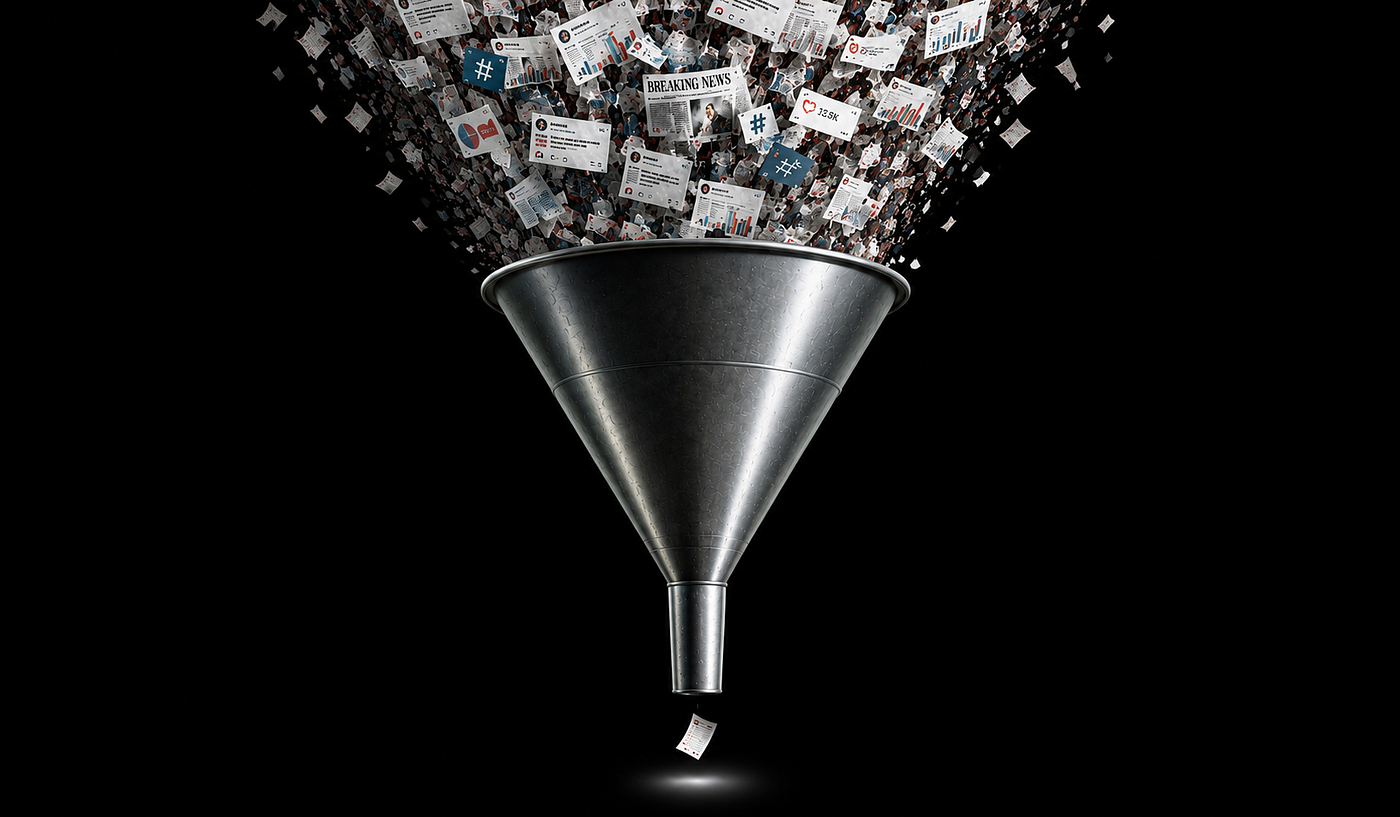
by Jing via GPT-image-2
The Incentives Behind the Work
The incentive matters, as I’ve been emphasizing.
For example, some AI newsletters, blogs, or LinkedIn accounts mostly repeat information from AI companies. And if you look closer, their positions are typically shaped by sponsorships, affiliations, and so on.
So when you aren’t certain about a piece, you should ask:
Why are they showing me this? What’s in it for them?
And naturally, if you don’t know what incentivizes the author, it becomes much harder to trust their judgment.
Why should you spend your limited time and attention on something when you aren’t sure if the authors’ incentive is aligned with yours?
That’s why many serious journalists or researchers don’t rely only on second-hand commentary. Instead, they go straight to primary sources. Think original papers, system cards, benchmark releases, and official research updates from the labs themselves.
This is also my main complaint about Stanford’s annual AI report: they are, at best, collectors of what others have found, with no critical judgment of the source or the thinking behind each piece of data they quote.
Or if you really want to understand what OpenAI or Anthropic are actually claiming, it’s often better to read the materials on their website rather than rely only on someone else’s interpretation (including mine if you’d like to fact-check).
Useful examples include:
- OpenAI research
- Anthropic research
- arXiv, where many AI papers are published
Of course, you might say:
That takes too much time, and reading technical papers is difficult.
Which is true.
To resolve this, I could suggest giving an AI assistant (like NotebookLM) the original paper or technical report and asking it to explain or summarize it. However, given my experience with NotebookLM (when it was first released), I recommend against it, even though the accuracy should be better these days.
This leaves you with the option: find a trusted human writer to get your insight.
Especially of those you are familiar with, the institution, the editor behind the newsletter, or their track record, and so on… so you can make a fair judgment of their work.
For example, someone like Ben Thompson at Stratechery has a very clear analytical style and a long-standing track record. You may agree or disagree with him, but you know what kind of thinker he is, what his framework is, and why people read him. Or Melanie Mitchell, a computer science professor, whose work is always well thought through and with the precision of someone who refuses to confuse a benchmark result with genuine understanding.
That kind of consistency matters.
Working Out Loud
Second, can you tell that the writer genuinely worked through the problem?
By that I mean, when you read the piece, can you tell that the author genuinely thought through the problem themselves? Or are they simply repackaging secondhand information?
Because today, almost anyone can use a deep research tool to gather lots of information and produce something that looks decent. But whether that person has a genuinely independent judgment about the topic is another matter.
The judgment trail is crucial.
But can you spot it, and how?
To be very honest, I think it can be quite challenging.
Abstract arguments are the hardest to tell. Anyone can summarise a debate they don’t fully understand.
But first-hand analysis does leave traces, such as numbers beyond the headline, methodology questions the author clearly asked themselves, and a reasoning chain you can actually follow.
For example, when I write about AI adoption, I’m reading the same McKinsey reports, Stanford HAI surveys, and vendor case studies everyone else is reading.
However, the angle I start and the questions I ask are unique because of my personality and the science and tech training.
I can’t help but want to understand the methodology. I look at who was surveyed, who wasn’t, how the questions were asked, and which questions weren’t asked. I compare the headline number to the footnote, which, in many cases, tells you what the team worried about (if they don’t, they won’t put it here).
And then I talk to people who are actually using these tools in real life and see whether the survey story matches the first-hand observations.
For example, the “90% of enterprises are adopting AI” number turns out to mean someone in the company has a ChatGPT subscription. Or a report is using two entirely different baselines in the 2024 vs. 2025 comparison.
Because I’ve seen how messy the reality is: clean experiments are hard, and enterprise adoption always has a catch.
So this is the second point: Independent Judgment (Working Out Loud)
Can you see that the author has thought deeply about the issue? Or does it feel like they simply used AI to quickly generate a polished article?
Does It Hold Up Over Time?
The third point is whether the article can actually change reality over time.
Most AI takes are unfalsifiable, which makes them disposable.
Last August, MIT’s NANDA initiative published a report claiming 95% of enterprise generative AI pilots were failing to deliver returns.
Within days, the consensus flipped. The same outlets that had spent two years writing “AI is transforming the enterprise” pivoted to “AI is failing the enterprise” without acknowledging the turn. The same writers churned out the new take with the same confidence as the old one.
To be clear, I’m not saying predictions have to be right, or people aren’t allowed to change their minds.
AI is moving fast, and reality will keep embarrassing all of us.
But a well-thought-out piece explains the premises behind the position. You can see the assumptions the writer is making, the evidence they’re relying on, and the conditions under which they’d think differently.
When new data arrives, you can also expect them to be the first to point out what they wrote x, and to update it against their own stated reasoning with a well-supported argument.
Or that they’d explicitly or implicitly state what evidence would update them.
For example, Gary Marcus has long argued that scaling current LLMs won’t be enough for AGI. You can disagree with him, but the premise is legible: he thinks these systems lack the reliability, reasoning, and abstraction needed for general intelligence, and that more data and compute alone won’t fix that.
Compare that to a McKinsey report or a random LinkedIn thought leader, which are engineered to absorb any outcome.
Whatever happens, they were right. That’s not analysis.
So the third point, in short, takes time, and it’s cliché but true.
For You, but Also a Reminder for Myself.
In the AI era, rather than AI literacy, let’s take a step back and start with building strong information literacy. We need to ask better questions about what we read/listen/watch:
Who’s behind this?
Why did they produce it? What is their source?
Can you see their independent judgment?
Can their logic hold up over time?
And most importantly:
Does this help me better understand x?

Outsource your overthinking to someone who gets paid to overthink. Just a coffee is sufficient
메타데이터
- post_id
- 0c19ad8ebbf2
- slug
- whose-ai-takes-are-worth-your-time-0c19ad8ebbf2
- url
- https://ai.gopubby.com/whose-ai-takes-are-worth-your-time-0c19ad8ebbf2
- canonical_url
- https://ai.gopubby.com/whose-ai-takes-are-worth-your-time-0c19ad8ebbf2
- author_url
- https://medium.com/@jinghuu
- status
- ok
- fetched_at
- 2026-06-12 07:40:50