The Changing Face of Age
I have a photograph that stopped me in my tracks.
The Changing Face of Age
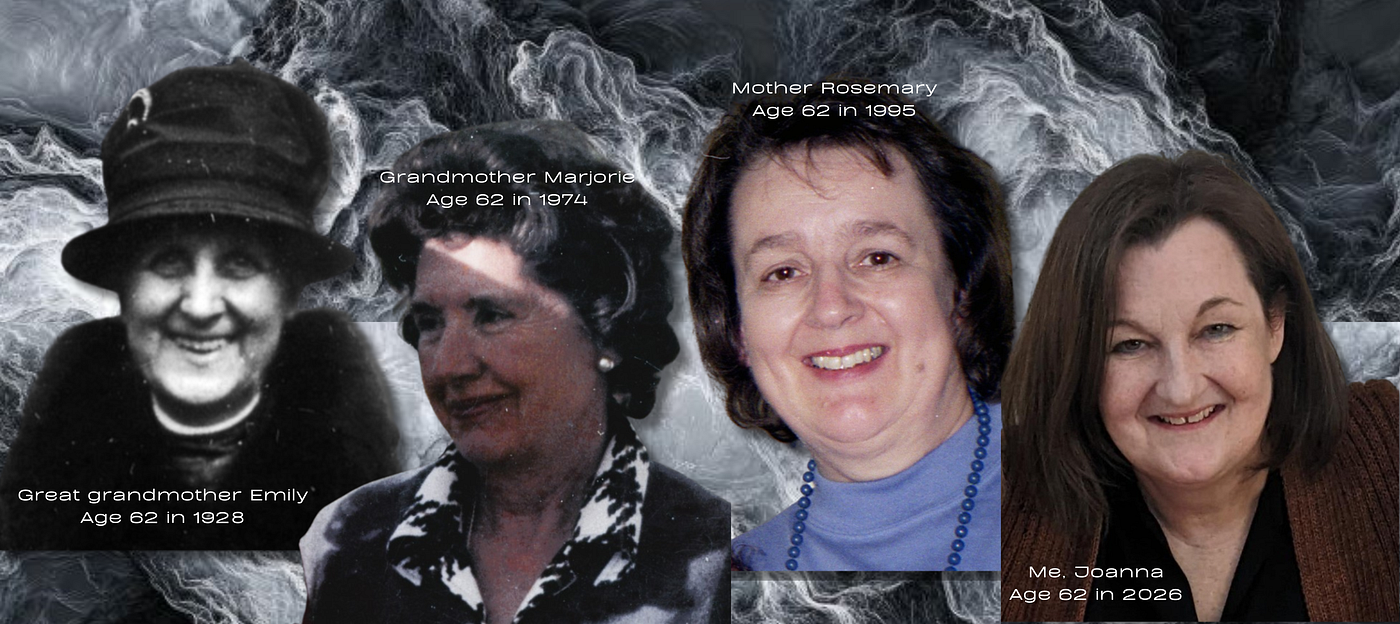
100 years of ‘62’ in one family
I have a photograph that stopped me in my tracks.
It’s a picture of my great-grandmother Emily. I assumed she was over 80, but when I did the calculation, I realised she was my age today… 62.
So I created a line-up of photos, all aged 62, spanning very nearly a hundred years: my great-grandmother Emily, in 1928; my grandmother Marjorie, in 1974; my mother Rosie, in 1995 — and myself, now. I think the difference is amazing. An entire century of change happened between us, inside one family.
Is it just a fashion choice? The lottery of when your hair goes grey? The miracle of the anti-wrinkle cream?
What actually changed?
Some of it is genuinely biological. People in their sixties today are, by the evidence, healthier than the same age group a generation or two ago — better mobility, sharper cognitive scores, fewer of the chronic conditions that used to be taken as simply part of getting older. By the age of sixty, people were expected to put their slippers on and sit by the fire, reminiscing.
Some of the distance between myself and Emily isn’t health-based but expectation-based.
I expect to be able to ride a Lime bike around London, walk 10,000 steps a day, run for a bus, sling on a pair of heels and dance myself silly at a party. Emily’s generation slid into genteel old age with grey hair, flat sensible shoes, and wrapped up warm against the cold their old bones felt. They expected to be given a seat on the bus, train or tube. I very rarely get offered one.
Today, people look at a full head of brown hair on a 62-year-old and assume it’s dyed. Mine isn’t, and I’m not remarkable for that; plenty of people simply don’t grey the way the stereotype expects, for all sorts of unremarkable reasons. The assumption itself is the interesting part. A youthful appearance may be authentic or it may be manufactured, and we’ve quietly decided that neither matters.
But is youthful-looking old age doing us a disservice?
Governments are operating on the reasoning that if we’re living longer, we can work longer too.
But this is a mask hiding a few truths that the government is carefully avoiding.
Firstly, ONS figures published this year show that “healthy life” expectancy has fallen to 60.7 years for men and 60.9 for women — the lowest since records began in 2011, and down nearly two years over the decade. So whilst 50+ year olds may look younger, their healthy life expectancy is going backwards.
Secondly, almost one in four (24%) women aged 52–69 who are in work are also unpaid carers to their ageing parents. (As an aside, this is in comparison to just over one in eight (13%) of men of the same age doing parental caring duties.)
This more youthful appearance only serves to support the government’s increase in the State Pension Age (SPA) from 66 to 67, which will rise further to 68 by the mid-2040s. And this works doubly against women, whose pensionable age equalisation with men — initiated by the 1995 Pensions Act so by 2018, the SPA for women was raised from 60 to 65, despite women also fitting unpaid caring responsibilities in around a need to work and earn money.
The principle works well for the 50+ year olds who want to carry on working because they enjoy it, they feel “up-for-it”, they’re “Not Done Yet” or they want to “Pay it Forward” — pass on the experience, knowledge and skills they’ve gained, put something back into the universe.
It may come with some requests, some flexibility. Not the same 50+ hour week of their younger years, but with a bit more flexibility, please, so they have time to support their 20-something children, or to care for their parents.
Unfortunately, the workforce is rejecting the ones who want to carry on working.
And the government and state pension scheme aren’t supporting the ones who can’t.
Society doesn’t know what to do with us.
Are 60-somethings applying for jobs being judged on the lottery of whether they look their age or not? They aren’t welcome in the office if they look old; only the youthful-looking 60+ year olds can gain entry. They’ve been pre-judged, and rejected, on their wrinkles and frizzy hair.
Then there are 60-somethings whose bodies have already entered retirement, even if they’ve won the youthful looks lottery. They don’t feel able to work like they always did, but can do a small job to earn a few pennies.
In effect, it appears that pre-judgement of one’s appearance is the criterion for who makes it through.
Are we old and can’t work? Or are we youthful and can work? Is it better to look your age or look younger? Or is it better for one’s appearance to match the creakiness of one’s bones?
If we can no longer reliably read a person’s age off their face, why does the DWP behave as though it can read a person’s capability off it too?
Finding the Missing Thousands
We can no longer afford to guess at the answers to these questions. Right now, thousands of over-50s are entirely missing from the workforce, leaving an empty space that policy-makers don’t know how to interpret. Are they pushed out by ageist recruitment? Are they physically unable to continue? Or are they simply crushed by the invisible weight of unpaid care?
To find out exactly what is happening behind the mask, a new research project at the University of Surrey is launching to investigate why this vital demographic is disappearing from the workplace. By looking past the statistics and looking into the lived realities of 50+ workers, this project aims to uncover the real barriers blocking over-50s — and crucially, what needs to change to bring them back.
In summary:
The truth is, one’s appearance can be an optical illusion, and society cannot allow increasing longevity or a superficially youthful appearance to be weaponized by the state to justify driving up the State Pension Age.
It is time to abandon the binary myth that people between 50 and 68 are either “fully employable” or “fully retired.” If society wants us to work for longer, we need this phase of life to be recognized as a distinct staging post — a transition period where our specific needs, from declining physicality to the heavy burden of unpaid care, are properly assessed and supported.
This Surrey project is born out of this exact battleground. Funded through the Economic and Social Research Council (ESRC) Impact Acceleration Account (IAA) Future of Work in Surrey programme, it is an urgent inquiry, particularly for women who face the double whammy of an ageist recruitment market and increasing family responsibilities. Until our research helps policy catch up and provide the structural flexibility this staging post requires, the changing face of age isn’t progress at all. It’s just a mask hiding systemic neglect.
메타데이터
- post_id
- 0c25d3ebabe2
- slug
- the-changing-face-of-age-0c25d3ebabe2
- url
- https://medium.com/@jo_56585/the-changing-face-of-age-0c25d3ebabe2
- canonical_url
- https://medium.com/@jo_56585/the-changing-face-of-age-0c25d3ebabe2
- author_url
- https://medium.com/@jo_56585
- status
- ok
- fetched_at
- 2026-07-09 00:50:33

