Republic of Batumi in 1918
Contents. The Republic of Batumi 1918–1920. A British puppet under dictator James Cook-Collis. What, how, why, why, how it was created, how…
Republic of Batumi in 1918
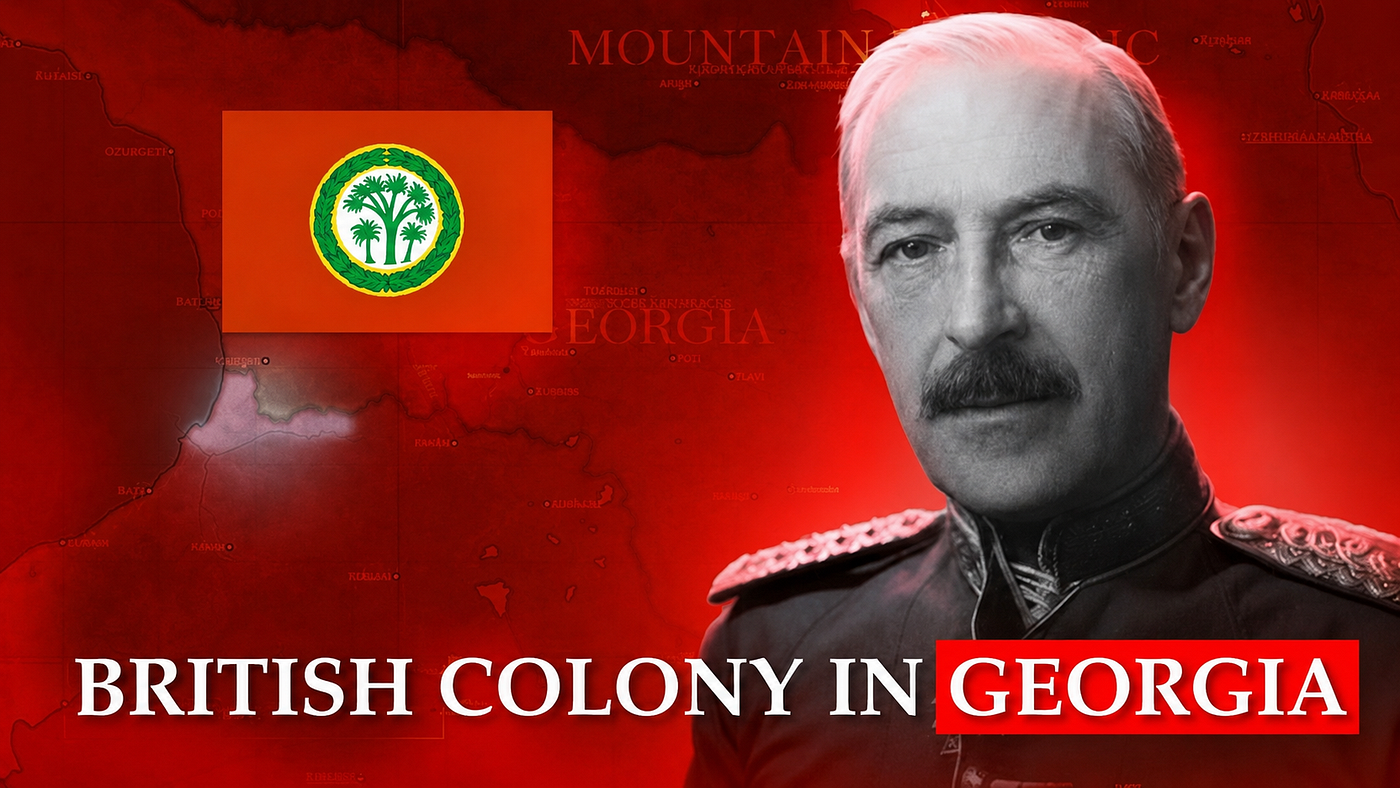
Contents. The Republic of Batumi 1918–1920. A British puppet under dictator James Cook-Collis. What, how, why, why, how it was created, how it was destroyed. The Batumi Region under the British military administration 1918–1920. To be fair, it should be noted: there is no fully recognized state named the “Republic of Batumi” in historiography. We use the term provisionally, as a journalistic designation for the special political regime established by Great Britain in the Batumi Region in 1918–1920 (for only 1.5 years).
The use of the term “republic” does not indicate legal validity, but rather the diplomatic language of the era, aimed at disguising foreign military domination under the guise of temporary autonomy. In fact, it was a small coastal enclave (the territory of one state, or part of it, surrounded on all sides by the territories of another state(s) within the Black Sea. Most other British puppet states lasted for decades, pretending to be “protectorates” or “League of Nations” mandates, and using local rulers to gain legitimacy. The goals were almost always similar: domination over resources (oil, ports), strategic routes, and the containment of rivals (Bolshevik Russia, Germany, the disintegrating Ottoman Empire, local nationalists, and the nascent Georgian state). As for the South Caucasus and Georgia, Russia, England, Germany, and the Ottoman Empire all claimed control.
The city did not enjoy full sovereignty during this period. Local government bodies existed, and attempts at political self-organization were made, but all were under the control of the British local administration. In particular, the Muslim National Council of Adjara/Batumi was active among the self-governing bodies. Its formation began in In 1917, after the February Revolution in the Russian Empire, its most active activity occurred in 1918, during the period of Ottoman influence. With the arrival of the British, the role of Muslim organizations changed: they were retained, but under British control; their political activity was limited, as the British sought to balance the Muslim population against Georgian claims to the region. Muslim committees continued to exist, but no longer as an independent political factor, but as one element of a governed system. It is safe to say that this was a kind of “protectorate”: formally, not a colony, but not an independent state either.
The British allowed local elites to participate in governance, but key decisions remained with the military administration. Why, then, did the idea of a “puppet republic” arise? After the collapse of the empires, a powerful impulse for self-determination arose in the region. But in Batumi, this impulse was curtailed by an external force.
The Justification for Choosing Batumi
The British arrived in Batumi in the late autumn of 1918. After World War I, two British cruisers (the Liverpool and the London) approached the shores of Batumi. On March 1, 1918 (under the Treaty of Brest-Litovsk), Batumi was transferred to the Ottoman Empire. For the Turks, this was more than just a port; it represented a direct expansion of their zone of influence in the Black Sea. The Treaty of Brest-Litovsk was signed between Russia, Germany, Austria-Hungary, and the Ottoman Empire. Three provinces of the former Transcaucasus — Batumi, Ardahan, and Kars — were transferred to the Ottomans. In April 1918, Turkish troops occupied Batumi with virtually no resistance. Historian Dimitri Silakadze, who has devoted his research to this period, writes:
“The main reason for the Batumi fiasco was the low morale of the Batumi troops.” The Ottoman troops and their allies were inferior to the Batumi garrison both in numbers (30,000 versus 12,000) and in artillery (25 guns versus 7), but numbers are one thing, and the will to fight is quite another. The Batumi troops were made up of demoralized soldiers, former deserters, and marauders who had no intention of fighting.
Silakadze says that most of the troops didn’t even engage in combat, although there were isolated pockets of resistance. “Captain Simon Shavgulidze and his 50 soldiers distinguished themselves, fought, and died heroically during the fortification of Anaria,” Silakadze recounts. After Turkey’s defeat in the Great War and the Armistice of Mudros (October 1918), the Ottomans withdrew from the city. A power vacuum opened again, and the British entered the picture. On October 30, 1918, the famous “Armistice of Mudros” was signed, ending the Ottoman occupation, and the Batumi district was handed over to the British.
The British were reluctant to immediately hand over the city to the Georgian Democratic Republic, fearing instability in the region and territorial claims on Batumi from Armenia and Azerbaijan. Nominally, the British were allies of the Entente, called upon to stabilize the region and prevent the spread of Bolshevism. But this was only the surface truth. In reality, Britain was expanding its sphere of influence, and Batumi was strategically important. Batumi was the Russian Empire’s most important port on the Black Sea — the gateway for Baku oil exports.
Denying the Red Army access to the Black Sea was the goal of the Batumi military government. The Cook-Collis regime also ensured control over oil and influence in the Transcaucasus (by containing Turkey, Armenia, and Georgia). Finally, the idea of a free port (making Batumi an international zone, similar to Danzig under the auspices of the League of Nations) was seriously discussed, but ultimately never came to fruition. According to historical and archival data, there were 1,500 British soldiers in Batumi at the end of 1918. “This man was Irish and had taken part in suppressing the uprising in India; he was an experienced military leader,” says historian Otar Gogolishvili. “Cook-Collis arrived in Batumi from Constantinople accompanied by 15 people, including Harris.” Turkey, Armenia, and Azerbaijan also laid claim to Batumi. For Great Britain specifically, control of Batumi meant control of Caspian oil and a weakening of the position of both Soviet Russia and potential competitors within the Entente.
The British Foreign Office wrote in a memorandum of January 1919: “Batumi is indispensable as an outlet for Baku oil, and should remain under effective British control until a stable settlement is established.”
The Arrival of British Troops
After the October Revolution of 1917, Russian administration in the Caucasus ceased to exist. The Ottoman Empire occupied Batumi in the spring of 1918, but Turkey’s defeat in the war made the region subject to a redistribution of Entente forces. Formally, the British troops’ mission was to maintain order, but the intention was to establish direct military control. General William Thomson, commander of British forces in the Caucasus, stated at the time: “Our presence in Batumi is dictated by the need to ensure strategic communications.”
How the puppet structure was created
Great Britain refused to immediately hand over Batumi to the Georgian Democratic Republic, despite its formal demands. Instead, a special administrative zone was established — the Batumi District — subordinate to the British military command. To legitimize the occupation and avoid direct conflict with Georgia, the British administration proclaimed the Batumi Region a separate administrative unit, and later, an independent republic. In December 1918, the British created a Regional Governance Council, headed by Cadet P. Maslov. The Council consisted primarily of Russians and representatives of various nationalities. However, on April 28, 1919, the British disbanded the “Council” as unnecessary.
In January 1919, the Batumi Parliament allegedly declared independence…
General James Cooke-Collis, holding the title of Chief Military Administrator (High Commissioner) of the Batumi District, was appointed head of the current administration. Order №17 of the High Commissioner of Batumi, issued in March 1919, stated: “All civil authorities are subordinate to the military administration. Any political activity that disrupts order in Batumi will be suppressed.” This document legally enshrined the primacy of military authority over any form of civil governance. In the spring of 1920, the Georgian government sent troops into the Atvin and Khulo districts, prompting an official British protest. The Georgian army attempted to take Batumi, but the British garrison made it clear that it was prepared to defend the city with arms if necessary. The personal intervention of British High Commissioner Sir Oliver Wardrop helped avoid armed conflict.
The Cooke-Collis Regime
The Cooke-Collis regime exhibited the characteristic features of a colonial regime:
the absence of elected bodies, subordination of the courts and police to military command, complete control over the port, customs, and railways, suppression of political activity.
In literature and journalism, Cooke-Collis’s name is often “demonized”: he is called the “dictator of Batumi,” accused of authoritarian rule, suppression of local initiatives, and strict control over the city. All of this was undoubtedly true, but the British operated in a climate of complete disorganization: surrounded by armed groups, ethnic conflicts, and economic collapse. Their task was utilitarian: to hold the port, ensure the transit of resources, and prevent the Bolsheviks from gaining influence in the region. Any strikes were viewed as a direct threat to military order. Cooke-Collis ruled harshly: he declared martial law, suppressed protests, and dissolved local governments. At the Paris Peace Conference in July 1919, the Georgian delegation stated:
“The Batumi region is being governed without the consent of the population and contrary to its economic interests.” Anton Denikin, who was politically distant from the authorities, wrote in 1926: “The British held Batumi as if it were one of their overseas ports.”
From December 22, 1918, to July 7, 1920, Batumi was a British puppet. Labor exchanges and currency exchange offices appeared in Batumi during British rule. The British pound sterling was used in the city, and British stamps (Batum Post, later with an overprint of “British Occupation”) were issued, as were passports and documents, emphasizing Batumi’s separate status. Ships carrying British and European goods finally docked in Batumi. However, demonstrations were also held in the city — the people wanted a return to Georgian rule.
The Economic Essence of the Cook-Collis Regime
The primary reason for the British command in Batumi was oil, not an attempt to create a sustainable political model. Revenues from transit and port operations were not directed toward the region’s development. Cooke-Collis wielded real power: he dissolved undesirable bodies (for example, parliament in April 1919), controlled the port, the railway, and the oil trade. In a 1919 memo, the Foreign Office stated: “The loss of Batumi would seriously undermine British interests in the Middle East.” Batumi, therefore, was a bet on his resources.
“Republic” as a diplomatic ploy
British diplomacy avoided the term “occupation.” The British War Cabinet minutes of August 1919 stated: “The term ‘occupation’ should be avoided in relation to Batum.” The British authorities understood the harmfulness of such a formulation. Other formulations were used, such as a republic under British rule. In the process, the concept of “provisional administration” emerged. Historian Ronald G. Suny noted: “Batum functioned more as a military staging area than as a political structure.” The British effectively imposed a strict regime of control over the port and railway. This caused discontent among both the local population and Georgian politicians, who considered Batum part of a future national state.
The Project’s Collapse
By 1920, the British government faced economic exhaustion and growing anti-war sentiment. The transcript of the House of Commons’ parliamentary debates in 1920 stated: “We can exercise targeted control over remote territories that show no desire to support our presence.” The British cabinet decided to hand over Batum to Georgia, subject to free port access for neighboring republics. Turkey ceded the territory in exchange for security guarantees for the local Muslim population.
The transfer of Batum to Georgia occurred in stages and was completed in the summer of 1920. This ended the brief period of external administration, which would later be variously interpreted: as stabilization, as occupation, or as a missed opportunity for autonomy. The last British troops left on July 9… The Republic of Batum ceased to exist. Georgian troops entered the city amid patriotic enthusiasm. Local national councils, including Muslim ones, lost their autonomous political role. In 1921, after the establishment of Soviet power, a final reorganization took place: all previous national-public committees were regulated. Soviet governing bodies (revolutionary committees, councils) were created in their place.
The final denouement came in 1921, when Batum became part of Soviet Georgia, with the autonomous status of Adjara. Batum once again found itself at the center of a geopolitical conflict — and this time, its chance for autonomy was irrevocably lost. By the end of World War I, Batum was one of the key ports in the Black Sea basin. Its importance was determined not so much by the local economy as by its role as a transportation hub: oil from the Baku region, as well as various goods linking the Caucasus with Europe, passed through it. After the Treaty of Brest-Litovsk, the region found itself in a zone of constant turbulence.
The Ottoman Empire, Germany, and then Great Britain all viewed Batum not as a territory, but as an infrastructural asset. The British inherited precisely this logic. The British military administration’s economic policy was not aimed at developing the region in the classical sense. It was focused on the following key objectives:
Port control. Rail logistics management. Transit security.
This created a special type of governance that can be described as a “port regime.” In it, the city and its population were secondary to its infrastructure. Batumi’s economy was effectively reduced to a transit service. Local institutions were allowed to participate in governance, but they had no access to key economic levers. Financial flows, tariff policy, and resource allocation were all controlled by the British administration.
Summing up
The history of the Batumi region from 1918 to 1920 exemplifies external control, without any sovereignty or social support. For Britain, it was a temporary foothold that lost its meaning after the region stabilized in favor of the Bolsheviks. For Georgia, it was a painful episode in the division of national territory. For local residents, it was a period of uncertainty between empires, nation-states, and revolution. Historian and academician E. Tarle wrote about it: “Intervention exists only as long as there is armed force behind it.” The history of Batumi from 1918 to 1920 exemplifies how, in the context of the collapse of empires, “gray zones” emerge, where familiar categories — state, sovereignty, republic — lose clarity and unambiguity.
Was there a republic in Batumi? Probably not, strictly speaking, legally. But as a political idea, as a project, as a sense of potential independence, it certainly existed. Was Cook-Collis a despot? Yes, he was also a military administrator, acting within the logic of the imperial policies of his time. His methods were truly authoritarian — in the spirit of the city’s military administration he led.
Why is this important today? The history of Batumi during that period is a reminder of how easily external forces fill a power vacuum and how difficult it is for small territories to assert their sovereignty in the face of global conflicts. Reality is always more complex than beautiful journalistic definitions. But it is precisely in this complexity that the true drama of history lies.
메타데이터
- post_id
- 0c574c71f577
- slug
- republic-of-batumi-in-1918-0c574c71f577
- url
- https://medium.com/@averinvalerij38/republic-of-batumi-in-1918-0c574c71f577
- canonical_url
- https://medium.com/@averinvalerij38/republic-of-batumi-in-1918-0c574c71f577
- author_url
- https://medium.com/@averinvalerij38
- status
- ok
- fetched_at
- 2026-07-14 22:43:35