Dalai Lama “Superstar”
Mystery and politics in Western films and narratives on Tibet
Dalai Lama “Superstar”
Mystery and politics in Western films and narratives on Tibet
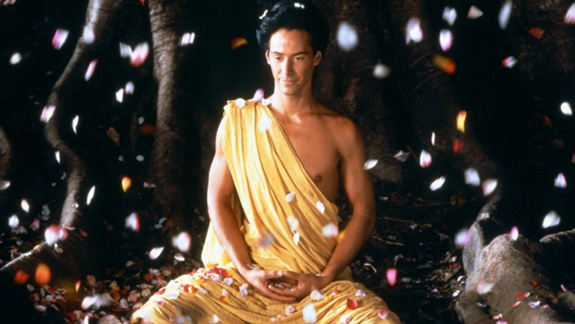
Figure: Keanu Reeves as the Buddha in Bernardo Bertolucci’s “Little Buddha.”
Invocation
When I was a graduate student at Indiana University (IU) in the 1980s, long before Tibetan Buddhism came into fashion in the New Age era, the first ever Tibetan stupa in the U.S. was being established at the outskirts of Bloomington, Indiana. The stupa was the brainchild of Thubten Norbu, professor of the Uralic-Altaic Department at IU and older brother to the Dalai Lama. My wife made and fired some of the terra cotta tsa tsa — Buddha statues and relief images — stored inside the stupa. The Dalai Lama eventually graced Bloomington to preside over and bless the opening ceremony. We visited the stupa one day and Professor Norbu — as he was warmly known there — stopped in his work to chat with us. He joked that had he been a little bit more patient and came out a couple of years late, he would have been the Dalai Lama. Humor seems to run in His Holiness’s family. With this and many other fond memories of the leading Tibetan Buddhists, readers can conclude that my title does not mean to malign the Dalai Lama, winner of the 1989 Nobel Peace Prize, but it does suggest a charismatic celebrity idolized by the public (hence the quotation marks for “superstar”), in the same vein as Andrew Lloyd Webber’s music intended for another fellow in the Broadway show and in the 1973 film.
The cult of Dalai Lama in the world, except perhaps in China, stems from his exceptionally warm, likeable, and unassuming personality, made all the more unique by his alleged identity as the Living Buddha, the reincarnation of the Awakened One. The rhetoric of such phrases as I have been using carries great affective power, in part because it points to the mystery of life that eludes us all, that lies beyond the confine of personal experience and verifiable scientific evidence. To most non-believers, such rhetoric is at once prophetic and superstitious. The ambivalence and the hesitancy to dismiss mystery altogether comes from the natural human longing for magic. Without this halo enveloping exotic religious faith like Tibetan Buddhism, the Dalai Lama might have been just another Tibetan refugee in India or the West, with an open grin and a high-pitched laugh. In point of fact, he has played a decisive role in disseminating to the West a Buddhism of love and compassion, but his reputation rests more on his persona than on the person’s teaching through books. The strain of abstruse philosophical Buddhist texts has not been favored by the Dalai Lama over the years, who composes easy-to-read, “how-to” books marked by commonsensical insights, honesty, and a great sense of humor. Those in search of Buddhist philosophy may be mildly disappointed by His Holiness’s recent publications, penned either by himself or by others based on interviews of him, such as Howard C. Cutler’s 1998 The Art of Happiness. Cutler’s subtitle, A Handbook for Living, reveals the basic, ethical bent of the Dalai Lama’s discourse. His geniality also leads him to endorse and even write forewords for a wide variety of publications on him and Tibet, including such children’s books as Demi’s The Dalai Lama (1998). A personal cult, however, is rarely built on that person’s philosophical and religious exegeses. No philosopher has ever written a best-seller, which some of the Dalai Lama’s recent books have been, without a doubt. This cult has inspired some of the 1990s Western films to be discussed shortly. But an overall comment on such Western discourse on Tibet is in order.
In Bernardo Bertolucci’s Little Buddha (1993), two Tibetan monks flew from their monastery in Bhutan to Seattle in search of the reincarnation of Lama Dorje, now believed to be a Caucasian boy. Supposedly traveling northbound on Interstate Highway 5 (I-5) from the Sea-Tac International Airport to downtown Seattle, their car, however, moves southbound. In the car ride, a fleeting glimpse of the highway road sign before entering a tunnel confirms this. The sign says Exit 164 to Highway 90 east to Spokane and to Airport Way. Note that the exit leads to the airport, not away from it. Barring a total obliviousness to the geography of the Pacific Northwest, the filmmaker’s motive for this misdirection is simple enough: only a southbound vehicle would enjoy an unobstructed view of Seattle’s cityscape west of I-5, including the landmark Space Needle; going northbound, the camera would have to take in the distraction of the coming traffic. Assuredly a minor miscue missed by most audiences, it nevertheless suggests a fundamental, shared feature of Western imaginary of Tibet, perhaps also missed by most audience. In the discursive history of Shangri-La, facts are oftentimes stretched and redirected to achieve the desired effect — escapism from the West’s own quandary and wish-fulfillment of the West’s sense of control. The misdirection of the car ride signals that it is not the East (Tibetan monks) coming to the West, but the West gone Oriental in search of itself. The mystery of an earthly paradise somewhere in the Himalayas bordering the Tibetan plateau and, amidst Tibetan exile, the mystery of one of its reincarnations in the heartbreakingly beautiful city of Seattle stem unequivocally from world politics at the time of the retelling of the story of Shangri-La. Mystery and politics in Western films and narratives on Tibet are Siamese twins, despite their feigned ignorance of each other. By “narratives” in the title, I point to books on which such films are based, film reviews, even advertising drawing from Tibetan images. The discursive web on Tibet is interwoven through a variety of expression — filmic, literary, popular culture. “Mystery” surrounding Western films and narratives on Tibet does not equate with the religious, although the religious plays a key role in creating this aura. “Politics” refers to the Tibet-China-West relationship as well as the East-West power structure.
This essay proceeds to discuss the 1933 Lost Horizon by James Hilton and its filmic renditions, particularly Frank Capra’s 1937 classic, in the context of utopian literature. After the “originary” texts, it then focuses on the 1990s offspring: Seven Years in Tibet (Heinrich Harrer’s autobiography in 1953 and Jean-Jacque Annaud’s film in 1997), Kundun (Martin Scorsese in 1997), and Little Buddha (Bertolucci). This discourse revolving around Tibet is “Western” for obvious reasons: Hilton is British, Capra and Scorsese American, Bertolucci Italian, Annaud French (whose film is based on an Austrian’s book). Scorsese’s music soundtrack is composed by Philip Glass, an American whose career spans the Atlantic Ocean and the European continent. All these Westerners involved in the Tibetan imaginary have had previous creative and professional engagement with the East, except perhaps the insulated Americans, Capra and Scorsese. Enamoured of the East as a cultural alternative, Bertolucci made The Last Emperor (1988), the first Western film shot inside post-Mao China, most scenes set in the Forbidden City. Annaud’s L’Amant (Lover) (1991) features the Hong Kong actor Tony Leung as the Chinaman character in Marguerite Duras’ interracial romance in Indo-China. In his memoir Music by Philip Glass (1987), Glass confesses that he is deeply influenced by Indian Music, as practiced by the sitar player Ravi Shankar and his drummer. His trilogy of “portrait drama,” Einsteins on the Beach (1975–76), Satyyagraha (1980), and Akhnaten (1983), contains two on non-Caucasian heroes, a young Gandhi in South Africa and the Egyptian Pharoah Akhnaten alleged to be the first monotheist. Perhaps an intriguing Freudian slip, Music by Philip Glass makes no mention of Freud’s controversial Moses and Monotheism (1939), which posits the very same thing about Akhnaten. This omission is peculiarly blatant in view of a memoir filled with prominent figures and boasting of his research work of a sort. Glass also provides the sound track for Francis Coppola’s Koyaanisqatsi (1983) and collaborates with David Henry Hwang in 1000 Airplanes on the Roof (1988).
Nurtured by their creators’ previous endeavors on things Oriental, Western films and narratives on Tibet knead together various strains: the earlier myth of Shangri-La, the current cult of Dalai Lama, the concern for Tibetan suffering, and mysticism associated with Tibetan Buddhism, such as reincarnations, mandalas (Carl Jung’s favorite), and oracles. These elements come together to concoct, shall we say, a powerful Molotov cocktail, which finds its rag wick in politics — the Chinese occupation of Tibet since 1950. Notwithstanding the genuine, altogether altruistic, concern of the West for human rights violations committed by the Chinese in their “colony” of Tibet, the overwhelming public support, which has not yet translated into political intervention, manifests uneasiness over China’s emerging role, since the collapse of the Soviet Union in 1989, as a constant irritant to American — and Western — world domination. Western anxiety of its global position lies behind the pro-Tibet and anti-China discourse. This fear of losing power is, of course, political. The pedigree of the West’s self-serving apprehension goes all the way back to Hilton’s Shangri-La, allegedly created by a priest from Luxembourg and succeeded by an American diplomat, with the mission of preserving world civilization — under Euro-American Masters. Lest it be dismissed as anti-West demagoguery, consider this: shortly after the High Lama of Shangri-La, aka Father Perrault of Luxembourg, dies, his American successor Conway “felt himself master of Shangri-La” (146; italics mine).
The Crash into Utopia
It is but human, in times of desperation, to dream of deliverance. Western utopian literature has traditionally reflected the longing for a miraculous release from turmoil and suffering, or a crash that lands characters right in the middle of utopia. Against the chaos of their own worlds, various writers have composed such earthly paradises: Thomas More’s Utopia (1516), Edward Bellamy’s Looking Backward (1888), B. F. Skinner’s Walden Two (1948), Aldous Huxley’s Island (1962), and many more. It is sobering, however, to reflect on the proximity of utopia and dystopia. Romantic fantasy is likely to induce its opposite — melancholy or utter disenchantment. Even Conway’s first impression of Shangri-La is apocalyptic in the sense that he has reached “an end, a finality” (49), a perfection that is also a cessation.
James Hilton’s Lost Horizon derives from a number of such crashes, actual or impending: the plane crash in the novel ushers the characters to the foothill of Shangri-La; the Fall of the Great War scars the protagonist Conway, so much so that he self-identifies as “1914–1918” (114); the Stock Market Crash of 1929 rings in the Great Depression, from which one of the survivors Barnard (pseudonym of a Chalmers Bryant, Wall Street financier) tries to escape, especially from his creditors; and World War II looms on the horizon. The mystery of Shangri-La offers an exit, at least psychologically, out of the political quagmire in the West. In view of the mutual interest between China and the U.S., one necessitated by the expansionist Japan of the early 1930s, Hilton’s formation of Shangri-La includes Chinese and their culture. The “receptionist” lama Chang, played by Sir John Gielgud, a yellowface with taped eyes, in the 1973 production, is Chinese and the inhabitants of the valley is a “blend of Chinese and Tibetan.” The “little Manchu” or “the little ivory doll” (81) who takes leave of Shangri-La, only to find herself reverted to her natural, advanced age, is Chinese. The residence for Conway and his party has a Chinese rather than Tibetan atmosphere, which pleases Conway immensely, having had fond memories of his decade-long station in China. In addition to Tibetan monastery, there coexist “a Taoist and a Confucian temple” (78). At times, Hilton seems downright contemptuous of Tibet and Tibetans, which explains the heavy dosage of Chineseness in the paradise. The High Lama entertains, indeed espouses, the theory of eugenics — a racial hierarchy in terms of residents’ susceptibility to the teaching and, hence, to longevity. Nordic and Latin races of Europe occupy the top of the pyramid, followed by the Chinese and, lastly, the Tibetans (110). China, however, is almost completely excised by Frank Capra in his 1937 film, since any allusion to China would remind moviegoers of the Sino-Japanese War and would distract from the transcendency Capra wishes to construct. This shift from China as part of the myth to Tibet as a distinct and separate myth heralds the 1990s eventuality where the “Red” China becomes, rightly so, a bully to Tibet, a destroyer of Tibetan culture and faith.
The story of Shangri-La can only be aptly embodied in the genre of mystery. Hilton’s novel, hence, gradually unfolds as the protagonist Conway discovers the true identity of the High Lama and the longevity of all Shangri-La inhabitants. With Conway’s thrill of finding the earthly paradise, one feels that his departure from it in search of the malcontent Mallison, a subordinate in the diplomatic corps and a fellow crash survivor, is somewhat contrived. The filmmaker Frank Capra ingeniously negates this jarring episode by recasting Mallison as Conway’s young and impetuous brother in the film. Brotherly love compels Conway to leave Shangri-La to rescue escapees, especially his brother’s lover who will in no time revert back to her true age. In the lover’s wrinkled face outside the valley do we see traces of the dystopia inherent in utopia. Citizens of Shangri-La, as Donald S. Lopez, Jr.’s book title suggests, are its prisoners.
Tibet in the West
The section title refers both to the representation of Tibet in the West and to Tibet to the west of China. Consequently, Tibet, China, and the West constitute a geopolitical and discursive triangle as intense as any emotional entanglements among humans. Of the three 1990s films on Tibet, Jean-Jacques Annaud’s Seven Years in Tibet starring Brad Pitt is arguably the most popular. Loosely based on the memoir of Heinrich Harrer, an Austrian mountain climber who spent seven years in Tibet prior to the Dalai Lama’s escape to India, the film freely extrapolates Harrer’s book into worn Hollywood formula to appeal to moviegoers, glossing over, uncritically, narrative fissures. One of such fissures is Harrer’s Nazi or German-Austrian connections: Annaud turns the protagonist into a reluctant participant in the Nazi-orchestrated expedition to the Himalayas; furthermore, the absolute, even inhuman, silence Harrer exercises over his homeland and family throughout his memoir is transformed by Annaud into remorse over leaving his pregnant wife and, subsequently, his son Rolf. Indeed, Pitt’s Harrer remains tormented by his desertion of wife and unborn son, manifested in diary entries and correspondence with Europe, whereas Harrer’s book contains a few brief, vague references to his country.[1] The film’s closure comes by way of a resolution with Rolf; Harrer pays a parental visit to a son he has never met. Harrer’s present of a music box fascinates the resentful boy and the two begin to engage each other. That music box used to belong to the young Dalai Lama, who is portrayed, to all intents and purposes, as Harrer’s son in the Potala.
Harrer the author must have regretted selling Annaud the film rights to his book. Other than an irresponsible husband and father-to-be, Harrer also proves to be a shady character in deceiving his fellow escapee from the British POW camp in India, Peter Aufschneiter, and losing to him the Tibetan woman they both love. With Pitt’s chic haircut, Gen-X irreverence, and what the film critic John Anderson calls his “Zen-wear,” Harrer is egotistic and self-aggrandizing. The maturing into a repentant, conscientious adult seems to coincide with his tutoring of the young Dalai Lama and with his compassion for Tibet’s looming tragedy. It is implied that Buddhist detachment in the face of great adversity has an impact on the flamboyant Harrer. Similar to the irony of Capra and Bertolucci going Oriental, the West’s own spiritual quest lies at the heart of Annaud’s vision of Tibet.
The West’s self-reflexiveness in these films ostensibly about the East recurs in the cliché plot of Western science and technology merged with Eastern religiosity. Invariably, a fresh-eyed, upright Western teacher of language and science comes to the aid of the Eastern ruler, be it Deborah Kerr in The King and I (1956), Peter O’Tool in The Last Emperor, or Brad Pitt. True, the Dalai Lama’s fascination with things Western — film projectors, telescopes, clocks, cars, and, presumably, music boxes — is legendary, verging on the unabashedly idolatrous, yet the fact that Western films forever favor this particular scenario of East meets West suggests a self-image, if only subconsciously, of Big Brotherhood. It is ironic that the all-knowing, all-seeing reincarnation of Buddha relies on a Western man of science to help him see through a film projector and telescope and help him hear through a music box. In fact, the possibility of having an audience with the young Dalai is so remote in Harrer’s memoir that it does not arise until the “Holy Mother” summons Harrer on page 135, more than one third into the narrative; the actual audience takes place on page 276, toward the end of the book. The relationship between the God-King and the mountaineer in the memoir never becomes as intimate and familial as the film depicts it, despite inklings of Harrer’s own paternal feelings. For instance, Harrer strives to impress the young Dalai in their lessons about the West, “like many a good father who wishes to earn the respect of his son” (277).
Scorsese’s Kundun resembles a filmic biography of the Fourteenth Dalai Lama, who has assisted in its completion. Based almost exclusively on documented facts from the discovery of the reincarnation to the 1959 escape, Kundun has the feel of a gorgeously-made, aesthetic documentary, with Melissa Mathison’s script and Roger Deakins’ cinematography. To the credit of Scorsese and his staff, Kundun does not romanticize Tibet; politics and religion are shown to pollute each other. Regent Reting, whose vision leads to the discovery of the Boy-King and who teaches the Dalai Lama’s present-day version of Buddhism on compassion, turns out to be greedy and corrupt, demanding a great fortune for his service and staging a monastery revolt to reclaim power. The film does present the Dalai Lama’s hot-tempered father in a light far more positive than does, for instance, Mary Craig’s biography of his entire family.
The film follows the Fourteenth Dalai at age two, five, ten, and a young adult. The Los Angeles Times film critic Kenneth Truan complains that “using four actors for the boy’s different ages makes it difficult to identify with him. Also, having to depend on inexperienced children with varying commands of English to tell a story of holiness and belief is especially problematic.” I can not disagree with Truan more in that the four actors are, I believe, totally convincing in the context of docu-drama, their English appropriately accented and their body language increasingly muted. In fact, I find the latter three stages played with great flair and vigor, which is not to diminish the spontaneous performance of the spoiled two-year-old. Bertolucci uses the same child perspective and multiple stages of Pu Yi in The Last Emperor as well. In a way, this historical, chronological approach befits the epic panorama of the rise and fall of a dynasty and of a nation both filmmakers seek to delineate.
Called by Truan a “visual cornucopia,” accompanied by Glass’s “hypnotic” score of electronic music, Kundun is most memorable in those scenes interweaving mystery and politics. It opens with the search party for the reincarnation of the Thirteenth Dalai Lama. Guided by Regent Reting’s vision, the search party locates the “small one-storey house with oddly-shaped guttering and turquoise tiles” (as recorded in Mary Craig’s biography, 13). Each of the two-year-old’s correct choice of items belonging to the Thirteenth Dalai Lama — necklace, hand drum, begging bowl, eye glasses, and cane — has, of course, a fifty-fifty rate of success and may appear ludicrous to non-believers, so long as we bear in mind that this process of identification is as “faulty” as any person looking for a lifelong mate in a sea of humanity, as “chancy” as any given sperm out of a sea of sperms impregnating the egg, or as legendary as Immaculate Conception.
Another node of mystery and politics revolves around the State Oracle’s foretelling of the Dalai Lama’s ominous future due to the Chinese aggression under Mao. The Oracle appears four times in Kundun: the first time to caution the ten-year-old Dalai, while tenderly straightening his saffron robe; the second time to advise the young adult Dalai be enthroned without delay; the third time to urge immediate flight from the Chinese, while dictating the route in a riddle-like prophesy; the fourth and final time to draw the escape route right across the Chinese army encampment. The Chinese come to relocate their position and, thus, the Oracle sees accurately into the future. The trance of the Oracle with its compelling pageantry and enigma crystalizes Tibet at its spectacular high teetering on the verge of disintegration. The brevity and perspicuity of the Oracle’s clairvoyance is accentuated by his collapse in exhaustion; the vision of Tibet will soon be snuffed out by the Chinese.
Such is the lesson of Tibetan Buddhism — the impermanence of all things. A close-up of sand painting or mandala opens the film, which transfigures into ripples of water, rays of light, forever shifting. This relentless movement is echoed in Philip Glass’s electronic music. While Glass’s signature synthesizers dominate the soundtrack, many scenes begin with traditional Tibetan music — low blasts of 6-foot-long straight trumpets, clashes of cymbals, and chordal chanting[2] — flowing seamlessly into Glass’s theme music. Glass’s soundtrack is always there, barely audible at times, persistently foreboding while strangely persevering. All the visions in this film, Reting’s and the Dalai Lama’s, are likewise accompanied by Glass’s score. These visions are the culmination of special effects and brilliant cinematography — aerial shots of a pristine mountain-top lake, tracking shots of the Dalai Lama’s childhood house, aerial shots over mountains and plateaux, and editing to visualize the bloodbath about to befall the Dalai’s escort and, by implication, Tibet under Chinese rule. Once again, technology in the form of soundtrack, camera skills, and special effect seeks to articulate the inexplicable; the craft of filmmaking is utilized to approximate what is essentially beyond human expression.
Village Voice film critic Georgia Brown calls Little Buddha Bertolucci’s “strangest” film. A film involving parallel plots of Siddhartha reaching enlightenment and a Seattle family’s spiritual pilgrimage to Bhutan is enough to elicit mixed reviews. Joe Brown finds Little Buddha a “botched, but beautiful, metaphysical epic.” While calling it “only superficially superficial,” Desson Howe mocks the script as “a paper-boat voyage over its [Buddhism’s] surface.” Roger Ebert, in his usual cynical self, comments that Little Buddha is “a slow-moving and pointless exercise.” The point, surely known to Ebert, is Bertolucci’s famous 1994 confession in Sight and Sound of his turn to Buddhism “from Marx and Freud” to save himself from depression once he is “deprived of the right to dream of utopias after the fall of the Wall,” a turn justified by Bertolucci in terms of the centrality of man in all three systems of thought. (“Bernardo Bertolucci: Intravenous Cinema” April 1994). Last of what Howe and others call Bertolucci’s “Oriental trilogy” with The Last Emperor (1988) and The Sheltering Sky (1990), Little Buddha concludes a deeply personal quest to non-Western cultures. Despite the opening disclaimer that tries to justify the film, namely, “the film is inspired by the true life stories of several children and their extraordinary voyage of discovery,” which no critic seems to notice anyway, Little Buddha’s ending credit includes “in memory of Francis Bouygues,” which directs attention, instead, to Bertolucci’s personal loss. Indeed, this film is about lost and found, about mourning over loss and miraculous retrieval. Whether a cooled passion for Marxism, the lulling “poison” of Buddhism, or the longing for an absent friend, elegy and rapture of reunion lie at the heart of Little Buddha. Following the theme of a children’s book on Siddhartha, Vittorio Storaro’s cinematography shuttles between a symbiotic contrast: the blue-tinted Seattle versus the orange-tinted South Asia — ancient Nepal or present Bhutan. The blue does not signify, as various critics suggest, “cool” and “chilling” materialism; rather, it is nostalgia and melancholia. Similarly, the red-gold of South Asia is not so much “warm” as parched, hungry for deliverance.
The story begins with the belief that Lama Dorje has been reborn as a Caucasian boy, Jesse Konrad, in Seattle, to which Lama Norbu, played by Ying Ruocheng, and the search party travel from their Bhutan monastery. West-centricism — a story of Buddhist genesis told by the West, for the West, and enacted by Westerners — reveals itself in the casting of a white boy as the possible reincarnation of Lama Dorje and, of course, of Keanu Reeves as Siddhartha and later the Lord Buddha. One hastens to add, however, Reeves’ Prince Siddhartha, like other Indian characters, gives appropriately-inflected dialogues and body language. For example, as his wish for the bowl to flow upstream comes true, a joyous Reeves swings his head left to right like a metronome, an accurate depiction of the Indian equivalent of pumping one’s fist while shouting “Yeah.”[3]
On the other hand, while Ying gives what Joe Brown believes to be a “charismatic” performance, Ying undercuts his image as “a deeply charming gentleman” (David Denby) with the repeated unsheathing of his eye-knives and eruptions of sharp tone, reminiscent of his role as Pu Yi’s warden in The Last Emperor. Investigating a potential Indian girl candidate of Lama Dorje’s reincarnation back in Katmandu, Ying corrects an Abbess in a caustic tone that the girl “was speaking Sanskrit.” In the final climax of identification ceremony among the three candidates, Jesse, Gita the Indian girl, and Raju the street foundling, Ying comes out of seclusion and wards off inquisitive monks with a stern wave of the arm worthy of Red revolutionaries. Ying’s best moment arrives when he, in slow-motion, kneels down and kowtows to each of the three reincarnations of Lama Dorje — the body, the speech, and the mind. By so doing, Ying buries his unmonkly hostile face and achieves a high point in his performance. While Ying pays obeisance to Jesse, Jesse, in turn, kowtows to Ying. The camera freezes as the two gently touch heads inches above the ground in utter humility and Ying’s voice-over narrates: “Perhaps, one day, you will find me.” In view of the imminent death of Ying’s Lama Norbu, this is, to all intents and purposes, his “last wish” to a successor, or predecessor. In layman’s terms, reincarnation is a metaphor for lost and found, a cyclical mutual search, a wish to return betokening a love as infinite as life itself. With respect to the problematics of a Chinese actor who is also a high government official playing a Tibetan High Lama in exile, Ying’s assistant monk, Champa, is far more convincingly Tibetan. As the film opens with the tale of a goat to be slaughtered and reborn, hence immediately setting the mythical tone, the assistant monk is called upon to imitate the goat’s bleating. He gives the sound of “baaahhh,” presumably onomatopoeic of the Tibetan language. Furthermore, his recitation of the Buddhist Sutra in the original language is self-assured, arising from the inner depth, somewhat different from Ying’s English translation at the closing of the film.
In fact, Ying’s charm is stolen by the the character of Dean Konrad, Jesse’s engineer/architect father played in a minimalist manner by Chris Isaak. Roger Ebert criticizes Isaak’s performance as “cold, closed-off,” and emotionally detached, but Ebert seems to miss the point in a factually erroneous review. Both Dean and Lisa (Bridget Fonda) Konrad are indeed taken by surprise by the Tibetan monks’ house visit. While Lisa shrouds it in feminine pleasantries, Dean looks downright rude in his John Wayne body language of nonchalance and boredom. As the monks describe their mission, Dean whispers to Lisa that he needs a scotch, and he refers to the visiting monks as “the round one” and “the square one.” But Dean’s evolution constitutes the subtext of this film: it is as much about Tibetan monks’ spiritual journeys and rebirths as it is about Dean’s own, as much about the son Jesse’s previous life as it is about the latter half of the father’s life. A young, tall, and successful Dean is tempered by the suicide of his career partner and by collapsing business ventures. This blow brings on a life crisis and his journey to Bhutan as the chaperon of his son is, frankly, a soul-searching for himself. Rather than taking Jesse across the globe to the great stupa of Bodhnath, the largest Buddhist shrine in Nepal and the center of Tibetan community, he is in fact taken there. Just like his namesake Joseph Conrad’s Heart of Darkness, Dean ventures out only to discover what is already within. Thus, the builder who lives in the blue house in the blue city of Seattle where he had constructed impressive highrises takes leaves of the materialist realm and enters into the red-hot thirst for renewal of the soul in Bhutan. There, he mourns yet again a second death — that of Lama Norbu. Sitting close by as if in wake, counting Norbu’s last breaths, Dean provides a crucial cinematic foil for the sadness of Norbu’s death. According to Buddhist doctrines, the grief over death of loved ones is attenuated by the hope of their return. In addition to mourning, Tibetans await reincarnation of the deceased. In this sense, the totality of audience’s affect of “bereavement” can only be channeled by way of Dean, the sole non-Tibetan, non-Buddhist in the monastery bearing the full brunt of Norbu’s demise.[4] As such, the palette of Dean’s emotion ranges from mockery and repulsion over Norbu’s outlandish mission to anger, sympathy, and unrelenting mourning. Without being able to identify with Dean the Westerner’s experiences, the audience would have been adrift, unmoored in this exotic, religious parable.
Although embodying an “entry point” for Western moviegoers, Dean is not the only hinge on which pivots the audience reception. In the sequence of Siddhartha’s enlightenment under the bodhi tree, Bertolucci seamlessly kneads together the realistic and the fantastic, the child’s innocent perspective and transcendent religiosity. Following Ying’s retelling, the three candidates circle around the gigantic tree in the backyard of Gita’s house, witnessing on the other side the mythical scene of Siddhartha’s ascendance to Buddhahood. The children crouch behind shield-like roots and stare intensely. To Bertolucci’s credit, the film renders stasis and passivity exciting. After all, Reeves sitting cross-legged in meditation is not his explosive and mobile self in Speed (1994), nor the kung fu and Zen master in The Matrix (1999). What Bertolucci accomplishes is the spiritual tableaux of the mind, unfolded in the temptation of Siddhartha by the five daughters of Mara, Lord of Darkness; in the strong gale from Hell which dislodges all but Siddhartha; in legions of warriors vaporized by Siddhartha’s stillness, a theme straight out of Akira Kurosawa’s Kagemusha (1980). Bertolucci thoroughly conjoins the story with its young listeners. As Mara’s daughter dances flirtatiously, Gita impulsively sways to the hypnotic singing. As the wind fails to unruffle Siddhartha, the children cower behind the tree. As fiery arrows transfigure into falling petals, the children revel in the shower of blossoms.
Victory, however, is half-won. Mara, in the image of Siddhartha rising out of the reflection in water, launches a second strike not from without but from within Siddhartha’s own ego. Similar to Kundun’s special effects in visualizing mystery, Bertolucci resorts to filmic techniques to present the moment of nirvana when the doubles lock in a deathly debate:
“Architect, I have finally met you. You will not rebuild your house again,”
“I am your house and you live in me.”
“O Lord of my own ego. You are pure illusion. You do not exist. The earth is my witness.”
While Siddhartha issues his stern rebuke to the ultimate “architect” of the illusion of life, thus circling back to Dean Konrad the builder and the contemporary, Seattle half of the film, his reproach is met with Mara’s sweet, solicitous, almost temptress response. However, Siddhartha’s final words are directed inward, a self-admonition that totally negates the reality of Mara, who vanishes, as he had arisen, like illusion.[5] As Siddhartha reaches enlightenment, the camera that has been roving around the bodhi tree on the heels of the three spectators now circles and hugs the Buddha, slowly elevating to capture the Buddha in a high-angle, slightly tilted shot to symbolize his soaring ascent.
The film concludes with the “afterimage” of Lama Nordu and his voice-over recitation of the Heart Sutra of emptiness, admittedly only the most accessible passages. The three burials of Norbu is movingly carried out by his three “finds.” A snatch of a soprano’s aria accompanies Gita’s scattering of Norbu’s ashes high in the bodhi-like tree, Raju’s releasing of a wind horse near Bhutan’s monastery, and Jesse’s letting go of Lama Dorje’s bowl with Norbu’s ashes in Seattle’s Elliott Bay. The camera remains slightly above water to linger over the ebb and flow that threatens to swallow the bowl at every turn. The sunset turns the bay and the city in blue into the red-gold of the East. The contrast of colors merge; the East enters Seattle. Yet with the hypnotic rhythm of the bay, it is no longer the dry, singed orange under an unrelenting South Asian sun, but a rich, watery blue wedded to the twilight.
Compared to Annaud’s and Scorsese’s films interlacing mystery and contemporary politics, Bertolucci’s film is profoundly personal. Little Buddha dwells on the possibility of redemption despite traumatic loss. With Bertolucci’s personal tone in mind, I now return to the Lamas’ southbound vehicle on I-5, where the car radio plays the country music “Ev’rybody is a-wonderin’ / What and where they came from.” I know and let me visualize the streets of Seattle. The car comes to a stop at the Konrads’ hill-top house in, if memory serves, the Queen Anne Hill neighborhood north of Seattle Center and Space Needle, not far from the Lake View Cemetery where Bruce and Brandon Lee are buried side by side. If the car goes northwest from the Konrads to land’s end, Discovery Park gives you a view of the Pacific Ocean, where the beach is littered with beautiful sea-washed pebbles. To go southwest from the Konrads, cutting across downtown Seattle with its Monorail, Seattle Museum of Art, and other tourist spots, you come to Alki Beach. The tidal pools there on a wintry afternoon in 1997 hid a young moray eel the size of my toddler daughter’s palm, so freshly green that it literally glows. She could not bring the eel back; she had to leave it where she found it.
Works Cited
1000 Airplanes on the Roof: a Science Fiction Music-Drama. Realized by Philip Glass, David Henry Hwang, and Jerome Sirlin. Premiered in Vienna International Airport in 1987. Salt Lake City: Peregrine Smith Books, 1989.
Annaud, Jean-Jacques, dir. Seven Years in Tibet. Perf. Brad Pitt. Columbia, 1997.
Bertolucci, Bernardo. Interview. “Bernardo Bertolucci: Intravenous Cinema.” Sight and Sound 4.4 (April 1994): 18–21.
— — -, dir. The Last Emperor. Perf. John Lone, Joan Chen, Peter O’Toole, and Ruocheng Ying. Columbia, 1999.
— — -, dir. Little Buddha. Perf. Keanu Reeves, Ruocheng Ying, and Bridget Fonda. Miramax, 1993.
Brown, Georgia. Rev. of Little Buddha. Village Voice. May 31, 1994: 58.
Brown. Joe. Rev. of Little Buddha. Washington Post. May 27, 1994: 42.
Conrad. Joseph. Heart of Darkness. 1902. New York: Penguin, 1999.
Demi. The Dalai Lama: A Biography of the Tibetan Spiritual and Political Leader. New York: Henry Holt, 1998.
Denby, David. Rev. of Little Buddha. New York. June 6, 1994: 52–53.
Ebert, Roger. Rev. of Little Buddha. Chicago Sun-Times. May 25, 1994: 49.
Freud, Sigmund. Moses and Monotheism. Trans. Katherine Jones. New York: Vintage, 1939.
Harrer, Heinrich. Return to Tibet: Tibet After the Chinese Occupation. 1983. Trans. Ewald Osers. New York: Tarcher/Putnam, 1998.
— — -. Seven Years in Tibet. 1953. Trans. Richard Graves. New York: archer/Putnam, 1996.
Hilton, James. Lost Horizon. 1933. New York: Pocket Book, 1962.
Koyaanisqatsi. Prod. Francis Ford Coppola. Dir. Godfrey Reggio. Music by Philip Glass. New Cinema, 1983.
Kurosawa, Akira, dir. Kagemusha. Perf. Tatsuya Nakadai. 20th Century Fox, 1980.
Lopez, Donald S., Jr. Prisoners of Shangri-La: Tibetan Buddhism and the West. Chicago: U of Chicago P., 1998.
Rodgers, Richard and Oscar Hammerstein II. The King and I. Dir. Walter Lang. Perf. Yul Brynner and Deborah Kerr. Twentieth Century Fox, 1956.
Scorsese, Martin, dir. Kundun. Buena Vista, 1997.
Truan, Kenneth. “‘Kundun’ Lacks a Certain Presence.” Rev. of Kundun. Los Angeles Times. December 24, 1997: 6.
NOTES
[1] Harrer in his memoir refers, for the first time, to his homeland when he pores over old newspapers and states: “The whole world was still simmering, and our country was going through hard times” (129). He follows that with an equally vague comment as he entrusts message home with a British representative: “We found him an opportune visitor as we very much wanted to send news to our families at home, who must have long given us up for lost” (142). Such is the extent of his allusion to home. The seven years he spent in Tibet is indeed about Tibet, with few backward glances.
[2] According to the jacket of David Lewiston’s CD on Tibetan Buddhism: Tantras of Gyuto, the Gyuto’s chanting style is the so-called “one-voice chording,” which means that “each participant produces a chord, which seems to consist of a low bass note (shifting slowly between B and D) and of another note, two octaves and a third higher. However, the structure of the sound is in fact more complex: When the C two octaves below middle C is sounded, the E above middle C is heard clearly. But what the ear does not easily register is the E an octave higher, which is also present. From time to time, other overtones emerge, giving the impression of augmented fourths, fifths, sixths, sevenths, and ninths.”
[3] Other Indian body language includes Siddhartha’s father the King’s speech and hand gestures. Bidding farewell to Siddhartha, he raises his right hand straight up, without waving it. Cleaning his palm of cremated ashes, the King scoops out a bit of water and rubs his thumb, index finger, and middle finger against one another in a way that resembles Indian way of eating.
[4] While Dean Konrad sits “in wake,” H. E. Dzongsar Khyentse Rinpoche, the Buddhist consultant to Bertolucci, makes a cameo appearance and provides a “running commentary” on the symbiosis of living and dying. Khyentse Norbu, of course, goes on to make The Cup (Phörpa 1999), a film about young Tibetan monks in exile and their obsession with soccer.
[5] Even the blue house the Konrads had built seems to have its origin in Lama Dorje’s wave of hand. Before his death, a Lama Dorje in blue jeans showed the site where the house is to appear to his disciples. Cinematically, the house plops down from the sky, out of the blue, as fluid as watery reflections. The color on the screen switches from orange to blue once the house is in place.
메타데이터
- post_id
- 0c5e86859621
- slug
- dalai-lama-superstar-0c5e86859621
- url
- https://medium.com/counterarts/dalai-lama-superstar-0c5e86859621
- canonical_url
- https://medium.com/counterarts/dalai-lama-superstar-0c5e86859621
- author_url
- https://medium.com/@mash_76311
- status
- ok
- fetched_at
- 2026-07-14 13:13:31