The Igbo Men Who Sold Their Neighbours: A Complete History
The men who marched captives to Bonny had Igbo names.
The Igbo Men Who Sold Their Neighbours: A Complete History
The men who marched captives to Bonny had Igbo names.
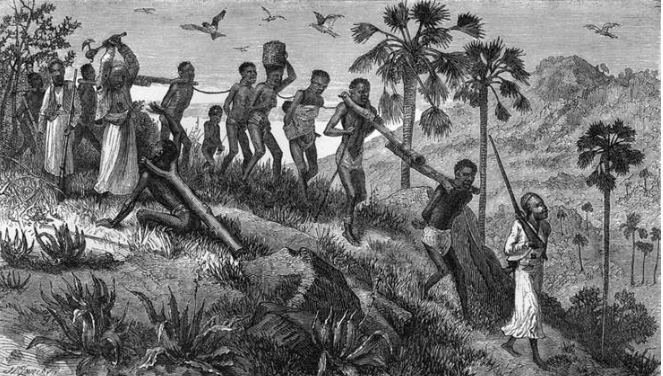
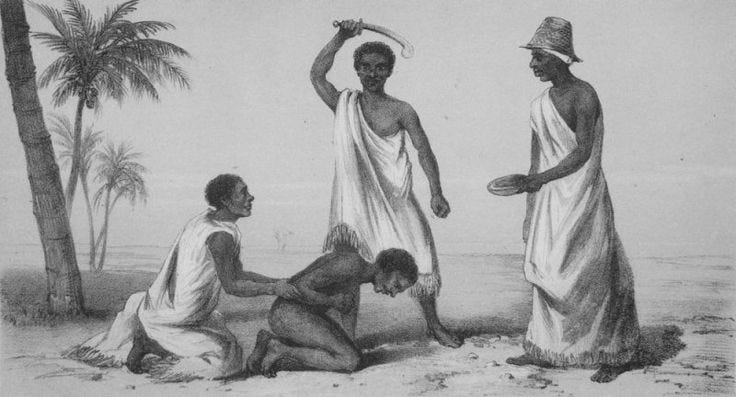
They were called agawhu. In the Igbo language, the word carries a weight of meanings: bandit, outlaw, crook, and in some usages, hero. They were the merchant-warlords of the Aro commercial empire, the men who controlled the interior trade routes to the West African coast, who organised the raids and kidnappings that supplied the Atlantic slave ships, and who grew wealthy and powerful by selling their neighbours. Historian Douglas B. Chambers, writing in Chapter 12 of Igbo in the Atlantic World (Indiana University Press, 2016), names the most documented of them: Okolie Ijoma, who died in the 1820s, Aro agawhu of Ndikelionwu, a man whose grandfather had himself been enslaved by an earlier Aro merchant-warlord.
The trade fed on itself. The enslaved produced the enslaver in the next generation.
The Architecture of Complicity
The Aro commercial empire has been documented in detail in the preceding suites on the oracle and the triangular trade. What requires specific attention here is the question of who, specifically, at the Igbo elite level, drove the slave exports, and what it cost Igboland.
A. E. Afigbo’s Chapter 5 in the same volume documents the Aro system’s five pillars: the Ibini Ukpabi oracle that gave divine sanction to the movement of condemned people, the settlement colonies encircling the major slave fairs at Bende and Uburu, the territorially zoned operations across ethnic lines, the blood oaths guaranteeing safe passage, and the diplomatic intelligence that kept every relationship calibrated. Each pillar required Aro leadership, Aro organisation, and Aro decision-making.
The Aro were not a monolithic people acting uniformly. They were a specific clan with specific leaders who chose to build a commercial empire around the supply of human beings to European slave ships. Those leaders prospered. Some of their descendants became the warrant chiefs of the colonial period. Some became the prosperous traders of the legitimate palm oil economy after abolition. The continuity of elite advantage across the shift from human cargoes to commodity cargoes is documented.
The agawhu were their operational arm. These were the men who hired mercenaries, organised raids, conducted the forced marches overland, and delivered captives to the coastal ports. The most documented individual case is Ikelionwu, the founder of Ndikelionwu, described as an mgburichi, a sacred Nri man, who was himself enslaved by the Aro merchant-warlord Ufere Mgbokwu Aka in the 1730s. His son Okolie Ijoma then became one of the most powerful agawhu of the late eighteenth and early nineteenth centuries. The Nri sacred order, victim of the trade in one generation, produced a slave-trading warlord in the next.
What the Trade Did to Nri: The Internal Casualty
The ancient Nri civilisation was the moral and spiritual centre of Igboland for centuries before the Atlantic slave trade reached its peak. Founded approximately 1000 CE, the Nri order was pacifist in its deepest values. The ichi facial marks of the mgburichi were a passport: the sacred men of Nri could travel throughout Igboland without fear of violence or capture because their status was universally recognised and protected.
By the 1770s, this protection had collapsed.
Chambers documents the evidence in Jamaica: seven men bearing the ichi marks of Nri appear in Jamaican runaway slave advertisements between 1777 and 1793. These were sacred Nri men, men whose marks should have made them untouchable, appearing as enslaved people on a Caribbean island. The social violence of the Aro agawhu had reached so deep into the Igbo interior that even the mgburichi were no longer safe.
The Nri orature, the oral records of the reigns of the Eze Nri, preserves the memory of what this period felt like from the inside. The reigns of Eze Nri Ezimilo (officially 1701–1723) and his successor Eze Nri Ewenetem (officially 1724–1794) are remembered as eras of crisis, calamity, social violence, slaving, drought, and famine. The first Aro settlements were established in the Nri heartland during Ewenetem’s reign. Slave trading, Chambers writes, “was ubiquitous.”
By the 1790s, the situation had become desperate enough that a newly consecrated Eze Nri, the aged Nri Añua, agreed to abdicate in favour of the young Enweleana of Ezekammadu. Upon becoming Eze Nri, Enweleana was driven to “the ultimate abomination,” in Chambers’s phrase: organising a war, the Amakom, the “defence of the land,” against the Aro agawhu Okolie Ijoma of Ndikelionwu. The oldest remembered age-grade at Nri is named Ochi Ogu, “Who Wants War.” The name alone encodes the desperation of a civilisation that had been pacifist for eight centuries.
The Aro elites who drove the slave exports did not only sell their neighbours. They destroyed the governing moral order of their own civilisation.
Igbo Women Who Owned Slaves: The Internal Dimension
The complicity was not only Aro. It was domestic.
Gloria Chuku, in Chapter 4 of the same volume, documents the internal slave economy of the Igbo region alongside her analysis of colonial-era gender relations. Her footnotes cite the documented case of Omu Okwei Ezeiwene, the wealthy merchant queen of Osomari who served in the Onitsha Native Court from 1912 into the 1930s, and other prominent Igbo women who owned slaves during the colonial period. She cites Nwando Achebe’s documented study of female power and authority in northern Igboland (Heinemann, 2005), which records the slave ownership practices of prominent Igbo women between 1900 and 1960.
The domestic slave trade in the Igbo region, distinct from the Atlantic export trade, involved the use of enslaved people in agricultural production, domestic service, and as collateral in debt transactions. Chuku documents that the internal slave trade continued until approximately 1950, ending not through British abolition but through the erosion of the social structures that had sustained it.
The warrant chief case documented by Afigbo captures the scale of personal accumulation that internal slavery enabled: one warrant chief, unchecked by the women’s institutional authority that colonial governance had dismantled, held 130 wives at the time of his conviction for slave dealing and child stealing. The bridewealth on each was less than fifteen shillings.
The reckoning with Igbo complicity must include this internal dimension, not only the Atlantic export trade.
What a Complete Reckoning Requires
The Atlantic slave trade had four distinct sets of actors, each with documented roles and documented moral accountability.
The British merchants who financed, organised, and commercially benefited from the trade bear the greatest institutional accountability. Britain controlled 85 percent of the Biafran trade before 1807, derived enormous national wealth from it, and then delayed meaningful acknowledgment of that wealth for over two centuries. The reparations case against British institutions is the strongest and most documented.
The Aro commercial elite who built and operated the supply network were the primary African agents of the trade’s efficiency and scale. They grew wealthy. They built political power. Their legacy included the near-destruction of Nri’s moral order and the social violence that scarred Igboland for over a century. A full accounting of Igbo Atlantic history that focuses only on the victims of the Middle Passage, and not on the Aro agawhu who supplied the ships, is not a complete history.
The communities that survived the trade, and the diasporic descendants of those who did not, carry the full complexity of this history. The enslaved person and the agawhu were sometimes from the same community. Ikelionwu was an mgburichi, a Nri sacred man, before he was enslaved. His son Okolie Ijoma became the slave-trading warlord who threatened the Nri heartland itself.
A complete reckoning holds all of this at once without collapsing into either exculpation or false symmetry. European buyers created the market. The market created the incentive. The incentive corrupted existing African social structures and produced new ones built around extraction. The corruption was African. The market was European. Both are documented. Both matter.
What matters most for the descendants of those who were enslaved, whether in Virginia’s Tidewater or in Mississippi’s cotton fields, is that the full architecture of what happened is now visible. The Aro agawhu. The ichi marks in Jamaica. The Nri king who called his age-grade “Who Wants War.” The one million sold south from Virginia between 1830 and 1860.
The complete history is not more painful than the partial one. It is more honest. And honesty is the only foundation on which the reckoning, and the healing, can actually begin.
Oge Samuel Okonkwo, PhD is a conflict historian, diaspora intelligence analyst, and founder of Sahel Advisory Group.
Subscribe to The Igbo Atlantic on Substack: https://osokonkwo.substack.com/ Follow on LinkedIn: https://www.linkedin.com/in/oge-okonkwo/ Read more on Medium: https://medium.com/@OS_Okonkwo Commission heritage research or consulting: ogesamuelokonkwo@gmail.com
How do you think the documented role of African elites in the slave trade should be incorporated into reparations arguments? Does acknowledging African complicity strengthen or complicate the case against European institutions?
메타데이터
- post_id
- 0c7cfc91ecbb
- slug
- the-igbo-men-who-sold-their-neighbours-a-complete-history-0c7cfc91ecbb
- url
- https://medium.com/@OS_Okonkwo/the-igbo-men-who-sold-their-neighbours-a-complete-history-0c7cfc91ecbb
- canonical_url
- https://medium.com/@OS_Okonkwo/the-igbo-men-who-sold-their-neighbours-a-complete-history-0c7cfc91ecbb
- author_url
- https://medium.com/@OS_Okonkwo
- status
- ok
- fetched_at
- 2026-07-11 01:11:15