Walking With Giant Tortoises in Mauritius
Photographing Aldabra giant tortoises across the landscapes of Mauritius
Walking With Giant Tortoises in Mauritius
Photographing Aldabra giant tortoises across the landscapes of Mauritius
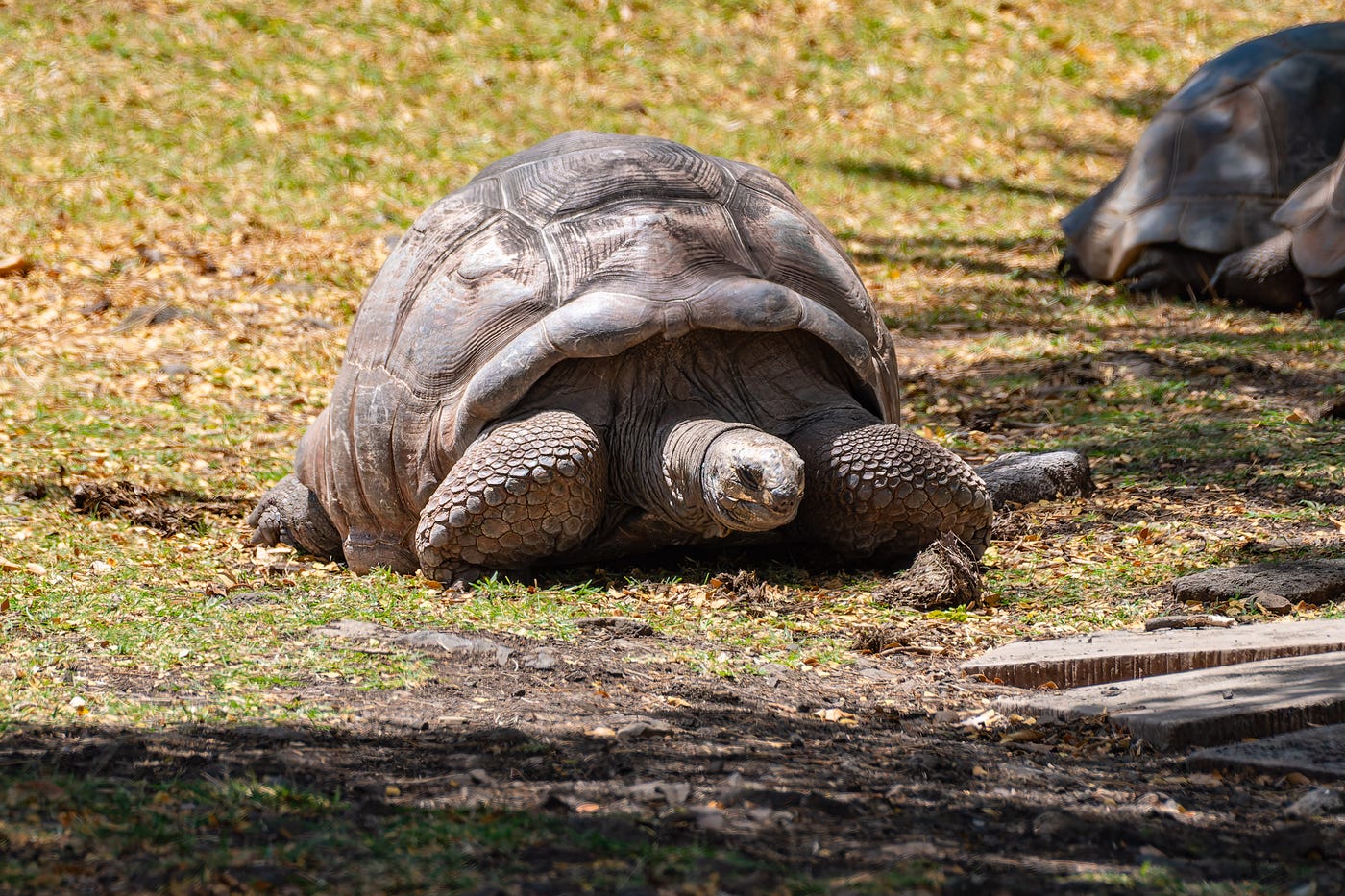
A solitary Aldabra Giant Tortoise slowly moves across the ground in Mauritius — photo by Rahuldev Rajguru
When I visited Mauritius, I had the opportunity to see the Aldabra giant tortoises, one of the memorable wildlife encounters of my life.
In the months leading up to my visit to the island, I had seen numerous photographs of these enormous reptiles. I knew they were famous, and I knew tourists often posed with them. That did not, however, prepare me for the first time I stood within a few feet of one of these reptiles.
It felt unreal.
The shell alone looked larger than a coffee table. Their legs resembled tree trunks wrapped in ancient scales. Their movements were slow, deliberate, and calming. I had never seen a tortoise this large in my life, and my excitement was palpable.
What surprised me even more was their behavior around humans.
They were completely relaxed.

A child sits leisurely with a group of Aldabra Giant Tortoises resting under shade — photo by Rahuldev Rajguru
I had assumed these tortoises would remain distant and cautious, forcing me to photograph them from afar. That assumption vanished within minutes.
I had carried my Nikon 200–500 mm lens expecting distant portraits. Instead, the tortoises walked so close to me that I could barely fit half of their body into the frame. I quickly switched to my smaller 70–300 mm telephoto lens, and also used a 35 mm prime lens for some frames.
Photographing giant tortoises at close range was a completely different experience.

A small group of Aldabra Giant Tortoises, photographed with my 35 mm lens — photo by Rahuldev Rajguru
Their eyes carried a gentle expression. Their wrinkled necks stretched forward. The shells looked weathered, filled with scratches, textures, and years of life under the tropical sun. Even while resting motionless, they had a strong presence.
I discovered these tortoises across multiple places in Mauritius, but not all experiences were equally pleasant.
At several small and offbeat places, the animals appeared cramped inside tiny enclosures with limited food and poor upkeep. Seeing such magnificent creatures restricted to unhealthy spaces was disappointing.
Eventually, I realized that the best places to observe and photograph them were Chamarel 7-Colored Earth Geopark and Casela Nature Parks.
Both locations had maintained large open enclosures with proper hygiene, water access, vegetation, and space for tortoises to move naturally. Entry fees are relatively high, but it becomes obvious where that money goes.
My first major interaction happened at Chamarel.

The wrinkled skin, heavy limbs, and weathered shell reveal the remarkable texture of these reptiles — photo by Rahuldev Rajguru
Around 30–40 Aldabra giant tortoises roamed freely across the enclosure. Some were feeding on grass while others rested lazily under trees. A few sat partially submerged in the muddy water.
That mud turned out to be extremely important for them.
Since tortoises are reptiles, they cannot generate their own body heat. Mud helps regulate temperature during intense Mauritian heat. It keeps their skin hydrated and protects them from biting insects, especially mosquitoes, which are abundant on the island. During the cooler evenings, the mud also retains warmth from the day.
Watching them move between grass, shade, and muddy pools gave me a better understanding of how perfectly adapted they are to tropical island conditions.
One thing stood out immediately.
These tortoises were completely unbothered by human presence.

Aldabra giant tortoises grazing freely inside the large open enclosure at Chamarel in Mauritius — photo by Rahuldev Rajguru
Tourists surrounded them from all sides, taking photographs and observing them closely. However, the tortoises continued grazing, resting, or slowly walking without any visible stress.
It was my first encounter with Aldabra giant tortoises, and honestly, I could have spent the entire day there.
These animals are usually solitary. They do not depend on a group or pack for survival, nor are they territorial. Most of their life revolves around grazing and resting. In fact, they can sleep or remain inactive for nearly 16 hours a day.
At the same time, they often gather in small groups temporarily around resources like shade, food, and water. Such a group is called a “creep.” Unlike many mammals, there is very little aggression between them even while sharing space.
That behavior gave me wonderful photography opportunities.

A close view of an adult Aldabra giant tortoise feeding on fresh grass— photo by Rahuldev Rajguru
I was already happy with my photographs.
Until I reached Casela Nature Parks.
Suddenly, the entire experience became even more memorable.
Casela has dedicated a large area to these tortoises, housing more than a hundred individuals spread across the landscape. Everywhere I looked, there was activity.
Some rested under trees.
Some grazed endlessly.
Some sat near the water.
As a photographer, it became overwhelming because every direction offered another frame worth taking. One particular encounter has stayed with me.
A large adult tortoise remained close to a juvenile near a water body. It was the first time I saw a young Aldabra tortoise. Compared to the adults, it still looked small, although it was already massive by normal standards.
The young tortoise was active and curious while the adult remained calm but observant.
I approached them carefully for photographs.
The adult seemed aware of my presence the entire time but showed no discomfort. I still maintained a distance to avoid disturbing them.

My first close interaction with two Aldabra giant tortoises at Casela Nature Parks — photo of Rahuldev Rajguru
A caretaker nearby noticed my hesitation and smiled.
He explained that Aldabra giant tortoises are generally friendly with humans. Then he added something I had never expected to hear.
“They enjoy affection.”
Apparently, their shells are closely connected to their nervous system, and they respond positively to gentle touch and scratching around the shell or legs. They may even close their eyes or stretch their necks in comfort.

A visitor gently interacting with an Aldabra giant tortoise at Casela Nature Parks — photo by Rahuldev Rajguru
I was skeptical at first.
Then I tried it myself.
I quietly sat beside two resting tortoises and gently touched the shell of one individual. The response was immediate but subtle. The tortoise slowly extended its neck and relaxed further into the ground.
It genuinely felt like interaction rather than tolerance. That moment changed how I viewed them completely.
At Chamarel, the experience had already overwhelmed me. At Casela, it became deeply personal.

Here I am interacting with the giant tortoises at Casela — photo of Rahuldev Rajguru
A little later, the juvenile tortoise I had photographed earlier slowly walked toward me to settle inside the shade nearby. The adult followed closely behind.
That gave me some beautiful close-up portraits of the young alone.
The caretaker later shared another fascinating detail.
An Aldabra giant tortoise usually walks at a speed of only about 0.3 kilometers per hour. When motivated by food, it may increase its speed up to 0.8 KMPH. Most individuals walk roughly 100 meters daily, although some may cover nearly a kilometer.
Those numbers sound tiny.
But once I spent hours observing them, I realized they were far more active than I had imagined.

A close-up of a juvenile giant tortoise at Casela — photo by Rahuldev Rajguru
Then came the part of the story I never expected.
The Aldabra giant tortoises are not native to Mauritius. Mauritius once had its own giant tortoise species long before human settlement. Curious to learn more, I visited the Natural History Museum in Mahébourg.
The story was both fascinating and tragic.
When the Dutch arrived on the uninhabited island in the late 16th century, Mauritius was home to two species of native giant tortoises. These tortoises were larger than the Aldabra species and had relatively lighter shells because the island originally had no predators.
These tortoises became easy targets.
Dutch sailors harvested them extensively for food. Historical records mention soldiers riding them for entertainment. Some tortoises were even boiled for oil extraction.
The Dutch also introduced pigs, cats, rats, and dogs to the island. These invasive species preyed on eggs and young tortoises.
By around 1730, the native Mauritian giant tortoises had disappeared forever.
Their extinction damaged much more than just biodiversity. These tortoises were ‘ecosystem engineers’.
With their large digestive systems and long digestion periods, they can consume fruits from native trees such as Ebony and disperse intact seeds across forests through their droppings. Many seeds actually germinate better after passing through tortoise digestion.
They also restrict the growth of invasive vegetation through grazing.
Without giant tortoises, parts of the island ecosystem slowly lost their natural balance.

A solitary giant tortoise slowly moving across the enclosure in search of food and cooler ground — photo by Rahuldev Rajguru
That is why conservationists later introduced Aldabra giant tortoises from the Seychelles as ecological replacements. These tortoises now help disperse seeds, maintain vegetation, and support the regeneration of indigenous forests across Mauritius.
Today, protected breeding programs in Mauritius represent more than species conservation. It is an attempt to repair the historical ecological damage caused centuries ago by humans.
As I reviewed my photographs later that evening, I realized something significant.
My initial goal was simply to take some interesting wildlife photographs and perhaps capture a memorable picture beside these tortoises. However, I left Mauritius with a deeper appreciation for them.
These slow moving reptiles are not just tourist attractions.
They are survivors of extinction, replacements for a vanished ecosystem, and living reminders of how fragile island biodiversity can be.
메타데이터
- post_id
- 0c88e1b3fd97
- slug
- aldabra-giant-tortoises-in-mauritius-0c88e1b3fd97
- url
- https://medium.com/live-view/aldabra-giant-tortoises-in-mauritius-0c88e1b3fd97
- canonical_url
- https://medium.com/live-view/aldabra-giant-tortoises-in-mauritius-0c88e1b3fd97
- author_url
- https://medium.com/@rahul.rajguru
- status
- ok
- fetched_at
- 2026-06-25 16:53:31