Should Your Money Work for You, or Should You Work With Your Money?
Imagine two people.
Should Your Money Work for You, or Should You Work With Your Money?
Imagine two people.
Both have exactly $500.
Both want to generate income from that money.
But they choose two completely different paths.
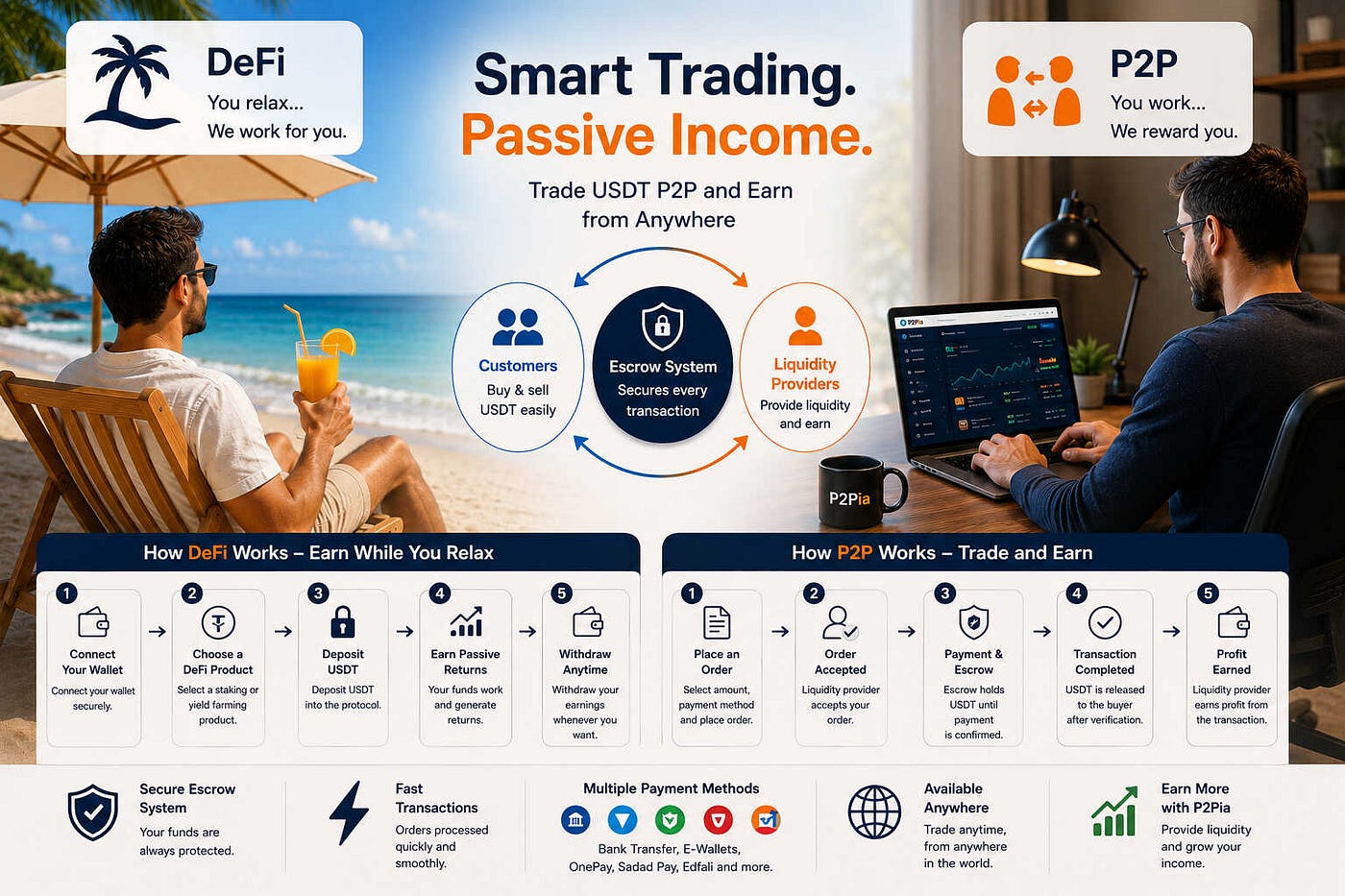
The first person deposits their crypto into a DeFi lending protocol or a liquidity pool. Within a few minutes, everything is set up. From that moment on, the smart contract takes over. Their capital begins generating yield automatically.
The second person makes a very different decision.
Instead of locking capital inside a protocol, they use it to become a P2P Liquidity Provider.
At first glance, both people seem to be doing the same thing.
Both are providing liquidity.
Both expect to earn money from their capital.
But in reality, they are participating in two completely different economic models.
Passive Capital
Decentralized Finance changed the way people think about investing.
For the first time, anyone could deposit digital assets into open financial protocols without asking permission from a bank or financial institution.
The idea is beautifully simple.
Deposit your assets.
Wait.
Earn yield.
Whether through lending markets or automated market makers, your money keeps working while you do something else.
It is one of the closest things crypto has to passive income.
Of course, passive does not mean risk-free.
Returns fluctuate.
Trading volume changes.
Interest rates move.
Liquidity providers may face Impermanent Loss.
Smart contracts themselves introduce technical risks.
But the operating model is remarkably simple:
Capital creates income.
Active Capital
Now imagine a different model.
Instead of asking your money to work alone, you combine your capital with your own time, reliability, and execution.
This is where next-generation P2P liquidity begins to look less like traditional investing and more like running a service business.
A useful analogy is Uber.
Owning a car does not automatically generate income.
The car becomes productive only when it is connected to a network of passengers.
Every completed trip creates revenue.
The same idea can apply to liquidity.
Your capital is the vehicle.
Customers are the passengers.
You become the service provider who uses that capital to complete transactions.
In this model, money alone is not enough.
Your availability matters.
Your speed matters.
Your accuracy matters.
The quality of your execution becomes part of your economic value.
Two People. Same Capital.
Let’s go back to our two people with $500.
The first person earns whatever the protocol generates.
Maybe the annual yield is attractive.
Maybe it drops next month.
Either way, there is very little they can do to influence the outcome.
The second person experiences something entirely different.
Their income depends on how many customer requests they process.
How quickly they respond.
How reliably they complete settlements.
How often they are available.
Two people with exactly the same capital may produce completely different results because one delivers a better service than the other.
This is no longer passive investing.
It is operational finance.
Which Model Is Better?
There is no universal answer.
If your goal is simplicity, automation, and minimal daily involvement, DeFi remains one of the most innovative financial systems ever created.
But if you enjoy building systems, serving customers, and treating capital as a productive business asset rather than a passive investment, active P2P liquidity offers a completely different opportunity.
Neither model replaces the other.
They solve different problems for different people.
One rewards capital.
The other rewards capital and execution.
The Future of Liquidity
Perhaps the most interesting lesson is that liquidity itself is evolving.
For years, liquidity providers were almost exclusively associated with decentralized exchanges and lending protocols.
Tomorrow, they may also become an essential part of real-world financial infrastructure, processing payments, settling transactions, and connecting traditional banking systems with digital assets.
That future raises a different question.
Instead of asking:
“Where can my money earn the highest annual yield?”
Perhaps we should ask:
“Do I want to be only an investor, or do I want my capital to become the foundation of a real financial service?”
The answer to that question may define the next generation of liquidity providers.
메타데이터
- post_id
- 0c99e851b23e
- slug
- should-your-money-work-for-you-or-should-you-work-with-your-money-0c99e851b23e
- url
- https://medium.com/@p2pia.com/should-your-money-work-for-you-or-should-you-work-with-your-money-0c99e851b23e
- canonical_url
- https://medium.com/@p2pia.com/should-your-money-work-for-you-or-should-you-work-with-your-money-0c99e851b23e
- author_url
- https://medium.com/@p2pia.com
- status
- ok
- fetched_at
- 2026-08-07 22:37:36




