WSO2 Devant: The AI-Native iPaaS That Changes How You Build Integrations
Stop duct-taping your systems together. There’s a smarter way.
WSO2 Devant: The AI-Native iPaaS That Changes How You Build Integrations
Stop duct-taping your systems together. There’s a smarter way.
Modern software teams are drowning in integration complexity. You’ve got microservices scattered across clouds, AI models you want to wire into your workflows, legacy systems that refuse to retire, and a growing pile of APIs nobody fully understands anymore. Traditional integration platforms were built for a simpler world and it shows.
WSO2 Devant is built for the world we actually live in.
It’s an AI-capable iPaaS (Integration Platform as a Service) that lets developers build, deploy, and manage integrations with first-class AI support baked in from day one not bolted on as an afterthought.
Let’s break down what makes it different.
What Exactly Is Devant?
Devant is WSO2’s answer to the question: “What should an integration platform look like in the age of AI agents?”
The short answer: it should let your AI agents feel right at home.
Devant allows you to incorporate AI agents directly into the integrations you build whether you prefer low-code visual flows or writing pro-code from scratch. The goal is to move your organization away from siloed, brittle system connections toward intelligent digital experiences that actually adapt and reason.
Think of it as the platform where your integration logic and your AI logic finally live in the same house.
Key Capabilities Worth Knowing
1. Unified Low Code and Pro-Code Development
One of the most common friction points in integration teams is the skill gap. Some developers prefer dragging and dropping in a visual editor; others won’t touch anything that isn’t a code editor.
Devant solves this with seamless transitions between low-code and pro-code through two powerful tools:
- WSO2 Integrator: BI -for visual, low-code development
- WSO2 Integrator: MI -for pro-code, configuration-driven integration
You don’t have to pick one and live with it forever. Junior developers can build in low-code while senior engineers drop into the same integration in pro-code mode when they need fine-grained control. No friction. No context-switching pain.
2. AI-Assisted Development (With a Real Copilot)
Devant ships with a VS Code based editor that includes an integrated AI copilot. This isn’t just autocomplete. The copilot actively assists at every stage of the development lifecycle:
- Generating boilerplate and integration scaffolding
- Refactoring messy logic
- Suggesting fixes during debugging
For integration developers, this is a genuine productivity multiplier. The kinds of things that used to take an afternoon of reading documentation can now take minutes.
3. Built In AI and Protocol Support
Devant has native support for integrating with third-party AI services and vector databases which is huge if you’re building RAG (Retrieval-Augmented Generation) pipelines, calling out to LLMs, or embedding AI agents into business workflows.
Beyond AI, it supports a comprehensive range of protocols out of the box:
- TCP and UDP
- File-based integrations
- WebSub and WebSubHub for event-driven patterns
This matters because real-world enterprise integration isn’t just REST APIs. You’ll hit legacy protocols, file drops, and event streams and Devant handles them without needing a sidecar tool.
4. Seamless Deployment with CI/CD and Multi Cloud Kubernetes
Building the integration is only half the battle. Devant takes deployment seriously with industry-standard CI/CD pipelines built in no manual builds, no fragile deployment scripts.
Deployment targets include:
- Azure, AWS, and GCP for managed cloud
- Your own Kubernetes clusters for private or hybrid scenarios
Configuration management is handled through a centralized interface where you can manage parameters, credentials, and secrets across all your deployment environments. No more environment-specific config files scattered across repos.
5. Automatic Scaling
Kubernetes-native scaling means Devant can scale services up or down based on demand automatically including scale-to-zero for services that don’t need to run 24/7. This directly optimizes your infrastructure costs without requiring manual intervention or complex autoscaling rules.
6. An Internal Marketplace for Reusable Assets
One of the most underrated features of Devant is its internal marketplace.Any integration, API, or digital asset you build can be published to a shared marketplace visible to internal teams, external partners, or both with role based access control governing who can publish and consume what.
This encourages reuse over reinvention. Instead of every team rebuilding the same Salesforce integration from scratch, one team builds and publishes it. Everyone else connects and ships.
7. Comprehensive Observability
When something breaks in a distributed integration landscape, finding the root cause is notoriously painful. Devant addresses this with:
- Anomaly detection and alerts get notified before issues become outages
- Detailed logs and traces aligned on a unified timeline, down to machine-level detail
- DORA metrics for tracking DevOps efficiency over time
- API analytics to understand performance and adoption patterns
- Cost insights for infrastructure optimization
You’re not flying blind after you ship. The platform gives DevOps and SRE teams the visibility they actually need.
Who Is Devant For?
Devant is designed for teams that:
- Are building or scaling enterprise integration across cloud services, APIs, and internal systems
- Want to incorporate AI agents or LLM calls into their integration workflows
- Have developers with mixed skill sets (low-code and pro-code)
- Need production-grade deployment without managing their own CI/CD infrastructure
- Want to reuse integration assets across teams rather than rebuilding constantly
It’s particularly compelling for organizations that are already in the WSO2 ecosystem (using WSO2 API Manager, WSO2 Micro Integrator, etc.) but genuinely stands on its own for new adopters too.
Getting Started
WSO2 offers several quick start paths for Devant:
- Schedule your first automation
- Develop your first AI agent
- Build your first integration as an API
- Set up event-driven or file-based integrations
The documentation is thorough and there’s an active Discord community for when you hit the inevitable edge cases.
Real-World Scenario: Building an AI Powered Customer Support System
Enough theory. Let’s walk through a concrete example of how a real team would use Devant to solve a real problem.
The Problem
Imagine you’re on the platform team at an e-commerce company let’s call it ShopNow. Every day, thousands of customers submit support tickets:
- “Where is my order?”
- “I want to return this item how do I start?”
- “The tracking page shows delivered but I haven’t received anything.”
Your current setup is a mess: a ticketing system (Zendesk), an order management system (a legacy REST API), a shipping provider API (FedEx/DHL), and a customer database (PostgreSQL). Each team queries these systems separately. Response times are slow, agents are copying data between tabs, and customers are frustrated.
You want to build an AI powered support agent that can:
- Accept a customer query
- Automatically look up their order and shipping status
- Give an intelligent, accurate answer in seconds
Here’s how you’d build this with Devant.
Step 1: Set Up Your Project and Import Your Repository
First, sign in to Devant and create an Organization (think of it as your company workspace). Then create a Project in this case, customer-support-platform.
Inside the project, you import your GitHub repository and create a new integration:
- Technology: WSO2 Integrator: BI
- Integration Type: AI Agent
Devant redirects you to VS Code with the WSO2 Integrator: BI extension automatically scaffolded. No boilerplate hunting.
Step 2: Connect Your Data Sources as Reusable Connections
Before writing any logic, you register your external systems as Connections in Devant’s marketplace:
order-management-api→ your internal REST APIshipping-provider-api→ FedEx/DHL REST endpointcustomer-db→ Devant-managed PostgreSQL
These connections are published to your internal marketplace once. Any integration in your organization can now reuse them your billing team, logistics team, or analytics team can all tap into the same order-management-api connection without rebuilding it.
Step 3: Build the AI Agent in WSO2 Integrator: BI
In the BI visual editor, you define your AI agent’s tools the functions it can call when reasoning through a query:
Tool 1: getOrderStatus
HTTP GET → order-management-api/orders/{orderId}
Returns: order status, estimated delivery date, items
Tool 2: getShippingTracking
HTTP GET → shipping-provider-api/track/{trackingNumber}
Returns: last scan location, carrier status, delivery confirmation
Tool 3: getCustomerProfile
SQL SELECT → customer-db
Returns: name, email, order history, loyalty tier
You wire these tools to an LLM (via Devant’s built-in AI service connector) and set a system prompt:
“You are a ShopNow customer support agent. Use the available tools to look up order and shipping information before answering. Always be concise, polite, and accurate.”
The AI copilot in BI helps you write the tool definitions and suggests error-handling patterns when your HTTP calls might fail. What would have taken days of plumbing now takes a few hours.
Step 4: Push, Build, and Deploy Automatically
Once you commit and push from VS Code, Devant’s CI/CD pipeline kicks off automatically:
- Detects the new commit
- Builds the integration
- Deploys it to the Development environment
No manual build commands. No deployment scripts. No “works on my machine” moments.
On the Devant console, you see the build status update in real time. Once it shows Build Completed, the agent is live in dev.
Step 5: Test the AI Agent
You open the built-in test console in Devant and send a prompt:
“Hi, I ordered a laptop 5 days ago (order #98231) but tracking shows it’s still in transit. What’s going on?”
The agent:
- Calls
getOrderStatuswith order ID98231 - Gets the tracking number from the response
- Calls
getShippingTrackingto get real-time carrier data - Synthesizes both into a clear, human-readable reply:
“Hi! Your order #98231 is currently with DHL and was last scanned at the Chicago distribution center on June 17th. It’s estimated to arrive by June 19th. Apologies for the slight delay it looks like it experienced a one-day hold at the distribution hub. Is there anything else I can help you with?”
Accurate. Fast. No agent had to touch it.
Step 6: Promote to Production and Expose as an API
After testing, you hit Promote to push the agent to the Production environment. Devant handles all the environment-specific config (API keys, database credentials, secrets) through its centralized Configuration Management you never hardcode credentials.
Once in production, the AI agent is exposed as a secure REST API endpoint. Your frontend team consumes it directly from the internal marketplace, secured with OAuth2. Rate limiting is configured in Devant’s API management layer to prevent abuse.
What Devant Solved Here
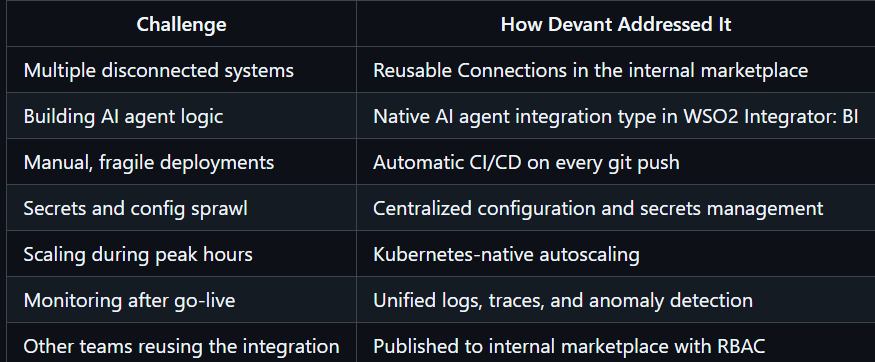
The same pattern applies across industries a healthcare team building a patient triage agent, a bank automating loan status queries, a logistics company wiring AI into their freight tracking. The scenario changes; the platform handles it the same way.
Final Thoughts
The integration platform market is crowded, and most players are scrambling to retrofit AI into tools that weren’t designed for it. Devant takes a different approach AI isn’t a feature, it’s part of the platform’s foundation.
If your team is dealing with a growing web of integrations, wants to bring AI agents into real workflows (not just demos), and needs a platform that doesn’t force developers into a single way of working, Devant is worth a serious look.
The shift from siloed systems to intelligent digital experiences doesn’t happen automatically. But with the right platform, it stops being a multi-year infrastructure project and starts being something your team can actually ship.
Interested in trying it out? Head over to WSO2 Devant and explore the documentation at wso2.com/devant/docs.
메타데이터
- post_id
- 0ca41be38628
- slug
- wso2-devant-the-ai-native-ipaas-that-changes-how-you-build-integrations-0ca41be38628
- url
- https://medium.com/@krishmaldinidu5466/wso2-devant-the-ai-native-ipaas-that-changes-how-you-build-integrations-0ca41be38628
- canonical_url
- https://medium.com/@krishmaldinidu5466/wso2-devant-the-ai-native-ipaas-that-changes-how-you-build-integrations-0ca41be38628
- author_url
- https://medium.com/@krishmaldinidu5466
- status
- ok
- fetched_at
- 2026-06-24 11:06:28