From Perfectionist to Terribleist: A Conversation About Creative Liberation
How one artist discovered joy by embracing artistic failure
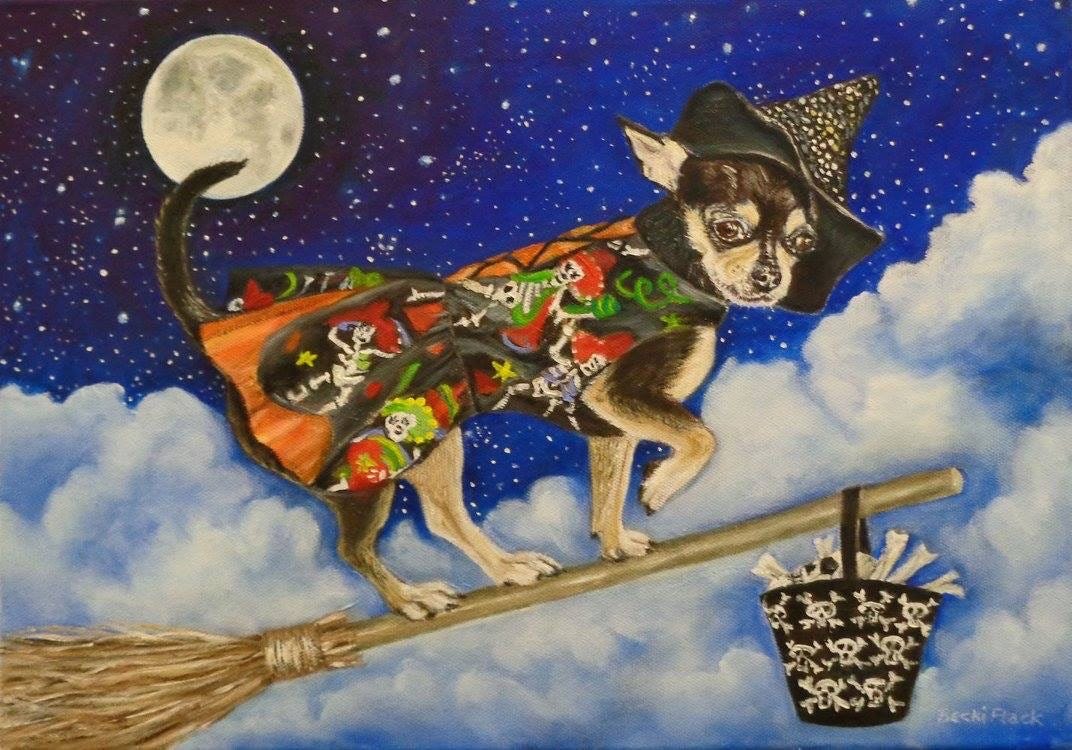
Portrait Of witch Tita by Becki Flack
From Perfectionist to Terribleist: A Conversation About Creative Liberation
How one artist discovered joy by embracing artistic failure
*Jack Myntan speaks with fellow Terribleist artist Becki Flack about her transformation from meticulous realism to liberated mark-making, and why painting with your feet might just be the key to creative freedom.
When I first introduced Becki to Terribleism six months ago, she was trapped in what I call the “perfectionist prison” — spending nine years creating meticulously detailed paintings of her Chihuahua, Tita, in various elaborate costumes and scenarios. Today, she’s painting portraits with her feet, creating deliberately awful makeup tutorials, and experiencing more artistic joy than she’s felt in years.
This conversation explores her transformation from technical perfectionist to proud producer of terrible art, and what this journey reveals about our culture’s obsession with flawless presentation.
The Perfect Prison
Jack: How did you first encounter Terribleism? What was your initial reaction to the concept of deliberately making terrible art?
Becki: Well, that was because of you. You introduced me to Terribleism. When I first encountered it, it seemed quite different and kind of alien to me because I was so used to painting in a very figurative way, very detailed, trying to make things look as much like the subject as possible — trying to be perfect, really. The concept of Terribleism was quite funny, and I liked the idea of it, but I wondered how I would be able to do it.
I can’t actually remember exactly how it happened. We were doing our joint sessions on speakerphone — originally you were doing your thing and I was doing mine. I’d be making one of my potato head collages whilst you’d be doing your terribleist work. I can’t remember at what point we decided I should try the same thing as you.
Jack: I said your collages were terribleist?
Becki: Yes! You did say they were terribleist. That’s how it started. I was thinking there’s some kind of wizardry that went on — I was doing my own thing, then suddenly I was doing Terribleism. It’s obviously part of your wizardry!
But I do remember thinking how much fun it was once I got into it, because initially I found it quite difficult.
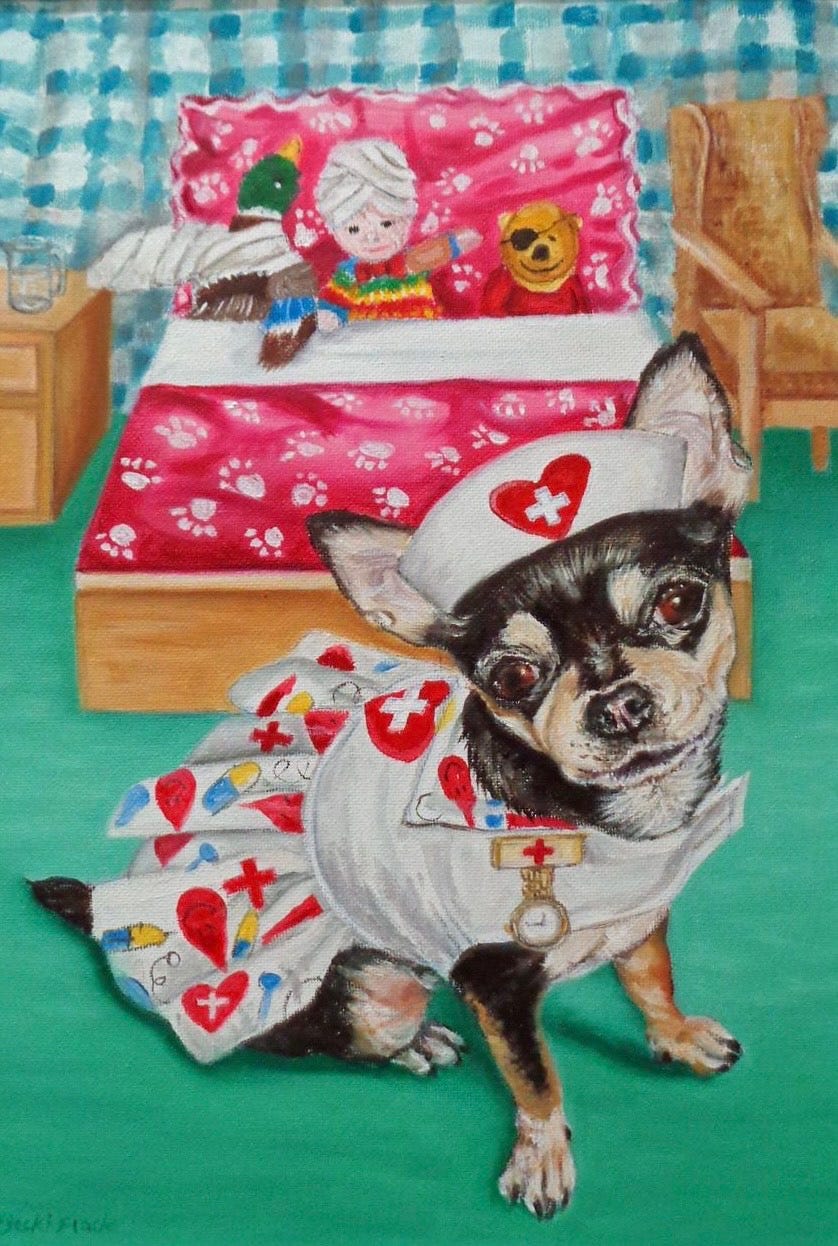
Portrait of nurse of Tita by Becki Flack
Before Terribleism, I was definitely caught in the perfectionist trap. I’d been painting my Chihuahua, Tita, in different adventures for nine years. It started as a bit of fun — I’d dress her up as a Mexican, a Wonder Chihuahua, a nurse. I’d make up little poems and even created a book. She became almost like my alter ego, doing everything I wanted to do. She was this character rather than just my pet.
Jack: So she was like a vehicle for your own aspirations?
Becki: Exactly. It was almost like how parents might have aspirations for their children, dressing them up, making costumes — expressing themselves through their children. Although Tita was passive in these scenarios, she was quite good at acting and posing.
The reason I wanted to paint it so naturalistically was because it was surreal — she’d be flying an aeroplane or on a broomstick. I wanted the painting to be as realistic as possible to make it almost seem like it could be real. If it wasn’t painted realistically, it would lose some believability. I was thinking of artists like Dalí — his work is surreal, but painted very realistically.
Also, I wanted to show that I could actually paint. I didn’t want people to think, “Oh, she’s just painting her dog — they’re just pet portraits.” I wanted to paint water, landscapes, clouds — difficult things. I wanted to show people I was skilled, to be taken seriously as a painter, not dismissed as someone who “just paints her pet.”
That’s why I wanted it to be so realistic and perfect. There was definitely a psychological aspect to it — proving oneself.
The Liberation Process
Jack: What was the first terrible piece you created? Can you describe that moment of letting go of control?
Becki: The first thing I painted was your portrait. I started painting it in a minimal way, with just a few brush strokes, thinking about the essence of you. You said, “Let me see your picture,” and I said, “It isn’t finished.” You said, “That’s it, that’s it.” And it looked like you.
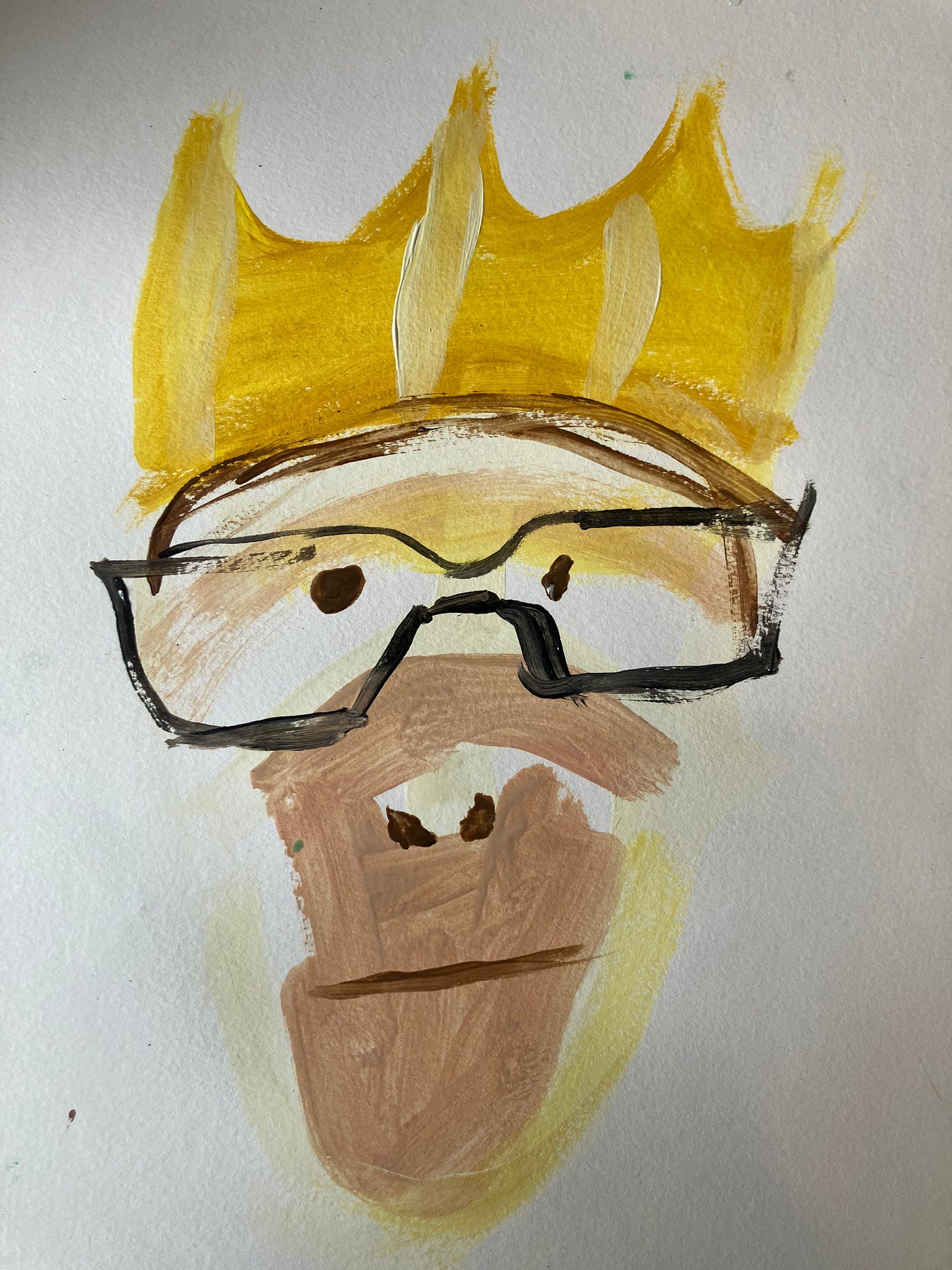
Terribleist Poortrait of Jack Myntan by Becki Flack
That was the first one. I suppose when I looked at it afterwards, I thought, “Oh my God, you can tell that’s him. That does actually look like him,” even though I’d only done it for about a minute with much less detail.
Jack: What I would have been stopping you from is letting the mind take over the artwork. The Tita paintings would be very mind-based, whereas if you can stop soon enough, you liberate yourself from that perfectionist thing where you’re correcting and over-working everything.
Becki: I found it remarkable that just doing a few bits — it’s more about using the paint to just do it. With Terribleism, it’s not so much in your head; When I look at them, I see the freedom of just putting the paint on.
Jack: Can you relate that to being about two or three years old, using crayons for the first time? I’ve watched my children drawing at that age — they don’t care about anything except mark-making.
Becki: Yes, just loving the paint, loving doing it. Just that joy. Though I must admit, when you didn’t stop me on later pieces, I went further and they became a little bit more like I’d carried on with them. I’d gone slightly back to thinking, “Oh, I’ve got to make it look like them.”
Jack: If you go too far with anything, the mind takes over and old patterns start to re-infiltrate your objectives. It’s easy to stop being a terribleist midway and start being the perfectionist accidentally.
Becki: When you’re trying to make something look like something, there’s a struggle, some tension. Whereas Terribleism is so much freer and more joyful. Some of the time I was just laughing at how terrible it was, which is unusual — there are no laughs when I’m painting normally. The Tita work was very cerebral, completely concentrating on one thing seriously, without thinking about anything else. Terribleism is a completely different experience.
Mistakes Become Features
Jack: Has Terribleism changed your relationship with mistakes? Do you see accidents differently now?
Becki: Yes, because they’re part of it. I struggled initially because I was still being a bit precious and perfect. Then we had that day when we were doing loads and loads of work. I started out still being precious, but then you’d say, “It’s got to be like a child did it.” I had to do it again and again, quicker and quicker, until I was laughing so much at how terrible things were. I had to go through that process — keep doing it, letting go, letting go, letting go — until it became quite fun.
Jack: There was a breakthrough point. From my perspective, your work gets very close to pure Terribleism. Sometimes there’s still a little inkling of quality — which is good, because I’ve always said there needs to be 10% brilliant and 90% terrible. I see that in your work. People might think, “It’s awful, but I love it.”
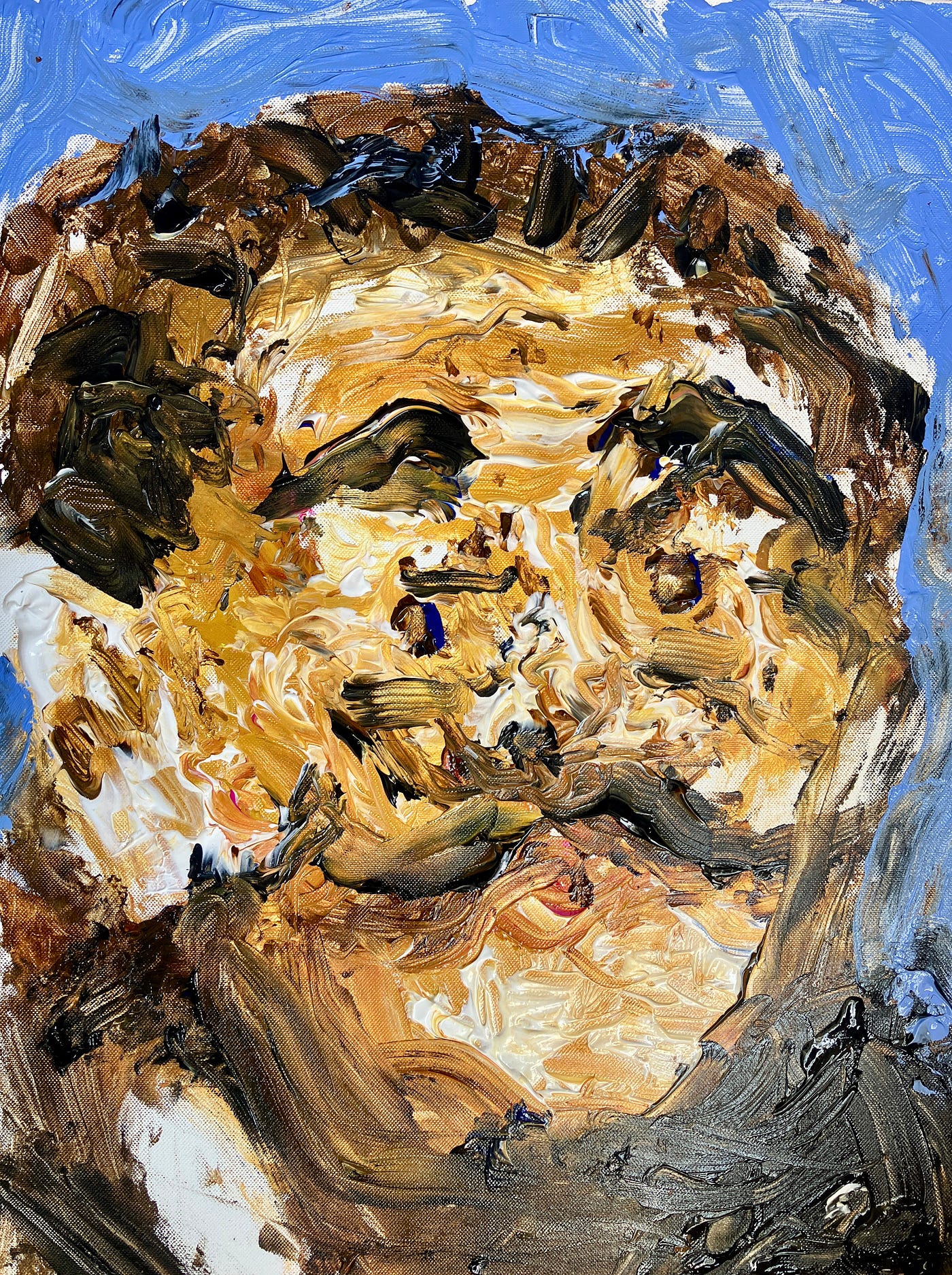
Terribleist Portrait (foot painting) of Salvador Dali by Becki Flack
Becki: I want to be as terrible as you! I did have that cringe factor with a couple of things I made. I thought, “That is so awful, I don’t want anyone to see that.”
Jack: But did you feel differently about them later? When I did the portrait of Dalí, I initially couldn’t stand it. I felt deeply hurt and wounded by it. But over the weeks since, I absolutely love it now. It hangs on my wall and I look at it every day thinking, “God, I love it.” Same with Marilyn Monroe — I was almost in tears when I did that, but now it’s framed and I adore it.
Becki: Yes, some of them I initially thought were so bad that a child could draw better. They were supposed to be self-portraits but looked nothing like me. But when I put them in our Open Studios as an experiment, people absolutely loved them.
Jack: Just explain what Open Studios is.
Becki: At our studios, every first Sunday of the month, about six of us hang our work in a gallery room. I decided to show only Terribleist work — no dog paintings, just terrible work and the manifesto. I had a whole collection because Terribleism is quicker to produce — work that would usually take me years. I was thinking, “How is this going to be received?” And everyone just loved it. Much more excitement than my previous work generated.
Joy in Creation
Jack: You were liberated emotionally into a more creative space?
Becki: Yes, and there’s the excitement of doing something. It’s much more joyful. I’m producing a lot more, feeling more motivated. It’s not like agonising over an idea that has to be brilliant, thinking carefully about what to do next. It’s exciting, wanting to be in the studio, wanting to do it. It feels good to be part of something different, something that’s loosened me up — gotten rid of the knots and tightness.
Jack: Perfectionism creates knots and tightness. You feel like you’ve got a metal bar down your back. It’s fear-based. Terribleism can achieve getting rid of that fear. You just go, “I will fail, and I will enjoy this because it’s liberating.” It’s like diving into a cool pool on a hot day.
Becki: I used to have this fear of starting a painting — fear about getting everything in the right place, the composition right. I’d think, “Oh God, I’ve forgotten how to paint. What if I can’t do it?” All this anxiety about doing it, then getting into it and it being all right, but basically it was an exercise in trying to make it look perfect.
With Terribleism, I don’t have that agony. I don’t have that fear and anxiety about whether the composition will be right, whether it will be perfect. There isn’t any of that. It’s just wanting to dive in and do it.
Political Implications
Jack: Terribleism seems to be a rebellion against our perfectionist, Instagram-filtered culture. Do you see your work as political?
Becki: Yes, I do, because I hate how fake and homogenised the media and culture seem now. I find it quite depressing that everyone wants to look a certain way, everyone looking false. It’s definitely isolating if you don’t fit into what everyone else wants to do. I find it so fake and awful, so unauthentic.
Jack: There’s a Terribleist proverb: “You are not the product.” We’re all reflecting these pixel-perfect personalities projected at us through our devices, and people are getting damaged by that.
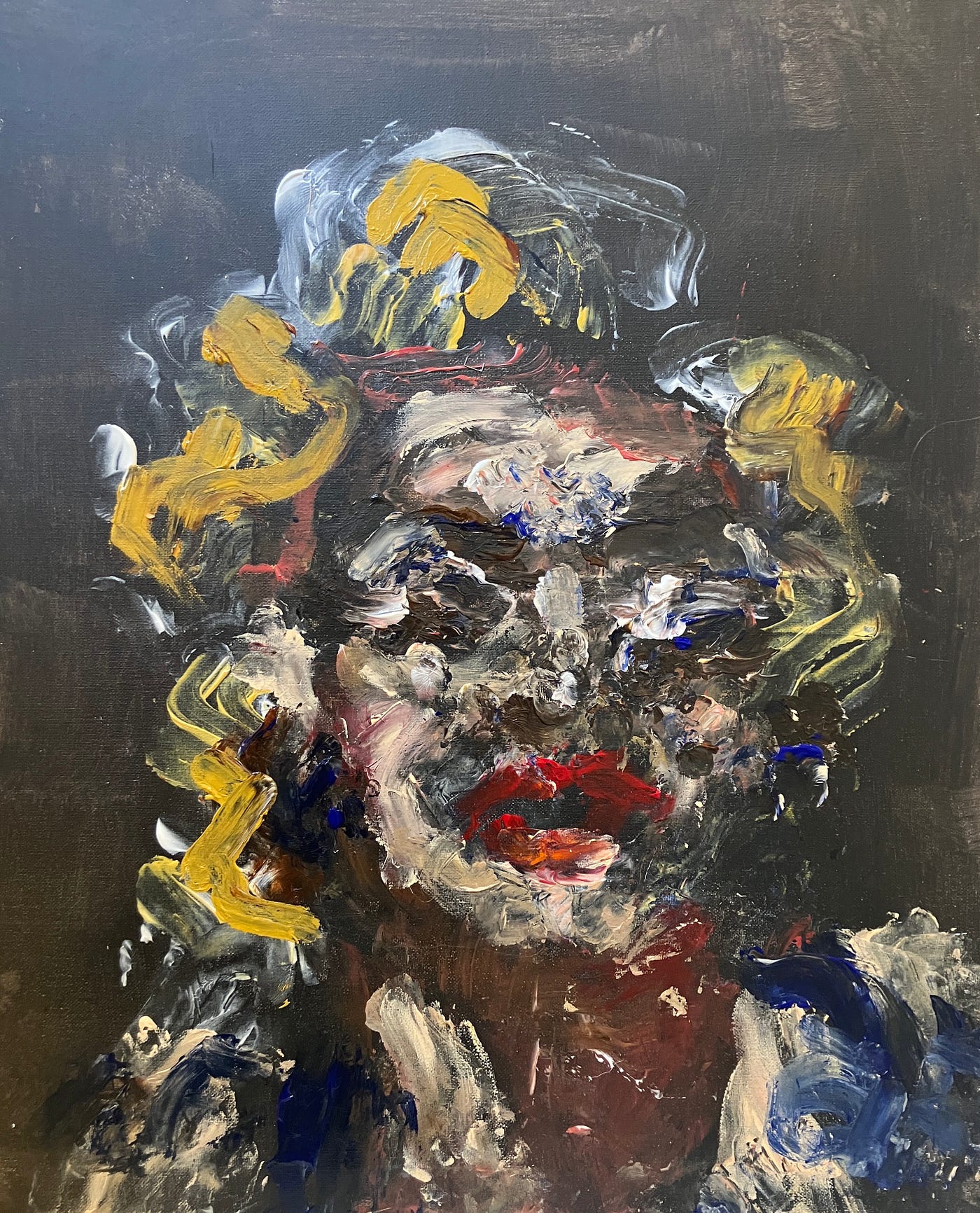
Terribleist Portrait of Marilyn Monroe by Becki Flack
The Terrible Makeup Rebellion
Jack: You went off on your own and did Terribleist makeup. Can you explain that?
Becki: That was brilliant — a protest against Instagram and TikTok, against young girls doing their makeup like drag artists, like masks. They don’t want to look like themselves, even though they look lovely with beautiful skin. Instead of accepting themselves as they are, they think they have to shade this and highlight that, put a dot on their nose to make it look turned up, shade for cheekbones, make their lips look big.
Sometimes people actually get fillers in their lips — these big, false-looking lips. They all end up looking the same, like mannequins. The makeup techniques they’re using are designed for men, like drag queens, to make them look more feminine. Men have different foreheads, so they shade them, but women don’t need that because they already have feminine foreheads.
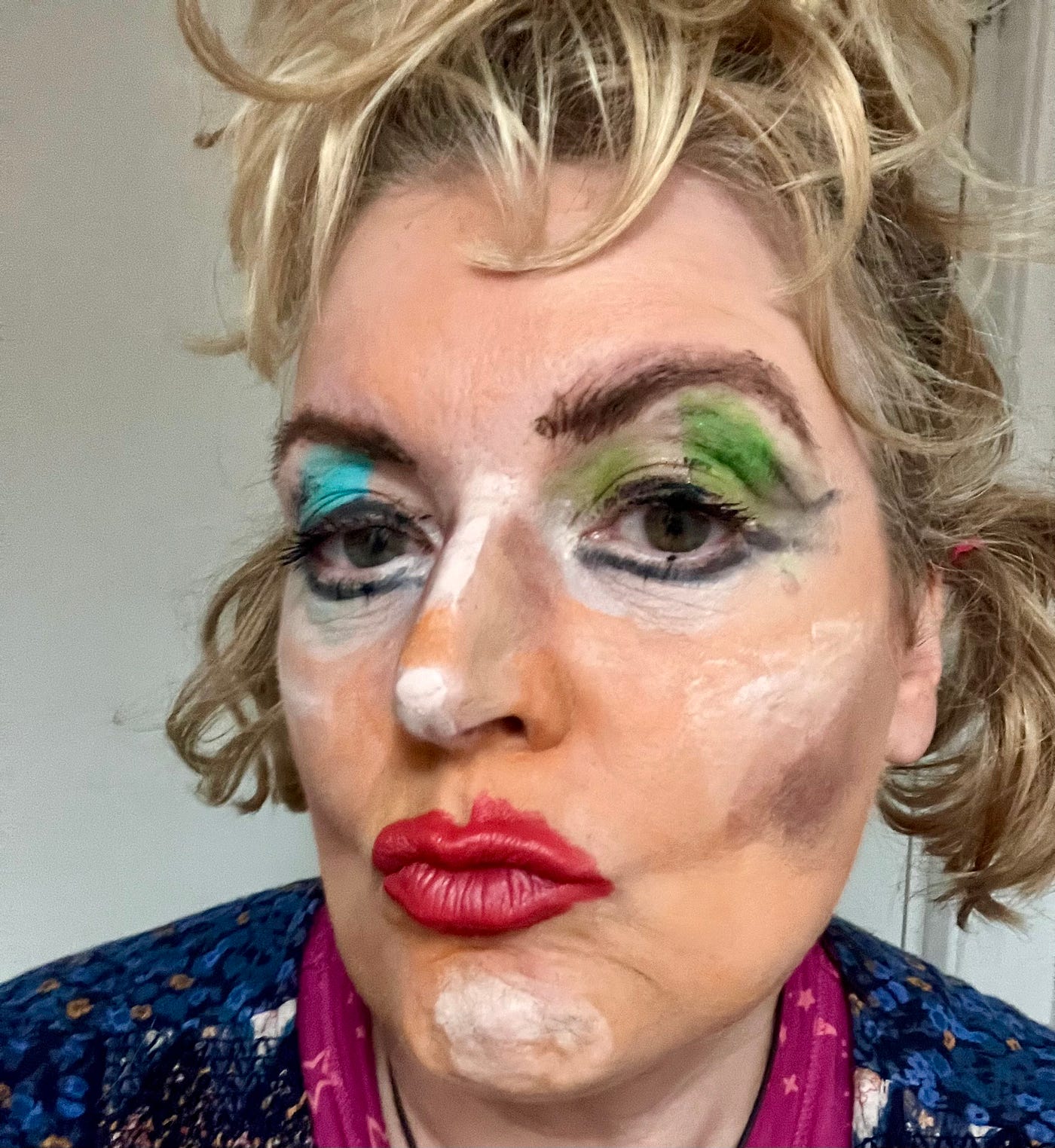
Terribleist Makeup self poortrait by Becki Flack
When I did the terrible makeup, I put on awful foundation that wasn’t the same colour as my skin — like Donald Trump’s terrible foundation. I did the shading really badly, made the lips completely grotesque and lopsided. Young girls are making their lips bigger by going outside the lip line, which looks odd.
I wanted to make myself look grotesque and terrible. I didn’t want to look beautiful. And it was making me laugh the whole time I was doing it.
Jack: That speaks to Terribleism causing joy rather than pain.
Becki: Bear in mind, I did a makeup course, so I can actually do makeup properly. This was about letting go of doing it properly and just doing it as funny and badly as possible. And people loved it.
Future Territories
Jack: Where do you see your Terribleist practice going? Are there new territories of awfulness you want to explore?
Becki: The one I haven’t done yet that I really want to do is “de-pooppage” — like decoupage but terrible. Decoupage is usually sticking Victorian flowers and cupids on objects, but I want to do it terribly.
Jack: Will you go back to doing Tita paintings?
Becki: I don’t think I will now. Maybe I should try doing a Tita painting in terrible style though.
Jack: I think that would be really good.
Becki: Before, her eyes had to look real with highlights and gloss, the hair had to be almost every individual hair. To just do a terrible painting of her would be so free.
Jack: If someone wanted to start their Terribleist journey, what would you tell them?
Becki: Foot painting is a really good way of being terrible. But maybe that’s too advanced initially. I’d say use big brushes, not detailed ones. Use any colours, use the same brush, and do it as fast as you can. I think that helps — not having time to perfect it.
The Transformation
Jack: Six months into this journey, what has Terribleism taught you about yourself as an artist and about art in general?
Becki: It’s taught me that I can produce something that’s fun and interesting to look at without spending ages on it. I was a very slow painter before. It’s given me freedom to just slosh around with paint and make marks. Especially with foot painting — you can’t control it that much. It’s definitely loosened me up, opened up a whole different world that’s much more free.
Jack: Would you say it’s given you more pleasure in the process of creation?
Becki: Yes, absolutely. There’s excitement to go and make another piece. With my other work, it’s almost too tight, too controlled. The lack of control in terribleism is liberating.
Jack: It’s anarchy art — find a technique and do the opposite. Find something and do the wrong thing instead of the right thing.
Becki: And paint is allowed to be paint. The whole texture, the paint’s allowed to be sloshed on with a toe or whatever. You can see it’s paint, whereas before it was trying to create an illusion. Sometimes if I showed someone a photo of my Tita work, they thought it was a photograph. Now it’s going back to that childlike joy of just colours, just paint, just the whole experience.
Jack: When you look at art history now, can you see Terribleist techniques embedded in famous works?
Becki: Yes, definitely. Some of Picasso’s work is actually really terrible. He wasn’t purposefully trying to be terrible, but there’s a tendency towards the terrible techniques in modern art. They’re just polished at the end.
The Pressure to Be Profound
Becki: There’s something else important about Terribleism. When I was in the studios at Wimbledon with 300 artists, I felt pressure to have some kind of concept, some intellectual reason for everything I did. You’d see someone’s work and then hear how they explain it — this really convoluted, intellectual reason that you can’t actually see when you look at it.
To be taken seriously as a proper artist, I felt I had to have some deep explanation, some meaning, some validation for why I’d done something. When you submit work anywhere, they always ask for a description, and there’s pressure to make it seem important.
Jack: So there’s pressure to have a concept attached to every piece rather than just art for art’s sake?
Becki: Exactly. I always found it difficult to give some huge, existential meaning to what I was doing. Sometimes I’d see explanations that bore no relation to the actual work. You could say anything about anything — add any concept over the top to make it seem political or meaningful when maybe it’s just a painting.
Jack: So we could use the word “pretentious”?
Becki: Yes, sometimes pretentious. With Terribleism, you don’t have all this angst about having to provide some deep, meaningful commentary. There is a philosophy behind it, but it’s an easily understood concept that everyone can get. It’s not some obscure reason.
Jack: It takes the pressure off. If you feel pressure to produce something with attached intent and philosophical writing, Terribleism says it doesn’t matter. We’re going to paint with our feet because it’s hard to paint with your feet and do anything good. The only attachment you need is: “I painted this with my foot and it’s a picture of somebody famous.” That’s it.
Becki: And it’s terrible! Before, I felt if I didn’t have some pretentious reason for doing something, I wouldn’t be taken seriously. I’d be looked down upon. But really, you could put any meaning, any concept over something to make it seem worthy when it might just be a painting.
Jack: So self-esteem is a factor in the perfectionist rule book?
Becki: Yes, definitely. Thinking that if you’re not doing something worthy, you’re lesser, not a proper artist.
Jack: And Terribleism has released you from that ideology?
Becki: Yes, it has. I stand proudly next to my Terribleist exhibition now. The responses have been all positive. People have said things like, “You’re now painting through your heart, not your mind. There’s so much emotion in there, it’s so real and raw.”
The worst one I did — supposed to be a self-portrait but looked like an evil clown, nothing like me — one of my friends said, “I don’t want anyone else to buy that. I’ve got to have that. I love it.” It was one of the most grotesque things I’d ever seen, completely terrible, and they absolutely loved it.
This conversation reveals something profound about our relationship with creative perfectionism. In a culture obsessed with flawless presentation and Instagram-ready outcomes, Terribleism offers a radical alternative: the joy of deliberate failure, the liberation of lowered expectations, and the surprising discovery that our “terrible” work might be more authentically expressive than anything we’ve ever made.
As Becki discovered, sometimes the path to artistic freedom leads directly through the territory we’ve been taught to avoid — the realm of the beautifully, gloriously, unapologetically terrible.
This article is part of the ongoing documentation of the Terribleist art movement, launched in 1987 and continuing to liberate artists from the prison of perfectionism worldwide.
메타데이터
- post_id
- 0cb2fc7b4b3a
- slug
- from-perfectionist-to-terribleist-a-conversation-about-creative-liberation-0cb2fc7b4b3a
- url
- https://medium.com/@terribleism/from-perfectionist-to-terribleist-a-conversation-about-creative-liberation-0cb2fc7b4b3a
- canonical_url
- https://medium.com/@terribleism/from-perfectionist-to-terribleist-a-conversation-about-creative-liberation-0cb2fc7b4b3a
- author_url
- https://medium.com/@terribleism
- status
- ok
- fetched_at
- 2026-06-25 07:00:49