Mummified Monkey Dressed in Rhea Feathers: New Study Analyzes the Only Subtropical Primate Mummy…
Study Provides Chronological, Genetic, and Dietary Reconstruction of a Subadult Male Alouatta caraya Mummy from Late Pre-Hispanic Argentina
Mummified Monkey Dressed in Rhea Feathers: New Study Analyzes the Only Subtropical Primate Mummy from South America
Study Provides Chronological, Genetic, and Dietary Reconstruction of a Subadult Male Alouatta caraya Mummy from Late Pre-Hispanic Argentina
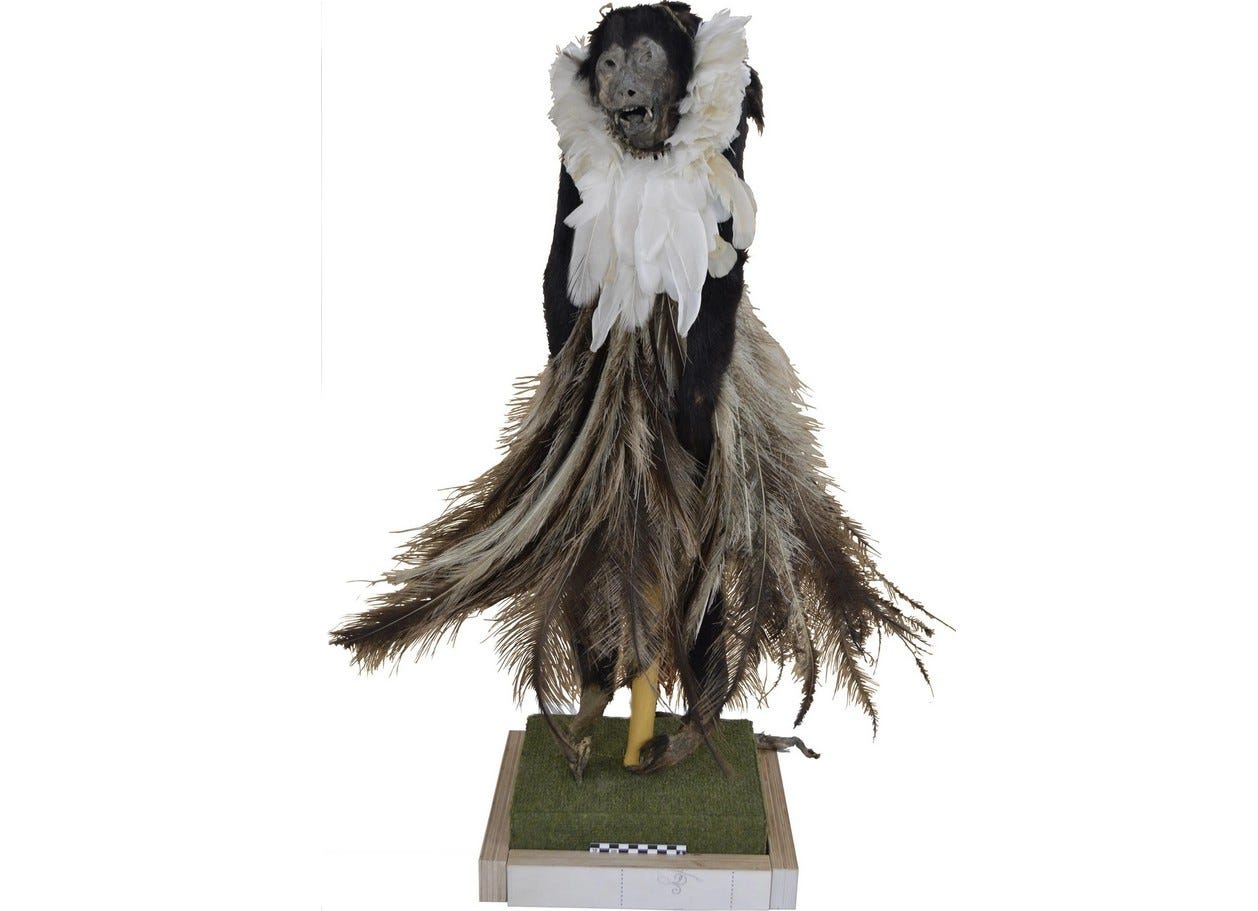
Back-and-gold howler monkey dressed in rhea and heron feathers from Gran Chaco, ca. 15 -17th century. Credit: Urbani et al. 2026
Cultures throughout history have been fascinated by primates, and it makes sense, after all, they are so human-like and yet so different. I remember hiking in the Drakensberg when I looked up at the summit we had just come down and saw a group of people sitting in a circle, staring at us. They were silhouetted against the setting sun, making it hard to distinguish anything besides their overall form. Then one of them suddenly ran up a tree to look at us, and it clicked, those were baboons, not people, and yet they looked eerily like a group of human friends hanging out on a mountainside.
Various cultures have taken to including these non-human primates in their cultures and mythologies, and even mummifying them for use as votives, ritual artifacts, or simply to preserve a beloved pet for the afterlife.
However, most mummified primates come from arid areas like Egypt and Chile, where they were either naturally or intentionally mummified and preserved by the dry, harsh landscape for millennia. Mummies of any kind in subtropical regions are far scarcer, simply because the tropics and organic preservation do not mix well.
However, a recent study by Dr. Bernado Urbani and colleagues examined a monkey mummy from South America. Now housed in the Museum of Archaeology at the Castle of Gottorf in Germany, very little was previously known about it. It came from somewhere in Gran Chaco, South America, and was acquired in the late 1800s. How old is it, what species is it, and why was it dressed in indigenous textiles and feathers? All of this remained unclear until now.
Non-Human Primate Mummies
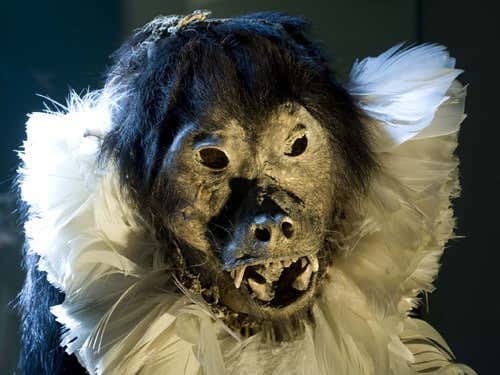
Gran Chaco mummy. Credit: New Scientist, 2010
Primate mummies have been studied extensively in ancient Egypt, with examples typically spanning from around 3750 BCE to the 1st and 2nd centuries CE. Among these mummified individuals in Egypt are baboons, although some isolated cases represent domestic/pet animals mummified by their owners; most are thought to have had votive (aka spiritual or ritualistic) functions. This makes sense as in ancient Egypt, baboons were associated with the god Thot, who in turn was the deity of the moon and wisdom.
Outside of the Western Hemisphere, there are only two other known examples of mummified primates, one from northern Chile, dated to between 1100 and 1350 CE, and associated with the Arica culture. The mummy was of a red howler monkey (Alouatta seniculus) and would likely have been transported from lowland forested regions (e.g., Peru or Bolivia) to the Chilean Atacama.
The other is the focus of this study. Unlike all previous primate mummies, which come from arid regions, this one originated in the subtropical Gran Chaco region of Argentina. It has lain unstudied in a specially made wooden box for decades, with little else known about its origin, life, and purpose.
Tracing a Monkey Through Time
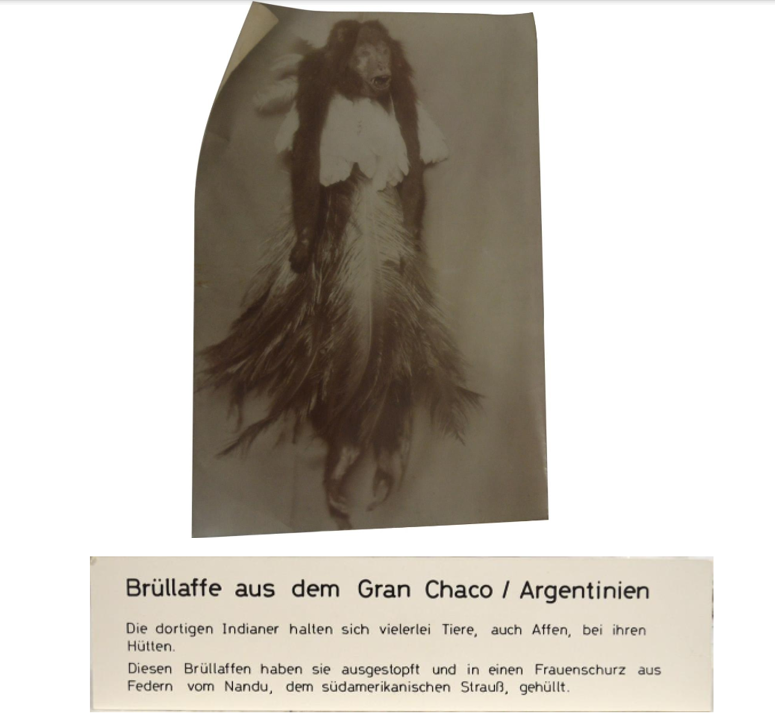
Photo of the mummy taken in the late 1800s with the feather collar beneath the armpits and label accompanying the mummy. Translation: A howler monkey from the Gran Chaco, Argentina. The local Amerindians keep many animals, including monkeys, near their huts. They stuffed this howler monkey and wrapped it in a woman’s dressing gown made of rhea, the South American ostrich feathers. Credit: Urbani et al. 2026
Today, the unique monkey is housed at Germany’s Museum of Archaeology at the Castle of Gottorf (my word, that is a long title, I shall shorten it to MACG). The only written document mentioning the mummy was a brief entry in the Museum of Ethnography in Kiel’s inventory book. According to the note, the mummy originated from Gran Chaco (South America) and was shipped from Montevideo (Uruguay) to Kiel. It was donated to the museum in Kiel on May 28, 1892, by someone named Th. Lamp.
What does Th. stand for? Perhaps Theodore or Thomas; however, despite their search, the researchers could not locate a person with this surname of North German origin with ethnographic or trading relations in Argentina, Uruguay, or Germany, and thus the submitter remains an enigma.
However, an E. Lamp was noted as a collector for the museum of Kiel, who donated objects between 2 December 1889 and 15 May 1896. E. Lamp was a watchmaker, or possibly an employee of an observatory in Kiel, and may have been linked to our mysterious Th. Lamp.
The mummy remained at the Museum of Ethnography in Kiel until 1995, when it was transferred to the MACG. Today, it is dressed in indigenous textiles, including a whitish cotton sash decorated with rhea feathers and secured with a cord, a reddish woolen sash, and a piece of gauze textile probably used to repair a tear or wound near the groin.
Weirdly, the attire was partially repositioned after museum acquisition. In a late-19th-century photograph of the mummy, the monkey wore a white feathered ring below the armpits, likely made from Chacoan stork or heron feathers. However, this piece of the attire was moved and is now a feathered collar positioned around the neck. According to the original label written between the 1960s and 1980s, the attire is representative of a “Frauenschurz,” aka a woman’s dressing gown.
It is thought the mummy may have originated in Paraguay or possibly Argentina, as the Chamacoco Amerindians used feathered headdresses and mainly resided there. Meanwhile, many cultural objects made from primates, rheas, and white herons were produced by the indigenous peoples of Chaco, Argentina.
So that is all we know about this monkey. It isn’t it a lot, is it? Especially not for the only known subtropical primate mummy outside of the Western Hemisphere. Thus, to better understand the mummy’s origins and purpose, the researchers employed a multidisciplinary approach combining genetic, morphological, isotopic, ethnographic, radiocarbon, and archaeological analyses to determine the species, its age, and place of origin.
Studying a Monkey
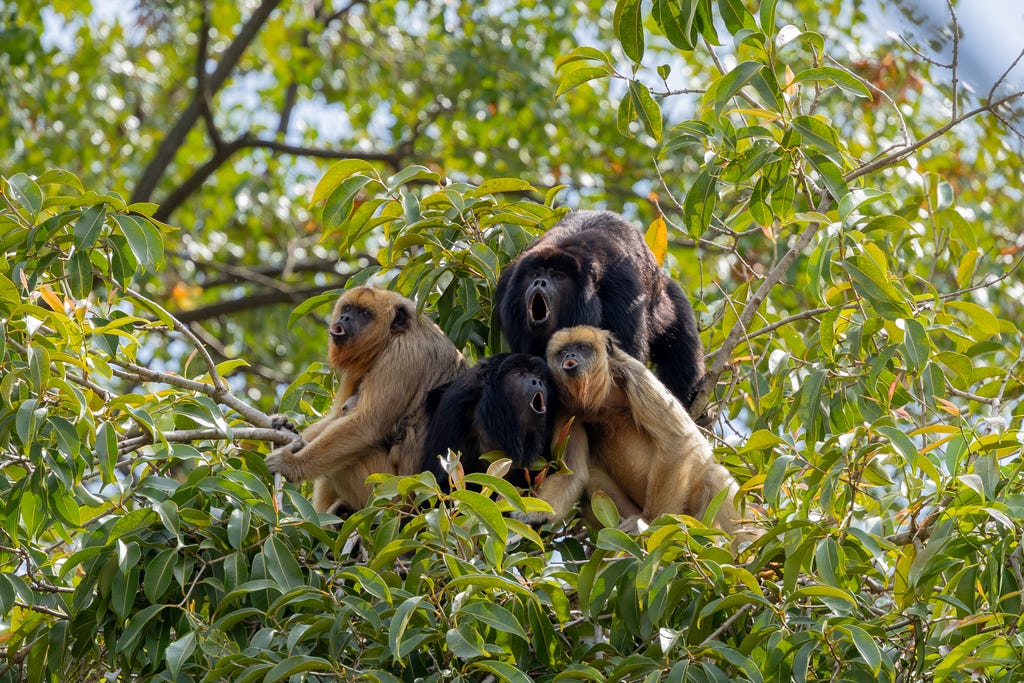
Black-and-gold howler monkeys. Credit: Miguel P. Biasoli on iNaturalist
The analysis revealed that the mummy was a male black-and-gold howler monkey (Alouatta caraya), likely originating in the Argentina-Paraguay border region. These New World monkeys are indigenous to South America. Males grow black fur while females sport golden-brown fur. They are among the largest of South America’s primates, with males reaching around 24–26 inches (~61–66 cm) and weighing between 6 and 7.7 kg (~13–17 pounds). They mainly eat leaves but also munch on fruits, flowers, and buds. Their name, as you might have guessed, comes from their powerful calls, which can be heard up to 3 miles (4,8 km) away.
Our mummy was a subadult when he died (basically a teenager). Interestingly, while it was initially believed the mummy was an ethnographic object, basically an object acquired specifically for study, the radiocarbon dates revealed the mummy was much older than previously believed. This mummy did not live in the 1800s, nor the 1700s; in fact, it likely lived between 1475 and 1644 CE. This means it may date to the Pre-Hispanic period or the very early Colonial era.
The Spanish first arrived in the Gran Chaco in 1527, meaning the mummy was made during a crucial transitional period, as the region and southern South America as a whole were beginning to change drastically due to European expansion.
But then, how did it end up in Germany hundreds of years later, and can we discern why it was dressed in such elaborate paraphernalia?
The Life and Afterlife of a Mummified Monkey
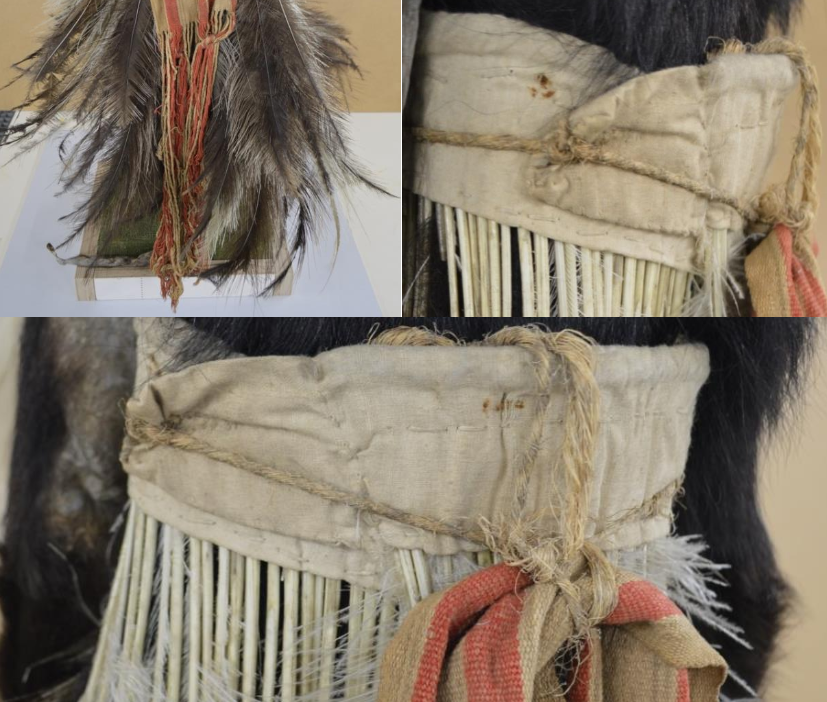
Details of the textiles used on the monkey mummy. Credit: Urbani et al. 2026
Based on the genetic analysis, isotopes, and known habitats of black-and-gold howlers and rheas, it is believed the monkey had to have come from the Misiones-Corrientes province in Argentina, as this is the region where all lines of evidence overlap. Making it likely that the monkey was hunted or reared locally rather than traded into the region from the Amazon.
Upon death, it was mummified, its eyes removed, its mouth opened to display its teeth, and dressed in elaborate attire. Its careful, intentional mummification and elaborate clothing suggest this was likely not done for practical purposes or, possibly, for personal ones, such as memorializing a pet (although howler monkeys were kept as pets on occasion by some indigenous peoples in South America). Rather, it is likely that the monkey served a ritual purpose.
Various ethnographic lines of evidence indicate the totemic qualities that howler monkeys were believed to possess by the indigenous peoples of Chaco. For example, the Qom who kept monkeys as pets believed that humans could transform into monkeys and that shamans who had pet howler monkeys would have ‘tutelage of all the howler monkeys [and] the capacity to communicate with clouds, lightning, rain, and wind’. In this same group, the skins of howler monkeys could be made into masks, which were used in healing rituals.
Meanwhile, the Guarani believed that humans could be transformed into howler monkeys as punishment for breaking moral rules. They also believed that howler monkeys could transform into humans when they decided to climb trees because of the iridescence of the sun on the ground. Once they climbed into the trees, however, they would become shrunk and scorched.
Considering I thought baboons silhouetted by the setting sun were humans, I can see how such a myth might evolve. The Guarani of Misiones Province also believe that the howler monkey’s call (karaja oporai) was a prayer chant for a newborn or an ill person.
Exactly why this monkey was mummified is uncertain, but perhaps it was linked to one of these beliefs, such as healing or transformation.
And how did it end up in Germany centuries later? The answer is that around the time of the mummy’s arrival, cultural objects across the Americas were being collected, looted, sold, bought, traded, received, exchanged, and stolen by both locals and Europeans, mainly to supply foreign collectors, museums, and universities.
According to Dr. Urbani, “the trail of Th. Lamp” reflects the intense 19th-century circulation of all kinds of ethnographical materials in the Río de la Plata and other parts of South America.”
The study provides insight into a rare primate mummy, the only one known to have originated in a subtropical climate outside the western hemisphere. It is one of only two known South American examples and was likely created for ritual purposes in the pre-Hispanic or early Colonial era. We may never be certain what site it came from specifically, but at least we can be certain of its species, age, geographic origin, and profound cultural significance to the Indigenous peoples of the Gran Chaco.
Monkeys are often associated with healing, protection, and wisdom, and I wonder if this was true of our mummified monkey. Interestingly, San baboon rock art is also associated with protection, specifically against lightning.
What do you think was the original purpose of this mummy, and why was its feather collar moved from below the armpits to around the neck?
Let me know your thoughts, and if you’d like to support the countless hours I pour into researching, writing, and bringing these hidden corners of history to life, why not Buy Me A Coffee
References
Black-and-Gold Howler, Alouatta caraya | New England Primate Conservancy. (2022, January 6). Neprimateconservancy.org. https://neprimateconservancy.org/black-and-gold-howler/
Egypt Museum. (2022, August 24). Mummy of a Baboon — Egypt Museum. Egypt Museum. https://egypt-museum.com/mummy-of-baboon/
Urbani, B., Roos, C., Valenzuela, L.O. et al. Inside a monkey with rhea feathers: Characterizing the nonhuman primate mummy from the Gran Chaco, South America. Archaeol Anthropol Sci 18, 71 (2026). https://doi.org/10.1007/s12520-026-02442-4
Published in Palaeopress. **Follow **to explore everything old
메타데이터
- post_id
- 0cb4f35f5316
- slug
- mummified-monkey-dressed-in-rhea-feathers-new-study-analyzes-the-only-subtropical-primate-mummy-0cb4f35f5316
- url
- https://medium.com/palaeopress/mummified-monkey-dressed-in-rhea-feathers-new-study-analyzes-the-only-subtropical-primate-mummy-0cb4f35f5316
- canonical_url
- https://medium.com/palaeopress/mummified-monkey-dressed-in-rhea-feathers-new-study-analyzes-the-only-subtropical-primate-mummy-0cb4f35f5316
- author_url
- https://medium.com/@sandeeoster17
- status
- ok
- fetched_at
- 2026-06-11 10:13:20