BP Discovers Oil Worth Billions, Its Biggest Find in Decades
British oil giant BP is back in the spotlight, this time thanks to its largest oil and gas discovery in the past 25 years. The field, aptly…
BP Discovers Oil Worth Billions, Its Biggest Find in Decades
British oil giant BP is back in the spotlight, this time thanks to its largest oil and gas discovery in the past 25 years. The field, aptly named Bumerangue, was discovered in the Brazilian part of the Santos Basin offshore zone and could mark a major turning point for the company. After a period of trying to transform into a “greener” company focused more on renewables, the tide now appears to be turning. This discovery is a clear sign that oil hasn’t said its last word in BP’s portfolio or in the broader energy game.
About the Company
BP (British Petroleum) is one of the largest energy companies in the world, headquartered in London, with a history dating back to the early 20th century. Its operations span the entire value chain — from oil and natural gas exploration and production, through processing and transportation, to retail fuel sales and the manufacture of petrochemical products. The company operates in more than 70 countries and employs tens of thousands of people. Over the past decades, BP has experienced several defining moments, most notably the environmental disaster in the Gulf of Mexico in 2010. In response to pressure from investors and the public, the company had previously pledged to transition toward a “lower-carbon future” and reduce CO₂ emissions. However, under current CEO Murray Auchincloss, BP is once again placing greater emphasis on maximizing the value of its fossil fuel assets and cutting costs. Renewable energy development remains part of its portfolio but is being pursued at a more cautious pace.
The Biggest Oil Discovery in a Quarter Century?
The Bumerangue field is located about 400 kilometers off the coast of Rio de Janeiro, nearly 2,400 meters beneath the ocean surface. Drilling results indicate a thick hydrocarbon column measuring 500 meters in height within exceptionally high-quality reservoir rock, potentially making it one of the most significant sites in the region. It marks BP’s tenth successful discovery this year alone, highlighting a more aggressive and effective exploration strategy than the company has pursued in years.
From a global market perspective, however, this isn’t expected to trigger an immediate price shift. While the find is far from small, BP has not yet disclosed specific reserve estimates, and the project is still in the early stages of economic viability assessment. One potential challenge lies in higher concentrations of carbon dioxide within the associated natural gas, which could impact the project’s overall profitability. Moreover, global oil demand trends are shifting. According to the International Energy Agency, consumption growth is projected to stall after 2026. This is largely due to the rapid rise of electric vehicles with over 20 million EVs expected to be sold in 2025 alone. That shift could reduce global oil demand by more than 5 million barrels per day by the end of the decade. [1]
Greater Emphasis on Renewables Is a Thing of the Past
The timing of this discovery is crucial for the company, especially due to the mentioned strategy shift that includes renewed focus on traditional fossil fuels. Brazil is set to become a key pillar of this strategy. The company plans to increase production to 2.5 million barrels of oil equivalent per day by 2030, with further growth planned through 2035. The departure from environmental commitments is also evident in portfolio decisions. This year, BP announced asset sales worth $3 billion and continued restructuring. It is selling businesses in electric mobility in the Netherlands as well as wind farms in the USA.
Financial Results
In the second quarter of 2025, BP recorded total revenues of $46.63 billion, representing a year-on-year increase of more than 8 percent compared to $43 billion in the same period last year. Net profit rose to $1.63 billion, lifting BP out of a loss of $2.24 billion reported in the second quarter of 2024. Underlying replacement cost profit, the company’s main measure of profitability, reached 2.53 billion US dollars, which is a year-on-year increase of more than 40 percent. The company also increased its dividend by 10 percent and launched a new share buyback program worth $750 million. Operating cash flow improved significantly, rising to $6.3 billion, while refining margins increased from $15.20 to $21.10 per barrel. BP continues to implement its savings program, which aims to achieve permanent cost reductions of 4 to $5 billion by 2027. [2]
Stock Performance
BP shares on the New York Stock Exchange (NYSE) gained approximately 10 percent from the beginning of 2025 to August 5, marking a significant recovery after a weak performance in 2024. The growth was supported by improved financial results and a strategic focus on efficiency. However, the share price remains below the levels seen in 2022, when the company benefited from high energy prices following the invasion of Ukraine. The announcement of the Bumerangue field discovery added more than 2 percent to the stock in a single day. Risks remain, including sensitivity to oil prices, pressure to reduce emissions, a high debt level of 26 billion US dollars, and uncertainties related to the energy transition.
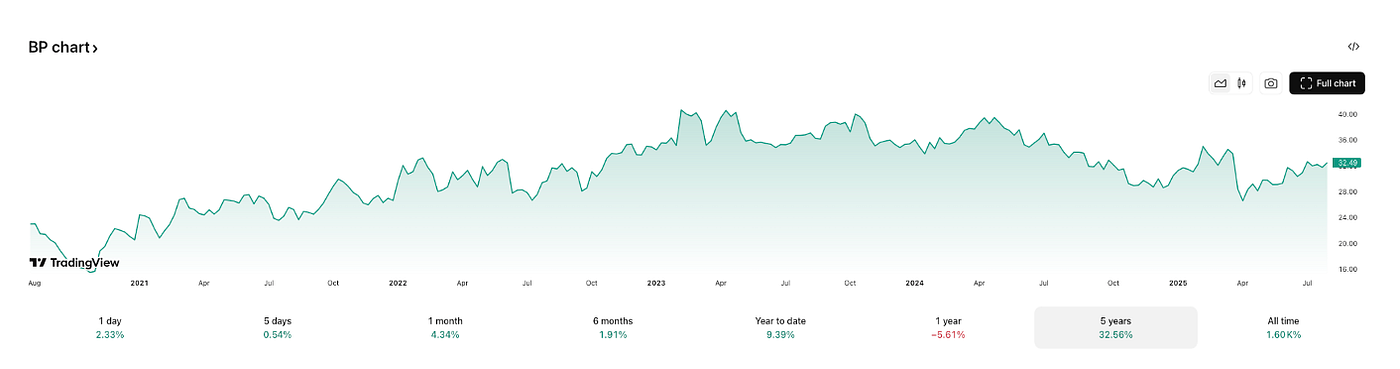
Stock price performance over the past 5 years. (Zdroj: tradingview.com) *
Conclusion
The Bumerangue discovery could give BP a new boost at a time when the company is strategically returning to fossil fuels. Combined with rising profits, cost-saving measures, and favorable stock price developments, this signals that BP is trying to redefine its position in a changing energy world. However, the question remains how long this course will be sustainable amid increasing environmental demands and declining oil demand.
[1,2] Forward-looking statements are based on assumptions and current expectations that may prove inaccurate or on the current economic environment, which may change. Such statements are not guarantees of future performance. They involve risks and other uncertainties that are difficult to predict. Actual results may differ significantly from those expressed or implied in any forward-looking statements.
*Past performance is not a guarantee of future results.
메타데이터
- post_id
- 0cb7598141cd
- slug
- bp-discovers-oil-worth-billions-its-biggest-find-in-decades-0cb7598141cd
- url
- https://medium.com/@ozios.slovensko/bp-discovers-oil-worth-billions-its-biggest-find-in-decades-0cb7598141cd
- canonical_url
- https://medium.com/@ozios.slovensko/bp-discovers-oil-worth-billions-its-biggest-find-in-decades-0cb7598141cd
- author_url
- https://medium.com/@ozios.slovensko
- status
- ok
- fetched_at
- 2026-06-28 14:26:31