Xenointelligence Pt 2: Biomes
Finding Nonhuman Intelligence (NHI) requires context between the life form and its native environment. Inherent Terrestrial human bias…
Xenointelligence Pt 2: Biomes
Finding Nonhuman Intelligence (NHI) requires context between the life form and its native environment. Inherent Terrestrial human bias, however, tends to limit the idea of life to known conditions upon the Earth’s surface.
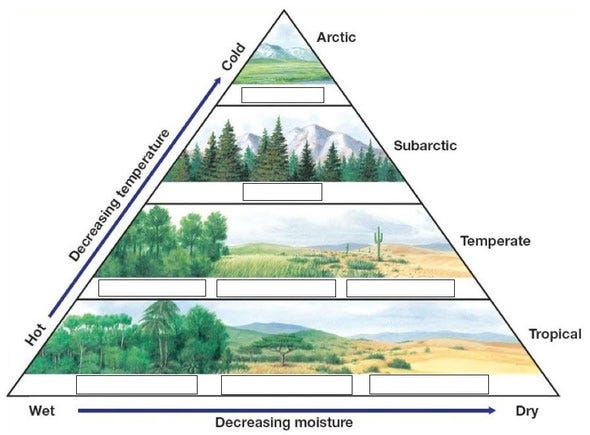
Traditional View of Biomes
The framework provided in my earlier article, Xenointelligence: Framework helps to overcome this bias by adopting a mathematical model free of definitions that detract from the meaning of life, consciousness, and intelligence.
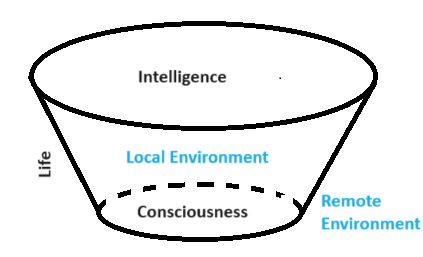
The Bucket of Life
By assuming consciousness to be the ability of a living thing to affect its environment, intelligence as its capacity to incorporate information into action, and life as the timespan during which the entity exists, its life may be represented as a volume of spacetime that may be overlapped with other volumes of spacetime. By studying this area of effect, we can then look for that which affects it, and the intelligence which is applied to those effects, the length of time it takes place, and use this theoretical information to inform the search for life within that volume.
Now comes the question of which volumes of spacetime to search for life. In order of usefulness at the moment:
- Current State Timeframe: What is alive right now, that is available to study? Most useful, as it can inform the future state of life that may be found.
- Future State Timeframe: What will be alive in the future, such as descendants in the recent future, a comet due to approach in a decade for the medium term, and evolutionary tracts or other stellar systems in the far future.
- Past Timeframe: What was alive but is now dead, or a recently exploded mountaintop would be volumes of spacetime in the recent past. What has gone extinct or climatic change such as ice ages would be the distant past, and so forth.
Current state is arguably the easiest to search for when it comes to advanced non-human intelligence, and as such, will be the focus going forward in this article series.
Next comes the question of biomes relative to the life form. Humans typically regard the surface of the Earth as being the ideal conditions for life, based on all the life that we’ve found on the surface. This ignores, however, the scale of aperture as to what we even looked at on the surface. Though first known to be postulated around 100 BC, it is only in the last 400 years that humans could be convinced of the existence of microbial life thanks to microscopes, and even then it was assumed only in specific conditions that life could exist. Though the first extremophile was discovered in the 1960s, it wouldn’t be until the 1980s that we were finally convinced that bacteria could ever live in something as acidic as the stomach.
Onward, humanity has found life in molten-temperature vents, metallic acids capable of turning animals to stone, and the bottom of Antarctic pits in volumes millions of years old. We have even found that life survives the vacuum of space, thrives in radiation. Everywhere we look, life appears capable of surviving or thriving, and that’s just the lives and volumes we are aware of. More and more, the evidence points to the fact that the biodensity of the Earth’s surface is not due to the fact that the surface of Earth is ideal for life, but rather that the type of life that evolved on Earth’s surface did so to match the conditions that were there.
The reason we do not have lava monsters roaming around the surface of the Earth is because the idea of such a thing is demonstrably improbable: lava is a liquid, it’s density (pumice not withstanding) would cause it to sink, moisture on the surface would cause it to cool and harden, anything it touched would start to burn, etc. However, it might be a different story deep within the caldera of a volcano, or within the liquid part of Earth’s core.
The immediate biased response would naturally be that life could not exist within molten lava, because any hydrogen bonds would be separated, the form would burn or melt, etc. However, lava itself is not a uniform entity like distilled water. Within it will be a variety of minerals at varying states, densities, specific gravities, buoyancies, and so forth, all relative to one another as being very real differences. This is much more easily demonstrated and observed by undersea rivers of fresh water at the bottoms of oceans, or even a simple glass of oil and water.
By the same token, the density of the life compared to the density of the biome will play an enormous factor in what would be most reasonable to search for. For instance, a human obviously cannot survive the relative heat and energy of a volcano, yet to a certain extent they can easily survive the relative heat and energy of water. Yet deeper into the ocean or lake that a human goes, the more pressure builds upon them to the eventual point of implosion.
Likewise, if a human is taken far enough up in altitude, there is not enough density to the oxygen for them to breathe, and eventually a relative vacuum that will cause any fluids near the surface to boil off and evaporate. The same human, holding their breath, closing their eyes and mouth such that it minimized all fluid boil-off, would still face death by the sheer bombardment of Solar radiation. Were they shielded from the sunlight, they would then have to deal with the increased density of cosmic rays, which would eventually pincushion the human to death.
Yet we find all manner of life capable of withstanding all of those things far easier than ourselves, and each time we assume it’s impossible for life to exist in a given environment, we find something that disproves it, or a very good reason why not. Those reasons, however, all tend to assume the same things: that alien life will more or less be like terrestrial surface life, and so would require heat in this range, gravity in this range, air composition in this range, pressure at this range, and so forth.
If instead we look at the biome itself and ask “What would it take for life to exist here?” and then apply the Bucket of Life model, we can parse out the questions.
For example, let’s take clouds. For the most part, they have remained almost entirely unstudied for life. The common consensus is, it would be too short-lived, too chaotic of forces, no solid purchase from which to build upon, too much radiation at the top, and so forth… for surface life. The prevailing assumption is that the air and sky are just mostly empty space, that clouds are ephemeral collections of particulate and ice crystals, and that any life among the clouds would just be some random bacteria, spores, viruses, etc., with other life merely occasionally traveling through them.
And yet these assumptions are made with very little testing, sampling, study, or effort made to contextualize the life that might form among clouds if it wasn’t aware of all the rules that surface life imposed upon it.
So, let us imagine instead the assumption that there is life in the clouds, but not life as we know it. What life would evolve, and why? For starters, our atmosphere should be thought of as a separate layer of the ocean. We humans live at the bottom of sky ocean. Our water ocean below it is akin to the freshwater river found at the bottom of our seawater ocean. Below it, the sedimentary layer would be the beginning of yet another ocean of mass in solid form, continually increasing in density and pressure the closer to the center of the Earth one goes, and decreasing in the opposite direction.
Thus if the sky is an ocean of life with transient creatures roaming it until they find more solid purchase, clouds may be thought of as giant floating islands the size of entire continents at times. Within these islands we find all manner of particulate prompting the creation of the clouds, likely rich in organic and mineral mass at scales rendering each bacteria like a single human dropped onto Australia. Because of the ephemeral nature of clouds, any lives to which it was host would have to develop an extremely fast-paced lifecycle and would likely constantly seek out new clouds as old ones either dissipate or become depleted of their resources by other lives.
The rapidly shifting forces in the centers of clouds are much like being in an arctic hailstorm, with constant collisions, displacement, and variance in position at any one moment within the cloud. Likely, the top of the clouds would provide the richest source of energy, warmth, and most stable surface on which to conduct any business before either the cloud or the lifeform moves on. However, the top surface of the clouds will be much higher in radiation as well, thus the hypothetical life would need adequate immunity from damage in order to utilize the top of the cloud, in the same way that a life that lived within the cloud would need some immunity from damage by freezing.
Next is the consideration of density. A human may change their buoyancy by decreasing their density while increasing their surface area (ex. holding your breath and floating on your back, vs exhaling and diving in. It is reasonable to assume that any creature capable of living in or around clouds would not rely on a constant energy expenditure such as wings, but would more likely evolve to change its buoyancy by increasing its surface area and/or filling up bladders with a lighter gas that could then be used as propulsion or lift as needed.
Such a balloon or jellyfish like creature would be incredibly difficult, if not impossible, to spot from the ground in most circumstances. Its coloration, density, and distance would render it effectively indistinguishable from the cloud for radar, infrared, and visual spectrum. Most that died would simply continue to drift in the air or fall with the weather, imploding to an unrecognizable extent by the time it hit the ground. If a plane few through one, the creature may not even have enough density or cross-section to impact the plane, but rather flow around its wake. If there were a collision, it’s unlikely a trace would remain any more than if it hit a feather — either the feather will have bounced harmlessly off or appear as a macro of unimportant particulate off of the plane.
So to imagine just life as we don’t know it, we might call this creature cephalopoda nubibus: cloud jellies, a low-mass, low-density, low-temperature, somehow evolved to float through the troposphere like their seaborn cousins. Rather than just assuming such a creature does not exist, we now have at least some framework by which to now search for them. Even if we are completely wrong in our assumption of the existence of cloud jellies, devising a test to sample clouds for them can then prove or disprove other aspects. We might find, thus instead of a jellyfish and bladders situation, something more like an insect, or a fungal colony, or some measure of evidence to the prospect of other unknown life to search for, such as a gaseous entity, or a new classification of other complex creatures unthinkable on the surface of the Earth.
I have little doubt that in the next ten years, we’ll have either confirmation of, or very strong evidence (other than statistical) of the existence of some form of non-terrestrial life native to somewhere other than Earth. Whether or not it is conscious, intelligent, or long-lived enough to be noticed by us will depend upon the tests that we devise to search for it. However, we should not forget the prospect that there may be native terrestrial life not as we know it, deep within the Earth’s mantle and core, up within the clouds, at scales unimagined on the surface world.
The next part in this article series will explore the mentality to design of experiments looking for xenointelligence.
메타데이터
- post_id
- 0cd115daffe3
- slug
- xenointelligence-biomes-0cd115daffe3
- url
- https://medium.com/@shamanbutsu/xenointelligence-biomes-0cd115daffe3
- canonical_url
- https://medium.com/@shamanbutsu/xenointelligence-biomes-0cd115daffe3
- author_url
- https://medium.com/@shamanbutsu
- status
- ok
- fetched_at
- 2026-06-09 15:37:30