How Would a Quantum Physicist Describe Bacteria?
Quantum fields, wave-function collapse, entanglement, and decoherence
How Would a Quantum Physicist Describe Bacteria?
Quantum fields, wave-function collapse, entanglement, and decoherence
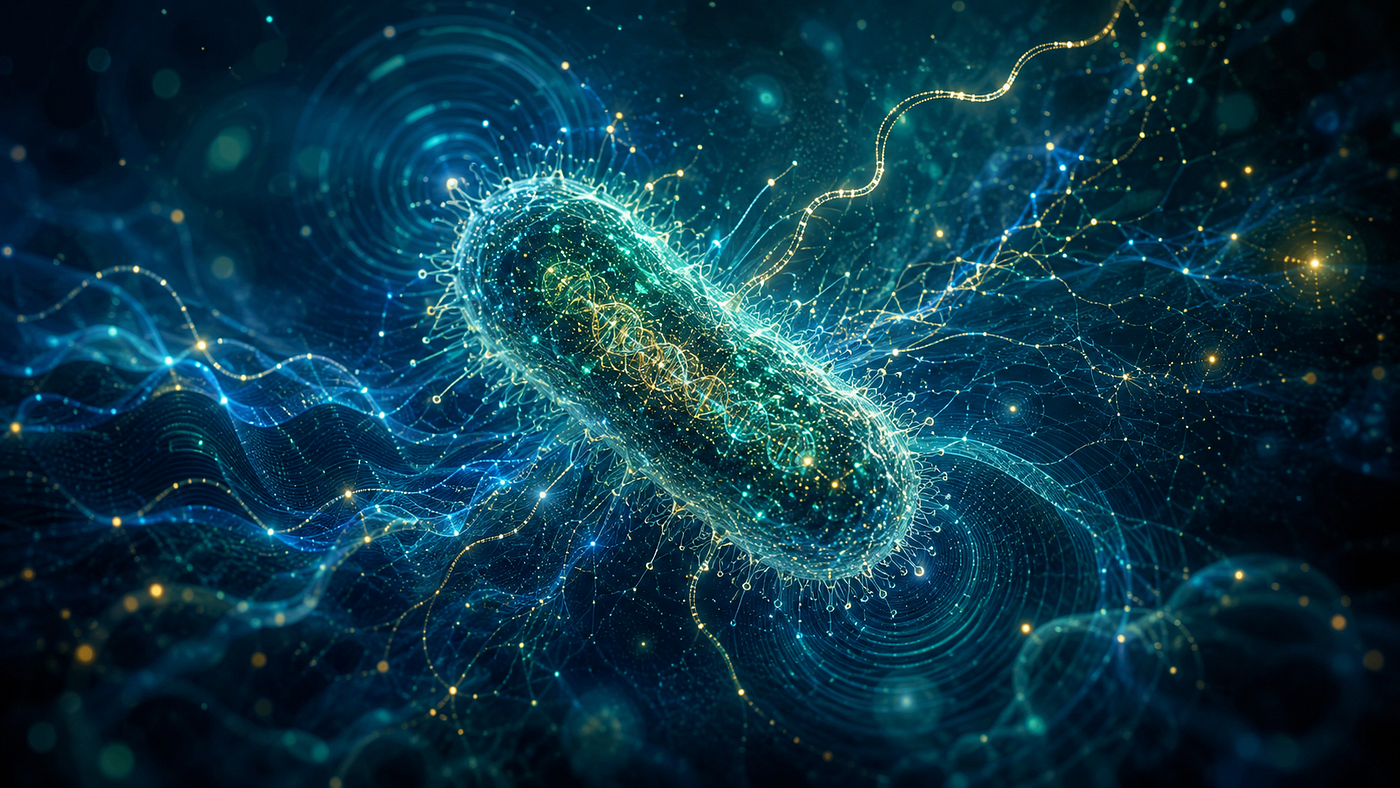
A bacterium looks simple only because we are used to seeing the world at the scale of familiar experience. At that scale, we say a bacterium is a tiny living cell. It has a boundary, takes in nutrients, senses its surroundings, moves, adapts, divides, and carries genetic information shaped by evolution. That description is useful. It’s the language of biology, and it works extraordinarily well.
But from the perspective of quantum fields, the bacterium is something stranger and deeper. It’s not fundamentally a miniature machine made of tiny solid parts. It’s not ultimately a little object sitting inside empty space. It’s a stable, self-maintaining pattern in the underlying fields that physics uses to describe reality.
Patterns in Quantum Fields
At the level of the very small, reality is described by quantum fields: the underlying fields whose excitations appear to us as particles like electrons and photons. Electrons are excitations of the electron field. What we call photons are excitations of the electromagnetic field. The protons and neutrons associated with ordinary matter are themselves complex patterns involving quark and gluon fields. From this perspective, a bacterium is not made of “stuff” in the old intuitive sense. It is an immense, organized arrangement of field activity.
The bacterium is therefore not a fundamental entity in physics. There is no special “bacterium field” alongside the electron field or electromagnetic field. Instead, “bacterium” is the name we give to a particular kind of recurring, durable, living pattern in the quantum fields. It is a region of highly organized correlations: field events arranged so that the pattern maintains itself, regulates itself, exchanges energy and information with its surroundings, and sometimes creates another version of itself.
Its membrane, DNA, proteins, receptors, and metabolic networks are real, but they are not fundamental in the deepest physical sense. They are higher-level patterns within the fields. The membrane is a stable field arrangement that helps maintain a distinction between the bacterium’s internal organization and the surrounding environment. DNA is a field configuration capable of storing and participating in the copying of inherited information. A receptor is a field pattern shaped so that certain external field configurations can alter the bacterium’s internal state.
This means that a bacterium is not best understood, at the deepest level, as a tiny lump of matter. It is a process. It is a persistent, living pattern in the fields, constantly renewed through interaction.
The Wave Function and Entanglement
Erwin Schrödinger’s wave function enters this picture as the mathematical description of quantum possibility. A wave function is a mathematical description of a quantum system that encodes the possible states it can be found in and the probabilities of different outcomes when it is measured.
For a simple quantum system, we sometimes speak as though there is one neat wave function describing one tiny thing. A bacterium is nothing like that. It contains an enormous number of interacting quantum degrees of freedom, and it cannot be cleanly separated from its surroundings. Its quantum state is woven together with the state of nearby water, nutrients, waste products, thermal radiation, surfaces, chemical gradients, and electromagnetic interactions.
This is where entanglement becomes essential. Entanglement means that the quantum state of one part of the world cannot be fully described on its own, apart from the state of another part. The bacterium is not merely near its environment. It’s continually becoming quantum-correlated with it. When a molecule interacts with a receptor, when a photon is absorbed, when energy is exchanged, when chemical bonds shift, when the bacterium releases a molecule into its surroundings, the bacterium and environment become entangled.
That entanglement is not rare. It is constant. The bacterium is immersed in interaction. Every moment, its internal field pattern is being correlated with external field patterns. These correlations are not incidental background noise; they are part of what it means for the bacterium to exist as a living system. It senses by becoming correlated with its environment. It acts by allowing those correlations to alter its internal dynamics. It persists by maintaining enough organization amid this continuous exchange.
Entanglement also explains why the bacterium does not appear to us as a delicate quantum blur of many visible alternatives. In principle, quantum theory allows superpositions: different possible states can coexist in the mathematical description. But a bacterium is warm, wet, chemically active, and constantly interacting. Its possible alternatives rapidly become entangled with different states of the environment. Once that happens, those alternatives can no longer easily interfere with one another.
Measurement, Decoherence and Wave Function Collapse
This process is called decoherence. Decoherence does not necessarily mean that quantum possibilities vanish from the total description of reality. Rather, it means that different possibilities become effectively separated because each has become entangled with a different environmental record. The surrounding fields carry information about the bacterium’s state. The environment “records” where the bacterium is, what it has interacted with, what it has absorbed, what it has emitted, and how its internal state has changed.
Decoherence helps explain why quantum systems can start to look classical: entanglement with the environment suppresses visible quantum interference, making outcomes appear definite even though the deeper description remains quantum.
That is why the bacterium appears definite. It seems to be this bacterium, here, undergoing this sequence of events. Its definiteness is not a rejection of quantum theory. It’s what quantum theory predicts when a complex field pattern is continuously entangled with its surroundings.
This also changes how we should think about the collapse of the wave function. In the older textbook language, measurement causes the wave function to collapse from many possibilities into one outcome. But the word “measurement” can be misleading, because it makes the process sound as though it requires a scientist, an instrument, or a conscious observer. A bacterium shows why that picture is too narrow.
Measurement, in the physical sense, is an interaction that creates a stable correlation. When a bacterium encounters a nutrient molecule, the two systems interact. If the molecule binds to a receptor, the bacterium’s internal state changes. That change may alter signaling pathways, gene expression, metabolism, or movement. The bacterium has acquired information, but not by thinking. It has become physically correlated with something in its environment.
In collapse language, we might say that the interaction selects one outcome from a set of possibilities: the molecule binds or does not bind; a signaling pathway activates or does not activate; a behavioral response follows or does not follow. But in decoherence language, we would say that the bacterium, molecule, and surrounding environment become entangled in such a way that different possible outcomes become effectively separated. To anything inside one of those outcomes, the result looks definite.
Life in Quantum Terms
This is why life is full of measurement-like events. A bacterium is not waiting to be observed by a physicist. It’s constantly participating in interactions that generate correlations, entanglement, and decoherence. Its existence is an ongoing exchange with the surrounding fields.
A bacterium also senses without having a mind. It has no inner narrator and no reflective awareness. Yet it can respond to chemicals, acidity, temperature, light, oxygen, pressure, salinity, and other conditions, depending on the species. From the quantum-field perspective, sensing is not the arrival of a message into a tiny biological control room. Sensing is the coupling of external field patterns to internal field patterns in ways that alter future behavior.
A chemical gradient, for example, is not merely an abstract signal. It is a structured difference in the surrounding field conditions. The bacterium’s receptors are shaped by their field configurations so that certain interactions are more likely than others. When those interactions occur, the internal pattern of the bacterium changes. That change may make certain future configurations more probable: altered metabolism, altered gene expression, altered motion, altered division, altered repair.
This is not conscious deliberation, but it is not mere randomness either. The bacterium’s responses are organized. They are shaped by inherited structure. They channel possibility. The bacterium’s present state constrains its future states, and those constraints exist because similar patterns persisted and reproduced in the past.
Choices and Actions
So what about choosing an action? A bacterium doesn’t think and deliberate in the human sense. It doesn’t imagine a future and choose among reasons. But it does conduct organized, directed activity. It can move toward favorable chemical conditions, retreat from harmful ones, repair damage, regulate its internal processes, exchange signals, and divide when conditions allow. From a quantum-field perspective, these actions are field dynamics shaped by inherited information and present entanglement with the environment.
The bacterium’s “agency,” if we use that word carefully, is not a little decision-maker hidden inside it. It is the way the whole living field pattern biases its own future. Its structure makes some future interactions more likely than others. Its sensory couplings allow external conditions to reshape internal possibilities. Its inherited regulatory networks transform environmental contact into organized response.
The bacterium acts because it is a self-maintaining pattern whose internal correlations are arranged to preserve, repair, adapt, and replicate that pattern. Its action is not separate from physics. Its action is physics organized by evolution.
Why Are You Here?
This brings us to a deceptively simple question: why is the bacterium in this specific location in the universe? At the biological level, we might say that it drifted in fluid, grew on a surface, followed a chemical gradient, emerged from a parent cell, or was carried by another organism. Those explanations are valid. But at the quantum-field level, the answer is deeper: the bacterium is where it is because the fields of the universe have evolved into a particular decohered, entangled history in which this living pattern occupies this region.
Its present location is not an isolated fact. It’s the result of a long chain of interactions. Replication events, molecular encounters, thermal fluctuations, chemical gradients, fluid flows, surface binding, nutrient availability, and prior environmental conditions all contributed to the present state. Each interaction left correlations. Each correlation helped narrow the effective history that led here.
In the full quantum description, there may have been many possibilities. But through entanglement and decoherence, those possibilities became separated into histories that no longer interfere in ordinary experience. Within this history, this bacterium is here because the prior field interactions led here. Its position is not simply a coordinate. It is a record of everything that has interacted, selected, constrained, and carried the pattern forward.
Evolution
Evolution adds another layer to this. A bacterium alive now is not only a present field pattern. It is the current expression of an ancient lineage of field patterns that copied themselves imperfectly. DNA replication, mutation, repair, selection, and reproduction are biological concepts, but beneath them are quantum-field interactions that preserve and alter patterns across time.
Evolution is the historical filtering of self-copying field configurations. Patterns that maintained themselves and generated further viable patterns tended to continue. Patterns that failed to do so disappeared from the living stream. Over immense timescales, this filtering shaped receptors, membranes, enzymes, metabolic pathways, motility systems, and regulatory networks.
The bacterium’s present form is therefore not arbitrary. Its ability to sense, respond, repair, and reproduce is inherited from prior patterns that succeeded. It carries evolutionary history not as a mystical essence, but as structure. Its field configuration contains constraints shaped by countless previous interactions between organisms and environments.
Memory and Information
Entanglement appears here too, though not as a simple memory of every ancestral quantum state. The bacterium isn’t literally carrying a clean quantum entanglement with all its ancestors; decoherence prevents that kind of delicate connection from surviving in a simple way. But its structure is the result of historical interactions that were once physical correlations. Evolution converts past environmental encounters into present biological organization. In that broader sense, the bacterium’s current field pattern embodies a history of prior couplings between life and world.
The bacterium is also not separate from its surroundings in the way everyday intuition suggests. Its boundary matters biologically, but it is not an absolute metaphysical wall. The bacterium exists by exchange. It absorbs, emits, binds, releases, responds, and modifies its surroundings. It remains itself not by being isolated, but by maintaining organization while remaining open.
This is one of the most profound lessons of viewing life through quantum fields: identity is not isolation. The bacterium is a local concentration of organized correlations. It is a region where field activity is arranged in a way that preserves a living pattern through time. But that preservation depends on continual interaction with everything around it.
What is a Bacterium (in Quantum terms)?
It’s a living, evolved, self-maintaining, decohered pattern in interacting quantum fields. It’s continuously entangled with its environment. It senses by forming correlations with external conditions. It acts by transforming those correlations into organized internal change. It occupies its specific place because a long chain of field interactions led to that local history. It appears definite because decoherence has separated its alternatives into effectively noninterfering histories. It carries evolution as inherited structure, a record of patterns that survived long enough to copy themselves.
At the deepest level, a bacterium is not a tiny machine moving through a passive world. It is a persistent event in the fields of the universe: a living knot of correlation, entanglement, memory, and response.
메타데이터
- post_id
- 0cd2d30d40be
- slug
- how-would-a-quantum-physicist-describe-bacteria-0cd2d30d40be
- url
- https://medium.com/@philogen888/how-would-a-quantum-physicist-describe-bacteria-0cd2d30d40be
- canonical_url
- https://medium.com/@philogen888/how-would-a-quantum-physicist-describe-bacteria-0cd2d30d40be
- author_url
- https://medium.com/@philogen888
- status
- ok
- fetched_at
- 2026-06-15 20:49:13