Content Distribution Agency USA: Why Good Content Needs More Than One Post
American brands are not struggling because they have nothing to say.
Content Distribution Agency USA: Why Good Content Needs More Than One Post

American brands are not struggling because they have nothing to say.
Most of them have plenty.
A founder records a useful podcast. A marketing team publishes a long article. A SaaS company runs a webinar. A coach shares a strong lesson during a livestream. A consultant writes a detailed LinkedIn post. A creator uploads a long YouTube video. A brand puts real work into making something useful.
Then it gets posted once.
Maybe it gets shared on LinkedIn. Maybe it gets added to the newsletter. Maybe someone puts it on Instagram or X. Then the team moves on to the next thing because the content calendar is hungry again.
That is where a lot of good content gets wasted.
The problem is not always the quality of the content. The problem is that it does not get enough distribution. It does not get repackaged, reshaped, reposted, clipped, adapted, or placed where different parts of the audience can actually find it.
A Content Distribution Agency USA service helps brands solve that problem. It takes existing content and turns it into a wider distribution system across short-form video, social media, newsletters, communities, search-friendly platforms, founder profiles, and other channels where attention already exists.
The goal is not to make more noise. There is already enough of that online, and most of it sounds like a LinkedIn guru trapped in a Canva template.
The goal is to help strong content travel further.
Why Content Creation Alone Is Not Enough
A lot of brands still treat content like publishing is the finish line.
They write the article. They record the podcast. They film the video. They publish the post. Then they wait.
Sometimes it works, but usually not as well as it should.
Content rarely performs at its best from one placement. One blog post on the website may not reach everyone who needs it. One podcast upload may not reach people who prefer short clips. One webinar replay may not reach people who missed the event. One LinkedIn post may disappear after a day or two.
This is especially true in the USA, where competition for attention is intense. Brands, creators, agencies, founders, consultants, coaches, and SaaS companies are all fighting for the same scroll.
Publishing once is not enough.
A single content asset needs multiple entry points. It needs to show up in different formats, on different platforms, for different audience habits.
That is what content distribution is supposed to do.
It turns one piece of content into many useful touchpoints.
What Content Distribution Actually Means
Content distribution is not just sharing a link.
A lot of teams think distribution means posting the same URL on LinkedIn, X, Facebook, and maybe in an email. That is part of it, but it is not the full job.
Real distribution means taking the core idea and adapting it to the platform.
A long podcast may become short clips. A blog post may become a LinkedIn carousel, a newsletter section, a short thread, and a founder post. A webinar may become multiple short videos, quote graphics, recap posts, and sales enablement content. A customer story may become a proof-based social post, a short video, and a section on a landing page.
The original content stays the same, but the format changes.
That matters because people do not consume content in one way.
Some people read. Some watch. Some scroll. Some save. Some search. Some listen. Some only notice a brand after seeing it several times in different places.
A good content distribution strategy respects that.
Why USA Brands Need Distribution More Than Ever
The USA market is crowded.
Whatever a brand sells, someone else is probably selling something similar. Even if the product is better, the market will not always notice unless the message is distributed properly.
This is where many brands lose momentum.
They create useful content, but competitors show up more often. They have strong insights, but those insights stay hidden in long recordings. They have proof, but it only appears on one page. They have customer stories, but nobody turns them into social content. They have founder knowledge, but it never becomes a repeatable content engine.
Distribution helps close that gap.
It gives the brand more chances to be discovered, remembered, and trusted.
This does not mean posting random content everywhere. That usually creates clutter. It means taking the best ideas and placing them where they make sense.
A content distribution agency can help by turning one useful asset into a full campaign instead of letting it die after one upload.
The Best Content Usually Has More Than One Life
One strong piece of content should not be treated as one post.
A podcast can become a week of social clips. A webinar can become a content series. A founder interview can become LinkedIn posts, Shorts, Reels, and newsletter ideas. A case study can become proof-based content for several channels. A blog post can become multiple short-form posts around different angles.
For example, one long-form video can become:
- A short educational clip
- A founder opinion post
- A quote-based social post
- A LinkedIn text post
- A newsletter intro
- A YouTube Short
- An Instagram Reel
- A TikTok clip
- A blog section
- A sales follow-up asset
That is not “reusing content” in a lazy way.
It is using the work properly.
The best ideas deserve more than one chance to be seen.
Why Distribution Needs Strategy
More posting does not automatically mean better distribution.
A brand can publish across ten platforms and still get very little from it if there is no clear strategy. The content may feel random. The message may keep changing. The audience may not understand what the brand stands for. The posts may look active but fail to build memory.
A strong distribution strategy starts with a few basic questions.
What does the brand want to be known for? Who is the audience? Which ideas are worth repeating? Which channels actually matter? What type of content works best on each platform? Which assets should be repurposed? Which should be left alone?
Not every piece of content deserves a full distribution push.
Some content is too thin. Some is too internal. Some is useful but not strong enough for short-form. Some needs to be rewritten before it can travel. A good distribution team knows the difference.
That is where the work becomes more than just posting.
It becomes selection, adaptation, timing, and consistency.
How a Content Distribution Agency Helps
A content distribution agency helps brands turn content into a system.
Instead of creating one asset and hoping it performs, the agency builds a plan around how that asset can travel.
This may include reviewing existing content, finding the strongest ideas, creating platform-specific versions, writing captions, producing clips, turning long-form material into short-form assets, planning publishing schedules, and tracking performance.
For a USA-based brand, that can be especially valuable because the market moves fast. Content has to be useful, clear, and visible enough to cut through the noise.
A strong agency can help with:
- Repurposing long-form content
- Creating short-form video clips
- Turning podcasts into social assets
- Building LinkedIn content from founder insights
- Turning webinars into multi-post campaigns
- Creating newsletter sections from existing content
- Developing content calendars
- Adapting content for different platforms
- Improving consistency across channels
- Tracking what actually gets attention
The goal is not just to publish more.
The goal is to make each strong idea work harder.
Short-Form Video Is a Major Distribution Tool
Short-form video has become one of the most useful content distribution formats.
That does not mean every brand needs to dance on TikTok or pretend the intern runs the company account. Thankfully.
It means short clips are an efficient way to surface useful moments from longer content.
A podcast clip can introduce a guest insight. A webinar clip can answer one question. A founder video can show personality. A customer story can build trust. A product demo can make one feature easier to understand.
Short clips work because they reduce the commitment required from the viewer.
Someone may not watch a full webinar, but they may watch a 35-second answer. They may not listen to a full podcast, but they may stop for one strong opinion. They may not read a full case study, but they may watch a customer result explained clearly.
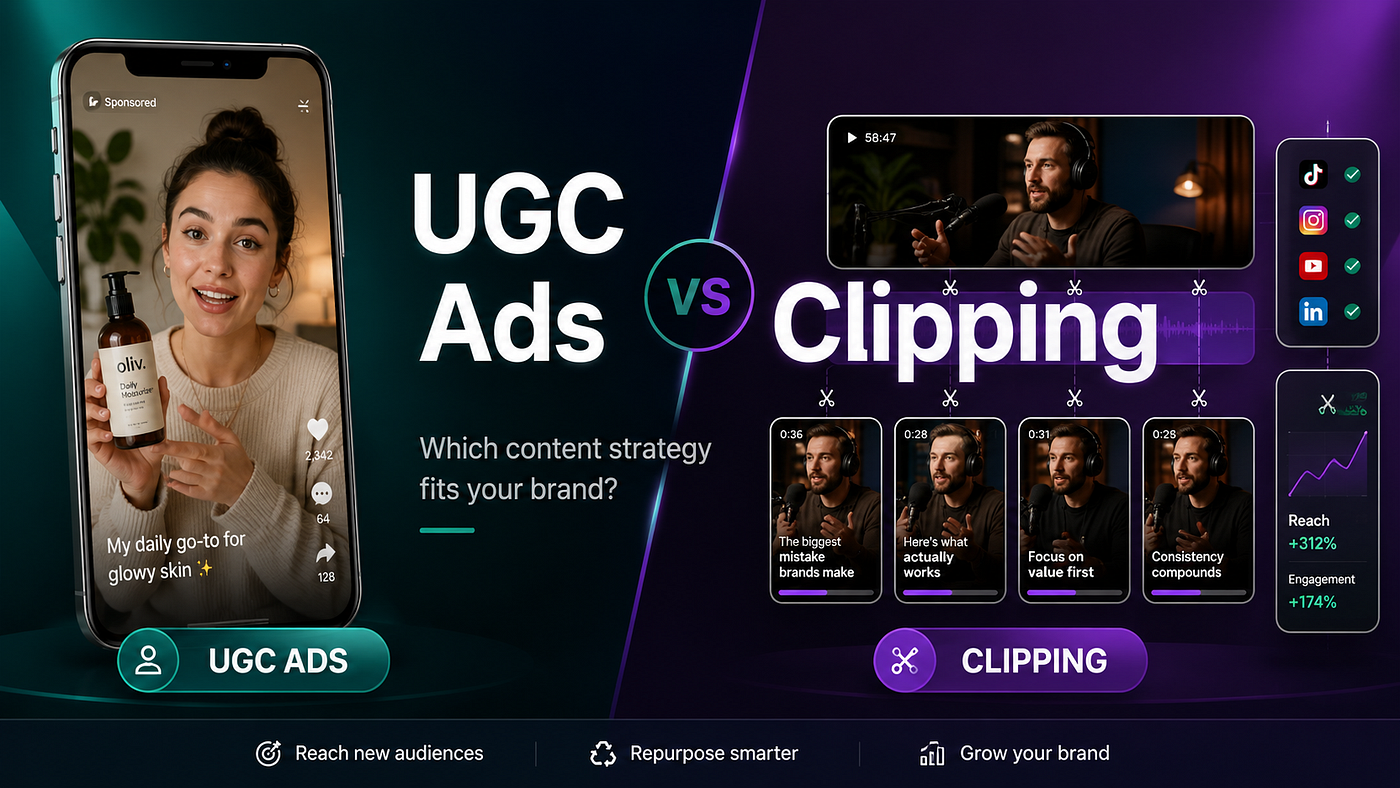
This is why clipping and distribution often work together.
The clip becomes the doorway. The longer content becomes the deeper resource.
Distribution Helps Build Brand Memory
A brand does not become memorable from one post.
People usually need repeated exposure. They need to see the same themes, ideas, proof points, and personality more than once. They need to understand what the brand talks about and why it matters.
Distribution helps create that repetition without saying the exact same thing every time.
One core idea can be expressed in different formats. It can become a clip, a post, a newsletter note, a carousel, a thread, and a website section. Each version reinforces the same message from a slightly different angle.
This is how brands become known for something.
A SaaS company may become known for solving a specific workflow problem. A coach may become known for a specific method. A podcast may become known for strong guest insights. An agency may become known for turning long-form content into short-form growth.
Brand memory is built through repeated useful appearances.
Distribution makes those appearances happen.
Common Distribution Mistakes
Many brands do content distribution badly because they treat it as an afterthought.
They finish the content and then ask, “Where should we post this?”
That is too late.
Distribution should be considered before the content is even created. If a podcast, webinar, article, or video is planned properly, it becomes easier to repurpose later. The team can think about clips, quotes, key takeaways, social angles, and follow-up assets from the start.
Common mistakes include:
- Posting once and moving on
- Sharing the same caption everywhere
- Ignoring short-form video
- Creating content with no repurposing plan
- Treating distribution as admin work
- Posting on too many platforms without focus
- Not tracking what performs
- Chasing trends that do not fit the brand
- Forgetting to connect content to business goals
A smarter distribution process avoids these problems.
It makes content easier to use, easier to adapt, and easier to measure.
What to Look for in a Content Distribution Agency
Not every agency that posts content understands distribution.
Some agencies can manage calendars but do not know how to extract value from long-form assets. Some can edit clips but do not understand positioning. Some can write captions but do not know how to build a repeatable content system.
A strong agency should understand both content and channels.
Before choosing one, brands should ask:
- Can they repurpose long-form content properly?
- Do they understand short-form video?
- Can they adapt ideas for different platforms?
- Do they write in the brand’s voice?
- Can they build a clear distribution calendar?
- Do they understand LinkedIn, TikTok, Reels, Shorts, and newsletters?
- Can they identify strong moments from podcasts or webinars?
- Do they track performance and improve over time?
- Can they connect content to business goals?
- Do they avoid making every post feel like a recycled template?
The right agency should make content feel more useful, not more mechanical.
Final Thoughts
Good content should not be posted once and forgotten.
A strong podcast, webinar, article, founder interview, customer story, or long-form video can become much more than a single asset. It can become clips, posts, newsletters, social proof, landing page material, and sales support.
A Content Distribution Agency USA service helps brands turn their existing content into a wider visibility system.
It helps the right ideas show up in more places, in better formats, for the right audience.
For American brands trying to get more reach, trust, and value from their content, distribution is no longer optional. It is the difference between creating content and actually getting seen.
메타데이터
- post_id
- 0cf070321f2d
- slug
- content-distribution-agency-usa-why-good-content-needs-more-than-one-post-0cf070321f2d
- url
- https://medium.com/@sociable_mint_coyote_210/content-distribution-agency-usa-why-good-content-needs-more-than-one-post-0cf070321f2d
- canonical_url
- https://medium.com/@sociable_mint_coyote_210/content-distribution-agency-usa-why-good-content-needs-more-than-one-post-0cf070321f2d
- author_url
- https://medium.com/@sociable_mint_coyote_210
- status
- ok
- fetched_at
- 2026-06-20 20:29:01