Dust Control Products Don’t Work Alone: The System Behind Long-Lasting Results
The Problem Most Sites Ignore
Dust Control Products Don’t Work Alone: The System Behind Long-Lasting Results
The Problem Most Sites Ignore
Walk onto almost any construction site or unpaved road project, and you’ll see the same pattern play out. A **dust control product** gets applied, the surface looks stable for a while, and then within days or weeks, the dust is back. At that point, everyone points at the product.
Almost always, that’s the wrong call.
Most dust failures have nothing to do with the product itself. They trace back to what’s happening underneath the surface condition before anything was ever sprayed, how it was applied, and how the environment gradually works against it. Dust isn’t really a surface issue. It’s a system issue. And until sites start treating it that way, the cycle just keeps repeating.
The Misconception That Keeps Sites Stuck
There’s a belief that’s surprisingly common across industries that dust control is basically a one-step process. Pick a product, apply it, and you’re done.
Dust doesn’t work that way.
It forms when a surface loses structural integrity. Loose particles break free under pressure from traffic, wind, and shifting weather. If you don’t address the underlying instability first, nothing sprayed on top will hold things together for long. That’s just physics.
The more honest way to look at it: you don’t have a dust problem. You have a surface problem. The dust is just what’s visible.
What Actually Drives Long-Term Results
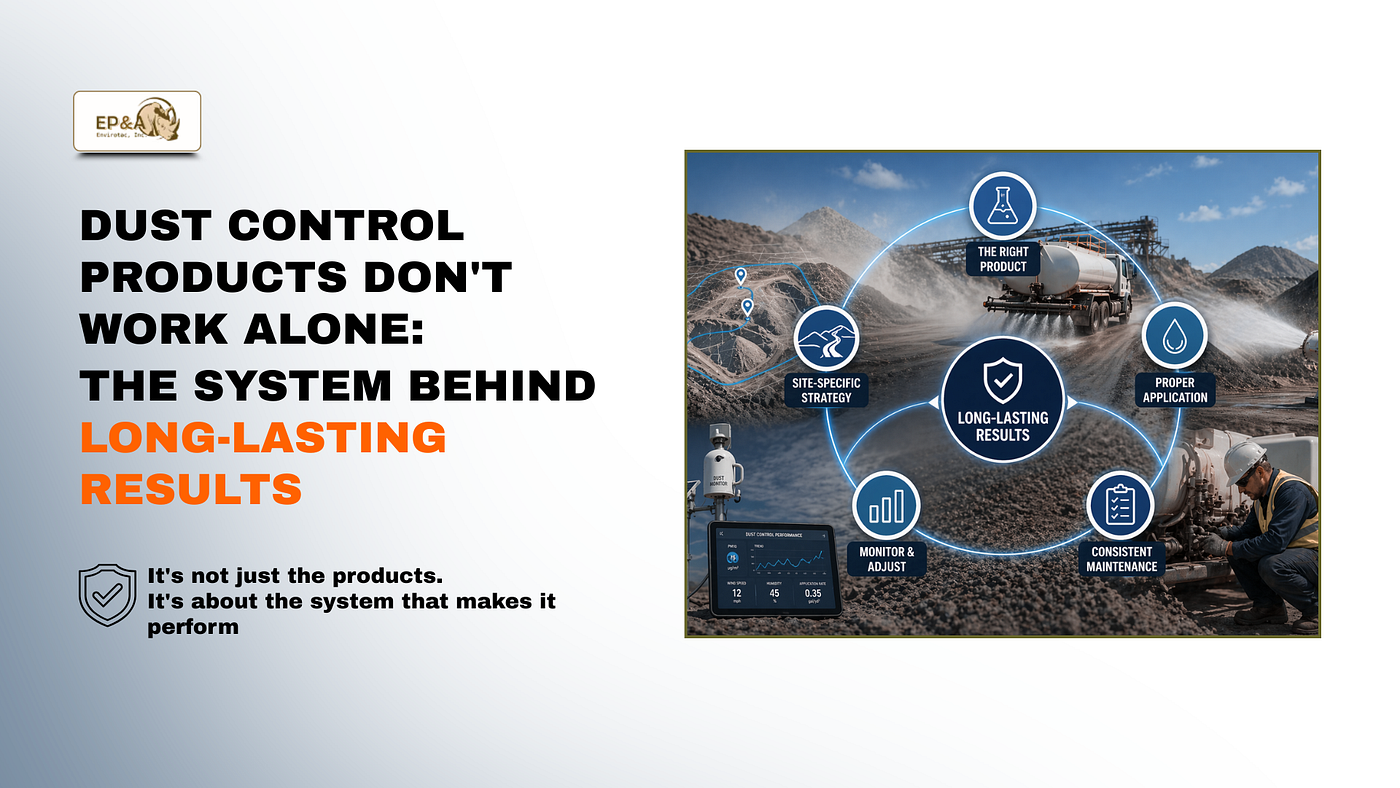
Good products can deliver solid results — but only when the conditions around them are right. Removing any single element from the equation can significantly reduce performance.
Surface Preparation
This phase is where a lot of projects quietly go wrong before anything is even applied. Loose, uneven, poorly graded surfaces give a product nothing stable to bond with. The chemistry doesn’t matter if the foundation is already shifting.
Grading, compaction, and clearing loose material — these aren’t extra steps. They’re what everything else depends on.
Moisture Balance
Moisture gets overlooked more than it should. Apply to a surface that’s too dry and the product won’t penetrate or bind properly. Too wet and you’re dealing with dilution and runoff that reduces effectiveness before it sets.
There is a specific window of surface moisture where the product can perform as intended. Miss that window and the results will reflect it.
Traffic Load
A lightly used access road and a heavy haul route in a mining operation are completely different environments. Constant heavy vehicle movement and load pressure will break down a weakly stabilized surface fast.
Traffic load needs to be factored in during planning, not after cracks start showing. If it’s not, failure isn’t really a surprise.
Application Technique
Right product, right surface, right conditions — and poor application still produces poor results. Uneven coverage, wrong dilution, bad timing around weather — these gaps compound. Small mistakes during application tend to show up as much bigger problems later.
Why Products Get Blamed for System Failures
When dust returns, the product is the first thing that gets questioned. Understandable, but usually misdirected.
In most cases, the failure was already in motion before the application crew arrived. The application crew faced rushed prep work, unverified moisture conditions, underestimated traffic loads, and a generic approach applied to a site with very specific demands. The product didn’t fail. The process did.
And that distinction is important because the instinct to just switch products doesn’t fix any of that. Same process, different product, same outcome.
Systems Thinking Over Product Thinking
Durable dust control comes from treating the whole picture together: surface condition, environment, traffic, and product, not from isolating any one element and hoping it carries the load.
When those factors line up, results hold. Things fall apart more quickly than anticipated when one is disregarded.
Lasting dust control isn’t something you apply to a surface. It’s something built into how the surface is prepared from the start.
One Approach Doesn’t Fit Every Site
Different environments create genuinely different problems, and that’s where a lot of dust control strategies start falling apart.
Construction sites deal with constantly changing surfaces — you need flexibility built into the approach. Mining operations face traffic loads that demand serious stabilization depth. Gravel roads face a challenging combination of environmental wear and vehicle stress, making it difficult to manage with generic solutions.
Taking the same method from one job and applying it to another rarely holds up. Conditions differ too much. Effective dust control is always site-specific.
Rethinking the Approach
Dust will always show up where surfaces are unstable. That part won’t change.
What changes is how well it’s managed — and how long that management actually lasts.
Products matter. But they’re one piece of a larger picture. Without solid surface prep, the right application strategy, and a clear-eyed read of traffic and environmental conditions, even a well-chosen product will underperform.
So if results aren’t holding, the answer isn’t to immediately go looking for a better product. It’s to take an honest look at the system behind the application.
Because at the end of it, what you apply matters, but how well the surface is set up to receive it matters more.
메타데이터
- post_id
- 0cfa290fa9cd
- slug
- dust-control-products-dont-work-alone-the-system-behind-long-lasting-results-0cfa290fa9cd
- url
- https://medium.com/@envirotacinc/dust-control-products-dont-work-alone-the-system-behind-long-lasting-results-0cfa290fa9cd
- canonical_url
- https://medium.com/@envirotacinc/dust-control-products-dont-work-alone-the-system-behind-long-lasting-results-0cfa290fa9cd
- author_url
- https://medium.com/@envirotacinc
- status
- ok
- fetched_at
- 2026-06-26 21:52:29