It Took Exactly 6 Minutes to Erase the “Wickedest City on Earth."
How a Tuesday morning earthquake turned a bustling pirate capital into an underwater time capsule
CITIES THE OCEAN SWALLOWED: PART IV (Port Royal)
It Took Exactly 6 Minutes to Erase the “Wickedest City on Earth."
How a Tuesday morning earthquake turned a bustling pirate capital into an underwater time capsule
Three parts in, a pattern has emerged.
*Helike vanished in a single winter night in ancient Greece, so completely that it became the ghost behind the world’s most enduring myth. Dwarka left behind scripture — three thousand years of sacred tradition pointing to a specific coastline, waiting for divers to confirm it. Doggerland left behind almost nothing at all: a harpoon point, a sonar map, and the silence of a people who had no writing and therefore no way to survive in memory.*
Each of those worlds is distant. Geological. Ancient enough to feel, somehow, like it happened to a different species.
Port Royal does not have that luxury of distance.
Port Royal happened on a Tuesday morning. People were eating breakfast. The taverns were already open.
The Wickedest Address on Earth
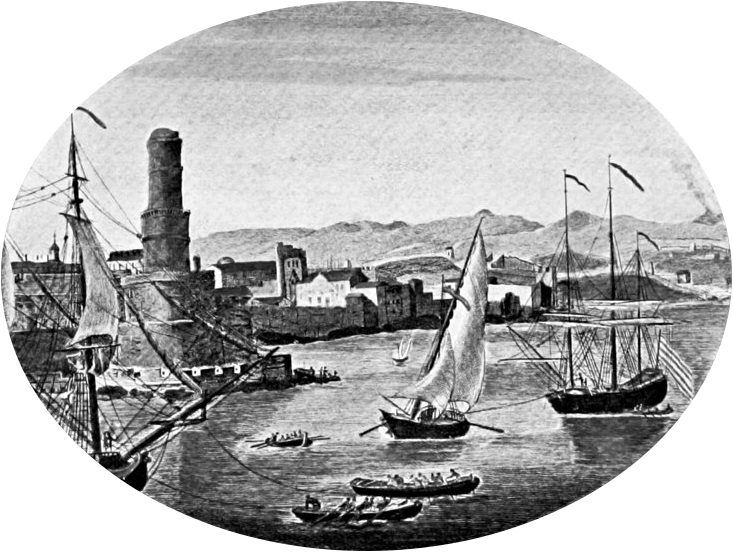
Old Port Royal Image via Wikimedia Commons
To understand what was lost, you have to understand what Port Royal was.
By the 1680s, the city occupied the tip of a long sand spit curling into Kingston Harbour on the southern coast of Jamaica. The English had held it since 1655, and in the decades since, it had grown into something that had no real equivalent anywhere in the Atlantic world: a fully functioning city of roughly 6,500 people — which made it one of the largest English-speaking cities in the Americas — built almost entirely on the proceeds of organized maritime violence.
Port Royal was the buccaneer capital of the world.
The buccaneers operated with letters of marque — royal licenses that made their piracy technically legal, as long as they were robbing Spanish ships and not English ones. The most famous of them, Henry Morgan, had raided Panama City, Portobello, and Maracaibo. He’d returned to Port Royal with holds full of plundered silver and a reputation that made him, improbably, a folk hero. He eventually became the Lieutenant Governor of Jamaica. Port Royal rewarded that kind of career trajectory.
The city had 2,000 buildings crowded onto a sand spit barely a quarter-mile wide. It had more taverns per capita than any city in the English-speaking world — roughly one for every ten residents. It had merchants and brothels and goldsmiths and chandlers and dockworkers and sailors rotating through on six-week turnarounds with pockets full of pieces of eight. It had slave markets. It had churches — because Port Royal was not without its hypocrisies — that the clergy reportedly refused to staff, on the grounds that the congregation was inedeemable.
Clergymen called it “the Sodom of the New World.” The name stuck.
A Jamaican minister named Emmanuel Heath wrote in the months before the earthquake that he had never in his life seen such a concentration of “debauchery, blasphemy, and drinking.” He considered it a city that God had specifically noticed.
He was, in the most literal sense, correct.
The Morning of June 7th, 1692
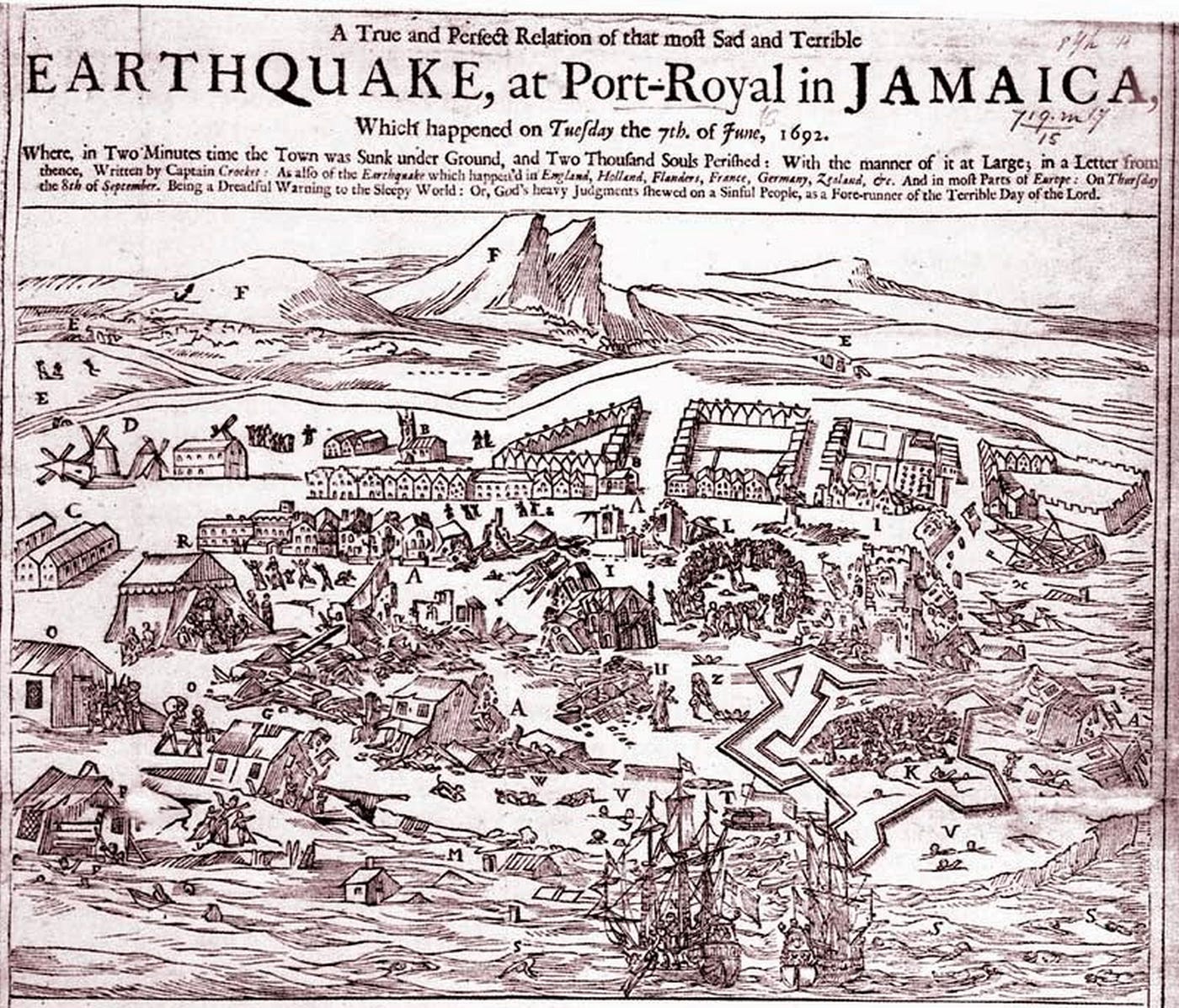
Sunken Pirate City of Port Royal Image via Wikimedia Commons
The day started ordinarily.
The harbor was full. The taverns on Thames Street and High Street — yes, Port Royal had a Thames Street and a High Street, because the English are nothing if not consistent — were already serving. The fish market was open. Ships were being loaded and unloaded at the wharves.
At 11:43 in the morning, the ground moved.
Not the gentle shudder of a minor tremor. A full rupture — a 7.5 magnitude earthquake, geologists would later calculate, originating offshore to the south. The shaking lasted roughly six minutes. In those six minutes, Port Royal was not merely damaged.
It was erased.
The particular cruelty of what happened to Port Royal has a name: **liquefaction.** The city had been built on a sand spit — loose, unconsolidated, heavily saturated with seawater. When the earthquake struck, the violent shaking caused the water-saturated sand to behave not like solid ground but like liquid. The soil lost its structural integrity almost instantaneously.
Buildings didn’t fall sideways. They didn’t collapse in the way earthquake buildings normally collapse, with rubble and ruin spreading outward. They went straight down, sucked vertically into ground that had turned to fluid. Streets, taverns, warehouses, homes — entire city blocks sank intact into the harbour. Two-thirds of Port Royal’s built environment disappeared below the waterline within minutes.
The survivors described the ground rolling in waves beneath their feet. People standing on solid earth watched as others twenty feet away sank as if the city floor were a trapdoor. A witness named John Pike wrote that he saw the ground open up and swallow a group of people whole, then close again above them.
Emmanuel Heath, the minister who had written about the city’s wickedness, survived. He wrote afterwards that he had “escaped by miracle.” He stood on the part of the spit that held, and watched everything around him go under.
Roughly 2,000 people died in the initial event. Another 3,000 in the days following, from injury and disease. The sea then gave back some of what it had taken — not the buildings, but the dead — and contemporary accounts describe bodies floating in the harbour for days.
The preachers who had refused to go to Port Royal arrived shortly after, and found exactly the conclusion they’d predicted.
What the Divers Found
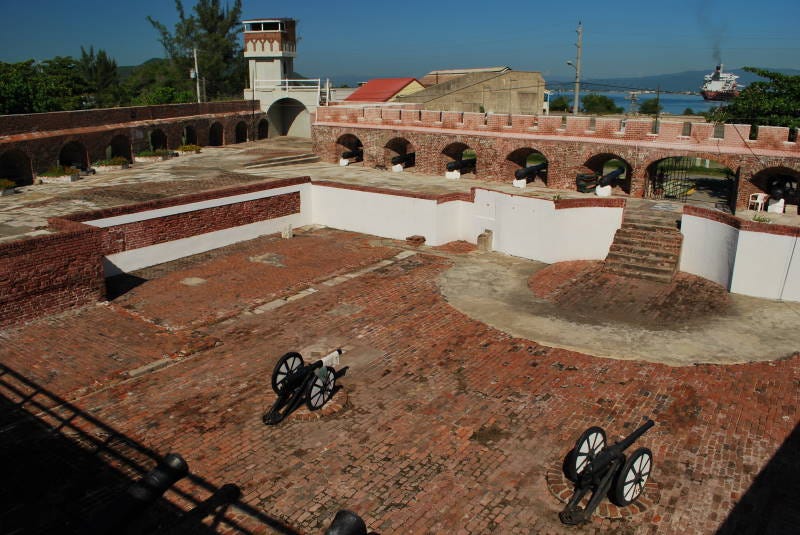
JM Port Royal Image via Wikimedia Commons
For nearly three centuries, Port Royal sat on the harbour floor largely undisturbed.
Then, in the 1960s and 1980s, marine archaeologists began working the site in earnest. What they encountered was unlike almost anything else in underwater archaeology. Because the city had sunk so rapidly and so completely — sucked down rather than washed away, its contents sealed by the speed of the event — Port Royal had not scattered. It had preserved.
Dr. Donny L. Hamilton of Texas A&M University led the most systematic excavations, beginning in the early 1980s. What his team found, under roughly twenty to forty feet of water and silt, was a city still in mid-moment.
Tavern shelves with intact bottles. Pewter plates with food still on them. A cobbler’s workshop with unfinished shoes on the bench. Clay pipes. Trade goods. The personal effects of people who had left their houses that morning expecting to return for dinner.
And then the detail that stops everyone when they hear it: a pocket watch, recovered from the seafloor, its hands frozen at 11:43 AM.
The moment the ground gave way. The moment the city went under. Preserved, inexplicably, in the mechanism of a watch that had no reason to still be telling the time but was.
Port Royal is now routinely called the Pompeii of the New World — and the comparison is fair, if you adjust for the water. Like Pompeii, it preserves not just structures but the material texture of ordinary life. What people ate, what they owned, where they worked. Unlike Pompeii, the people who built it are not entirely sympathetic figures. The wealth that bought those pewter plates and clay pipes and pocket watches had routes through enslaved labor and plundered ships and the routine brutality of a colonial port economy.
The sea kept all of it. The evidence of the violence and the evidence of the ordinary life that violence funded, sealed together in the same silt.
What Four Cities Teach Us About the Sea
Pull back now. Look at all four.
Helike, swallowed in a single night of earthquake and flood in 373 BCE, forgotten for two millennia, rediscovered under a farmer’s field. Dwarka, drowned slowly by rising sea levels and then by collective memory that kept pointing to the right coastline for three thousand years, until divers finally went to check. Doggerland, the continent that vanished so completely and so long ago that it left almost no human memory at all — only objects in the silt, waiting for sonar technology to make them legible. And Port Royal, modern enough for us to have the pocket watch, documented enough for survivor letters to still exist in Jamaican archives, gritty enough to complicate any easy mythology.
Each of them raises the same question differently.
What does the sea actually do with what it takes?
Not destroy — that is the wrong word. It changes the conditions of survival. A city on land is subject to fire, to looting, to the patient erasure of wind and rain and the recycling habits of later generations who need the building stones for something new. A city beneath the sea is subject to pressure and current and silt, and those forces preserve differently but they do preserve. Amphora intact in the wreck. Pocket watch intact on the harbor floor. Harpoon point intact on the seabed for eleven thousand years.
The ocean is not a graveyard. It is, in a specific and serious sense, an archive — one with its own filing system, its own preservation logic, its own gaps and emphases. It keeps some things perfectly. Others it destroys entirely. And it has been doing this for longer than we have had cities to put in it.
We have explored less than twenty percent of the ocean floor. The ruins and tools and peat layers and city blocks and watch mechanisms that are down there, preserved in the cold and dark, represent a volume of human history that we have only just begun to read.
Port Royal’s site remains largely unexcavated. Dwarka’s ruins extend further offshore than the surveys have yet mapped. Doggerland has yielded a few hundred objects from a seafloor the size of a country. And those are the sites we know about. Sites we found by accident, dredged up by fishing nets or noticed in oil-industry sonar data.
The ocean is not finished with us yet. And we are nowhere near finished with it.
A Note Before We Surface
This is where the first four parts of Cities the Ocean Swallowed leave you — standing at the edge of an ocean that contains more history than any library.
We’ve covered four drowned worlds across four continents and eight thousand years of human experience. A Greek city that became mythology. An Indian kingdom that scripture wouldn’t let people forget. A European heartland that no one even knew to remember. A pirate port that went down mid-breakfast on a Tuesday.
There are others.
Pavlopetri, off the southern coast of Greece — a Bronze Age town with streets and buildings still mapped out on the seabed, submerged around 1000 BCE, older than classical Athens. Thonis-Heracleion, Egypt’s great lost harbor city, found beneath Abu Qir Bay in 2000 by the underwater archaeologist Franck Goddio, its massive statues still standing upright on the seafloor. The submerged temples of Mahabalipuram off the Tamil Nadu coast, revealed briefly to stunned beachgoers when the 2004 tsunami temporarily pulled the water back. The Bronze Age port of Caesarea Maritima. The ancient harbors of Alexandria. The lost towns of Suffolk, swallowed by the North Sea on the English side of what was once Doggerland.
The vault is not closed. It’s barely been opened.
Cities the Ocean Swallowed will return — not on a fixed schedule, because the best stories from the seabed don’t arrive on schedule, but when something surfaces worth the telling. Consider this series an ongoing dispatch from the waterline. The ocean keeps accumulating. So will we.
If these four parts stayed with you, follow for the bonus deep-sea files. The next one is already down there somewhere, waiting.
Links for the other parts:
Part I: The City That Became Atlantis
https://medium.com/write-your-world/the-city-that-became-atlantis-999089eed205
Part II: The Lost Golden City of India
https://medium.com/write-your-world/the-lost-golden-city-of-india-4f2825f9c005
Part III: The Map with No Names
https://medium.com/write-your-world/the-map-with-no-names-4dc916ca5af4
Sources & Further Reading
Documentaries and Media
**National Geographic: Drain the Sunken Pirate City (2017)* — A stunning visual entry in the Drain the Oceans* series that uses cutting-edge sonar and 3D mapping to virtually “drain” Kingston Harbour and reveal the 33-acre ruins. Available on Disney+.
Primary Historical Accounts
- **Emmanuel Heath’s Letter (1692)** — The harrowing firsthand account by the surviving rector of Port Royal, detailing the city’s sudden descent into the sea.
- **John Pike’s Witness Letter (1692)** — Famous for its visceral description of the earth opening up and swallowing crowds whole.
- **Calendar of State Papers, Colonial Series** — Official British administrative dispatches cataloging the immediate political and economic fallout of the disaster.
Archaeological & Geological Research
- **Texas A&M Port Royal Project** — The definitive digital archive of Dr. Donny L. Hamilton’s decades of underwater excavations, featuring artifact catalogs and site maps.
- **Nature Geoscience Study (2010)** — “Submarine Landslides and the Origin of the 1692 Port Royal Earthquake.” The essential modern study breaking down the exact physics of the liquefaction event.
- **UNESCO Cultural Underwater Heritage** — Documentation on Port Royal’s tentative list nomination and the framework protecting the site.
Historical Context Books
- Port Royal, Jamaica by Michael Pawson & David Buisseret (University of the West Indies Press) — The gold standard historical account of the city’s rise and fall.
- Port Royal Rediscovered by Robert F. Marx — A gripping account of the earliest pioneering dives on the sunken city.
Cities the Ocean Swallowed is an independent series. The ocean’s archive is open-ended. Follow for future installments when the tide is right.
메타데이터
- post_id
- 0d2c9089c39d
- slug
- it-took-exactly-6-minutes-to-erase-the-wickedest-city-on-earth-0d2c9089c39d
- url
- https://medium.com/write-your-world/it-took-exactly-6-minutes-to-erase-the-wickedest-city-on-earth-0d2c9089c39d
- canonical_url
- https://medium.com/write-your-world/it-took-exactly-6-minutes-to-erase-the-wickedest-city-on-earth-0d2c9089c39d
- author_url
- https://medium.com/@sugashnandita
- status
- ok
- fetched_at
- 2026-07-13 09:40:43