Taiwan’s Five Longshan Temples: Guanyin’s Island Sanctuaries
Every Longshan Temple in Taiwan traces its spiritual lineage to a single source: the ancient Longshan Temple at the foot of Dragon Mountain…
Taiwan’s Five Longshan Temples: Guanyin’s Island Sanctuaries

Every Longshan Temple in Taiwan traces its spiritual lineage to a single source: the ancient Longshan Temple at the foot of Dragon Mountain in Anhai, Jinjiang, Fujian province, where a camphor-wood Guanyin statue has drawn worshippers since the early Tang Dynasty. When Fujian settlers crossed the Taiwan Strait in the seventeenth and eighteenth centuries, they carried incense from Anhai’s temple to protect them on the treacherous voyage, and once established in their new home, they built branch temples to honor the bodhisattva who had delivered them safely. Five of these temples survived the centuries to become collectively known as Taiwan’s Five Great Longshan Temples, each one a chapter in the island’s story of migration, conflict, and enduring faith.
What makes these temples remarkable as a group is how clearly they map the arc of Han Chinese settlement across Taiwan. The earliest stands in Tainan, where the Dutch and then Koxinga’s Ming loyalists first established footholds. Others rose in the booming port towns of Lukang and Fengshan as Qing-era trade pushed southward and inland. The youngest two appeared in the north as Taipei and Danshui grew from frontier outposts into the island’s political and commercial centers. Visiting all five is less a temple crawl than a journey through Taiwan’s past, with Guanyin as a constant, compassionate witness.

1. Bangka Longshan Temple (艋舺龍山寺), Taipei
Founded: 1738
Taipei’s Longshan Temple is the most visited religious site in Taiwan, and for good reason: it sits at the spiritual and historical heart of the capital. Wanhua District, known in older Hokkien as Bangka, was where Taipei began, a riverside trading settlement where immigrants from Jinjiang, Nan’an, and Hui’an in Fujian pooled their resources to build a temple worthy of the Guanyin who had protected their crossing. For nearly three centuries the temple has served not only as a house of worship but as a community hall, a center of self-governance, and even a makeshift fortress during the ethnic clashes that periodically roiled early Taiwan society.
The temple’s most dramatic chapter came on May 31, 1945, when American bombers struck the surrounding neighborhood during the Taihoku Air Raid, reportedly targeting Japanese armaments hidden inside the complex. The main hall and left corridor were devastated, and priceless artifacts were lost. Yet witnesses reported that the camphor-wood statue of Guanyin survived amid the rubble, an apparent miracle that deepened the faith of generations. The reconstruction that followed, incorporating elements from a masterful 1920s renovation by architect Wang Yi-shun, produced the building visitors see today: its bronze dragon columns, octagonal caisson ceiling, and sweeping swallowtail eaves representing the pinnacle of Taiwan’s temple artistry. The temples houses over a hundred deities spanning Buddhism, Daoism, and folk religion, with Guanyin presiding serenely in the main hall.

2. Lukang Longshan Temple (鹿港龍山寺), Lukang
Founded: circa 1647 (moved to current site in the 18th century)
If Taipei’s Longshan Temple overwhelms with energy and crowds, Lukang’s offers something rarer: silence, proportion, and the kind of architectural beauty that stops you mid-step. Widely regarded as Taiwan’s best-preserved Qing Dynasty building, this temple in the old port town of Lukang earned its designation as a national historic site through sheer artistic excellence. Its octagonal caisson ceiling, a web of interlocking wooden beams sustained without a single nail, is the oldest and largest of its kind in Taiwan, a masterpiece of structural calculation and craftsmanship completed during an 1831 reconstruction.
The temple complex spans four principal structures across more than 9,600 square feet, its granite dragon columns among the most celebrated stone carvings on the island. Where Lukang’s nearby Tianhou Temple dedicated to Mazu pulses with constant activity and incense smoke, Longshan Temple maintains a serene elegance suited to quiet contemplation. The contrast between these two temples in the same town illustrates something fundamental about the island’s religious life: different deities serve different spiritual needs, and the same community can move between boisterous folk celebration and meditative stillness within a few blocks.
3. Danshui Longshan Temple (淡水龍山寺)
Founded: 1858
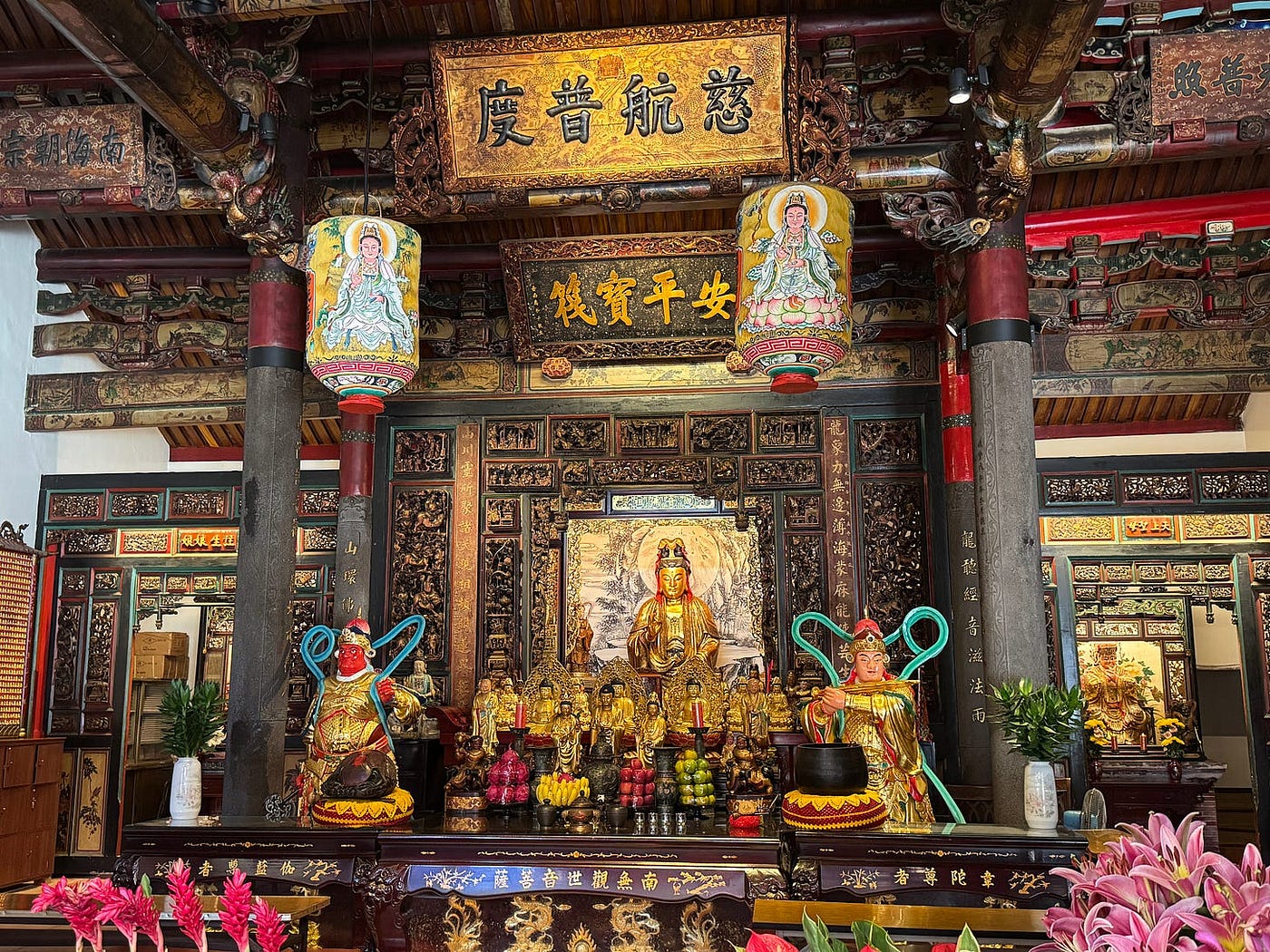
Tucked into an alley off Danshui Old Street and hidden within the bustle of the local market, Danshui’s Longshan Temple is the smallest of the five, yet it holds perhaps the most vivid connection to Qing Dynasty statecraft. Together with Qingshui Temple, Yinshan Temple, and Fuyou Temple, it forms one of the “Four Great Temples of Danshui,” and it served as a religious and governance center for people from the Sanyi district of Quanzhou, who formed the majority of Han Chinese settlers in the area.
The temple’s most treasured artifact tells a story of war and divine intervention. In 1884, during the Sino-French War, French warships blockaded Danshui harbor. Local residents believed that Guanyin manifested to protect them during the conflict, turning back the foreign assault. Governor Liu Ming-chuan, deeply impressed, petitioned the Guangxu Emperor to recognize this divine intervention. The emperor bestowed an imperial plaque reading “Ci Hang Pu Du” (慈航普度/The Compassionate Vessel Delivers All), which which still hangs in the main hall today. It remains a tangible artifact of Qing imperial authority, a piece of nineteenth-century diplomatic theater preserved in wood and gold leaf, and evidence of the deep faith that sustained Danshui’s residents through one of Taiwan’s most precarious moments.
4. Fengshan Longshan Temple (鳳山龍山寺), Kaohsiung
Founded: circa 1740s (early Qianlong Emperor period)
The second-oldest of Taiwan’s five Longshan Temples stands in Kaohsiung’s Fengshan District, a neighborhood so steeped in Qing heritage that you can walk from cannon emplacements to stone city gates to tutorial academies within a single afternoon. Fengshan rose to prominence in the late eighteenth century when repeated uprisings forced the Qing administration to relocate the Fongshan County seat here, and the Longshan Temple served the growing population of officials, soldiers, and merchants who followed.
Unlike its tourist-thronged Taipei counterpart, Fengshan Longshan Temple remains primarily a neighborhood sanctuary where devoted locals seek blessings from Guanyin in relative tranquility. Its proximity to the Fongyi Academy, the City God Temple, and the remnants of the old city walls makes it an essential stop for anyone tracing the Qing-era roots of southern Taiwan.
5. Tainan Longshan Temple (台南龍山寺), Tainan
Founded: 1715
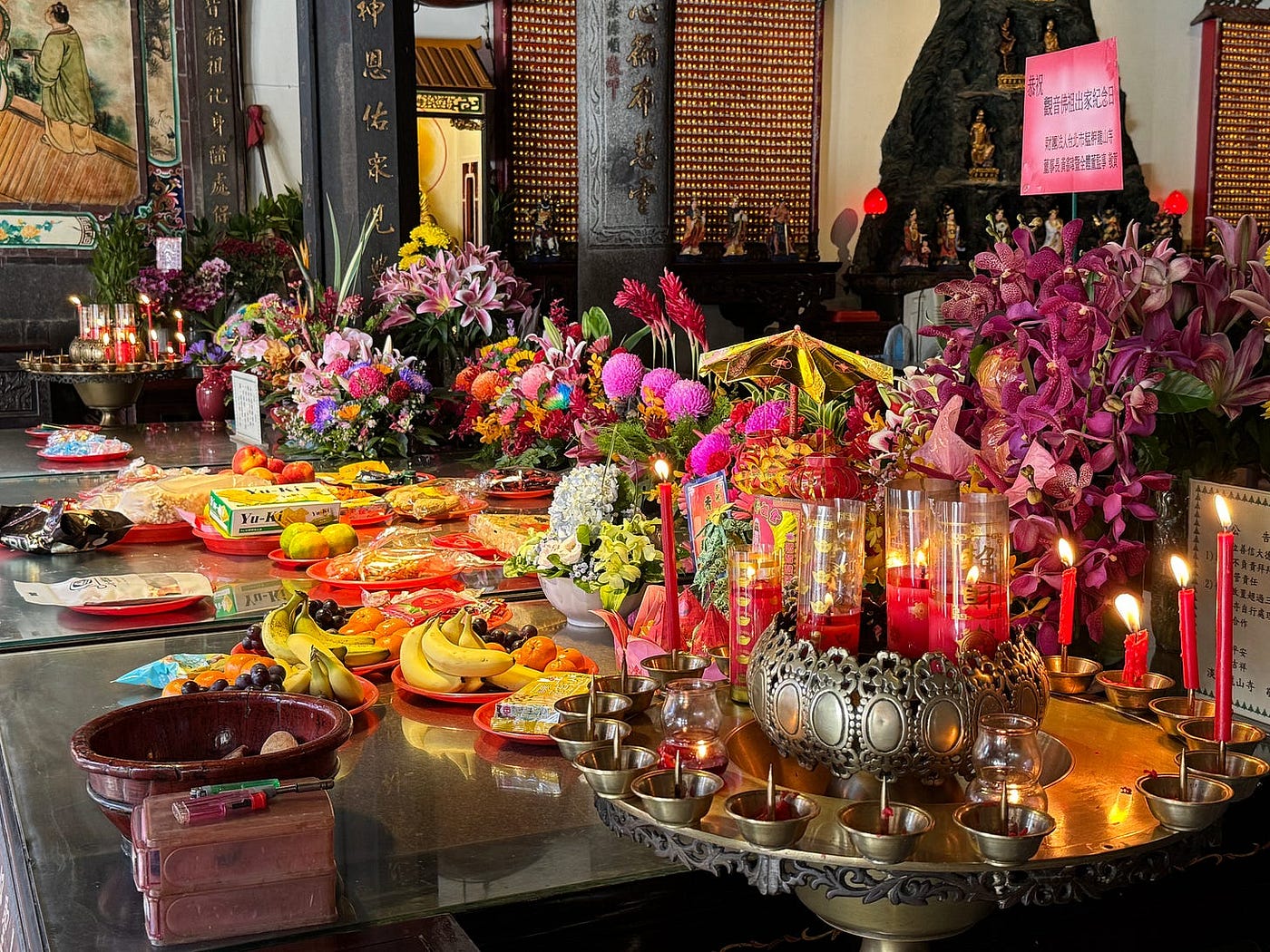
The southernmost and the earliest of the five Longshan Temples occupies a site in Tainan’s East District that was once outside the old city walls at the East Gate. Originally constructed from coral stones during the reign of the Kangxi Emperor, the temple’s history is one of repeated reinvention. Rebuilt in 1778, then partially demolished during Japanese colonial road-widening projects, it has been reconstructed several times, and the three-story building visitors see today is relatively modern. Yet it retains the atmosphere of an ancient temple, and a significant collection of Qing Dynasty plaques grounds the space in its deep past. In a city where temples dedicated to Mazu, Confucius, and countless folk deities jostle for attention on nearly every block, Tainan’s Longshan Temple offers a quieter refuge where Guanyin’s compassion persists through cycles of destruction and renewal that mirror Taiwan’s own turbulent history.
Taken together, Taiwan’s five Longshan Temples form something greater than a list of heritage sites. They are a network of faith stretching from Tainan to Danshui, from the seventeenth century to the present, each one reflecting the community that built it, the settlers clinging to the memory of a temple at the foot of Dragon Mountain in a homeland most would never see again. Whether you visit for the architecture, the history, or the simple peace of watching incense curl before a gilded Guanyin, these temples reward attention with layers of meaning that no guidebook can fully capture.
메타데이터
- post_id
- 0d2f4faec14b
- slug
- taiwans-five-longshan-temples-guanyin-s-island-sanctuaries-0d2f4faec14b
- url
- https://medium.com/@brownbeat/taiwans-five-longshan-temples-guanyin-s-island-sanctuaries-0d2f4faec14b
- canonical_url
- https://medium.com/@brownbeat/taiwans-five-longshan-temples-guanyin-s-island-sanctuaries-0d2f4faec14b
- author_url
- https://medium.com/@brownbeat
- status
- ok
- fetched_at
- 2026-08-15 14:23:34