Two Churches, Two Gods: Why Musk’s Space Data Centers Fail the Monkey Test
Two Churches, Two Gods: Why Musk’s Space Data Centers Fail the Monkey Test
Prologue: A Curious Filing
In January 2026, SpaceX quietly filed with the FCC. Buried in the technical weeds was a number that strains belief: one million satellites. This is the headline for Musk’s latest attempt to rewrite the rules of space-based AI.
These aren’t just more Starlink satellites. The idea is to build the backbone of an ‘Orbital Data Center system’ — a swarm of AI supercomputers in orbit, each supposedly cranking out 100 kW of compute power and, together, adding 100 gigawatts of capacity to Earth’s AI infrastructure. Or so the story goes.
Google, meanwhile, is moving with the caution of a seasoned engineer. Their ‘Project Suncatcher’ will launch just two prototypes in 2027, not to promise the moon, but to find out if space-based AI computing is even possible. The focus is on data, not declarations.
Two companies, two visions, and two radically different playbooks for the same near-impossible problem. One is running an experiment. The other is selling a narrative.
Part I: The Physics Problem That Won’t Go Away
To understand what these companies are attempting, you have to start with a critical number: 1 kW per ton, which defines the power-to-mass ratio of the International Space Station and underscores the fundamental physics challenge they face.
That is the power-to-mass ratio of the International Space Station. The most complex structure ever built in space, with over 100 tons of hardware, generates about 110–120 kW of power — enough for a modest office building, not a data center.
Musk’s plan demands a 100-fold leap in power-to-mass ratio. Ambitious is one word for it. Anyone who’s ever built hardware in orbit knows this is the kind of claim that should trigger alarm bells.
This isn’t a matter of slapping on better solar panels or shaving a few grams off the frame. It’s a physics problem at its core. To get 100 kW of compute out of a 1-ton satellite, you have to crack three puzzles at once:
- Power Generation: You need solar arrays that are simultaneously ultra-light and ultra-efficient. They must deploy reliably, survive radiation, and generate power continuously — likely requiring Sun-synchronous orbits, because batteries for the dark side of Earth would weigh more than the satellite itself.
- Thermal Management: This is the showstopper. A 100 kW AI chip throws off about 60 kW of waste heat. In space, there are no fans, no liquid cooling — just radiation. To dump that much heat, you need 40 to 70 square meters of radiator, about the size of a tennis court, bolted to a 1-ton box. Every kilogram spent on a radiator is a kilogram you can’t spend on a computer.
- Structural Integrity: The satellite has to survive launch, unfold its radiators and solar panels, and keep a laser pointed with precision — all while being lighter per watt than anything built before.
Musk’s supporters like to say the ISS is weighed down by life support, and that removing humans changes the equation. But they’re missing a critical piece:
The Maintenance Factor.
The ISS keeps running because there’s always a crew on hand to swap out cooling pumps, patch radiator lines, and free stuck solar arrays. Space is the harshest zero-maintenance environment imaginable. On Earth, data centers swap dead chips and drives every day. Take away the crew, and you take away the only thing keeping complex hardware alive in orbit. One blown capacitor or a jammed hinge, and your $10 million AI supercomputer is just a 1-ton paperweight.
Even without life support, a 100x efficiency jump would require breakthroughs in materials that, for now, belong to science fiction.
Part II: The Failure Rate Problem No One Talks About
Physics may bend a little. Materials will improve, radiators will slim down, and solar cells will squeeze out a few more watts. But there’s one thing physics can’t wish away: entropy.
Every satellite fails, sooner or later. SpaceX’s own Starlink fleet proves the point: between 2020 and 2024, 583 satellites burned up on reentry. That’s a 6 to 8 percent failure rate — not exactly comforting if you’re planning to park your AI data center in orbit.
For Starlink, this is a manageable nuisance. Each satellite costs about $250,000. Losing a few hundred is just a blip, covered by service revenue.
Now, picture a computer satellite. Each one is packed with hundreds of high-end AI chips. A single top-tier GPU runs north of $30,000. A 100 kW satellite could carry hundreds. The payload alone is worth millions.
Apply that 6 percent failure rate to a million satellites, and you get 60,000 dead units every year. That’s not a rounding error. Even the most optimistic planner should pause at those odds.
And that’s just the money. The scale is staggering. As analyst Will Lockett notes, generating 100 gigawatts in space means hauling hundreds of millions of kilograms into orbit. If 60,000 of these 1-ton, radiator-laden blocks fail each year, they don’t just add to the usual space junk. They create dense shrapnel fields right where we need clear orbital lanes for communication.
This isn’t just about losing a few million dollars. At this scale, you risk a Kessler Syndrome-style debris cascade that could lock us out of Low Earth Orbit for decades. The challenge isn’t building one high-powered satellite — it’s building a million that rarely fail, in a place where repairs are off the table.
Part III: Two Churches, Two Gods
This brings us to the two companies and their radically different approaches.

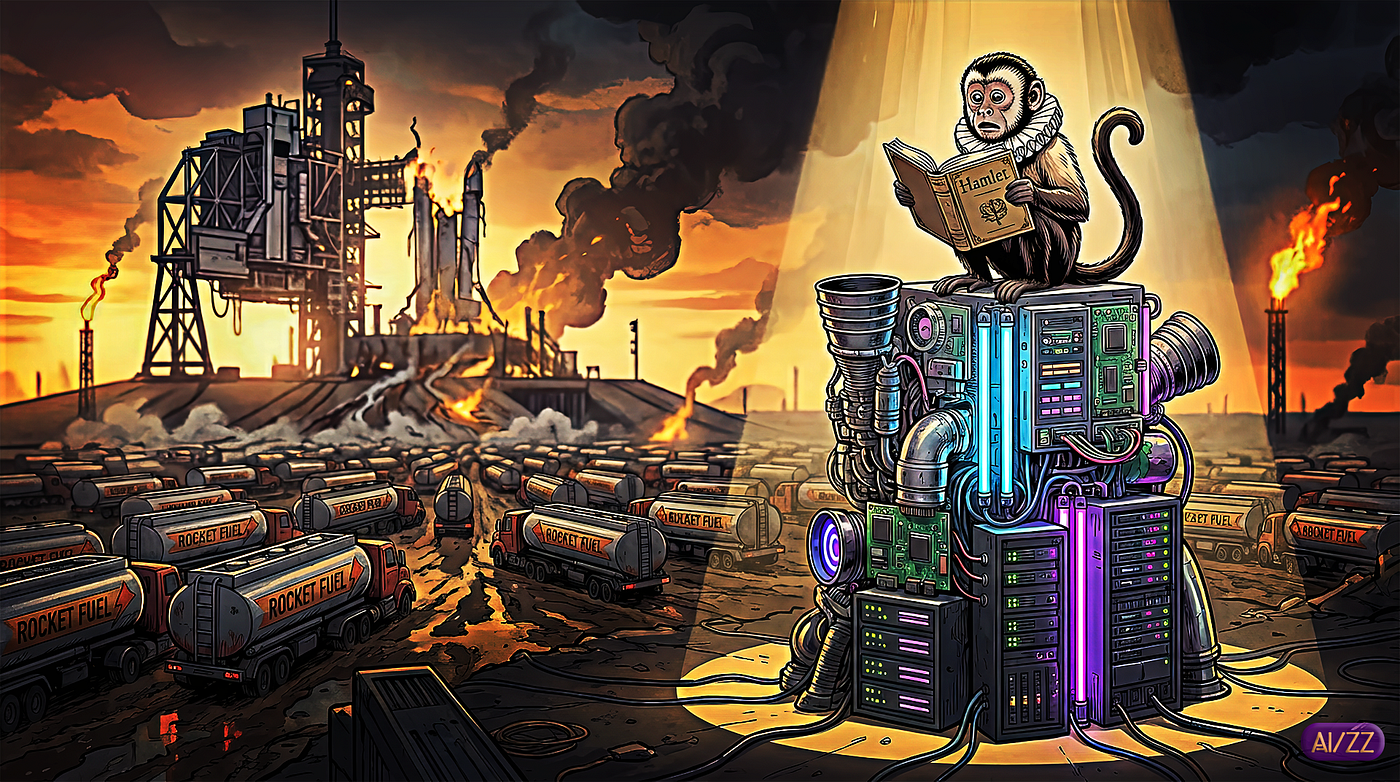
The “monkey test” comes from Astro Teller, the head of Google X. His famous analogy: if you want to teach a monkey to recite Shakespeare on a pedestal, you don’t build the pedestal first. First, figure out whether you can teach the monkey. The pedestal is easy. The monkey is the hard part.
For Google’s Project Suncatcher, the question is whether a TPU can survive and perform in space for years. The pedestal — the satellite bus, the solar panels, the launch — is secondary. By launching just two prototypes in 2027, Google is testing the monkey.
SpaceX, by contrast, is betting the monkey will play along. The pedestal — Starship, the constellation, the billion-dollar ground network — is already under construction, on the hope that the hard part will sort itself out.
Part IV: The Deeper Roots of Google’s Patience
To see why Google works this way, you have to rewind further than most people do. The machine learning that led to Waymo started in university labs in the 1990s. Google knows real technological shifts take decades. They can afford that patience because their business — surveillance capitalism and advertising — throws off steady cash to fund long bets.
Project Suncatcher is cut from the same cloth. When Google launches those two prototypes, they’re not hoping for a miracle. They’re collecting data. If the chips fail, they’ll know why. If the thermal systems hold, they’ll know what worked.
They’re playing the long game. They always have.
Part V: The Financial Imperative Behind Musk’s Narrative
Now look at the other side of the table.
In 2025, xAI — Musk’s AI venture — was burning through cash at a staggering rate. Reports put the broader AI infrastructure bill at $10 billion a month. For a standalone company, that’s a death sentence. No VC market can keep that up for long.
The fix arrived in February 2026: merge with SpaceX. The combined company would be valued at $1.25 trillion. SpaceX, flush with Starlink cash, would keep the lights on. An IPO aiming for $500 billion in new funding would seal the deal.
But to justify that price tag — and get IPO investors to open their wallets — you need a story. Enter the space data center. It’s a neat narrative: SpaceX brings the rockets and hardware, xAI brings the AI and the rationale for launching, and together they promise the first off-planet AI infrastructure.
It’s a compelling story, but the pedestal crumbles on the ground long before anything reaches orbit.
To launch a million-satellite constellation, SpaceX would need about 5,000 Starship launches. To hit that in a year — the pace the hype suggests — means 14 launches every day. That would take 700 liquid methane tanker trucks rolling into Starbase daily, all funneled down a two-lane road through a wildlife refuge. Even if the trucks could make it, the law won’t. The FAA currently caps Starship launches in Florida at 44 per year. Musk’s pedestal isn’t just unbuilt; at this scale, it’s legally and physically impossible.
The timeline isn’t set by physics. The IPO calendar sets it. The story only needs to hold together until the money lands.
Part VI: The 2027 Reckoning
Google’s two prototypes will launch in 2027. By 2028 or 2029, we will have data — real data, from real hardware, operating in the actual environment of space.
If Google’s prototypes return data showing the thermal and radiation problems are as bad as expected, what happens to the SpaceX story? The uncomfortable truth: stories are often immune to data. SpaceX can always say Google used the wrong chips or didn’t try hard enough.
The real question is whether IPO investors will keep funding a story after a credible, science-driven rival shows it doesn’t add up. Google puts its faith in evidence: if the data says stop, they stop. SpaceX puts its faith in willpower: if the data says stop, they push harder.
Both approaches have worked before. The difference is that when Google fails, it’s cheap, and they learn. When SpaceX fails at this scale, it’s not just expensive — it could be catastrophic for everyone who needs orbit.
Part VII: The Monkey’s Fate
The phrase ‘teach a monkey to recite Shakespeare’ sums up both the absurd ambition and the patience needed even to try.
Teaching a monkey to talk is hard. It might be impossible. Biology sets the limits. No amount of training, will, or narrative can change that. The space data center monkey faces its own hard stops: radiation degrades silicon, thermal cycling cracks materials, and failure rates pile up.
Google is building a small cage, putting one monkey inside, and listening closely. If the monkey stays silent, they’ll conclude monkeys can’t talk.
SpaceX, meanwhile, is building a million cages, telling investors the monkeys will be quoting Hamlet any day now, and hoping that somewhere in the noise, one manages a few lines.
If you think the careful experiment will settle the question, the obituary for space data centers won’t be written by a competitor, but by two small satellites quietly launched in 2027, sending back data that says, in science’s only language: this path leads nowhere.
Epilogue: A Confession of Bias
I lean toward skepticism, evidence, and the slow build-up of knowledge over dramatic leaps of faith. In this case, I side with Google because its approach aligns with how hard problems are actually solved.
We’ve seen narrative-driven companies promise the impossible — and sometimes deliver. But when they fail, they fail big, taking investor money and sometimes whole industries down with them.
Maybe space data centers will exist someday — 2040, 2050, whenever materials science catches up. But they won’t exist in 2028. They won’t save xAI from its burn rate. And they won’t justify a $1.25 trillion price tag.
The monkey gets its test in 2027. If the data says what we expect, the only honest answer is that the monkey can’t be taught — not yet, and not just by spinning a good story.

If you found this article useful, consider supporting more work like this by buying me a coffee. Each contribution helps keep asking difficult questions and seeking better answers.
메타데이터
- post_id
- 0d379d38cfbe
- slug
- two-churches-two-gods-why-musks-space-data-centers-fail-the-monkey-test-0d379d38cfbe
- url
- https://medium.com/truthseeker-journey-to-wisdom/two-churches-two-gods-why-musks-space-data-centers-fail-the-monkey-test-0d379d38cfbe
- canonical_url
- https://medium.com/truthseeker-journey-to-wisdom/two-churches-two-gods-why-musks-space-data-centers-fail-the-monkey-test-0d379d38cfbe
- author_url
- https://medium.com/@zygmundzee
- status
- ok
- fetched_at
- 2026-08-16 13:48:30