Craig Johnson and Derrius York on the Business of Staying in Motion
With Saulna, they are building around a simple idea: a company should not outsource the part of itself that creates demand.
Craig Johnson and Derrius York on the Business of Staying in Motion
With Saulna, they are building around a simple idea: a company should not outsource the part of itself that creates demand.
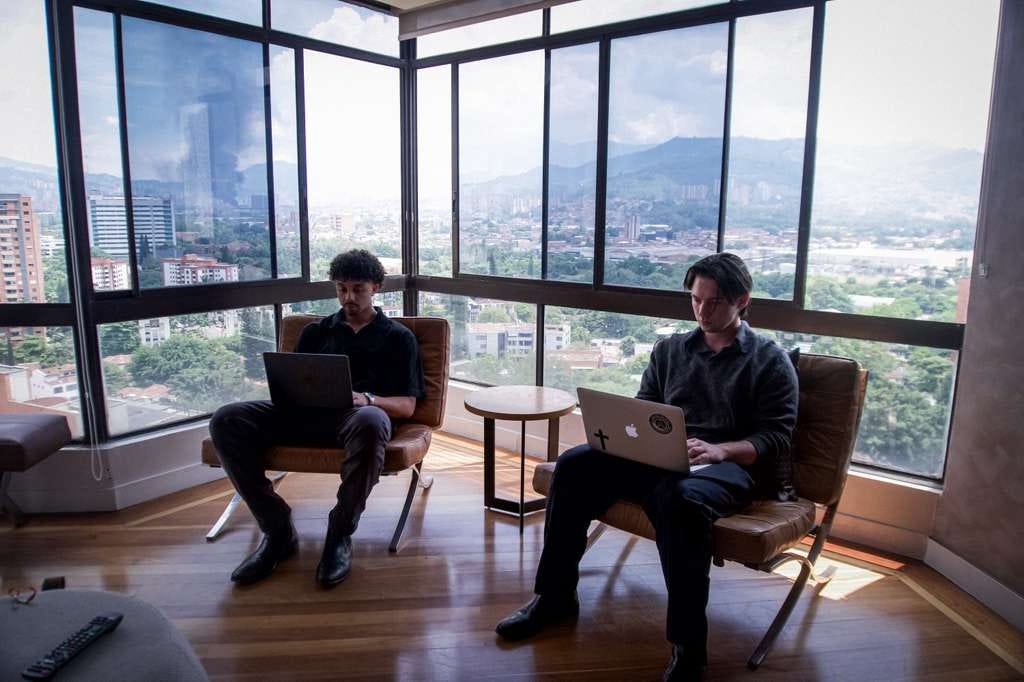
There is a kind of business advice that sounds responsible until the market touches it.
Hire the agency. Delegate the hard part. Let someone else build the funnel, generate the leads, run the follow-up, and hand you growth in a clean monthly report. It is an attractive promise because it lets a founder believe the most uncomfortable part of the business can be moved outside the business.
Craig Johnson and Derrius York are building Saulna against that promise.
Their company sits in the B2B consulting and software space, helping businesses install internal systems for acquisition, nurturing, conversion, hiring, tracking, and outbound lead generation. The surface category is familiar enough. Growth. Funnels. Consulting. Software. The internet has no shortage of people selling those words with varying levels of confidence.
But Saulna’s sharper argument is less about growth itself.
It is about ownership.
A company that cannot generate demand internally is never quite as independent as it looks. It may have revenue. It may have an offer. It may have testimonials, a team, and the language of scale. But if the engine lives somewhere else, the business is still borrowing motion.
Naturally, motion is the company motto.
In their case, the word is not decorative. It is closer to an operating system, though occasionally it also sounds like something shouted across a sales floor by people who have consumed exactly the correct amount of caffeine.
Motion is only useful when it exposes the bottleneck
The easiest version of Saulna’s story would be a hustle story.
Two entrepreneurs meet outside a barber shop in Tampa. They start working together. Their previous business partners step away. They move into high-ticket offers, growth partnerships, and B2B demand generation. They grind, bootstrap, solve problems, and eventually build something that works.
That version is true.
It is also too thin.
The more interesting part is how they learned. Johnson and York did not arrive with a finished theory of the market. They found it by repeatedly putting too much pressure on their own systems and watching what broke.
“We just got to break it,” one of them says.
That line could sound reckless in another context. Inside Saulna, it functions more like a diagnostic method. They would push a funnel until the weak point became impossible to ignore. First, booking calls was the problem. Then show rates. Then conversion. Then follow-up. Then lead quality. Then hiring. Then the systems needed to make other people run the same process without everything living inside the founders’ heads.
A cleaner founder story would pretend each part was planned.
Their version is more honest. They flooded the system, found the break, fixed it, and moved to the next constraint.
There is something useful in that. A lot of businesses try to look stable before they understand what their instability is teaching them. Saulna’s approach runs in the opposite direction. Stability comes later. First, the machine has to be pushed hard enough to reveal where it is lying.
“We’ve had bottlenecks with every step of the funnel. Then we solved those bottlenecks at every step of the funnel by breaking it.”
That is not the language of polish.
It is the language of operators who learned through contact.
The outsourced engine creates a quiet dependency
Johnson and York are not selling the idea that every company should do everything itself.
They are selling a narrower claim: the systems that create demand are too important to remain mysterious.
Their flagship offer, Acquisition Ascension, is built around that belief. Saulna installs scripts, talent systems, KPI trackers, middle-funnel processes, bottom-funnel conversion mechanisms, and outbound lead systems inside a client’s company. The aim is not to make the founder admire the machinery from a distance. It is to make the machinery usable.
“We don’t want people to be outsourcing agencies anymore,” one of them says. “We want to give people the actual in-house systems.”
This is where the company separates itself from the usual agency promise.
An agency often sells relief. Stop worrying about acquisition. Let us handle it. Saulna is selling something less comfortable: the client should understand the process well enough to own it.
That is harder to package because ownership requires participation. It means learning the numbers. Watching the funnel. Seeing where leads fall off. Knowing when the script is weak, when the setter is undertrained, when the offer is unclear, and when the market is simply not responding.
The irony is that many founders say they want freedom, then build companies around dependencies they barely understand.
Johnson and York seem allergic to that arrangement.
Their own path explains why. Before Saulna became its current version, they were helping others scale high-ticket offers while taking a small percentage of the upside. Eventually the obvious frustration appeared: they were generating demand for other people’s companies. Why not build that engine for themselves?
That question became the company.
The software came from a market problem, not a technical fantasy
Saulna’s software did not begin as a founder trying to become a SaaS founder because the market liked the label.
It began with a lead quality problem.
For much of the previous year, Johnson and York tested outbound tools, spent heavily on software, and tried to understand how to get qualified leads at a high enough rate. They followed the problem into strange corners of the internet, including tools that apparently required Russian translation help. Every company has its origin mythology. Saulna’s includes a friend translating software so the funnel could continue moving, which is at least more specific than another founder saying they “saw a gap in the market.”
Eventually, they built their own refinement system.
The technical work is handled by Juraj, whom they describe with both affection and comic awe as the person behind the scenes. Johnson and York are direct about their own role. They are not positioning themselves as technical founders in the traditional sense. Their skill is knowing the use case, recruiting the right people, directing the work, and getting others bought into the vision.
“We’re not good at tech,” one of them says. “But we’re good at directing the right people.”
That admission helps the story.
In the current market, founders are often tempted to cosplay whatever title seems most valuable. AI builder. SaaS operator. Automation specialist. Technical visionary. Saulna’s founders do not seem especially interested in pretending. They know the commercial problem. They know the customer’s pain. They know what the system needs to produce.
The software exists because the existing tools did not give them what they needed.
That is a better reason to build than wanting a dashboard to point at during sales calls.
The market punished the wrong kind of dependence
The most useful test of a company’s philosophy is usually the moment it becomes inconvenient.
For Saulna, that moment came when Instagram outbound, a channel they had spent a year building around, collapsed. Accounts were torched. Processes stopped working. Clients were affected. A funnel that had started to produce real momentum was suddenly no longer reliable.
Motion, in this case, meant moving after getting punched in the mouth by a platform.
The easy reaction would have been to treat it as bad luck. The better reaction was to see the platform risk underneath the entire system. They had built something that worked, but it depended too heavily on an environment they did not control.
So they pivoted.
The phone became more important. The software became more central. Lead quality became the bigger battle. The acquisition system was rebuilt around what they could own more directly.
There is a broader point here about modern business. Many companies think they have systems when what they really have is platform access. A channel works, so it feels like an asset. Then the platform changes the rules, and the asset starts looking more like rented land.
Saulna’s response was not elegant in the way business case studies like things to be elegant.
It was practical. Pick up the phone. Rebuild the funnel. Keep going.
Or, in company language, keep it in motion.
The motto earns its keep there. It is easy to say when calls are booking and dashboards look clean. It becomes more interesting when the channel burns down and everyone still has to show up the next morning.
Culture is the part of the funnel most people forget
Johnson and York talk about systems constantly, but Saulna does not sound like a sterile systems company.
The culture is unusually central to how they describe the business. They want people to feel part of something larger. They invest in the team’s skill set. They talk about helping team members make real money, build their own lives, and grow inside the ecosystem.
One of the milestones they mention is not a revenue number. It is a setter in Nigeria buying a PlayStation 5. Another is helping someone get a marketing position and an apartment.
That detail could be easy to overlook.
It gives the company’s ambition a different texture. The goal is not only to build funnels that scale. It is to build an environment where the people running those funnels can also move.
“I want the lowest guy on my team to be able to make a living,” one of them says.
There is a serious idea inside that sentence. A company’s culture is often tested at the bottom, not the top. Founders can talk about freedom while quietly building businesses where only they get any. Saulna’s founders seem aware of that contradiction, even if they would probably describe it in less polished language.
Their culture is direct, competitive, informal, and unusually human for a corner of the market that can drift into performance. They joke. They push. They say things in ways that sometimes need editing before publication. But underneath the noise is a clear standard: if someone backs the vision, the company should back them too.
That is not soft.
It is infrastructure.
Saulna is really selling internal momentum
The next phase for Saulna is more structured.
The consulting side has become clearer. The software is being developed into a stronger front end, with the goal of scaling users and building a larger ecosystem around the product. They also want to move into a media phase, becoming more intentional about content, personal brand, PR, and market presence.
The ambition is large. They talk about building toward eight figures over the next few years, moving upstream in the B2B market, developing advisory and implementation packages, and eventually creating assets with enterprise value.
But the article should not end on the number.
Numbers are often the least interesting part of a company, even when they are large enough to be useful. They can show motion, but they rarely explain it.
Craig Johnson and Derrius York are more interesting as an example of a specific entrepreneurial instinct: refuse to let the most important part of the business stay outside the business. Learn the system. Break the system. Rebuild the system. Then teach the next company how to stop renting its own momentum.
Saulna is not simply a growth company with a good slogan.
For Craig Johnson and Derrius York, motion is not about moving faster for the sake of it. It is the ability to keep going when a channel breaks, a funnel stalls, or a system stops telling the truth.
It is what remains when growth is no longer rented, but built into the company itself.
메타데이터
- post_id
- 0d3bdade4c12
- slug
- craig-johnson-and-derrius-york-on-the-business-of-staying-in-motion-0d3bdade4c12
- url
- https://medium.com/@aminzayd/craig-johnson-and-derrius-york-on-the-business-of-staying-in-motion-0d3bdade4c12
- canonical_url
- https://medium.com/@aminzayd/craig-johnson-and-derrius-york-on-the-business-of-staying-in-motion-0d3bdade4c12
- author_url
- https://medium.com/@aminzayd
- status
- ok
- fetched_at
- 2026-06-17 08:20:12