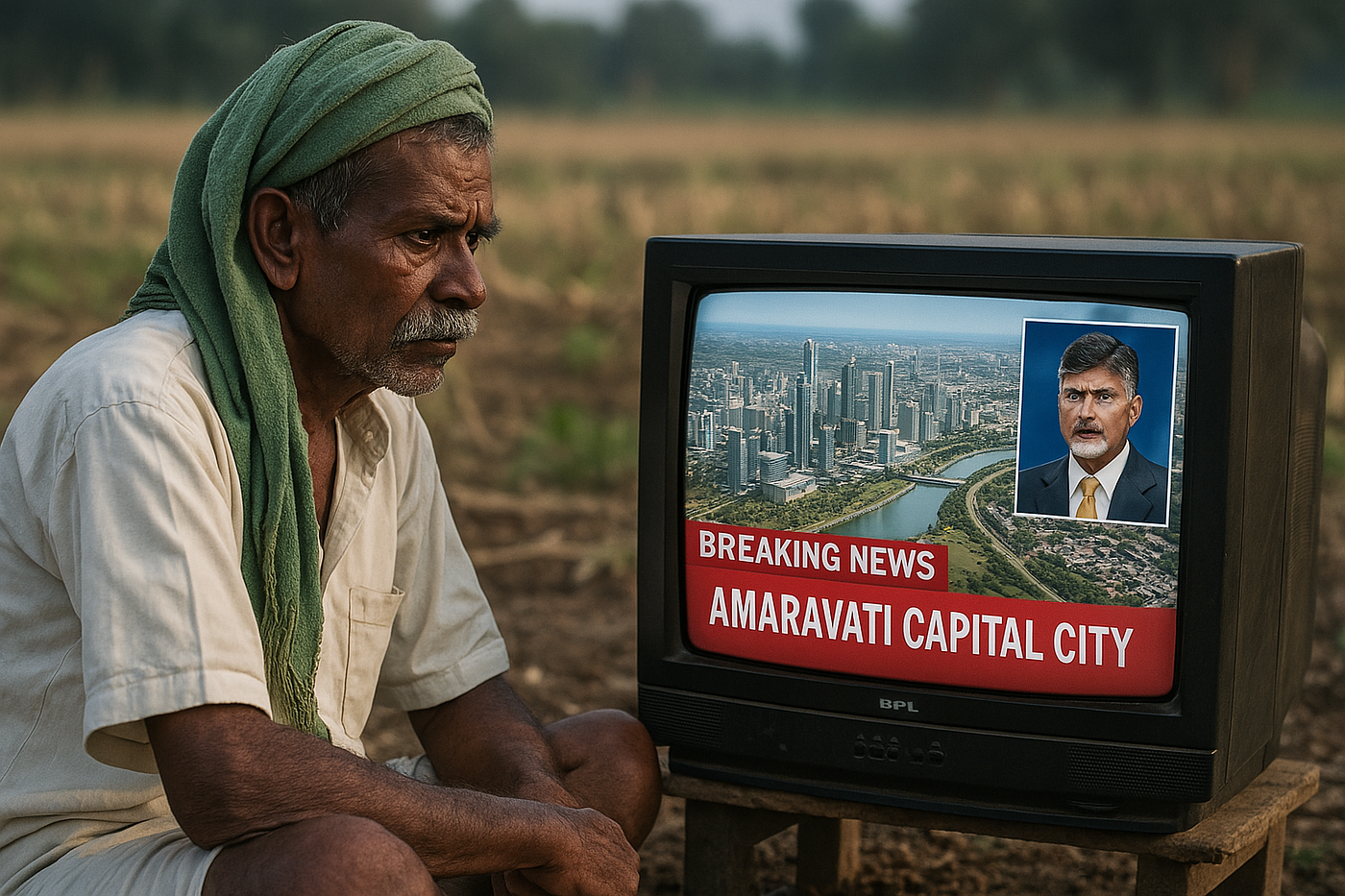
Concrete Promises, Crooked Paths: The Amaravati ORR Playbook
In an era where infrastructure is equated with development, the announcement of a 189-km Outer Ring Road (ORR) in Amaravati — a city that…
Concrete Promises, Crooked Paths: The Amaravati ORR Playbook

In an era where infrastructure is equated with development, the announcement of a 189-km Outer Ring Road (ORR) in Amaravati — a city that doesn’t yet exist in any functional form — raises fundamental questions: Who is it for? Why now? And at what cost?
Marketed as a symbol of future-readiness, the Amaravati ORR is less about mobility and more about real estate mapping, political financing, and institutionalized displacement. It follows a global pattern of infrastructure being used as a tool — not to solve real urban problems — but to manufacture legitimacy and extract value from land, people, and public funds.
A City Without a Pulse, Yet a Ring Road?
In cities across the world, ORRs are typically introduced as a response to:
- Explosive population growth
- Inner city traffic saturation
- Regional logistics demand
- Infrastructural fatigue within a functioning urban system
But Amaravati doesn’t meet even a single criterion. It is still a fledgling political idea wrapped in concrete dreams. There’s no urban congestion to ease, no metro or regional rail to integrate with, and no economic activity warranting large-scale freight diversion.
Planning an ORR at this stage is like building the roof before laying the foundation. It assumes a city will grow around the road. But history tells us that urban growth doesn’t follow concrete — it follows community, commerce, and culture.
When governments initiate mega roads before core infrastructure, they project the illusion of a developed city. The ORR becomes a billboard for ambition, not a backbone for necessity. And in that illusion, speculation thrives, capital concentrates, and governance is reduced to choreography.
Amaravati’s ORR is Cutting Through One of the Most Cultivated Deltas in India
Beneath the concrete corridor, an entire ecological network is being dismantled. Streams redirected. Canals filled. Forests cleared. Fertile soil sealed. This rich and renowned Delta is:
- Known for its canal-fed agriculture, the region supports rice, chillies, pulses, and horticulture.
- It sustains seasonal wetlands, supports migratory bird paths, and offers natural flood buffers.
- The expansion and execution of ORR will displace irrigation lines, water tanks, and bund systems — irreversible damages not counted in cost-benefit analyses.
When agricultural lands are fragmented and road-access becomes restricted, the younger generation often exits farming. The transition is swift and violent:
- Crops fail.
- Families sell under distress.
- Land ends up in the hands of developers.
In the name of connectivity, we disconnect people from land, culture, and food sovereignty.
Oversizing as a Strategy of Extraction
The Amaravati ORR, originally planned at 70 meters, is now being proposed for expansion to 140 meters, making it the widest ring road in the world. Wider than Beijing’s, Seoul’s, or Washington D.C.’s — even though Amaravati doesn’t have 1% of their traffic or density. This isn’t urban foresight. It’s infrastructural bloat designed to:
- Acquire more land from rural communities under the veil of public good
- Create inflated construction contracts for favored firms
- Set up speculative belts of resale-ready real estate
The doubling of width translates to double the displacement, double the environmental degradation, and double the political rent-seeking. The concrete serves a few. The cost is shared by many. Global comparisons reveal the absurdity:

Amaravati’s Proposed Outer Ring Road Outpaces Global Megacities
The road in Amaravati ORR is not being widened for vehicles. It’s being widened for speculation.
The Mechanics of Monetizing ORR
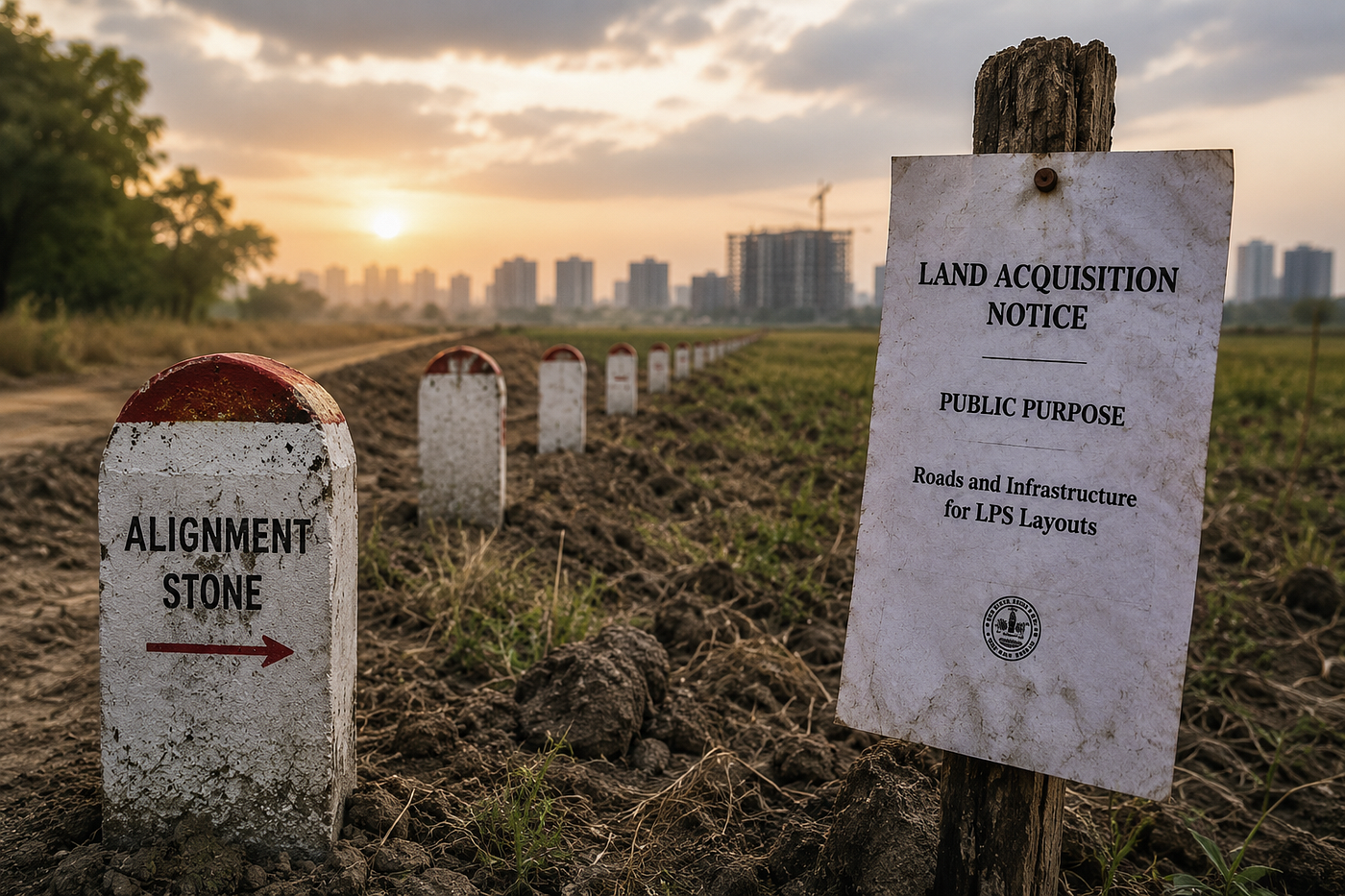
Every major announcement tied to the ORR — whether a survey, a notification, or a groundbreaking — sets off a wave of speculative land deals. But this isn’t market optimism. It’s state-sponsored speculation.
- Pre-alignment insiders acquire land cheaply in silence.
- Official announcements trigger price spikes, benefitting those who had advance access.
- Landowners in target zones — mostly farmers, SC/ST families, and assigned beneficiaries — are offered forced sales or meager compensation.
- The state declares public purpose, while private entities capitalize on the perception of impending growth.
In Amaravati, ORR development isn’t based on economic data — it’s based on a choreography of ceremonies and engineered perception. A single board marking “ORR begins here” can double land prices overnight, while the people who lose their land disappear from the master plan entirely.
The ORR is not just a ring of concrete. It is a system of incentives designed to extract value, not create it. There are deeper, less visible mechanisms at work — strategies that weaponize infrastructure to entrench power and wealth:
1. Digital Dispossession — Land records are manipulated digitally to remove rightful claimants or reclassify commons as private holdings.
2. Social Targeting — Villages that resisted land pooling or supported political opposition often find themselves in the alignment path.
3. Legal Bypasses — Environmental clearances are fast-tracked. Land ceiling violations are bypassed through “infrastructure exemption zones.”
4. Institutional Legitimacy Laundering — Funding from institutions like ADB or the World Bank is used not just for capital — but for credibility, despite poor on-ground outcomes.
5. Electoral Symbolism — Even a half-finished road with LED lights becomes a photo-op, a claim to vision, a spectacle of progress.
Infrastructure becomes a substitute for governance. A stage, not a solution.
Displacement, Debt, and Despair: The Hidden Cost of Concrete
Most people impacted by ORR don’t move into cities. They move into poverty.
Assigned landowners — many from marginalized Dalit families — see their assets taken without long-term rehabilitation. Tenant farmers, who have no official claim to the land, receive nothing. Laborers who depended on agriculture find themselves unemployed are pushed to in to construction industry, to earn daily wages with no options left.
Meanwhile, the state enters into public-private partnerships with toll operators, guaranteeing revenue projections that often never materialize. The traffic estimates are inflated; the state ends up paying shortfalls from public funds.
This is how infrastructure debt grows: not through failure of engineering, but through success of political misdirection.
What Lies Beyond the Ring
Amaravati’s ORR project is a masterclass in how infrastructure can be weaponized — not for movement, but for manipulation. It is a tool to alter land relations, reward loyalty, and manufacture the appearance of governance.
What’s being built is not just a road — it is a boundary. A boundary between those who benefit from development, and those who are buried beneath it. The future of India’s cities must not be drawn by asphalt alone. It must be shaped by justice, by memory, and by those who refuse to be erased.
If left unchecked, the ORR will not mark the boundary of a new capital — it will mark the beginning of a systemic betrayal, where roads are paved not for people, but for power.
메타데이터
- post_id
- 0d42befaaa36
- slug
- concrete-promises-crooked-paths-the-amaravati-orr-playbook-0d42befaaa36
- url
- https://medium.com/amaravati-speaks/concrete-promises-crooked-paths-the-amaravati-orr-playbook-0d42befaaa36
- canonical_url
- https://medium.com/amaravati-speaks/concrete-promises-crooked-paths-the-amaravati-orr-playbook-0d42befaaa36
- author_url
- https://medium.com/@theramnutakki
- status
- ok
- fetched_at
- 2026-08-18 02:41:29