7 Ways AI Is Quietly Killing Your Business Presentations.
Building a great presentation has always been time-consuming. Research, structure, narrative, design — there’s no shortcut to getting it…
7 Ways AI Is Quietly Killing Your Business Presentations.
Building a great presentation has always been time-consuming. Research, structure, narrative, design — there’s no shortcut to getting it right.
Then AI walked in and changed the deal. A full deck in minutes. No more staring at blank slides. Just describe what you need, and watch it appear.
Sounds like the fix everyone was waiting for. But does it actually save you time?
Here’s what’s actually happening.
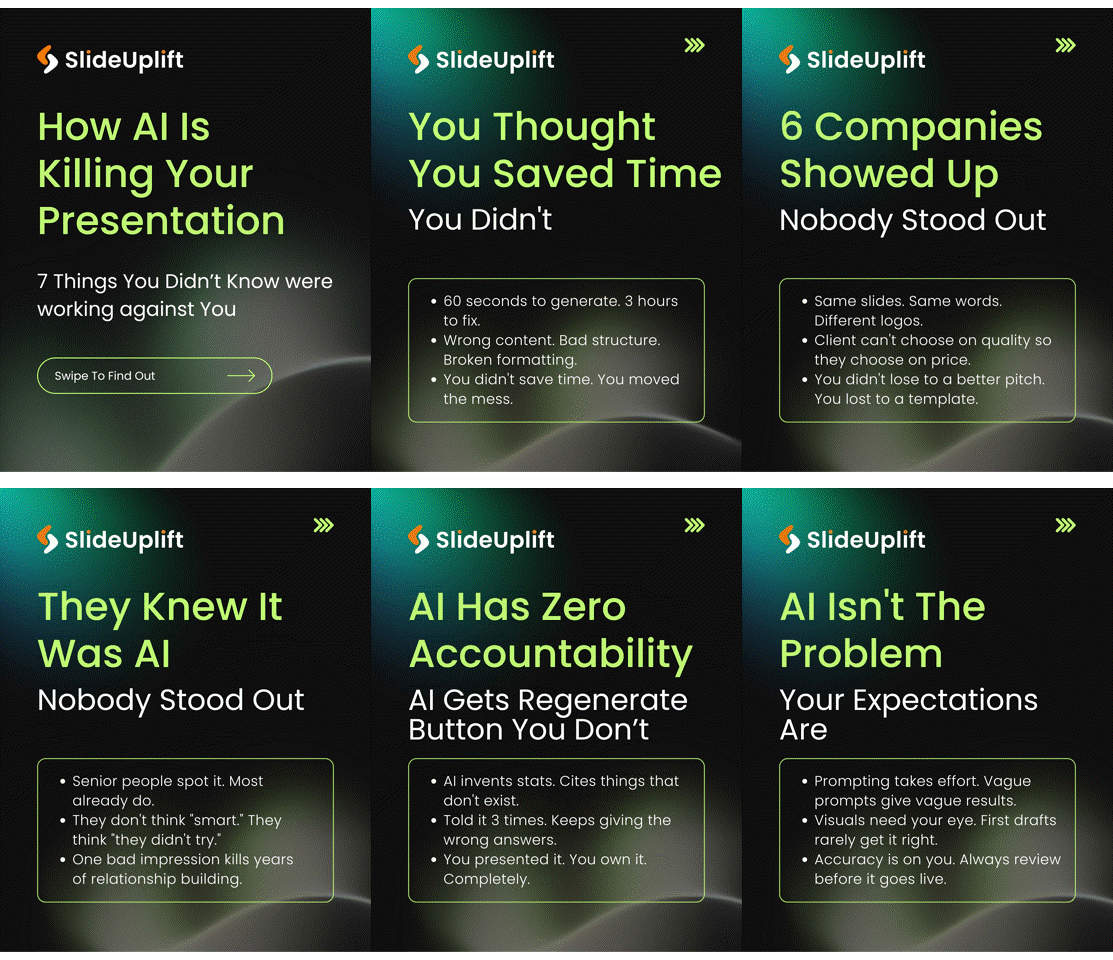
1. You thought you saved time. You moved the mess.
The promise of AI-generated slides is seductive: type a prompt, get a deck in 60 seconds. And technically, yes — you do get something in 60 seconds.
The problem is what comes next. Wrong structure for your audience. Content that’s 80% generic filler. Formatting that looks fine in the AI preview and breaks the moment you open it in PowerPoint. A narrative arc built for a hypothetical pitch, not your actual one.
You spend the next three hours fixing it. Adjusting, rewriting, reformatting, second-guessing. The deck that was supposed to take 60 minutes now took five hours — and it still doesn’t feel quite right.
AI didn’t save you time. It gave you a first draft that looked like a finished product, which is actually harder to fix than a blank slide. A blank slide invites original thinking. A nearly-complete deck invites tinkering.
What to do instead: Use AI for ideation and structure, not execution. Ask it for an outline, a list of objections your audience might have, or three different narrative angles for the same content. Then build the slides yourself — or use structured templates that enforce consistency from the start — so you’re editing signal, not noise.
2. Your brand is falling apart. Quietly.
Here’s a scenario that plays out in companies every day: a sales rep builds a deck using AI. A consultant builds one using a different AI tool. The marketing team has its own workflow. Nobody coordinates.
The client sees three different versions of your brand in one month. Different fonts. Different color choices. Different tone — clinical in one, casual in another, buzzword-heavy in a third. Different ways of describing what your company actually does.
Nobody stole your brand. Your own team is quietly dismantling it, one AI-generated slide at a time.
Brand consistency isn’t just a design principle — it’s a trust signal. When a prospect encounters your company multiple times and it looks different every time, their brain registers something is off, even if they can’t name it. It erodes confidence before your salesperson even opens their mouth.
What to do instead: Centralize your presentation assets. Lock down a master template with approved fonts, colors, and messaging that AI tools and team members pull from — not one they freestyle on. The creative flexibility lives in content, not in whether your logo is 12px or 18px this week.
3. Six companies showed up. Nobody stood out.
This one is the most expensive problem, and the least visible.
When AI tools generate presentation content, they draw from the same massive corpus of professional writing, business frameworks, and design conventions. That’s why an AI-generated McKinsey-style deck looks like every other AI-generated McKinsey-style deck. The structure is borrowed. The language is borrowed. The visual logic is borrowed.
In a competitive pitch, that means you’re competing on the same aesthetic terrain as everyone else in the room. The client can’t differentiate on quality, so they differentiate on price. You didn’t lose to a better pitch — you lost to a template.
The decks that actually win are the ones that feel like they could only have come from you. Your point of view. Your specific understanding of the client’s problem. Your aesthetic choices, made deliberately.
What to do instead: Use AI to speed up the parts that don’t differentiate you — formatting, initial structure, proofreading. Invest your actual creative energy in the parts that do: the opening hook, the specific insight only your team has, the one slide that makes the client lean forward. That’s where the win is.
4. Senior people can already tell. And it changes how they see you.
There’s a widespread assumption that AI-generated content is getting good enough that people can’t tell the difference. Some of it is. Most presentation content isn’t there yet.
Experienced professionals — the ones who have read thousands of documents, reviewed hundreds of pitches, sat through decades of meetings — have developed a finely tuned sense for writing that has no author behind it. They can feel the absence of a perspective. They notice when the confident-sounding language doesn’t actually commit to anything. They recognize the specific cadence of a ChatGPT paragraph.
And crucially, they don’t think “impressive, they used AI efficiently.” They think “they didn’t try hard enough to put something specific in front of me.”
One presentation that reads as AI-assembled can undo a year of relationship-building. Not always. Not inevitably. But the risk is real, and it compounds over time.
What to do instead: Read your own deck out loud before you send it. If a sentence could have been written by anyone about anything, rewrite it. Specificity is the tell. “We help companies grow revenue” reads as AI. “We helped a mid-market logistics company cut their sales cycle from 90 days to 34” reads as human.
5. You’re giving away your clients’ secrets without knowing it.
This one isn’t about optics. It’s about legal and ethical risk.
When you paste a client’s name, their pricing structure, their internal strategy, or their competitive concerns into an AI tool to help build a presentation, that data doesn’t stay inside your company. Depending on the tool, it may be used to train future models. It may be stored in ways your client didn’t consent to. It may be accessible to others.
Most enterprise AI tools have made strides on this. Most free and consumer-grade tools have not. And most companies using AI for presentations have no formal policy, no training, and no awareness of what’s actually happening to the data they’re feeding into these systems.
What to do instead: Treat your AI tool like a junior employee. You wouldn’t hand a freelancer your client’s full NDA and competitive strategy to build a deck. Apply the same judgment to the prompts you write. Anonymize sensitive details. Check your tool’s data retention policy. Push your organization to establish a clear AI usage policy before a client asks whether you have one.
6. AI gets a regenerate button. You don’t.
When an AI tool makes a mistake — invents a statistic, misattributes a quote, structures a financial model incorrectly — you hit regenerate. It tries again. It costs nothing.
When you present that mistake in front of a client, a board, or a funding committee, there is no regenerate. You own it, completely.
This asymmetry is the part of AI-assisted work that doesn’t get discussed enough. The tool has infinite patience and zero consequences. You have the relationship, the reputation, and the professional stake. A hallucinated market size figure in a deck that gets forwarded to a client’s CFO is not a technology problem — it’s your credibility problem.
What to do instead: Never let an AI-generated fact escape your review. Build a habit of verifying every statistic, every quote, every figure before it goes into a deck. It takes ten minutes. It’s the ten minutes that stands between you and having to explain to a client why you cited a study that doesn’t exist.
7. AI isn’t the problem. Your expectations are.
Here’s the part most AI productivity content skips.
AI presentation tools are genuinely useful. They can compress real work into real time savings. They can help a small team punch above its weight. They can take the terror out of a blank slide and give you something to react to.
But they are tools, not authors. They don’t know your client. They don’t know your point of view. They don’t know why this pitch matters, or what the room will be thinking when you walk in. They can’t do the one thing that actually wins: make a human feel like they’re dealing with another human who understands them.
The problem isn’t that people are using AI. The problem is that people are using it as a replacement for the thinking that makes presentations work, instead of an accelerant for it.
Prompting well takes effort. Vague inputs give vague outputs — which is why “write me a pitch deck for a SaaS company” produces something that could apply to 10,000 companies, not yours. Visuals need your eye. Accuracy needs your verification. The narrative needs your judgment about what this specific audience actually cares about.
What to do instead: Change the question from “how much can AI do for me?” to “where is my judgment irreplaceable?” Your strategic insight, your relationship knowledge, your ability to read a room — those are the inputs AI cannot replicate. Feed it everything else. Guard those.
The practical checklist
Before your next AI-assisted deck goes out, run through this:
- Structure: Does this narrative make sense for this audience, or does it feel generic?
- Brand: Is every slide consistent with the visual and verbal identity your company has agreed on?
- Differentiation: Is there at least one thing in here that could only have come from our team?
- Tone: Read it out loud. Does it sound like a person, or like a LinkedIn post?
- Data: Has every statistic and claim been verified against a real source?
- Privacy: Have you pasted any client information into a tool you don’t fully control?
- Ownership: Are you ready to defend every word in this deck if someone pushes back?
If the answer to any of those is uncertain, the deck isn’t ready.
AI has made it faster to produce a presentation. It hasn’t made it easier to produce a good one — because the hard part was never the production. The hard part is still the thinking. And that part is still on you.
The good news: once you know where AI is working against you, you can fix it. Use structured templates to lock down brand consistency. Use AI for outline and research, not for final copy. Verify everything before it leaves your hands. And save your real creative energy for the moments that actually differentiate you.
That’s how you walk into a room with six other companies and walk out with the deal.
What if most of these problems simply weren’t yours to solve anymore? Something’s coming. Early sign-ups find out first — sign up here.
Found this useful? Follow for more on business communication, presentations, and working smarter with the tools that are reshaping how we pitch.
메타데이터
- post_id
- 0d7c57d7e853
- slug
- 7-ways-ai-is-quietly-killing-your-business-presentations-0d7c57d7e853
- url
- https://medium.com/@slideuplifts/7-ways-ai-is-quietly-killing-your-business-presentations-0d7c57d7e853
- canonical_url
- https://medium.com/@slideuplifts/7-ways-ai-is-quietly-killing-your-business-presentations-0d7c57d7e853
- author_url
- https://medium.com/@slideuplifts
- status
- ok
- fetched_at
- 2026-06-09 15:37:30