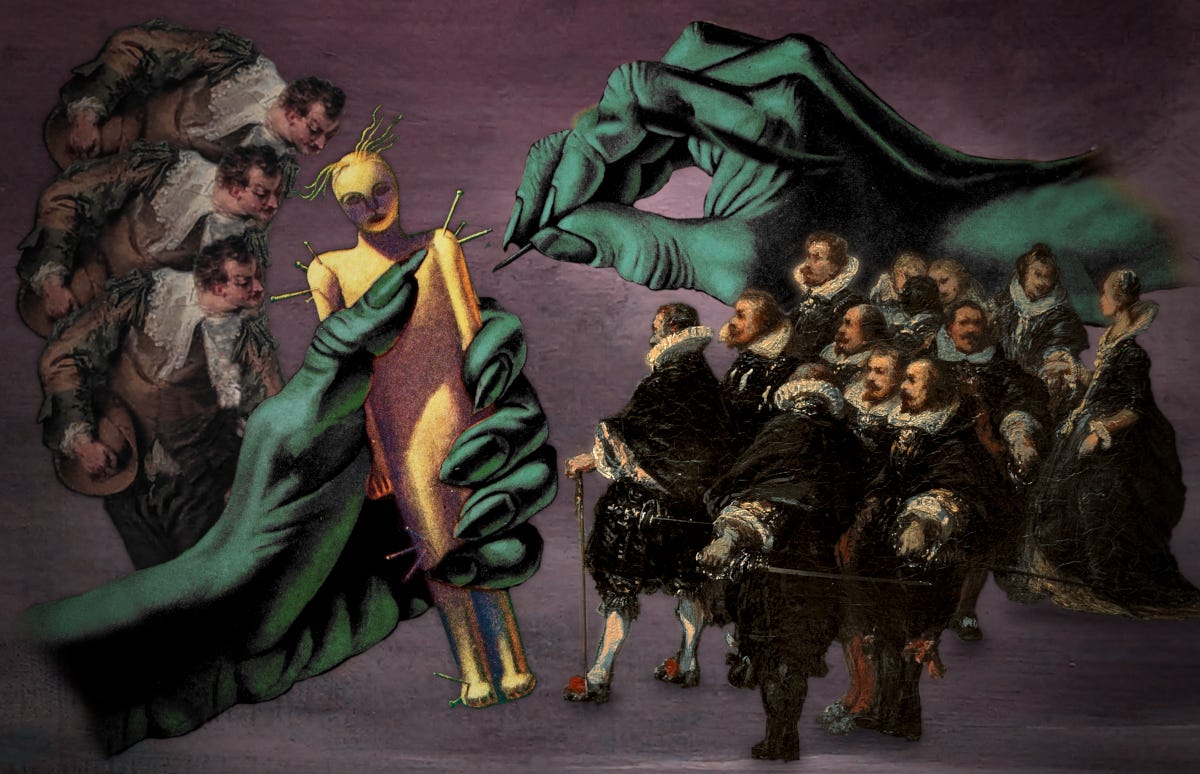
How A Western Democracy Engineered Its Own Extraction
Procedural Illusion, Witchdoctors, and the Financialization of the British Commons Through a Post-Colonial Lens
How A Western Democracy Engineered Its Own Extraction
Procedural Illusion, Witchdoctors, and the Financialization of the British Commons Through a Post-Colonial Lens
To an observer in New Delhi or any other capital of the global south, the contemporary economic spectacle unfolding in the United Kingdom carries a profound, ironical sense of familiarity. For centuries, the institutional machinery of the British Empire perfected the art of extraction on foreign shores, treating entire subcontinents as resource frontiers where profits were aggressively expatriated while the structural, environmental, and social liabilities were dumped squarely onto the native populace. As the political economist Prabhat Patnaik observed of that era, “The drain of wealth was not merely a transfer of surplus; it was the institutionalized hollowing out of the domestic economic engine” [1]. Today, however, the frontier of extraction has been brought home. In a bizarre historical inversion, the metropolitan core has deployed those exact same structural mechanics against its own domestic territory.
The vehicle for this modern internal colonization was the sweeping wave of privatization initiated under Margaret Thatcher (1979–1990) and sustained by successive administrations. Over the course of four decades, the baseline requirements of British human survival — water, electricity, transit, and shelter — were systematically carved up and handed over to private cartels. To the post-colonial eye, this was never an exercise in free-market modernization. It was, from its inception, a classic manifestation of what David Harvey terms “accumulation by dispossession,” a process where public wealth is enclosed and funneled into private hands [2]. What makes the British experiment so instructive to the rest of the world is that this massive corporate plunder was not executed by a foreign military dictatorship, but was instead legitimized, voted for, and cheered on within the framework of a mature, western procedural democracy.
1. The Illusion of the Polling Booth and the Elite Monopolization of Choice
The complete failure of the British public to mount an effective pushback against the systematic destruction of their own public assets exposes the profound limitations of what political theorists call procedural democracy — the mere performance of holding an election every five years. We are taught by civic textbooks that the franchise grants the citizen ultimate sovereignty. Yet, as Karl Marx dryly noted in the nineteenth century, “The oppressed are allowed once every few years to decide which particular representatives of the oppressing class shall represent and repress them” [3].
In a massive nation-state, procedural democracy does not empower the individual; instead, it creates an environment ripe for structural capture. The system functions through what the economist Mancur Olson identified as the asymmetry of collective action. Olson posited that “large groups are less able to act in their common interest than small, concentrated groups,” because a small corporate elite has billions of direct financial incentives to capture the state, whereas the general public’s resistance is diluted across millions of distracted individuals [4].
This structural vulnerability is compounded by what public choice theory calls “rational ignorance.” The economist Anthony Downs observed that in a large electorate, “the incentives for an individual citizen to become deeply informed on complex economic policies are near zero, because their single vote has a statistically negligible chance of altering the outcome” [5]. The corporate elite masterfully exploit this rational ignorance. By working through a compliant media apparatus, they systematically replace serious economic debate with high-emotion cultural wars, spectacles, and manufactured panics. As a result, the public is kept in a state of perpetual distraction. As the French sociologist Pierre Bourdieu observed, “The field of political production is an autonomous space where elites speak to other elites about the public, but never with them” [6]. This renders the actual voting process a superficial exercise in selecting the management team for an unchanging, extractive economic reality.
2. The Witchdoctors and the Architecture of Hegemony
This extraction could never survive on brute political force alone; it requires a highly sophisticated class of secular priesthood to legitimize it. These are the “witchdoctors” of the metropolitan core — an interconnected network of free-market think tanks (such as the Institute of Economic Affairs and the Adam Smith Institute), corporate-funded academics, and financial columnists who police the boundaries of public discourse. Their function fits perfectly within Antonio Gramsci’s definition of cultural hegemony: the process by which the ruling class manufactures consent, ensuring that “the subaltern classes accept the elite’s worldview as the natural order of things, as common sense itself” [7].
When the cracks in these privatized monopolies widen into catastrophic chasms, the witchdoctors do not question the foundational model. Instead, they deploy a reliable playbook of rhetorical deflections designed to insulate capital from public anger.
[Systemic Failure Occurs] ──► [Witchdoctors Deploy Alibi] ──► [Public Consent Restored]
When a water company dumps raw sewage into public rivers, the witchdoctors immediately orchestrate the Flawed Regulation Alibi, arguing that the model itself is flawless but the state-appointed referee merely failed. This obfuscates what Noam Chomsky described as the inevitable reality of corporate-state relations: “The regulatory apparatus is almost invariably captured by the very interests it is meant to oversee” [8].
If an energy supplier or rail network collapses entirely and demands a multi-billion-pound taxpayer bailout, the witchdoctors pivot seamlessly to the Purest Trap, invoking the classic libertarian defense that “true capitalism hasn’t been tried yet.” They echo the warning of the economic historian Karl Polanyi, who noted in The Great Transformation that “the idea of a self-adjusting market implied a stark utopia,” one that cannot physically exist in the realm of natural monopolies without completely destroying the human and natural substance of society [9]. Yet, because these witchdoctors dominate the narrative architecture, they successfully shield the financial elite from accountability. Their intellectual gymnastics validate Upton Sinclair’s famous aphorism: “It is difficult to get a man to understand something, when his salary depends upon his not understanding it” [10].
3. Eight Case Studies in Rentier Capitalism
The material consequences of letting these witchdoctors direct national policy are visible across eight distinct, broken sectors of British infrastructure. Together, they constitute a textbook study in what Guy Standing calls rentier capitalism, where profits are generated not through genuine economic production or innovation, but through the monopolistic control of an essential asset [11].
I. Water and Sewage (England & Wales)
Privatized entirely in 1989, England and Wales became the only nations on earth to hand their entire fresh water supply over to private operators. Free from competition, these corporations operated under the pure logic of financialization. Over thirty-five years, they loaded the water network with over £60 billion in debt, while simultaneously declaring £52.7 billion in statutory dividends between 1992 and 2024 [12]. As the geographer Brett Christophers documented in his study of rentier economies, “The asset ceases to be a public utility and becomes a debt-generating vehicle designed to strip wealth” [13].
The consequences are visible in environmental degradation: outdated networks cannot cope, leading companies to systematically discharge millions of tons of raw sewage into Britain’s historic rivers and coastlines. Thames Water, the nation’s flagship utility serving 16 million people, sits on the edge of total financial insolvency in 2026, saddled with over £16 billion in debt, forcing the government to step up preparations for a Special Administration Regime (SAR) after rejecting a corporate rescue plan that failed to protect consumers [12].
II. Railtrack (The Railway Infrastructure)
In 1996, the British state split its national rail network, handing the physical tracks, signals, and stations over to a private monopoly named Railtrack. Operating under intense pressure to maximize short-term equity returns, Railtrack systematically deferred vital track maintenance and shed senior engineering expertise to slash operational costs. This corporate negligence led directly to a series of fatal rail disasters, culminating in the Hatfield rail crash (2000), where a fractured rail — known to engineers but left unreplaced — caused a high-speed derailment. The catastrophe proved that when safety is subordinated to dividends, the state is eventually forced to step in. Railtrack went bankrupt in 2001, forcing the government to absorb billions in liabilities and effectively re-nationalize the tracks under Network Rail.
III. Passenger Rail Franchises
Passenger train operations were fragmented into a chaotic patchwork of private regional franchises. Rather than generating efficiency, the model resulted in UK commuters paying some of the highest fares in Europe for increasingly delayed and overcrowded services, all while the operators relied heavily on public subsidies to maintain profitability. This parasitic relationship aligns with the economist Mariana Mazzucato’s critique of the modern corporate state: “We have a system that socializes the risks while privatizing the rewards” [14].
The franchise model has completely fractured. Major operators like Northern Trains, TransPennine Express, and ScotRail have been stripped of their contracts due to continuous, chaotic cancellations, and brought back into public hands under the state’s “operator of last resort” mechanism.
IV. Energy Distribution (The Supply Crisis)
The privatization of British Gas (1986) and the regional electricity boards was heralded as a triumph for consumer choice. In reality, the market rapidly consolidated into an oligopoly known as the “Big Six,” which weaponized its market leverage to aggressively escalate prices. When global energy shocks hit, the sheer fragility of this speculative supply market was laid bare as dozens of smaller private suppliers collapsed overnight. When Bulb Energy went under, the state provided a £3.02 billion taxpayer rescue package to keep the lights on for 1.5 million homes, confirming that the public purse functions as the ultimate financial insurance policy for private commercial failure.
V. Royal Mail
The privatization of the historic postal service in 2013 represented the realization of a long-held Thatcherite goal. Once in private hands, the corporate entity shifted its primary focus toward highly lucrative parcel deliveries to compete with global logistics firms, intentionally letting its legally mandated “Universal Service Obligation” — delivering letters six days a week anywhere in the country for a flat rate — wither away. Letter delivery times crashed to historic lows, causing communities to miss critical medical appointments and legal correspondence. Despite this severe degradation of service, the firm continued to prioritize hundreds of millions of pounds in dividend distributions and stock buybacks, triggering prolonged labor strikes and permanent operational instability.
VI. The “Right to Buy” Housing Crisis
The iconic Housing Act of 1980 allowed millions of council tenants to purchase their public homes at massive, state-subsidized discounts. While celebrated as a triumph of individualism, the legislation legally barred local councils from reinvesting the revenues into building replacement social housing. Decades later, roughly 40% of those original council homes have been acquired by private buy-to-let landlords. Because there is now an acute shortage of social housing, local councils are forced to rent these exact same properties back from private landlords at soaring market rates to house vulnerable families. The state is trapped in a loop, spending billions annually in Housing Benefits to enrich private landlords to mitigate a housing crisis it engineered.
VII. Private Finance Initiatives (PFI)
Pioneered in the 1990s, PFI was a deceptive accounting mechanism designed to use private consortia to fund and construct public infrastructure like schools and hospitals, keeping the immediate capital debt off the government’s official balance sheet. These long-term contracts were packed with extortionate interest rates and mandatory, index-linked maintenance monopolies. Today, National Health Service (NHS) trusts find themselves legally locked into predatory, decades-long arrangements where private contractors charge thousands of pounds just to execute basic repairs like changing lightbulbs. Multiple hospitals now spend a crushing percentage of their frontline clinical budgets merely servicing historical PFI debts, even as the broader NHS faces a £13.8 billion maintenance backlog [15].
VIII. British Steel
Privatized in 1988 as a highly streamlined and profitable entity, British Steel was cast into the volatile waters of the global commodities market. Successive corporate owners chose to extract capital rather than invest in modern, low-emission electric-arc furnaces. When international steel prices slumped and industrial energy costs soared, these private owners repeatedly used the threat of mass layoffs and total plant closures to extort financial lifelines from the state. The UK government has been forced to repeatedly step in with hundreds of millions of pounds in emergency subsidies, propping up a strategic domestic asset whose historical profits had already been siphoned off by private equity.
4. The Seduction of Consent and the Fabrication of the Stakeholder
How did the British elite manage to win popular consent for this systematic asset-stripping? They did so by transforming the electorate from a collective civic body into a fragmented mass of short-term speculators. Thatcher’s genius lay in her understanding of what the sociologist Zygmunt Bauman called “liquid modernity,” an atomized state where collective solidarity is replaced by individual consumer anxiety [16].
Through the “Tell Sid” campaigns for British Gas, ordinary citizens were offered undervalued shares. They watched their stock value jump on day one and believed they were participants in wealth creation. In reality, they were victims of a macroeconomic sleight of hand. They traded their permanent, generational ownership of the nation’s fundamental infrastructure for a minor, one-time cash windfall. They were induced to behave like what the behavioral economist Daniel Kahneman identifies as systematically short-sighted actors, choosing immediate, minor personal gain over long-term collective security [17]. By turning citizens into minor shareholders and property speculators, the state successfully fractured the working-class coalition that could have organized resistance, effectively co-opting the public into underwriting its own ultimate exploitation.
5. The Permanent Moral Hazard
The structural wreckage of these eight utilities is not an accident of poor management; it is the logical, unalterable endpoint of introducing profit maximization into a natural monopoly. In a genuine capitalist market, if a company produces a poor product, consumers take their business elsewhere, and the failed firm goes bankrupt. But as the classical economist John Stuart Mill observed centuries ago, “A government which concedes a monopoly over a public good to a private company without strict price and quality controls grants a license to tax the public for private benefit” [18].
In the realm of infrastructure, there is no alternative market. A citizen cannot choose an alternative water pipe or lay a separate rail line to commute to work. Because these utilities provide the irreplaceable material foundation of society, they cannot be allowed to fail. This structural reality creates a permanent, systemic moral hazard, which the economic theorist Hyman Minsky warned would always lead to destabilizing corporate behavior:
“When the state guarantees the survival of an institution, management is incentivized to take extreme, destabilizing risks to maximize short-term profits, secure in the knowledge that the losses will be socialized” [19].
The private operators of Britain’s infrastructure understood this perfectly. They stripped the capital, deferred maintenance, ran up massive debts, and paid out billions in dividends, fully aware that when the pipes burst and the network broke, the state would have no choice but to step in with taxpayer funds to clean up the mess.
Conclusion: A Warning from the Post-Colonial World
For nations in the global south that are routinely lectured by western financial institutions on the virtues of deregulation, privatization, and good governance, the state of contemporary Britain offers a sobering cautionary tale. It demonstrates that the veneer of a mature, procedural democracy offers zero protection against the systemic extraction of public wealth by a determined elite.
When Margaret Thatcher passed away in 2013, her political allies mourned her as a transformative leader, while in the former industrial heartlands of the North of England, Scotland, and Wales, communities celebrated with the song “Ding Dong! The Witch Is Dead” — a stark reminder of how deeply polarized her legacy remains. Yet, while Thatcher the individual is gone, the structural loop she inaugurated continues to spin. The elite continue to extract wealth, the witchdoctors continue to manufacture intellectual cover, and the public continues to pay the bills.
Ultimately, the British experiment confirms the bitter realism of Frantz Fanon’s warning in The Wretched of the Earth:
“The wealth of the imperial nations was built on the backs of the colonized. When that frontier is exhausted, the predatory mechanics of capital accumulation do not disappear; they merely turn inward, seeking new victims within the borders of the mother country itself” [20].
Procedural democracy has not proven to be a shield against exploitation. Instead, it has served as the legal and narrative framework through which a society was successfully persuaded to vote for its own structural decline.
References
[1] Patnaik, Prabhat (2017). The Drain of Wealth and Colonial Macroeconomics. Oxford University Press.
[2] Harvey, David (2003). The New Imperialism. Oxford University Press. (pp. 137–182 on Accumulation by Dispossession).
[3] Marx, Karl (1871). The Civil War in France. Progress Publishers.
[4] Olson, Mancur (1965). The Logic of Collective Action: Public Goods and the Theory of Groups. Harvard University Press.
[5] Downs, Anthony (1957). An Economic Theory of Democracy. Harper & Row.
[6] Bourdieu, Pierre (1991). Language and Symbolic Power. Harvard University Press.
[7] Gramsci, Antonio (1971). Selections from the Prison Notebooks. International Publishers.
[8] Chomsky, Noam (1999). Profit over People: Neoliberalism and Global Order. Seven Stories Press.
[9] Polanyi, Karl (1944). The Great Transformation: The Political and Economic Origins of Our Time. Farrar & Rinehart.
[10] Sinclair, Upton (1935). I, Candidate for Governor: And How I Got Licked. University of California Press.
[11] Standing, Guy (2016). The Corruption of Capitalism: Why Rentiers Thrive and Work Does Not. Biteback Publishing.
[12] Ofwat Historical Dataset / UK Parliament Hansard (2026). Future of Thames Water and Sectoral Dividend Records (1992–2024).
[13] Christophers, Brett (2020). Rentier Capitalism: Who Owns the Economy, and Who Pays for It? Verso Books.
[14] Mazzucato, Mariana (2018). The Value of Everything: Making and Taking in the Global Economy. Penguin Books.
[15] NHS England (2026). Capital Guidance and Estates Return Information Collection (ERIC) Datasets.
[16] Bauman, Zygmunt (2000). Liquid Modernity. Polity Press.
[17] Kahneman, Daniel (2011). Thinking, Fast and Slow. Farrar, Straus and Giroux.
[18] Mill, John Stuart (1848). Principles of Political Economy. Longmans, Green, and Co.
[19] Minsky, Hyman (1986). Stabilizing an Unstable Economy. Yale University Press.
[20] Fanon, Frantz (1961). The Wretched of the Earth. François Maspero.
메타데이터
- post_id
- 0d7d3d677db7
- slug
- how-a-western-democracy-engineered-its-own-extraction-0d7d3d677db7
- url
- https://medium.com/@amit.amitsinha/how-a-western-democracy-engineered-its-own-extraction-0d7d3d677db7
- canonical_url
- https://medium.com/@amit.amitsinha/how-a-western-democracy-engineered-its-own-extraction-0d7d3d677db7
- author_url
- https://medium.com/@amit.amitsinha
- status
- ok
- fetched_at
- 2026-08-20 12:24:54