When the Prank Reveals Truth. Social Revenge in Maupassant
We must begin by establishing that Maupassant grew up in Tourville-sur-Arques in Normandy. When he writes about this region, he draws upon…
When the Prank Reveals Truth. Social Revenge in Maupassant

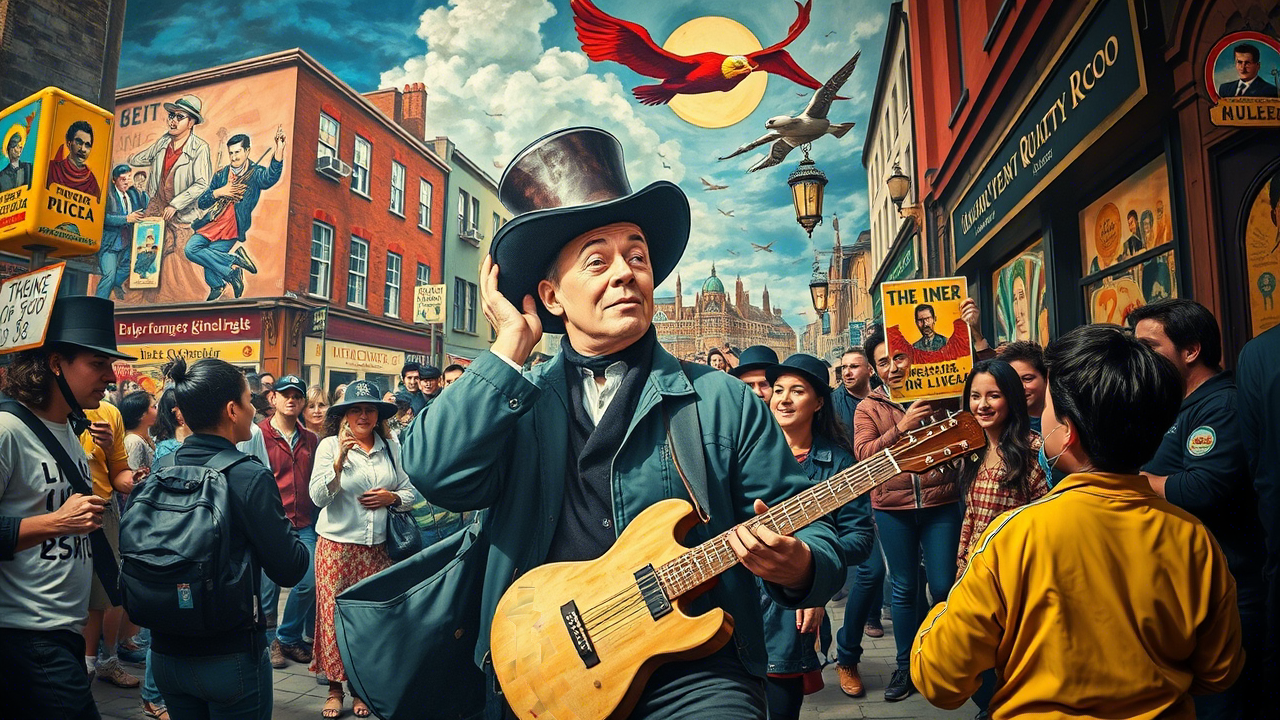
Illustration Artwork by Federico Berti. Created with Gimp/Fotor
We must begin by establishing that Maupassant grew up in Tourville-sur-Arques in Normandy. When he writes about this region, he draws upon places intimately familiar to him through their cultural patterns and social dynamics. This strongly rural, provincial tradition provided fertile ground for highlighting the hypocrisy and moral attitudes of respectable society, the attachment to material values, and the social tensions between landowners and peasants. Towards the end of the nineteenth century, Normandy also served as the stage for conflicts between the modernity brought by the industrial revolution and traditional customs, resulting in a coexistence of modern class conflicts alongside feudal traditions from the past.
We had previously encountered Normandy in another story that satirised matrimonial traditions and the alcohol-heavy celebrations still characteristic of that French region. This earlier tale featured a man forced to marry a woman after inadvertently entering her room whilst returning drunk from a dance. On that occasion, Maupassant specifically addressed the epic Norman weddings as a deeply rooted tradition of rural France.
In this present work, the author advances further by addressing two fundamental themes: that of student pranks during wedding celebrations, and that of economic interests attributed to landowners who never tire of watching over their properties, even during their wedding night. The image of the groom rising from his bed, where his newly wed wife awaits him anxiously, to take up his rifle and shoot at suspected wood thieves whom he fears are stealing his timber, inherently carries the satirical tone concerning the greed of landowners.
Naturally, it is precisely upon this characteristic that the groom’s friends and companions play their trick. These companions do not all belong to his same social class, and they stage the nocturnal theft of wood to create an opportunity to mock the landowner by tying him to a tree and placing around his neck game that was hunted on his property that very night.
This represents more of a carnivalesque jest than a nuptial prank, wherein one can also discern a component of revenge for what appears to be an attitude more attached to material possessions than concerned with personal relationships. The groom presents himself in the narrative as miserly and avaricious, someone who even during moments of festive conviviality demonstrates readiness to take up his rifle to chase poachers from his land.
The unknown aggressors leave the man tied up throughout the entire night on his property and disappear without allowing themselves to be recognised. He is discovered only the following morning. The prank is immediately classified as such, and consequently no one considers treating it as an act of aggression punishable by law. These are simply things that occur during epic Norman weddings, student pranks and nothing more.
No investigations are conducted therefore. Given the festive occasion and the extraordinary climate of the celebrations, the matter passes without consequence, whilst not losing its intimidatory value. The same act, performed at another time, would have been interpreted as an open threat, a warning message. However, occurring as it does at the climax of a wedding celebration, it assumes the character of an innocent jest.
This innocence, however, must not be confused with naivety. The act itself remains significant, constituting a full-scale aggression justified by the exceptional nature of the context, yet it does not lose its subtext. Norman society is sending the groom a clear message: think more about your family than about material goods, consider whether you might enjoy life somewhat with your loved ones instead of constantly worrying about your timber, your land, and your game.
메타데이터
- post_id
- 0d7e5bda6cd3
- slug
- when-the-prank-reveals-truth-social-revenge-in-maupassant-0d7e5bda6cd3
- url
- https://medium.com/the-short-story-review/when-the-prank-reveals-truth-social-revenge-in-maupassant-0d7e5bda6cd3
- canonical_url
- https://medium.com/the-short-story-review/when-the-prank-reveals-truth-social-revenge-in-maupassant-0d7e5bda6cd3
- author_url
- https://medium.com/@bertitacabanda
- status
- ok
- fetched_at
- 2026-08-02 22:42:55