Beyond the QR: Integrating Rubik’s Cube Cryptography into 2D Barcodes
At Draft QR, a B2B SaaS tool focused on data tracking and Digital Product Passports (DPPs) for textiles, we’ve been exploring ways to…
Beyond the QR: Integrating Rubik’s Cube Cryptography into 2D Barcodes
At Draft QR, a B2B SaaS tool focused on data tracking and Digital Product Passports (DPPs) for textiles, we’ve been exploring ways to enhance product security and traceability. Standard QR codes, particularly the compact 21x21 grid (Version 1), are incredibly versatile but have severe limitations for high-security supply chain needs, such as complying with incoming EU regulations. They are static, binary, and relatively easily copied. Crucially, a Version 1 code offers only about 25 alphanumeric characters, or 17 bytes of data capacity, allowing just one level of public routing. To build the future of Digital Product Passports for textile manufacturing hubs like Tiruppur and Dhaka, we needed to look beyond these constraints.
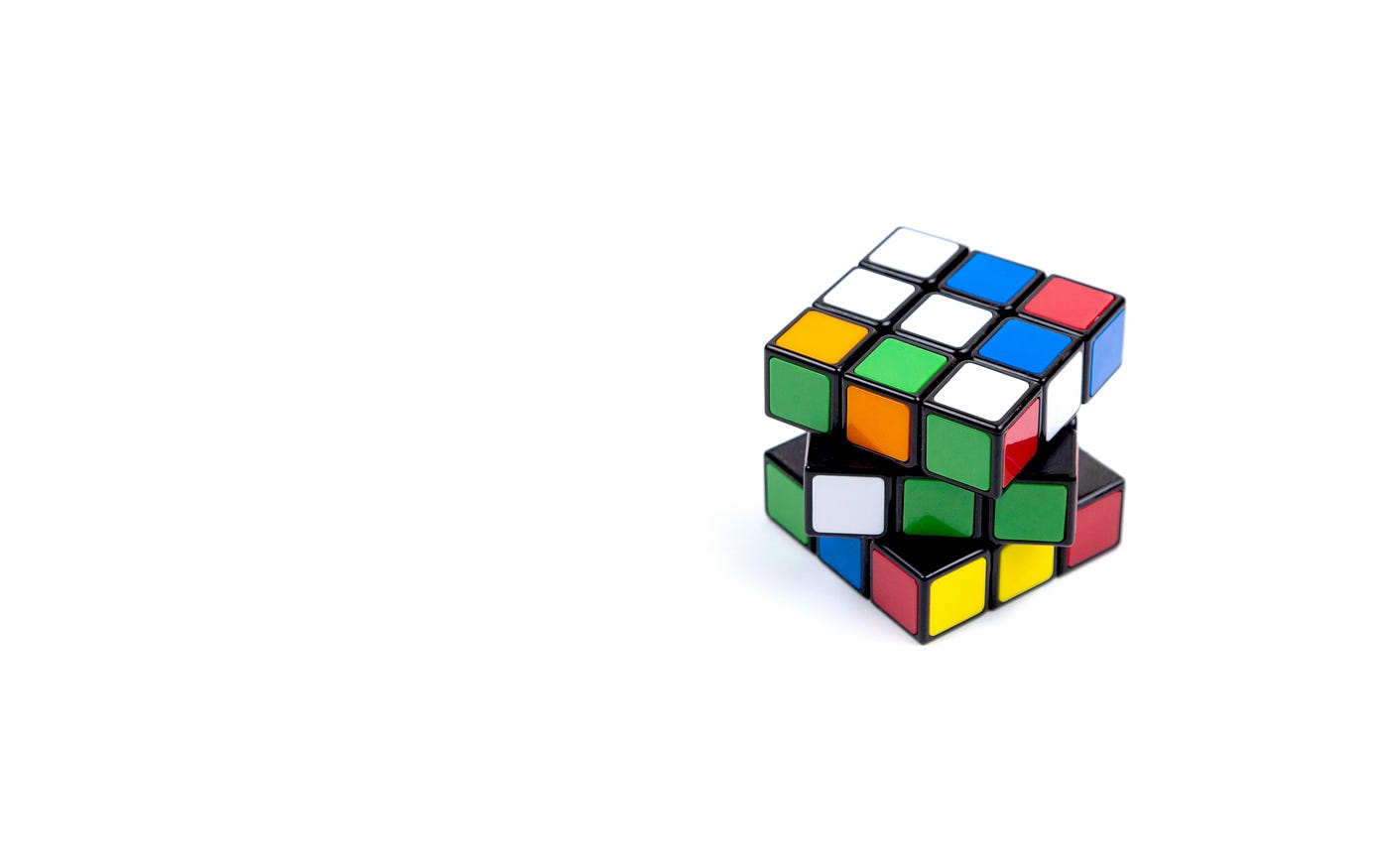
We found our inspiration in a classic source of mathematical complexity: the Rubik’s cube.
The Solvability Check: A Revolutionary Authentication Layer
The core breakthrough in our concept came from an incredibly clever insight: using the mechanical rules of a 3x3x3 Rubik’s cube as a built-in cryptographic checksum. Our proposed concept involves unfolding the complex, 3D structure of a scrambled cube into a flat, 2D net. By requiring that this printed 2D net represents a state that is mathematically solvable, we create a powerful, multi-state validation mechanism.
This solvability check acts as a primary firewall against counterfeiting. If a counterfeiter attempts to generate their own random pattern on the 2D net, they face a staggering challenge: there is only a 1 in 12 chance (≈8.3%) that a random combination will represent a validly solvable cube state. Our scanner app can instantly reject 91.7% of fakes locally, without needing an internet connection to query a database.
This enables offline “Zero-Knowledge” validation. An auditor in a disconnected warehouse can scan the code, verify the unsolvability of the printed 2D net, and instantly identify counterfeit goods before accessing sensitive supply chain data.
The MorphoMatrix Concept: Dual-Zone Security
To make this concept physically viable for the textile industry, we had to address printing costs. Factories in manufacturing hubs like Tiruppur rely on fast, inexpensive monochrome thermal printers for garment care labels. Requiring a full-color code, which we initially explored with the “ChromaMatrix”, would have been prohibitively expensive.
Our solution is the MorphoMatrix. We maintain the massive mathematical complexity of the Rubik’s cube by using six distinct black-and-white geometric shapes as “state variables,” such as solid and hollow squares, circles, and triangles, instead of six colors. This allows factories to use their existing thermal printers while achieving tremendous cryptographic depth.
The resulting code uses a “dual-zone” architecture:
- The Core: A standard 21x21 black-and-white QR code remains in the center for public routing, accessible by any consumer’s smartphone to view basic brand information.
- The Secure Halo: Surrounding the core is a complex border (the halo) built from the sequences of our six distinct B&W shapes. This zone holds the multi-state cryptographic key.
Translating Complexity into Tracking Power
A 3x3x3 Rubik’s cube possesses over 43 quintillion permutations (43,252,003,274,489,856,000). This translates into exactly 65 bits of information. By applying this complexity to our shape sequences, a sequence of just 25 of these shapes can generate over 28 quintillion unique states.

This allows for truly dynamic, stateful tracking within the Digital Product Passport. As a product moves through its manufacturing lifecycle — from a raw material to a finished garment — the digital state of the data tied to that physical tag can “twist” to append new, immutable cryptographic signatures for each stage, mimicking the dynamics of a solving cube.
The dual-zone MorphoMatrix tag supports role-based access tiers:
- Consumer: Scans the 21x21 QR core to see public compliance data and care instructions.
- Auditor/Customs: Scans the core URL plus the secure halo of shapes, which acts as a dynamic key to unlock sensitive tier-1 supplier certificates and carbon footprint data in the backend database.
- Recycler: Uses a specific organizational scan to reveal the exact chemical dye composition and material blends needed for proper textile sorting.
Looking Forward: Symmetrical V2
Our prototype layout has evolved to optimize scanning performance on the narrow care labels typical in textiles. While our V1 design appended the solvable 2D net as an irregular cross to the corner of the QR code (see image 6), we have refined the layout into a symmetrical border of smaller 3x3 nets (see image 7). This symmetrical structure ensures optimal framing and superior scanability for warehouse environments, making it a powerful candidate for Draft QR’s high-security textile tracking platform.
We are excited about the potential of bringing military-grade cryptographic complexity to flat, cheaply printable monochrome labels, providing an unbeatable solution for Digital Product Passports in the textile industry.

메타데이터
- post_id
- 0dab1378adfa
- slug
- beyond-the-qr-integrating-rubiks-cube-cryptography-into-2d-barcodes-0dab1378adfa
- url
- https://medium.com/@subashmatheswaran/beyond-the-qr-integrating-rubiks-cube-cryptography-into-2d-barcodes-0dab1378adfa
- canonical_url
- https://medium.com/@subashmatheswaran/beyond-the-qr-integrating-rubiks-cube-cryptography-into-2d-barcodes-0dab1378adfa
- author_url
- https://medium.com/@subashmatheswaran
- status
- ok
- fetched_at
- 2026-06-11 05:11:55



