From Rationality to Reality: How Interdisciplinary Research Enhances Economic Understanding
Economics is an arrogant science. The models are perfect, and the people are rational — unlike reality.
From Rationality to Reality: How Interdisciplinary Research Enhances Economic Understanding
Economics is an arrogant science. The models are perfect, and the people are rational — unlike reality.
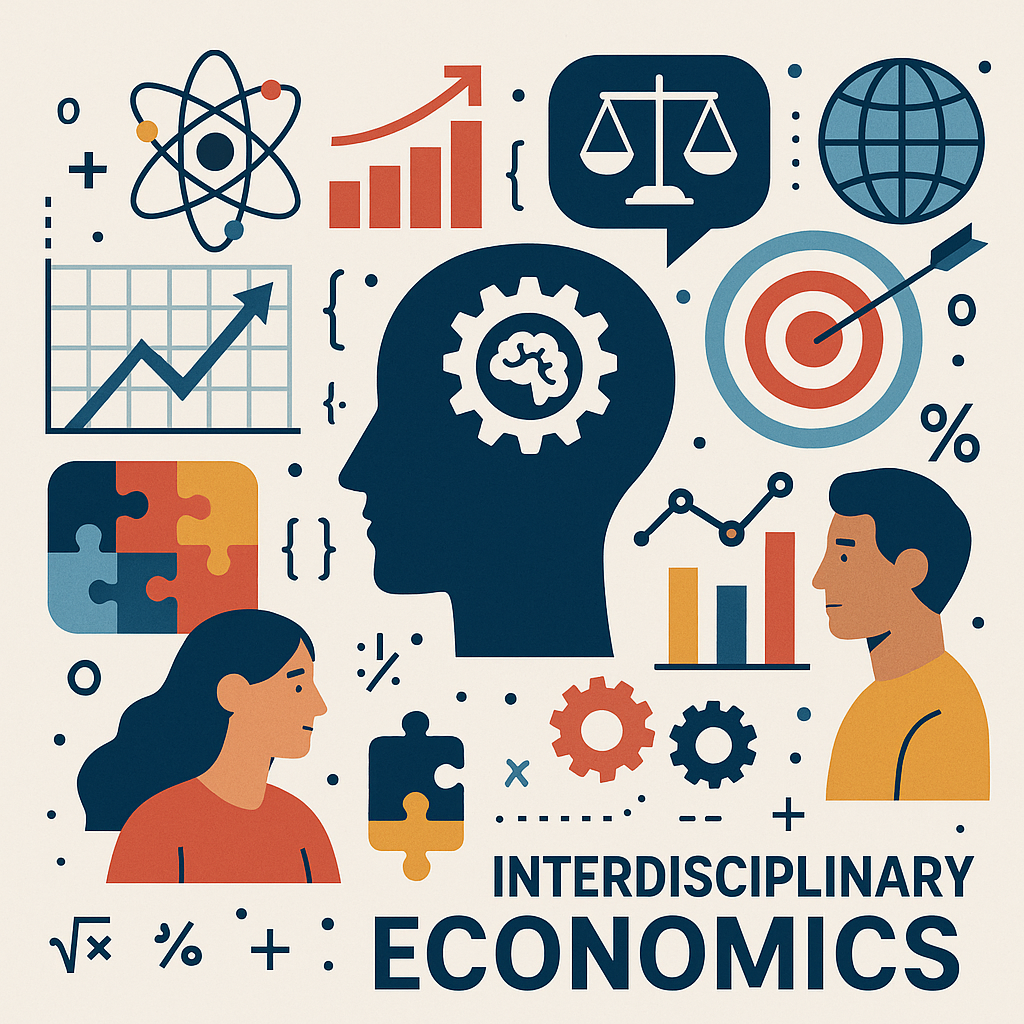
(AI Generated)
Economics has long relied on traditional methods rooted in mathematical models, statistical analysis, and theoretical frameworks to understand and predict complex economic phenomena. While these methods have provided valuable insights into market behavior, resource allocation, and policy impacts, they are not without limitations. Traditional approaches often prioritize equilibrium models and assume rational behavior, which can oversimplify the dynamic and interconnected nature of real-world economic systems. This essay explores the inherent limitations of traditional economic methods and discusses how incorporating new methodological approaches, including interdisciplinary borrowing, could enrich economic analysis.
Economics is often critiqued for its reliance on assumptions about human behavior. It is a social science built on an infinite set of assumptions, reflecting the complexities of human behavior and market dynamics. Economic laws and theories often end in the phrase “ceteris paribus” — all else being equal — whereas, in reality, that is never the case. Central to these assumptions is the concept of rationality. Traditional economic models presuppose that individuals and firms decide to maximise their utility or profits. This simplification often overlooks factors like bounded rationality or irrational behaviours. The model of Homo Economicus — the economic man — confidently advocates for rational, utility-maximizing, and self-interested behaviour, with limited integration of insights from neuroscience and psychology. Markets are presumed to reach equilibrium efficiently through supply and demand interactions despite real-world imperfections and frictions. In reality, perfect information — where all participants have complete knowledge about prices, products, and market conditions — rarely exists. Information gaps can lead to inefficiencies, as consumers and producers may make suboptimal decisions based on imperfect information. Mathematical models are fundamental to economic analysis but rely on simplifying assumptions to make complex phenomena tractable. Several models assume linear relationships between variables for analytical simplicity, whereas economic relationships are often nonlinear, involving feedback loops, thresholds, and tipping points. Linear models can miss these complexities, leading to inaccurate predictions and policy recommendations. Predictive limitations are inherent in mathematical models due to the uncertainties and unpredictable shocks that characterize economic systems. Models are sensitive to initial conditions and parameter values, which may not be known with precision. This sensitivity can lead to significantly different outcomes based on slight variations in inputs. For example, macroeconomic models used for forecasting can produce varying results depending on assumptions about consumer behavior, government policy, and external shocks, making accurate prediction challenging (Stock & Watson, 2001). Data limitations further constrain the accuracy and applicability of mathematical models. Models rely on data for calibration and validation, but data may be incomplete, inaccurate, or unavailable, especially in emerging markets or for new economic phenomena.
There have been attempts, in recent times, to look beyond the economic man and understand the complexities of human behaviour. There have been popular discussions where economists have argued that a wide range of motivations for individuals, ranging from altruism to self-interest, might influence the decision-making process. This argument surfaced only when we integrated the dimension of other disciplines into our theories. The prospect theory by Daniel Kahneman and Amos Tversky in Behavioural Economics (Psychology) incorporates psychological insights. It shows that people often make decisions based on perceived gains and losses rather than final outcomes. This includes cognitive biases such as loss aversion, where losses are felt more intensely than gains of the same size. Similarly, biological theories such as kin selection and reciprocal altruism explain why individuals may act in the interest of others. Kin selection posits that individuals are more likely to help relatives to ensure the survival of shared genes. Reciprocal altruism suggests that helping others increases the likelihood of being helped in return in the future. These theories indicate that altruistic behavior can have evolutionary benefits, influencing economic models of consumer behavior. Neuroeconomic research uses brain imaging techniques to study the neural mechanisms behind altruistic behavior. For instance, studies have shown that when people donate to charity, areas of the brain associated with reward and pleasure (such as the ventromedial prefrontal cortex) are activated. This suggests that altruistic acts can be inherently rewarding, supporting the idea that consumers derive intrinsic satisfaction from helping others.
The integration of interdisciplinary research has brought monumental advancements to the field of economics, offering richer explanations for human complexities and decision-making processes. Traditional economic methods, while foundational, are limited by their reliance on simplifying assumptions and equilibrium models. By incorporating insights from psychology, biology, neuroscience, and other disciplines, economists can develop more accurate and comprehensive models that better reflect the real-world dynamics of human behavior and market systems. This interdisciplinary approach not only enriches economic analysis but also enhances the development of more effective and equitable economic policies.
References
- Kahneman, D., & Tversky, A. (1979). Prospect Theory: An Analysis of Decision under Risk. Econometrica, 47(2), 263–291.
- Hamilton, W. D. (1964). The Genetical Evolution of Social Behavior. I & II. Journal of Theoretical Biology, 7(1), 1–52.
- Trivers, R. L. (1971). The Evolution of Reciprocal Altruism. The Quarterly Review of Biology, 46(1), 35–57.
- Fehr, E., & Camerer, C. F. (2007). Social Neuroeconomics: The Neural Circuitry of Social Preferences. Trends in Cognitive Sciences, 11(10), 419–427.
- Moll, J., et al. (2006). Human Frontotemporal Neuroanatomy and the Evolution of Altruism. Annals of the New York Academy of Sciences, 935(1), 271–294.
- Bowles, S. (2015). Cooperative Species
- Schneider, F., & Enste, D. H. (2000). Shadow Economies: Size, Causes, and Consequences. Journal of Economic Literature, 38(1), 77–114.
- Solow, R. M. (1956). A Contribution to the Theory of Economic Growth. The Quarterly Journal of Economics, 70(1), 65–94.
메타데이터
- post_id
- 0db40db8a1f0
- slug
- from-rationality-to-reality-how-interdisciplinary-research-enhances-economic-understanding-0db40db8a1f0
- url
- https://medium.com/@aakriti.n/from-rationality-to-reality-how-interdisciplinary-research-enhances-economic-understanding-0db40db8a1f0
- canonical_url
- https://medium.com/@aakriti.n/from-rationality-to-reality-how-interdisciplinary-research-enhances-economic-understanding-0db40db8a1f0
- author_url
- https://medium.com/@aakriti.n
- status
- ok
- fetched_at
- 2026-07-19 23:43:22