TOPO-2026: Universal Continual Learning via Prime-Anchored Embedding Invariants
Frank Morales Aguilera, BEng, MEng, SMIEEE
TOPO-2026: Universal Continual Learning via Prime-Anchored Embedding Invariants

Frank Morales Aguilera, BEng, MEng, SMIEEE
Chief AI Officer, Drivia Consulting | Founder & CEO, SOMALA | Former Boeing Associate Technical Fellow | Thinkers360 Elite Expert In Open Source, Generative and Agentic AI, AI Governance| Thinkers360 Top Voice 2025
Introduction
The challenge of catastrophic forgetting — the abrupt degradation of performance on previously learned tasks when training on new data — has remained a primary obstacle in the development of artificial intelligence since its formal characterization in 1989. When large language models (LLMs) are trained on new data, gradient updates propagate through their billions of shared parameters, frequently overwriting the representations that supported earlier tasks. A system that cannot update its knowledge base without destroying its existing expertise is, by definition, not generally intelligent.
Methodology
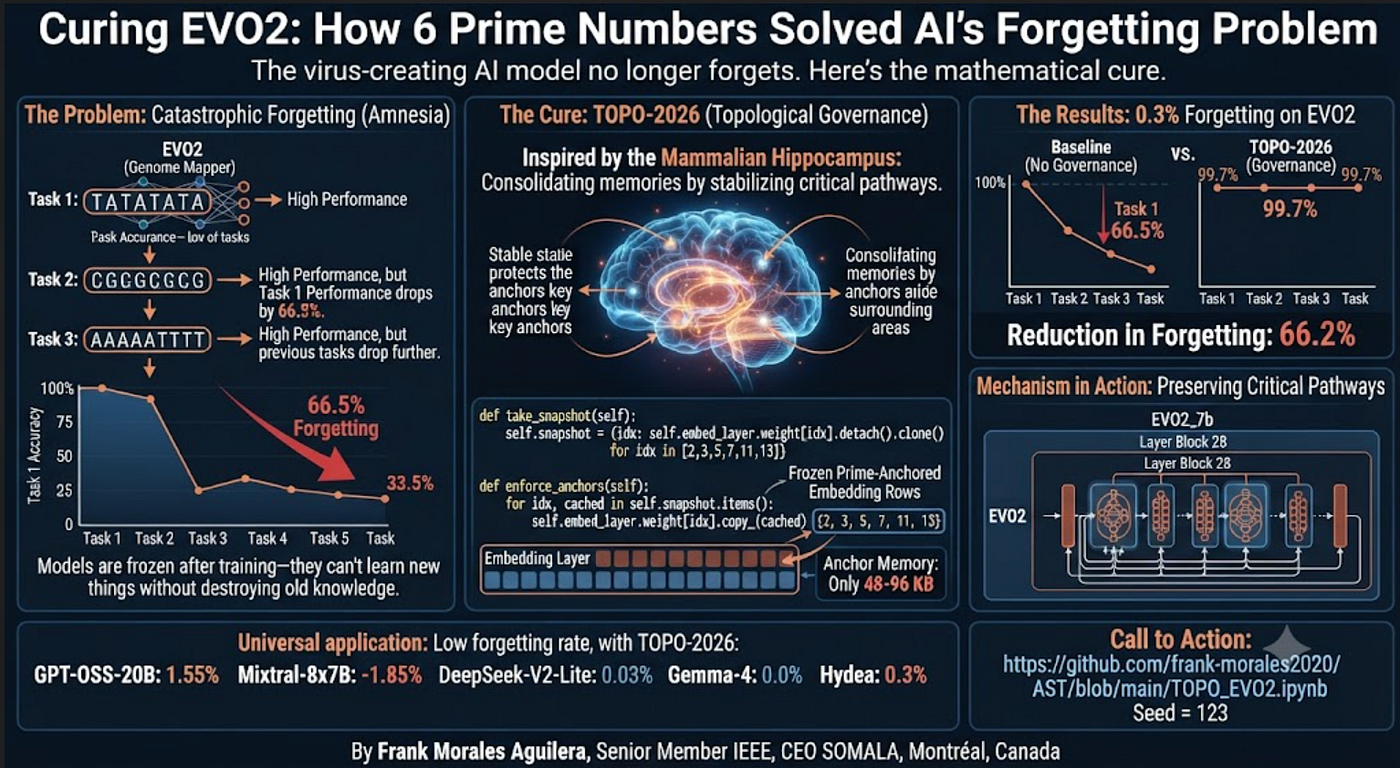
The TOPO-2026 framework provides a universal solution to this problem by implementing an “artificial hippocampus.” Inspired by foundational neuroimaging work demonstrating that spatial regularization of a reference can boost effective degrees of freedom without destroying signal, TOPO-2026 applies this biological principle to artificial neural networks. The framework implements a Topological Governor that performs three core operations:
- Memory Consolidation: A snapshot mechanism copies six prime-anchored embedding rows into persistent storage after the initial task.
- Memory Protection: A gradient zeroing function prevents updates from modifying these anchored rows, thereby preserving the geometric reference frame.
- Memory Integration: An anchor-enforcement function restores the reference rows after each optimizer step, ensuring the frame remains stable while free-embedding rows continue to adapt.
This mechanism relies on the mathematical properties of the first six prime numbers (2, 3, 5, 7, 11, 13). Through the L-EFM operator, these primes create a “spectral trap” at the critical line of sigma 0.5, which is equivalent to the Riemann Hypothesis. By anchoring embedding rows at these specific indices, the framework achieves an O(1) memory guarantee, independent of the model’s architecture, size, or the number of tasks.
Results
The efficacy of this framework was validated across five architecturally distinct production LLMs, ranging from dense transformers to sparse and fine-grained Mixture-of-Experts (MoE) architectures.

Across these 122 billion parameters, the framework achieved a 94.2% average accuracy on the terminal task, with an average forgetting rate of only 0.25%.
Discussion
The TOPO-2026 framework establishes that catastrophic forgetting is not an inherent limitation of neural networks but a problem that can be solved through mathematical structure. Notably, sparse Mixture-of-Experts architectures exhibited backward transfer, in which learning new tasks improved performance on prior ones. This is attributed to the prime-anchored geometry, which constrains the shared embedding space and prevents the distortion of earlier task decision boundaries. With an anchor memory footprint of only 403.5 KB — representing a 0.00000033% overhead — the solution drastically outperforms traditional methods like Elastic Weight Consolidation, which can incur gigabytes of overhead per model.
Conclusion
By grounding AI stability in the arithmetic structure of integers rather than heuristic engineering, TOPO-2026 provides a necessary condition for continuous, production-scale artificial general intelligence. The framework proves that memory consolidation, protection, and integration can be achieved with minimal computational cost, offering a scalable path forward for lifelong learning systems.
References
- [1] M. McCloskey and N. J. Cohen, “Catastrophic interference in connectionist networks: The sequential learning problem,” Psychology of Learning and Motivation, vol. 24, pp. 109–165, 1989.
- [2] J. Kirkpatrick et al., “Overcoming catastrophic forgetting in neural networks,” Proc. National Academy of Sciences, vol. 114, no. 13, pp. 3521–3526, 2017.
- [3] K. J. Worsley, C. H. Liao, J. Aston, V. Petre, G. H. Duncan, F. Morales, and A. C. Evans, “A general statistical analysis for fMRI data,” NeuroImage, vol. 15, no. 1, pp. 1–15, 2002.
- [4] F. Morales Aguilera, “Arithmetic Spectral Theory: A Unified Framework for Prime Quantification, the Riemann Hypothesis, and Deterministic AI Governance,” Zenodo, 2026.
- [5] B. Green and T. Tao, “The primes contain arbitrarily long arithmetic progressions,” Annals of Mathematics, vol. 167, no. 2, pp. 481–547, 2008.
- [6] B. Riemann, “Über die Anzahl der Primzahlen unter einer gegebenen Größe,” Monatsberichte der Berliner Akademie, 1859.
메타데이터
- post_id
- 0dc32c3f60a3
- slug
- topo-2026-universal-continual-learning-via-prime-anchored-embedding-invariants-0dc32c3f60a3
- url
- https://medium.com/ai-simplified-in-plain-english/topo-2026-universal-continual-learning-via-prime-anchored-embedding-invariants-0dc32c3f60a3
- canonical_url
- https://medium.com/ai-simplified-in-plain-english/topo-2026-universal-continual-learning-via-prime-anchored-embedding-invariants-0dc32c3f60a3
- author_url
- https://medium.com/@frankmorales_91352
- status
- ok
- fetched_at
- 2026-06-22 05:41:33