Virtual Nodes: The Key to Consistent Hashing
To start with lets go with!!
Virtual Nodes: The Key to Consistent Hashing
To start with lets go with!!
What is Consistent Hashing?
A Consistent Hashing Ring with Virtual Nodes is a mathematical data-routing system sitting quietly under the hood of massive distributed databases and caching systems.
Instead of tossing data blindly at any random server, this system creates a conceptual circle to distribute data storage, computational load, and user requests with absolute, mathematical fairness across a fleet of servers.
Didn’t get it?? 🤔 No issues let’s do it this way:
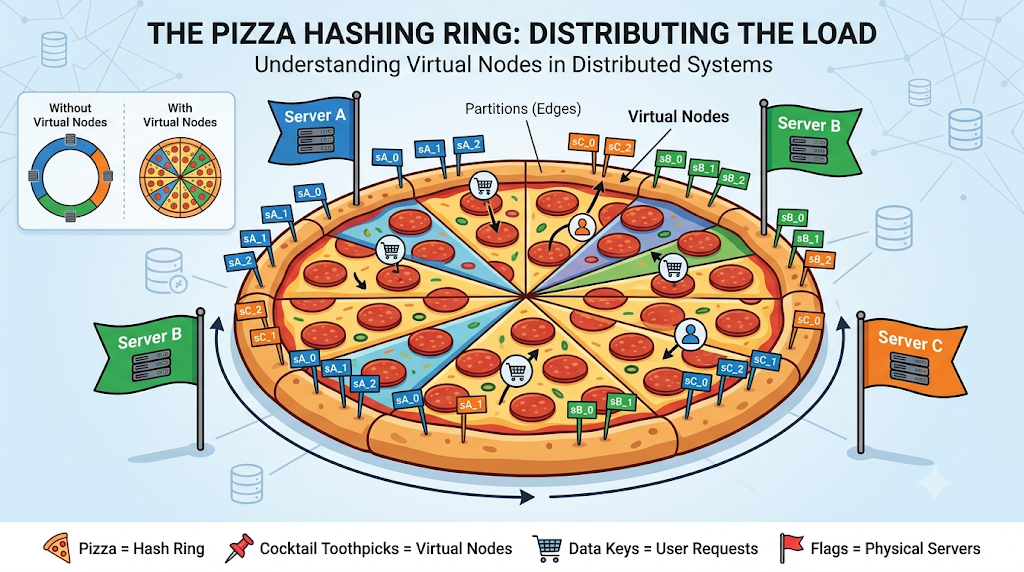
Imagine you and two friends, let’s call them Alice, Bob, and Charlie, are sitting around a massive circular table sharing a giant party pizza 🍕.
To decide who gets which part of the pizza, you put one single name tag for each person on the outer crust. The rule is simple: you must eat everything clockwise from your name tag until you hit the next person’s tag.
Because you placed the tags completely randomly, Alice and Bob’s tags end up right next to each other, while Charlie’s tag lands way down at the other end.
As a result:
- Alice gets a tiny, thin slice (10% of the pizza).
- Bob gets another tiny sliver (10% of the pizza).
- Charlie gets stuck with the remaining 80% of the entire pizza! 🤯
Charlie is now completely overwhelmed, choking on pizza, and about to pass out, while Alice and Bob are sitting around twiddling their thumbs.

Now let’s build this around system architecture as an analogy:
- The Circular Pizza is the Hash Ring (a continuous mathematical number line wrapped into a loop, typically spanning 0 to 2³²−1).
- The Slices of Pizza are the Data Keys (unique user identifiers like
user_charlieororder_1024that need a server home). - Alice, Bob, and Charlie are your physical Data Servers (Server A, Server B, Server C).
- The Name Tags are the Virtual Nodes (the Node Tokens assigned to each server on the ring.).
Now think of a massive system where user data requests are flooding in through the internet.
When a user tries to access a data key, the system runs it through a hash function (commonly MD5 or MurmurHash) to find its coordinate on the ring. It then performs a “clockwise walk” (also called successor lookup) on the circle until it bumps into the very first server’s tag. The request hits that server, the server grabs the data, and sends the response back.
But what about poor Charlie?
Enter Virtual Nodes: Stealing Back the Territory
Instead of giving Alice, Bob, and Charlie just one big name tag on the crust, we give them each 100 tiny cocktail toothpicks (Virtual Nodes) with their names on them.
We scatter all 300 toothpicks completely randomly across the entire pizza crust.
Because we are throwing so many toothpicks, they naturally mix together. You see an Alice toothpick, then a Charlie, then a Bob, then a Charlie, then an Alice, all the way around the circle. The pizza is now chopped up into hundreds of microscopic slices.
Look at what happens to Charlie’s giant 80% monopoly: Alice and Bob’s tiny toothpicks landed right inside that giant zone Charlie used to dominate.
- Alice’s tiny toothpicks stole back dozens of small slices from that zone.
- Bob’s tiny toothpicks stole back dozens of small slices from that zone.
Now, if you count up all the tiny slices owned by Alice’s toothpicks across the whole ring, they add up to roughly 33.3% of the pizza. Bob’s add up to 33.3%, and Charlie’s add up to 33.3%.
Yes, if a user hits any of Alice’s 100 toothpicks, the request is still directed to the exact same physical Server A hardware. Virtual nodes don’t change where the traffic goes — they change how much total capture range a server can claim on the circle.
So what happened with Virtual Nodes in HashRing?
1. Perfectly Balanced Load Distribution
As the number of virtual nodes increases, the data points (the storage load on each server) shift tightly towards the perfect average. Because the standard deviation shrinks down toward zero, no single machine bears the brunt of an accidental hotspot.
2. Graceful Crash Handling (Fault Tolerance)
If Server B suddenly crashes, you don’t have to reshuffle all your data. Server B’s 100 virtual nodes simply vanish from the ring. Because its slices were tiny and interleaved, its workload is distributed gracefully and evenly among Server A and Server C, without overloading either one.
3. Seamless Scalability
Need to add Server D to the cluster? Just throw 100 new Server D toothpicks onto the ring. They will gently steal tiny slices from A, B, and C uniformly, scaling up your infrastructure smoothly without a system-wide re-indexing nightmare.
You can find out a Proof of Concept :- https://github.com/HUMANCODERMJ/POC-Consistent-HashRing
메타데이터
- post_id
- 0dc6011cff02
- slug
- virtual-nodes-the-key-to-consistent-hashing-0dc6011cff02
- url
- https://medium.com/@humancodermj/virtual-nodes-the-key-to-consistent-hashing-0dc6011cff02
- canonical_url
- https://medium.com/@humancodermj/virtual-nodes-the-key-to-consistent-hashing-0dc6011cff02
- author_url
- https://medium.com/@humancodermj
- status
- ok
- fetched_at
- 2026-06-09 15:37:30