The 0.13% Delusion: Inside the One-Sided UK-India Trade Deal”
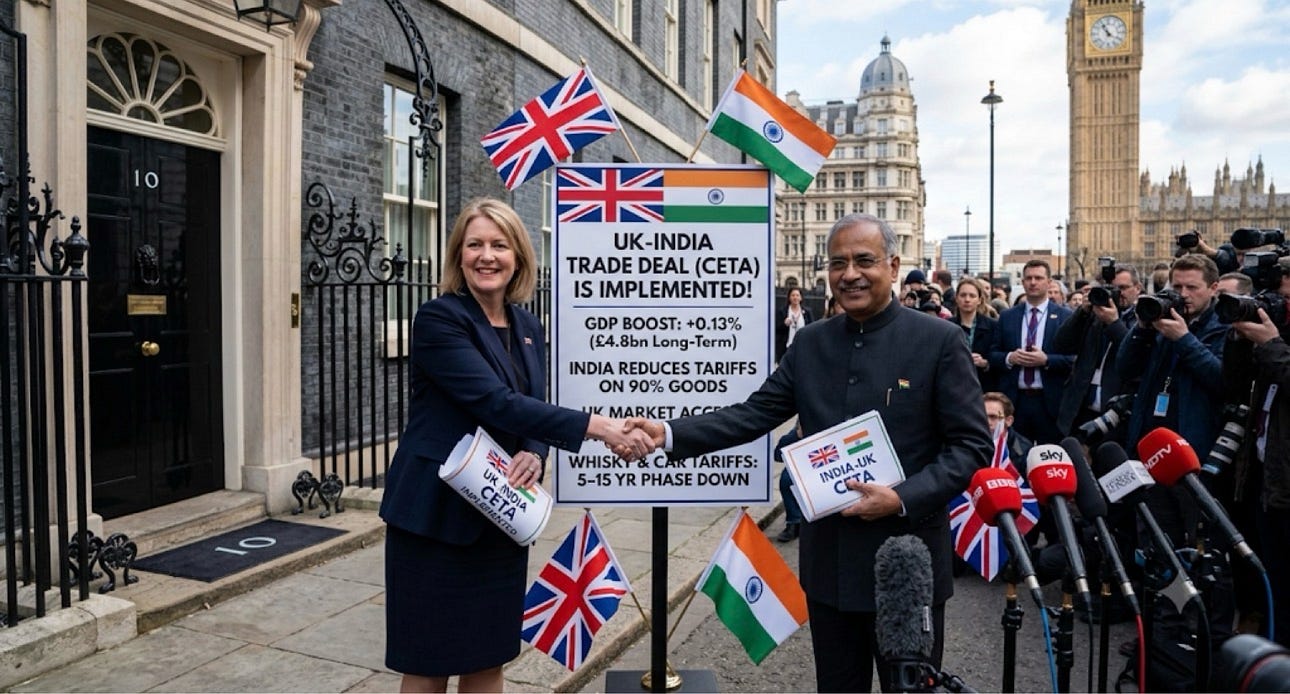
The implementation of the UK-India Trade Deal.
The 0.13% Delusion: Inside the One-Sided UK-India Trade Deal”
The implementation of the UK-India Trade Deal.
One of the biggest promises of Brexit was regulatory freedom – the liberty for the UK to strike trade deals with whoever it wants, from close allies like the US to strategic rivals like China. The latest milestone on this front is the UK-India Comprehensive Economic and Trade Agreement (CETA). While the government has loudly celebrated the deal’s implementation, a closer look at the details reveals a highly one-sided arrangement. Here is what the official announcements gloss over, backed by the data.
The government is championing this as a massive win, but the macroeconomic reality is incredibly modest. The official impact assessment reveals that the deal will only boost UK GDP by 0.13% in the long run. That equates to roughly £4.8 billion a year by 2040. While a deal is a deal, a 0.13% bump to national output is hardly the transformative post-Brexit economic engine we were promised.
The core of the deal is a massive compromise on tariff timelines. While the UK is opening its doors immediately, India is taking its time. The UK has agreed to eliminate tariffs on 99.5% of the value of Indian goods right from day one, opening British markets to a massive influx of Indian imports. In contrast, India is only dropping tariffs on 89.4% of trade value, and many of these cuts are heavily delayed. While the government boasts about cheaper Scotch whisky and British cars, the reality is that UK exporters must wait 5 to 15 years for these tariffs to fully phase down. For instance, India’s astronomical 150% tariff on Scotch whisky only drops to 75% at entry into force, taking a full 10 years to reach its final rate of 40%. This raises an obvious question: was this deal born out of desperation? Why did UK negotiators agree to give India immediate, near-total market access while letting British businesses wait up to 15 years for the same privilege?

The deal is also being spun as a major victory for digital trade and financial services. However, India’s historically protectionist stance remains largely intact. As trade experts and the House of Lords International Agreements Committee have pointed out, the deal primarily secures basic access to existing, highly regulated frameworks rather than genuinely opening a brand-new, deregulated market. Once again, India’s domestic service sectors remain shielded, leaving UK negotiators with very little leverage.
Immigration remains the most sensitive political issue in the UK, with every major party constantly trying to out-manoeuvre the other on border control. But to get this deal signed, the government quietly conceded on India’s primary demand: worker mobility. To bypass domestic immigration targets, the government rebranded this movement of people as “business mobility” rather than immigration. The biggest giveaway is the newly implemented Double Contributions Convention (DCC). Under the DCC, temporary Indian professionals coming to the UK for up to 5 years are entirely exempt from paying UK National Insurance contributions, as long as they maintain social security coverage in India. This means over 75,000 Indian workers will bypass the National Insurance charges that British taxpayers have to pay.
No one can blame the UK for wanting a piece of the action. India is a rapidly growing global powerhouse set to become the world’s third-largest economy by 2035. But in their rush to secure a headline-grabbing post-Brexit win, UK negotiators signed an incredibly unbalanced treaty. The small victories – like phased-in whisky tariffs – are real. However, when you look past the political spin, India secured the immediate structural benefits, while the UK got a long, 15-year wait.
Enjoyed this breakdown? I write regularly on Substack and Medium, cutting through the political spin with hard data and economic reality. Follow me on Medium to get my latest analytical pieces sent straight to your feed. Let’s keep the conversation going in the comments below!
메타데이터
- post_id
- 0dd42ed47606
- slug
- the-0-13-delusion-inside-the-one-sided-uk-india-trade-deal-0dd42ed47606
- url
- https://medium.com/@gntoya76/the-0-13-delusion-inside-the-one-sided-uk-india-trade-deal-0dd42ed47606
- canonical_url
- https://medium.com/@gntoya76/the-0-13-delusion-inside-the-one-sided-uk-india-trade-deal-0dd42ed47606
- author_url
- https://medium.com/@gntoya76
- status
- ok
- fetched_at
- 2026-07-17 10:32:35



