The Data Engineer’s Dilemma: Power BI vs Tableau (And the Enterprise Alternative You’re Probably…
As a data engineer, I spend most of my time living in the backend. My days consist of writing PySpark jobs, optimizing cloud data…
The Data Engineer’s Dilemma: Power BI vs Tableau (And the Enterprise Alternative You’re Probably Ignoring)
As a data engineer, I spend most of my time living in the backend. My days consist of writing PySpark jobs, optimizing cloud data warehouses, and ensuring that our data pipelines don’t silently fail at 3 AM.
Recently, as I’ve been preparing for my advanced software architecture exams this year, I’ve been thinking a lot about the entire data lifecycle. It became especially apparent while I was architecting a personal data pipeline to track SEO clusters and Google AdSense revenue for a subscription-based product I’m building. I realized a fundamental truth: no matter how elegant your backend architecture is, the business only cares about the visualization layer.
If the dashboard is slow, the data is “wrong.” If the interface is clunky, the data team is “unresponsive.”
This inevitably leads to the most common debate in data slack channels: Power BI vs Tableau.
But from an engineering perspective, how do these heavyweights actually impact our infrastructure? And more importantly, when should we be looking past both of them to true enterprise self-service alternatives like **FineBI**? Let’s break it down.
1. Power BI: The Microsoft Ecosystem Anchor
When business stakeholders ask for Power BI, they are usually looking for cost-efficiency and deep integration with Office 365. As an engineer, my feelings on Power BI are mixed.
The Engineering View:
- The Good: If your company is already running on the Azure stack (Synapse, Data Factory, SQL Server), Power BI connects seamlessly. It forces a highly structured tabular data model, which aligns well with standard dimensional modeling (Star Schemas).
- The Bottleneck: DAX (Data Analysis Expressions). While DAX is incredibly powerful, it shifts a massive amount of business logic away from the data warehouse and into the BI layer. When a dashboard performs poorly, debugging complex DAX queries to find the bottleneck can be a nightmare. Furthermore, handling real-time, massive datasets can sometimes strain its premium capacities if not perfectly optimized.
2. Tableau: The Visualization Heavyweight
When analyzing the Power BI vs Tableau debate, Tableau is almost always championed by the analysts. It is the gold standard for exploratory data analysis and visual storytelling.
The Engineering View:
- The Good: Tableau’s VizQL technology translates drag-and-drop actions into optimized database queries brilliantly. It connects to almost everything. I also love Tableau’s Hyper extract engine — it is incredibly fast and can mask a poorly optimized backend data warehouse (at least temporarily).
- The Bottleneck: The dreaded “Extract Refresh” queue. Because live connections to massive datasets can sometimes render Tableau dashboards sluggish, businesses rely heavily on scheduled extracts. As a data engineer, managing hundreds of concurrent extract refresh schedules on Tableau Server can quickly become an infrastructure headache. Additionally, complex calculations (LODs) require a steep learning curve for business users.
The Real Problem: The “Dashboard Ticket” Queue
Here is the frustrating reality of the Power BI vs Tableau debate: both tools still heavily rely on the data engineering team.
Whether it’s writing complex DAX in Power BI or managing massive Hyper extracts in Tableau, business users often hit a technical wall. What happens next? They submit a Jira ticket asking the data team to build a custom SQL view or add a new column.
We don’t want to build dashboards. We want to build scalable architecture. We need a semantic layer where business users can truly serve themselves without breaking the database.
Enter the Enterprise Alternative: FineBI
If you are dealing with massive enterprise datasets and want to truly democratize data without creating a bottleneck for your engineering team, you need to look at FineBI.
As a data engineer, I’ve started recommending FineBI for organizations that need heavy-duty, governed self-service. Here is why it shifts the paradigm:
1. Built-in ETL for Business Users
Unlike Tableau, which often requires external prep tools, or Power BI, which relies on Power Query/DAX, FineBI allows business users to perform their own data processing visually. They can filter, merge, and group data using a drag-and-drop interface. This drastically reduces the number of ad-hoc SQL requests landing on my desk.
2. The Spider Engine (Handling Big Data)
When comparing Power BI vs Tableau, performance on massive datasets is always a pain point. FineBI tackles this with its proprietary Spider Engine. It supports real-time data analysis directly against your data warehouse, but also offers an incredibly robust data extraction engine that processes hundreds of millions of rows in seconds. You get enterprise-grade performance without constantly babysitting server loads.
3. True Governed Self-Service
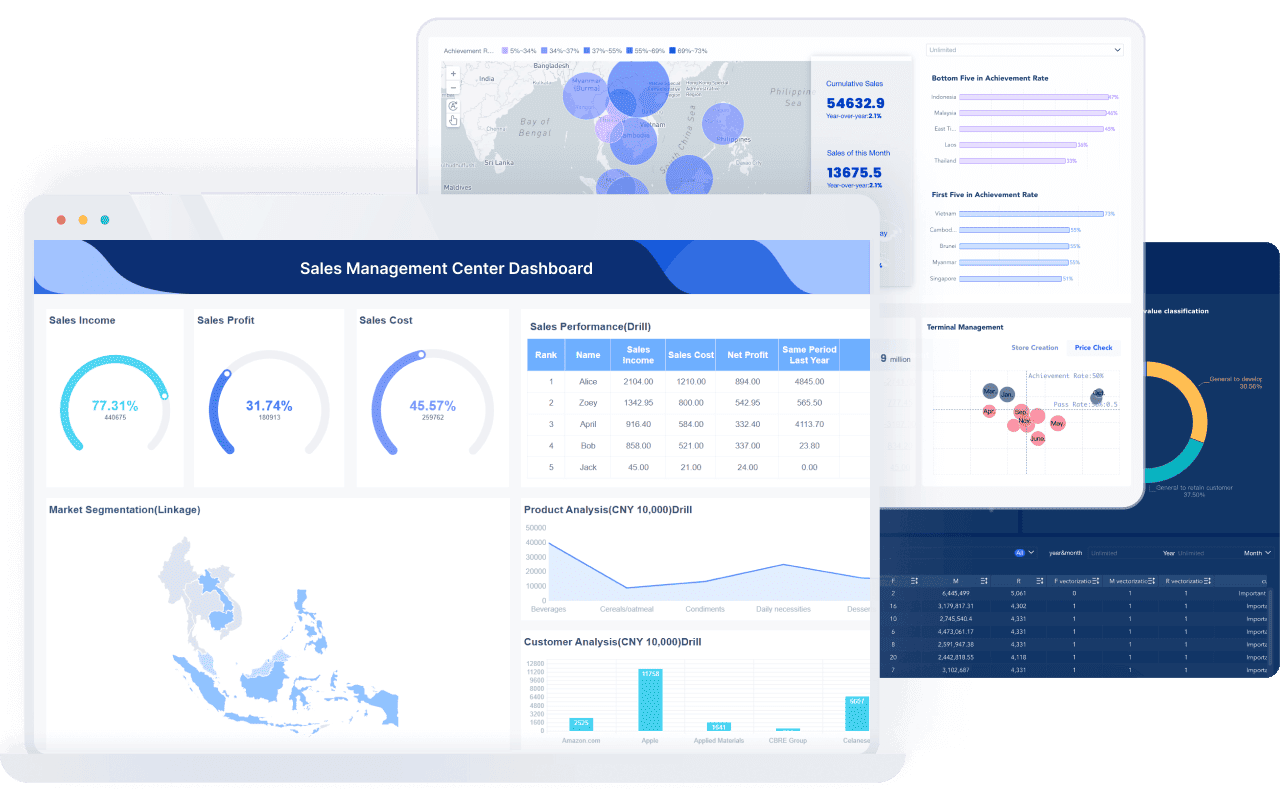
FineBI is built around the concept of IT-governed self-service. As an engineer, I can set up the core data connections, apply strict row-level security, and then step back. The marketing, sales, or operations teams can safely build their own interactive dashboards and drill-down analysis within the sandbox I created.
The Bottom Line: Which Should You Choose?
The Power BI vs Tableau conversation isn’t going away anytime soon.
- Choose Power BI if you are deeply entrenched in the Microsoft ecosystem and want a cost-effective, highly structured semantic model.
- Choose Tableau if your primary goal is empowering data analysts to do deep, exploratory visual storytelling.
But choose FineBI if your goal is operational efficiency. If you want to stop writing ad-hoc SQL for business users, handle massive datasets with ease, and empower non-technical teams to build their own enterprise dashboards, FineBI bridges the gap between backend engineering and frontend business value better than almost anything else on the market.
At the end of the day, our job as data engineers isn’t just to move data from point A to point B. It’s to build a reliable foundation that lets the business run itself. Choose the tool that lets you get back to building.
메타데이터
- post_id
- 0dd8d29e61c6
- slug
- the-data-engineers-dilemma-power-bi-vs-tableau-and-the-enterprise-alternative-you-re-probably-0dd8d29e61c6
- url
- https://medium.com/@1580985824/the-data-engineers-dilemma-power-bi-vs-tableau-and-the-enterprise-alternative-you-re-probably-0dd8d29e61c6
- canonical_url
- https://medium.com/@1580985824/the-data-engineers-dilemma-power-bi-vs-tableau-and-the-enterprise-alternative-you-re-probably-0dd8d29e61c6
- author_url
- https://medium.com/@1580985824
- status
- ok
- fetched_at
- 2026-07-15 16:22:14