The Agile Manifesto, Rethought: Why People Matter More Than Process
Part 2 of 6 — Individuals and Interactions Over Processes and Tools
The Agile Manifesto, Rethought: Why People Matter More Than Process
Part 2 of 6 — Individuals and Interactions Over Processes and Tools

Have you ever watched a team grind to a halt — not because they lacked tools, but because no one was actually talking to each other?
This is the second article in a six-part series reframing the Agile Manifesto as a thinking framework for any uncertain project — not just software. In the first article, we explored how Agile helps clarify priorities when certainty isn’t available. Now we’re looking at the first value: Individuals and Interactions Over Processes and Tools.
In this article, you’ll learn three concepts that change how you think about team structure and communication: Interaction Is the System, Context Beats Control, and Trust Scales Faster Than Oversight. Each comes with practical steps and a free AI-powered resource (linked in the first comment) to help you put it into practice right away.
If you know a project manager struggling with teams that follow process but miss the point, share this with them.
Scroll to the end for a visual infographic that summarizes what you’re about to read.
Let’s dig in.
INTERACTION IS THE SYSTEM
The system isn’t the tool — it’s the conversation that happens around it.
We treat systems like they’re made of software, workflows, and org charts. But the real system — the one that actually determines whether work gets done well — is the pattern of interaction between people. A brilliant process with poor interaction will fail. A rough process with strong interaction can work.
Why? Because uncertainty lives in the gaps between people. Requirements change. Priorities shift. Context gets lost in translation. The only way to close those gaps is through real-time human exchange — questions, clarifications, challenges, problem-solving out loud.
Tools are necessary. They hold information, track progress, create visibility. But they don’t replace judgment. They don’t negotiate tradeoffs. They don’t say, “Wait, I think we’re solving the wrong problem.” People do that. And they only do it when interaction is treated as the primary system.
Research from MIT’s Human Dynamics Laboratory found that patterns of communication — who talks to whom, how often, in what setting — are the single best predictor of team performance. Better than individual talent. Better than tools. Better than formal structure.
The teams that win aren’t the ones with the best ticketing system. They’re the ones where people talk to each other like the work depends on it. Because it does.
What It Looks Like
When Alex proudly showed Maria a dashboard glowing with green checkmarks and declared launch just a week away, his confident words met her skeptical gaze — sparking a simple question that exposed the hidden red flags no tracker could capture.

How To Do It
- Design for collision. Schedule cross-functional work sessions where people who don’t normally talk have to solve a problem together. Proximity drives understanding.
- Treat silence as a signal. If someone hasn’t spoken in a meeting, ask them directly: “What are we missing?” Quiet doesn’t mean agreement — it often means uncertainty.
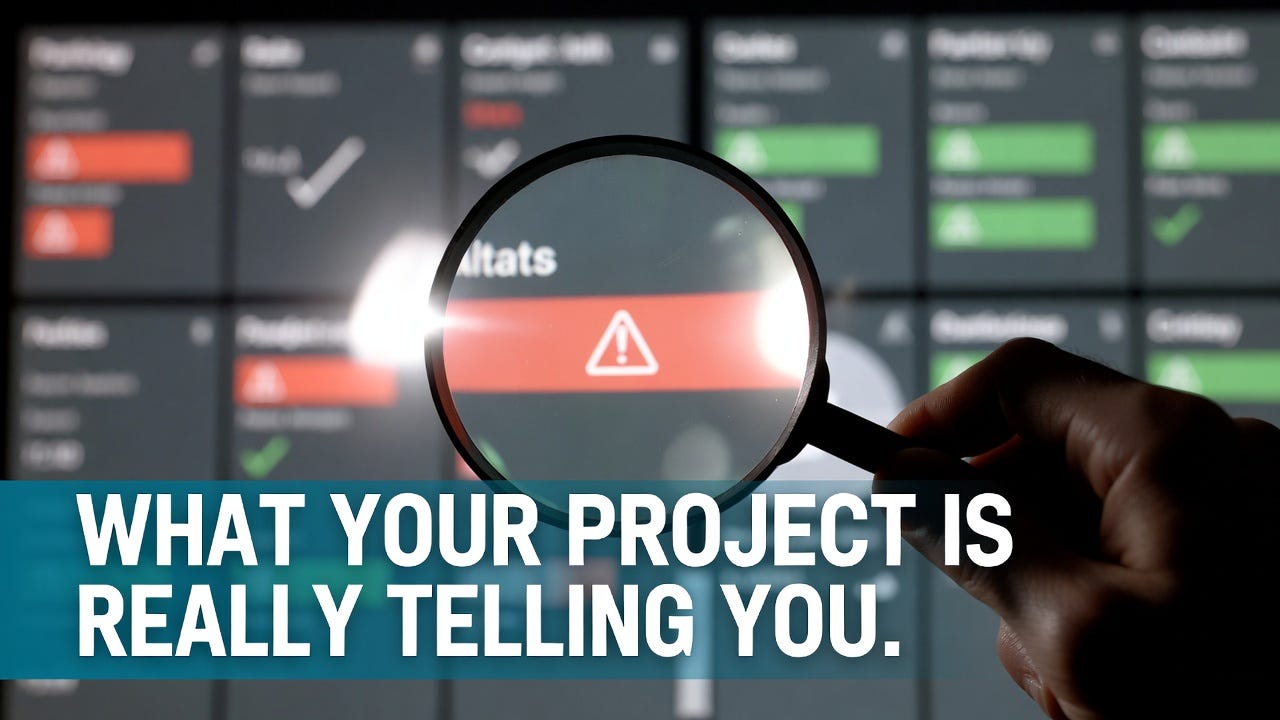
- Question the green light. When a dashboard says everything’s fine, ask one person, “Is it really?” Like Maria did with the engineer — sometimes the system lies because people don’t challenge it.
- Make the implicit explicit. If someone says, “I assumed…” in a retrospective, that assumption should have been a conversation earlier. Build rituals that surface assumptions before they become problems.
- Measure interaction, not just output. Track how often cross-functional conversations happen. If people only talk in formal meetings, you have a process — but not a system.
Free Resource:
Interaction Audit Prompt Guide
This guide helps you identify where your team’s real communication gaps are — not just who talks, but whether those conversations are creating shared understanding.
You’ll get copy-paste prompts to use during planning, retrospectives, and team check-ins. The AI will help you surface hidden assumptions, spot silence patterns, and clarify what’s being said versus what’s being heard.
These prompts don’t make decisions for you. They make it easier to see what deserves your attention.
CONTEXT BEATS CONTROL
The best teams aren’t managed — they’re equipped with enough context to make their own calls.
Most management operates on the assumption that control creates consistency. Lock down the process, standardize the inputs, and you get predictable outputs. It works beautifully when the work is predictable.
But knowledge work isn’t predictable. Requirements shift. Constraints change mid-sprint. A customer priority that seemed urgent last week is irrelevant today. In this environment, control becomes a bottleneck. Decisions stack up waiting for approval because only one person has the context to make them.
The alternative is to distribute context. Give people access to the same information leadership has: Why this matters. What tradeoffs we’re willing to make. What success looks like. Where we have flexibility and where we don’t.
When people understand the why, they can adapt the how without asking permission. They make smarter decisions faster because they’re not guessing what you would have decided — they’re applying the same framework you would have used.
Harvard Business Review research on high-autonomy teams showed that when context is shared widely, decision quality improves and decision speed doubles. Not because people are smarter — but because they’re not waiting.
Context isn’t just information. It’s the logic behind priorities, the constraints that matter, the reasoning that led to a decision. When that’s visible, teams self-correct. When it’s hidden, they follow instructions and hope for the best.
What It Looks Like
When an urgent sales deal threatened to derail the team’s Q4 priorities, product manager Jamie faced a classic pressure test — until she paused, checked the bigger picture, and turned a potential fire drill into a strategic win.

How To Do It
- Share the decision framework, not just the decision. When you make a call, explain the logic — what you weighed, what you traded off. Like Jamie did with the sales team — context turned a directive into a shared understanding.
- Make priorities explicit and ranked. Don’t say “everything’s important.” Say, “If we have to choose, this comes before that.” Ambiguity forces people to guess.
- Open the leadership conversation. Let teams sit in on strategy discussions — even if they’re not deciding. Hearing the debate builds the mental model they’ll use later.
- Document the why, not just the what. Meeting notes should capture reasoning, not just action items. Future decisions depend on understanding past logic.
- Test for context fluency. Ask someone, “If I’m unavailable, what decision would you make?” If they’re guessing, they don’t have enough context. If they’re confident, they do.
Free Resource:
Context Distribution Checklist
This resource walks you through how to build a simple decision framework that you can share with your team — so they stop waiting for you to make calls they’re capable of making themselves.
It includes AI prompts to help you clarify your own priorities, document the reasoning behind past decisions, and create a one-page guide your team can reference when you’re not available.
These prompts don’t make decisions for you. They make it easier to see what deserves your attention.
TRUST SCALES FASTER THAN OVERSIGHT
The cost of verification grows exponentially. The cost of trust grows linearly.
When you don’t trust someone to do the work, you verify. You check their output. You ask for updates. You build review processes. Every additional layer of oversight adds time, friction, and delay. Multiply that across a growing team, and oversight becomes the bottleneck.
Trust works differently. It doesn’t require constant checking. It doesn’t add review cycles. It scales because it’s based on competence and shared expectations, not surveillance.
Here’s the difference: oversight assumes people will fail unless watched. Trust assumes people will succeed unless something prevents them. That shift changes everything. Instead of asking, “How do I make sure this gets done right?” you ask, “What’s preventing this person from succeeding?”
The answer is usually clarity, resources, or authority — not motivation.
Research from Google’s Project Aristotle found that psychological safety — the foundation of trust — is the strongest predictor of team performance. Teams where people trust each other ship faster, solve harder problems, and make fewer critical mistakes. Not because they’re monitored less, but because they’re empowered more.
Trust doesn’t mean blind faith. It means verifying competence once, setting clear expectations, and then stepping back. If someone consistently delivers, you don’t need to check their work every time. If they don’t, you address the skill gap — you don’t add more oversight.
The teams that scale are the ones that build trust into the foundation. Because oversight might work for five people. It doesn’t work for fifty.
What It Looks Like
Rachel, buried under 12-hour days of reviewing every single pull request and decision for her team of six engineers, thought she was the only thing preventing disaster — until her manager David challenged her to test whether the real bottleneck was her team or herself.

How To Do It
- Verify competence once, then trust. When someone proves they can do the work, stop checking every output. Like David coached Rachel — test trust intentionally, then commit to it.
- Build feedback loops, not approval gates. Instead of requiring sign-off, create visibility. Let people see each other’s work and raise concerns if needed. Trust scales when oversight doesn’t.
- Set clear boundaries, then release control. Define what good looks like, where flexibility exists, and what’s non-negotiable. Inside those boundaries, let people operate.
- Assume good intent, address bad outcomes. If something goes wrong, ask, “What blocked you?” before assuming negligence. Trust breaks when you treat mistakes as moral failures.
- Scale responsibility, not surveillance. As teams grow, distribute decision-making authority. If you’re still the single point of approval for everything, you’re preventing scale.
Free Resource:
Trust Calibration Tool
This tool helps you identify where you’re over-verifying and where you’re under-supporting — so you can build trust without sacrificing quality.
It includes AI prompts to assess competence, map decision authority, and create lightweight feedback mechanisms that replace approval bottlenecks.
These prompts don’t make decisions for you. They make it easier to see what deserves your attention.
TYING IT TOGETHER
People are the system. Process is the tool.
When teams fail, we blame the process. We add more steps, more reviews, more oversight. But the problem is rarely the process — it’s the absence of real interaction, shared context, and mutual trust.
Agile’s first value isn’t a rejection of tools or structure. It’s a reordering of priorities. Tools matter. Process matters. But they only work when people are equipped to use them with judgment, autonomy, and connection.
The three concepts in today’s article — Interaction Is the System, Context Beats Control, Trust Scales Faster Than Oversight — aren’t abstract ideals. They’re operational principles that determine whether your team adapts or stalls when uncertainty hits.
Try one. Pick a meeting this week and replace the status update with a real conversation. Or share the decision logic behind a priority instead of just announcing it. Or let someone make a call you’d normally approve yourself. See what changes.
If this resonated, hit “Like” to help more leaders find these ideas. And scroll down for the infographic.
This series continues with Value 2: Working Solutions Over Comprehensive Documentation — exploring how progress reveals truth faster than planning does. That’s next.
Remember:
The strongest systems aren’t built on tools. They’re built on trust.
This article is part of a six-part series reimagining the Agile Manifesto as a practical thinking framework for leaders managing uncertainty. Want more? Subscribe to Idea Express for the next installment.

REFERENCES
Duhigg, Charles. “What Google Learned From Its Quest to Build the Perfect Team.” The New York Times Magazine, February 25, 2016.
Edmondson, Amy C. “Psychological Safety and Learning Behavior in Work Teams.” Administrative Science Quarterly 44, no. 2 (1999): 350–383.
Google re:Work. “Understand team effectiveness.” Accessed February 2026. https://rework.withgoogle.com/intl/en/guides/understanding-team-effectiveness
McChrystal Group. “How to Build Empowerment Throughout Your Team.” April 1, 2025. https://www.mcchrystalgroup.com/insights/detail/2025/04/01/how-to-build-empowerment-throughout-your-team
Pentland, Alex “Sandy.” “The New Science of Building Great Teams.” Harvard Business Review, April 2012. https://hbr.org/2012/04/the-new-science-of-building-great-teams
ADDITIONAL SUPPORTING RESEARCH (Not directly cited but relevant)
- MIT Human Dynamics Laboratory publications: https://www.media.mit.edu/groups/human-dynamics/overview/
- Gartner Research on Employee Empowerment (2018)
- Harvard Business Review general research on autonomy, empowerment, and team performance
- Multiple studies on psychological safety in teams (Amy Edmondson’s body of work)
- McChrystal Group Team of Teams framework research
메타데이터
- post_id
- 0dea02d940d6
- slug
- the-agile-manifesto-rethought-why-people-matter-more-than-process-0dea02d940d6
- url
- https://medium.com/@kcbarr/the-agile-manifesto-rethought-why-people-matter-more-than-process-0dea02d940d6
- canonical_url
- https://medium.com/@kcbarr/the-agile-manifesto-rethought-why-people-matter-more-than-process-0dea02d940d6
- author_url
- https://medium.com/@kcbarr
- status
- ok
- fetched_at
- 2026-06-11 15:16:29