The Fourth Property of Money That Need Not Exist
Every introductory economics textbook describes money as having three fundamental functions. Money is a unit of account, a medium of…
The Fourth Property of Money That Need Not Exist
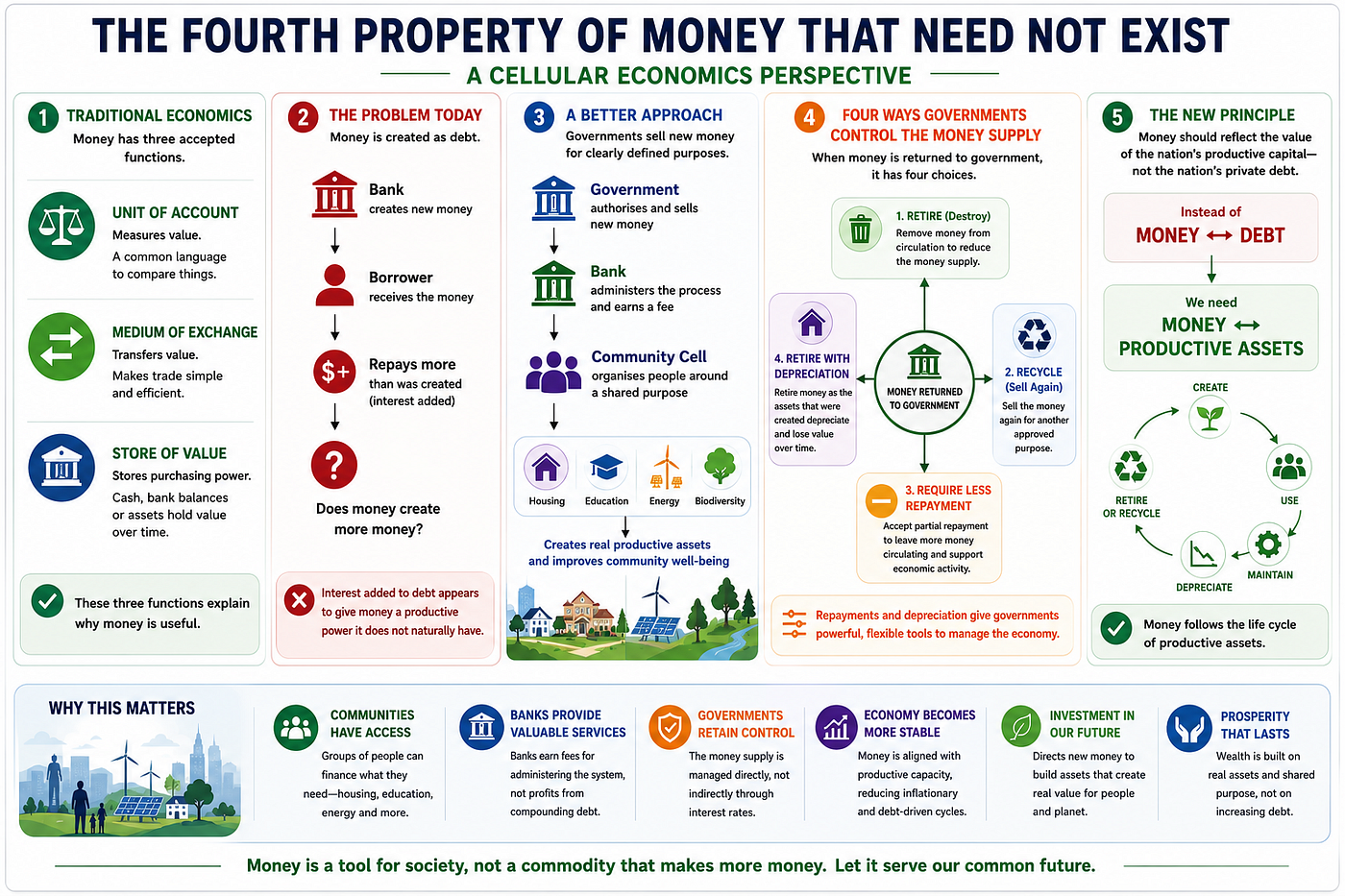
Every introductory economics textbook describes money as having three fundamental functions. Money is a unit of account, a medium of exchange, and a store of value.
These three functions are straightforward. As a unit of account, money is simply a measuring stick. Just as metres measure length and kilograms measure weight, pounds, yen, rupiah or dollars measure value. The value itself exists only because people assign it. Money merely provides a common language for comparing different goods and services.
As a medium of exchange, money allows people to trade efficiently. Instead of exchanging wheat for shoes or timber for bread, people exchange money for whatever they wish to buy. Money removes the need for barter and greatly simplifies economic activity.
As a store of value, money allows purchasing power to be transferred through time. People may keep money in a bank account, hold cash, or purchase assets that preserve value. Whether stored as cash or embodied in an asset, money represents value that can be used later. These three functions explain why money is useful.
Yet modern banking introduces a fourth property.
The Hidden Fourth Property
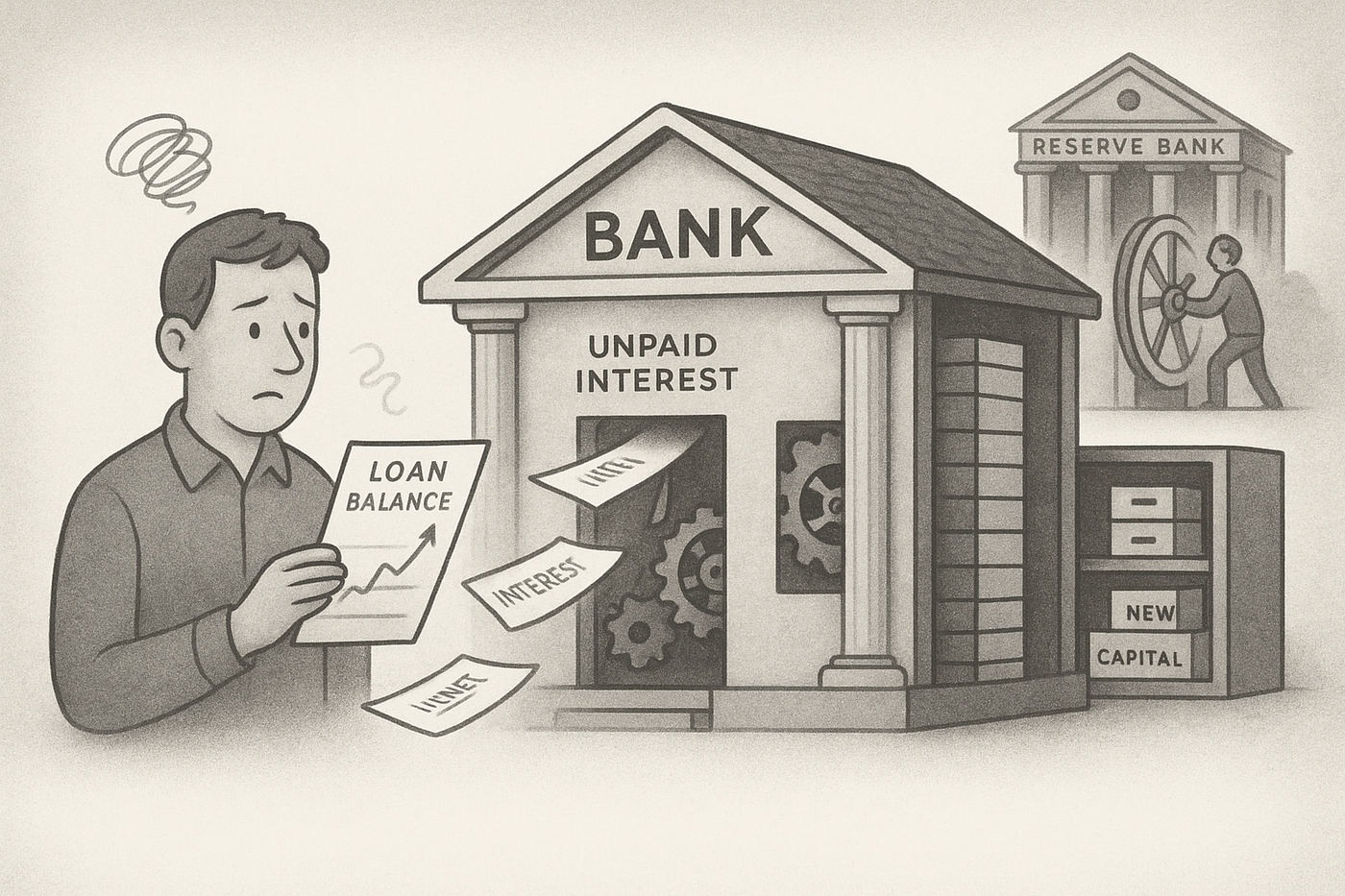
When a bank creates a loan, it creates new money. This is now widely accepted by central banks and monetary economists. The borrower receives newly created purchasing power which did not previously exist.
The borrower must then repay not only the amount created but also additional money through interest. Conceptually, this suggests something quite different from the traditional functions of money. The money itself appears to generate more money, yet this is not one of the three recognised properties of money.
Money does not multiply while sitting under a mattress. A $100 note remains a $100 note. A bank balance does not grow unless someone transfers additional money into the account. Assets may rise or fall in value, but that reflects changes in market prices and production, not the creation of new money by the money itself. The only institution capable of creating additional money tokens is the monetary authority operating through the banking system.
From this perspective, interest capitalised into debt can be seen as treating money as though it possesses a productive power it does not naturally have.
Why Governments Chose This System
Governments face a genuine problem. Creating electronic money costs almost nothing. If governments gave everyone unlimited new money, the money supply would expand without limit, and prices would eventually lose meaning.
The present system attempts to solve this problem by requiring banks to create money as loans. The expectation is that loans will eventually be repaid, allowing the newly created money to disappear from circulation. This provides a practical mechanism for controlling the money supply.
The system has worked reasonably well, but it comes with an unintended consequence. Because money is issued primarily through interest-bearing loans, every new unit of money enters the economy carrying an obligation to repay more than was created. It in turn leads to casino like markets such as the stock market, currency markets and other financial markets.
Is Interest the Only Way?
Banks unquestionably perform valuable functions. They assess risk, verify borrowers, process payments, maintain accounts, provide liquidity and manage defaults. Every one of these services deserves to be paid.
However, none of these functions requires interest to be added to the outstanding principal. Banks could instead charge explicit fees for providing these services. Alternatively, governments could determine the price charged for creating new money and allow banks to retain an agreed portion as payment for administering the process.
Banks would remain profitable. Governments would continue to control the money supply, and the financial system would continue to function. What changes is the assumption that money itself somehow creates more money.
Selling Money Instead of Lending It
This leads to a different way of thinking about finance. Instead of lending money into existence, governments would authorise banks to sell newly created money for clearly defined purposes.
The money would not be available simply because someone wanted it. Access would require an organisation capable of guaranteeing that the money would be returned over time. For example, a housing organisation could be authorised to purchase newly created money for the sole purpose of buying or constructing owner-occupied homes.
Members would agree to make ongoing payments, and those payments would return the original money to the government over time, allowing it to be retired from circulation in the same way that loan repayments retire bank-created money today.
The government would still control the quantity of money created. Banks would still earn income for administering the process, and the money supply would remain under control. The system, however, would no longer depend upon continuously increasing debt.
From Housing to Other Public Purposes
Housing is only one possible application. The same principle could support organisations established for education, renewable energy, biodiversity restoration, public transport, community infrastructure, aged care or other clearly defined public purposes.
The government would determine which purposes justify the creation of new money. Banks would administer the transactions, while communities would organise themselves to use the funds productively and return the money over time. Money creation would therefore become directly linked to productive capacity and long-term public benefit rather than primarily to the willingness of individuals to assume interest-bearing debt.
Controlling the Money Supply

One obvious question is how governments would control the money supply if they sold newly created money instead of allowing banks to lend it into existence.
The answer is that governments would retain the same ability to regulate the money supply as they have today, but with considerably greater flexibility and transparency.
When governments authorise the creation of new money, they are doing so because new productive value is being created. A new house provides accommodation for decades. A school educates children. A renewable energy system produces electricity. A transport system moves people efficiently. In each case, the newly created money represents an increase in society’s productive capacity.
Over time, however, those assets change. Some continue to provide value for many decades. Others wear out, become obsolete or are replaced by better technologies. The money supply should therefore evolve with the value of the productive assets that support it.
When money is returned to the government, there are several options.
The first is to retire the money permanently by removing it from circulation. This reduces the money supply when economic activity expands faster than the economy’s productive capacity and inflationary pressures begin to emerge.
The second is to recycle the money by selling it again for another approved purpose. Instead of creating additional money, the government reissues money that has already been returned. The government can therefore fund housing, education, renewable energy, biodiversity restoration, or other public purposes without continually increasing the total quantity of money in circulation.
The third option is to require communities to repay less than the amount created. If additional purchasing power is needed, the government decides how much money is returned. The remainder stays permanently in circulation, increasing the money supply without requiring additional borrowing.
A fourth option recognises that productive assets depreciate. Roads wear out — buildings age. Machinery becomes obsolete. Even houses require continual maintenance and eventual replacement. Where money was created to represent these productive assets, governments can gradually retire money as those assets lose value. In this way, the quantity of money in circulation remains aligned with the value of the nation’s productive capital rather than continually increasing regardless of changes in the real economy.
These choices give governments a far richer set of monetary policy tools than simply adjusting interest rates. Instead of attempting to influence the economy indirectly by making borrowing more or less expensive, governments can regulate the money supply directly by deciding how much money to create, how much returned money to recycle, how much to retire and how much to allow to remain permanently in circulation.
The objective is not to maintain a particular quantity of money but to maintain an appropriate relationship between the money supply and the productive capacity of the economy. As productive capacity expands, additional money can be created. As assets depreciate or economic conditions require, money can be retired. The money supply therefore becomes a dynamic reflection of the nation’s real productive wealth rather than a by-product of the level of private debt.
Under Cellular Economics, banks continue to perform their essential commercial functions. They assess proposals, manage accounts, process payments, provide liquidity and earn fees for these services. Governments retain responsibility for controlling the quantity of money, while communities organise themselves to use that money productively. Monetary policy becomes simpler, more transparent and more closely connected to the real economy.
Cellular Economics
This is the foundation of Cellular Economics. Instead of treating finance as a series of transactions between isolated borrowers and lenders, Cellular Economics organises people into purpose-driven groups, or cells.
Each cell accepts responsibility for using newly created money to achieve a specific objective, and its members collectively ensure that the money is returned over time. Banks become professional service providers rather than creators of long-term debt, governments retain control over the quantity of money created, and communities gain access to finance without assuming that money itself possesses the mysterious ability to generate more money.
A Simpler View of Money
Money is one of humanity’s greatest inventions because it measures value, allows exchange and stores purchasing power. Those three functions are sufficient.
We do not need to assume that money has a fourth property — that it naturally creates more money. Once we separate payment for banking services from the creation of money itself, new possibilities emerge.
Banks can remain profitable while governments continue managing the money supply. Communities can organise around shared purposes, and money can return to being what it was originally designed to be: a measuring system that helps people exchange value rather than a commodity that appears to manufacture value by itself.
Selling money under controlled circumstances does not mean the existing system of loans goes away. It remains, and governments determine where the money is spent as they do today when spending taxes on infrastructure and services. Cellular Economics brings competition to finance.
What it means is that governments and all citizens can have a voice in deciding where to allocate new money rather than leaving it to the already wealthy who have plenty of funds to use for their own purposes.
메타데이터
- post_id
- 0df8702b2f3d
- slug
- the-fourth-property-of-money-that-need-not-exist-0df8702b2f3d
- url
- https://medium.com/@kevin-34708/the-fourth-property-of-money-that-need-not-exist-0df8702b2f3d
- canonical_url
- https://medium.com/@kevin-34708/the-fourth-property-of-money-that-need-not-exist-0df8702b2f3d
- author_url
- https://medium.com/@kevin-34708
- status
- ok
- fetched_at
- 2026-08-10 20:44:44