Amazon S3: Strategies for Securing, Ensuring Availability, and Durability
Additional Measures to Apply on Amazon S3 for Security, Availability, and Durability despite de fact that S3 is highly available and…
Amazon S3: Strategies for Securing, Ensuring Availability, and Durability
Introduction
Amazon Simple Storage Service (Amazon S3) is a highly scalable object storage service offered by AWS, designed to store virtually unlimited amounts of data in the cloud. Data stored in S3 is automatically replicated across multiple Availability Zones within a region, providing exceptional reliability with 99.999999999% durability and 99.99% availability by default. However, high availability and durability alone do not fully protect data from risks such as accidental deletion, unauthorized access, misconfiguration, or uncontrolled data growth. To address these challenges, enterprises must actively configure additional data management and security controls. Features such as object versioning, lifecycle rules, and fine-grained access controls play a critical role in safeguarding data, managing costs, and ensuring compliance, even in a service as resilient as S3.
I- Different Storage type
AWS provides multiple storage services, each designed to meet specific business needs, performance requirements, durability expectations, and access patterns. Below is summary of the main AWS storage types:

II. S3 Common Use Cases
Amazon S3 is used in many typical cloud scenarios:
1️⃣- Media and content hosting: Enterprises store static media assets (images, videos, audio) in S3 and often front them with Amazon CloudFront (a CDN). CloudFront caches S3 objects at edge locations worldwide, delivering content with low latency and high availability. This setup “ensures fast content delivery with low latency and high availability” for media streaming.
2️⃣- Static website hosting: S3 can host static websites (HTML/CSS/JS) without any servers. You enable the website feature on an S3 bucket ,,) upload your site files, and Amazon serves them via the bucket’s website endpoint. S3 automatically replicates content across multiple data centers. Even if one data center is impaired, the site remains up. In practice, it’s common to use CloudFront + Route 53 with S3 for a highly available, global website.

3️⃣- Data lakes and analytics: Many enterprises use S3 as a centralized data lake. It can hold structured or unstructured data of any size (log files, CSV/JSON, images, backups, etc.) for analytics. AWS services like Athena, Glue, EMR, and Redshift Spectrum can query data directly in S3 without moving it. For example, Amazon Athena lets you run SQL queries on data stored in S3 as if it were a database.
4️⃣- Backups and archiving: S3’s high durability and flexible storage classes make it excellent for backups and long-term archives. Organizations backup databases, files, and virtual machine images to S3 Standard or S3 Glacier classes. AWS Backup and third-party tools can automate these S3 backups. Because S3 supports versioning and cross-region replication, critical data can be redundantly stored in a second region (meeting RTO/RPO and compliance needs). For long-term archiving, S3 Glacier Instant Retrieval, Flexible Retrieval, and Deep Archive provide extremely low-cost, durable storage (with longer retrieval times).
5️⃣- Other enterprise uses: S3 is also used for big data frameworks (e.g. Spark/Hadoop on EMR), software distribution (hosting installer binaries), IoT data collection, and as a backend store for event-driven processing (e.g. triggering AWS Lambda when objects arrive). These use cases all leverage S3’s scale and simplicity to store large datasets or serve files to applications.
III. Strategies to Secure, Ensure High Availability, and High Durability of Amazon S3
Amazon S3 is designed to be secure, highly available, and extremely durable by default. However, in real-world enterprise environments, additional configurations and best practices are required to fully protect data and ensure business continuity. This section explains how organizations can secure their S3 data, keep it continuously available, and protect it against data loss.
1. Securing Amazon S3
Security is a fundamental requirement for any storage service. In Amazon S3, security is achieved through access control, encryption, data protection features, and continuous monitoring.
➡️ Access control
By design, all S3 buckets and objects are private. Access is granted explicitly using AWS Identity and Access Management (IAM) and bucket policies. The principle of least privilege should be implemented to grant only permissions to the users and applications. IAM roles should be used rather than long-term access keys, which reduces the risk of credential exposure.
➡️Encryption
Encryption is another critical layer of protection. Amazon S3 automatically encrypts all newly uploaded objects at rest using AWS-managed keys (SSE-S3 with AES-256). For sensitive or regulated data, we can enable Server-Side Encryption with AWS Key Management Service (SSE-KMS), which provides greater control over encryption keys and auditability. In some cases, client-side encryption may be used to encrypt data before it is uploaded to S3.
Also, Data must be protected in transit. This is achieved by enforcing HTTPS-only access. Bucket policies can require secure transport by denying any request that does not use TLS.
➡️ Versionning
To protect against accidental or malicious data loss, S3 provides versioning. When versioning is enabled, every change to an object creates a new version instead of overwriting the existing one. This allows recovery from accidental deletions or unwanted modifications.
➡️Monitoring
Visibility and monitoring are critical to maintaining the security and reliability of data stored in Amazon S3. AWS provides several services that work together to give organizations full awareness of who is accessing data, what actions are being performed, and whether the environment remains compliant with security best practices.
AWS CloudTrail is responsible for answering key security questions: Who accessed the data? From where? At what time? When?
Amazon CloudWatch acts as the real-time monitoring and alerting engine. It collects metrics from S3, such as the number of requests, error rates (4xx and 5xx errors), and data transfer activity. CloudWatch detects abnormal behavior in real time and triggers alerts.
AWS Config ensures configurations remain secure and compliant
2. High Availability in Amazon S3
Although the S3 Standard storage class provides 99.99% availability and automatically stores data across multiple Availability Zones (AZs) within a region, this level of availability is sometimes not sufficient for enterprise-scale or global workloads. We can adopt Content Delivery Networks (CDNs) and S3 Cross-Region Replication (CRR) to address limitations related to performance, geographic reach, and disaster recovery.
➡️Content Delivery Networks (CDN)
Amazon S3 is a regional service. While it is highly available within a region, users located far from that region may experience higher latency. To solve this problem, enterprises commonly use Amazon CloudFront, a global CDN.
A CDN caches copies of S3 objects at edge locations around the world, allowing users to retrieve content from the nearest geographic location. This reduces latency, improves user experience…
CloudFront acts as a protective shield between users on the internet and the S3 origin, reducing the exposure of S3 resources to external threats. CloudFront it’s then protected against Distributed Denial of Service (DDoS) attacks. Because CloudFront is part of the AWS global edge network, and it’s automatically integrating with AWS Shield Standard (AWS Shield is a managed security service that protects applications and data hosted on AWS from Distributed Denial of Service (DDoS) attacks.)
➡️ S3 Cross-Region Replication (CRR)
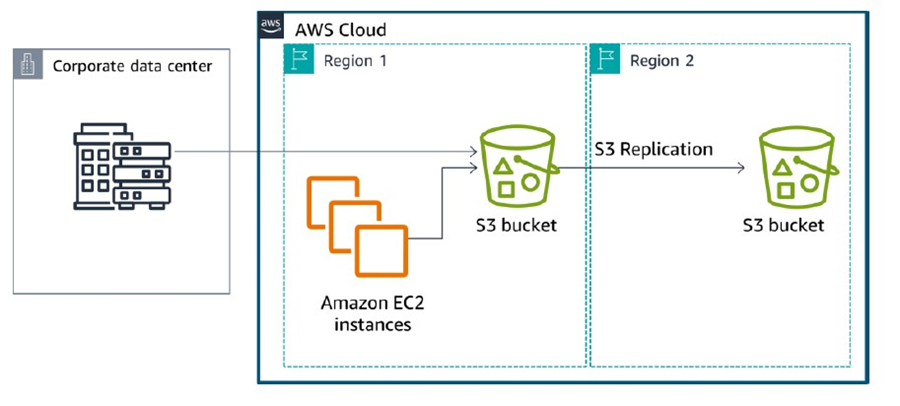
By default, S3 replicates data across multiple AZs, all copies still reside within the same AWS region. In case of critical scenarios such as a large-scale regional outage, natural disaster, or regulatory requirement, this may not be sufficient.
S3 Cross-Region Replication (CRR) addresses this risk by automatically copying objects to a bucket in another AWS region. This provides geographic redundancy and supports disaster recovery strategies. If an entire region becomes unavailable, applications can switch to the replicated bucket in the secondary region, ensuring continued access to data.
3. High Durability in Amazon S3
Amazon S3 is engineered for extremely high durability, with most storage classes offering 99.999999999% (11 nines) durability. This means that the probability of losing an object is extremely low. S3 achieves this by storing multiple redundant copies of data across different devices and Availability Zones. Durability can be further enhanced through versioning and replication.
Versioning preserves every object change, making it possible to restore previous versions after accidental deletions or overwrites. When combined with Cross-Region Replication, every object version is also copied to another region, adding an extra layer of protection against regional failures.
IV. Best Practices to Apply on S3
AWS recommended below best practices for S3 environments:
1- Lifecycle management
Define S3 Lifecycle rules to automatically transition objects to lower-cost classes or expire them after a defined retention period. For example, you might move logs to Standard-IA after 30 days and then to Glacier after 90 days, finally deleting them after one year. This reduces costs and enforces data-retention policies without manual intervention. (AWS notes that lifecycle configurations apply to both existing and new objects automatically
2- Disaster recovery planning
Treat S3 as part of your broader DR strategy. Determine acceptable RTO/RPO for S3 data. Use versioning and multi-region replication or backups accordingly. For instance, enable CRR or AWS Backup for critical buckets so that you can fail over to a DR region. Document and regularly test restoration procedures, ensuring you can recover quickly from data corruption, accidental deletion, or region-level outages.
3- Monitoring and auditing
Continuously monitor S3 usage and health. Use AWS CloudWatch metrics to alert on abnormal activity. Set up AWS Config rules to audit bucket settings (for example, rules that flag buckets allowing public read/write). Regularly review AWS CloudTrail logs and S3 access logs for any unusual access or permission changes.
4- Compliance and governance:
Enforce encryption (SSE-S3 or SSE-KMS) and secure transport for all buckets. Use S3 Object Lock and MFA Delete on regulatory buckets to prevent tampering. Apply IAM policies and S3 Access Points with strict rules for data access. Finally, use AWS Organizations and S3 Block Public Access settings to centrally enforce security standards across multiple accounts.
Conclusion
Amazon S3 already offers an extremely durable and available storage platform (11‑nine durability and four‑nine availability by design, but the additional configuration controls and practices above ensure that corporate data remain secure, recoverable, and cost-efficient. By combining strong access policies, encryption, versioning, replication, and monitoring.
메타데이터
- post_id
- 0e19a0f97afb
- slug
- amazon-s3-strategies-for-securing-ensuring-availability-and-durability-0e19a0f97afb
- url
- https://medium.com/@gwladysgodem/amazon-s3-strategies-for-securing-ensuring-availability-and-durability-0e19a0f97afb
- canonical_url
- https://medium.com/@gwladysgodem/amazon-s3-strategies-for-securing-ensuring-availability-and-durability-0e19a0f97afb
- author_url
- https://medium.com/@gwladysgodem
- status
- ok
- fetched_at
- 2026-08-05 14:49:01