Maiden Voyage
All Aboard the Great Camel Battleship: Notes on Dairakudakan’s Annual Summer Intensive
Maiden Voyage
All Aboard the Great Camel Battleship: Notes on Dairakudakan’s Annual Summer Intensive
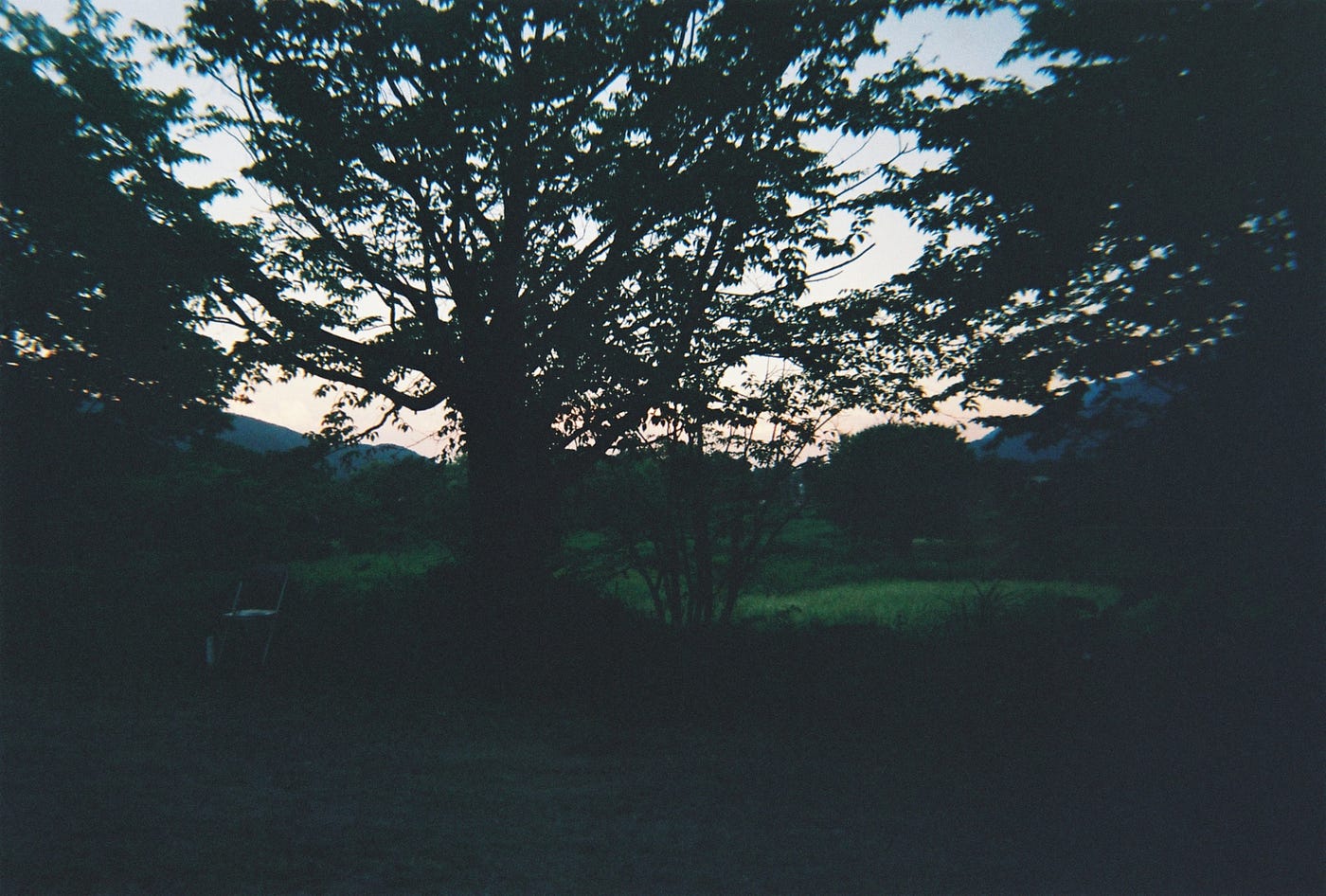
Outside the Camp in Hakuba, Japan. Image Credit: Megan O’Hare
I recently had the great privilege of attending Dairakudakan’s annual summer intensive in Hakuba, Japan. This involved 9 rigorous days of Butoh training, culminating in performing with Dairakudakan. I hope this post provides further information for those considering attending the intensive. I conclude with some reflections on the experience as an emerging performing artist.
The Intensive in Akaji Maro’s Own Words
Originally it was just for Dairakudakan members. It began as a summer retreat. Then we started to bring in outside participants in 2002, people from Japan and all over the world, from 16-year-olds to people in their 60s and 70s. It’s a very diverse group. There are people who haven’t danced before, masterclass level performers who have put on shows worldwide, people who have gone to drama school and people with no experience at all. For those with theater experience, it doesn’t really apply at our summer school. There is no use for techniques and skills learned in theater schools. For the young participants who are 16, I tell them that their 16 years of life is a form of dance, it’s a source of dance.
We put them together as a group and then they give a performance at the end of the summer camp with a real audience. They use a routine which has been taught to them. There are many reasons why we do the camp. It’s to communicate with the outside world and to rethink and reevaluate our relationship with nature. There is the sky and the earth and, as a direct connection between them, we have human beings standing in the middle. It’s to reevaluate our position on earth, in contrast to the sky above us and the land below. To pass that kind of knowledge on is another reason for the camp.
Source: McInnes, Paul. “The Master: Akaji Maro.” Metropolis Japan, August 31, 2008. https://metropolisjapan.com/akaji-maro-dairakudakan-interview/
Information I Wish I Would’ve Found When Googling
Be prepared to surrender to the experience and work hard! The days are long, the weather is hot, and the calibre of instruction is high. It is a rare gift to have the opportunity to learn in such a rigorous environment. To this point, it’s worth noting that the camp had repeat attendees, despite the content reportedly remaining similar (if not the same) each year. Returning participants reported gleaning new insights each year. Everyone reported a positive overall experience in the camp’s closing circle.
Finally, if making the pilgrimage from overseas, do take the time to enjoy the access to Butoh that being in Japan affords you. My trip also provided a valuable opportunity to spend the (entire) day at the Hijikata Tatsumi Archive at the Keio University Art Center in Tokyo. This included an extensive talk by Kae Ishimoto, who is incredibly knowledgeable and personable. A visit (or three) is highly recommended.
Reflections
The intensive revealed Butoh’s extraordinary potency. Performers enter an ‘empty’, meditative state to improvise and perform — frequently described as ‘being danced’ rather than ‘dancing’ — which brings forth compelling movement and strong stage presence. The sense of freedom and spontaneity I experienced while dancing was transformative.
Lastly, living alongside attendees and company members as part of the camp provided valuable insight into the culture of both Dairakudakan as a company and Japanese culture itself, which is inseparable from Butoh as an art form.
Dairakudakan’s members demonstrated a level of artistry and precision that I have yet to encounter elsewhere — if the experience appeals to you, I highly recommend attending so that you too can become infected with the ‘Butoh virus’.
My sincere thanks to all involved for this wonderful experience, made possible by the support of the Regional Arts Development Fund (RADF).
This initiative is supported by the Regional Arts Development Fund (RADF), a partnership between Queensland Government, through Arts Queensland, and Sunshine Coast Council to support local arts and culture in regional Queensland.


메타데이터
- post_id
- 0e2bf513f0d0
- slug
- maiden-voyage-0e2bf513f0d0
- url
- https://medium.com/@meganohare/maiden-voyage-0e2bf513f0d0
- canonical_url
- https://medium.com/@meganohare/maiden-voyage-0e2bf513f0d0
- author_url
- https://medium.com/@meganohare
- status
- ok
- fetched_at
- 2026-07-16 04:52:32