The Evolution of Agile: From Frameworks to Mindset, and What Comes Next
The Evolution of Agile: From Frameworks to Mindset, and What Comes Next
Agile’s journey has been shaped not just by its frameworks; it has also been influenced by the voices of practitioners and thought leaders. They have advocated for its continuous evolution. Over the years, I have explored Agile’s shifting landscape. I did this through my guest appearances on the Agile in Action Podcast with Bill Raymond. I have also written a series of articles published online via this platform. Additionally, I have published articles on IPM. I have shared real-world experiences, interviewed industry experts, and reflected on how its principles apply in diverse contexts.
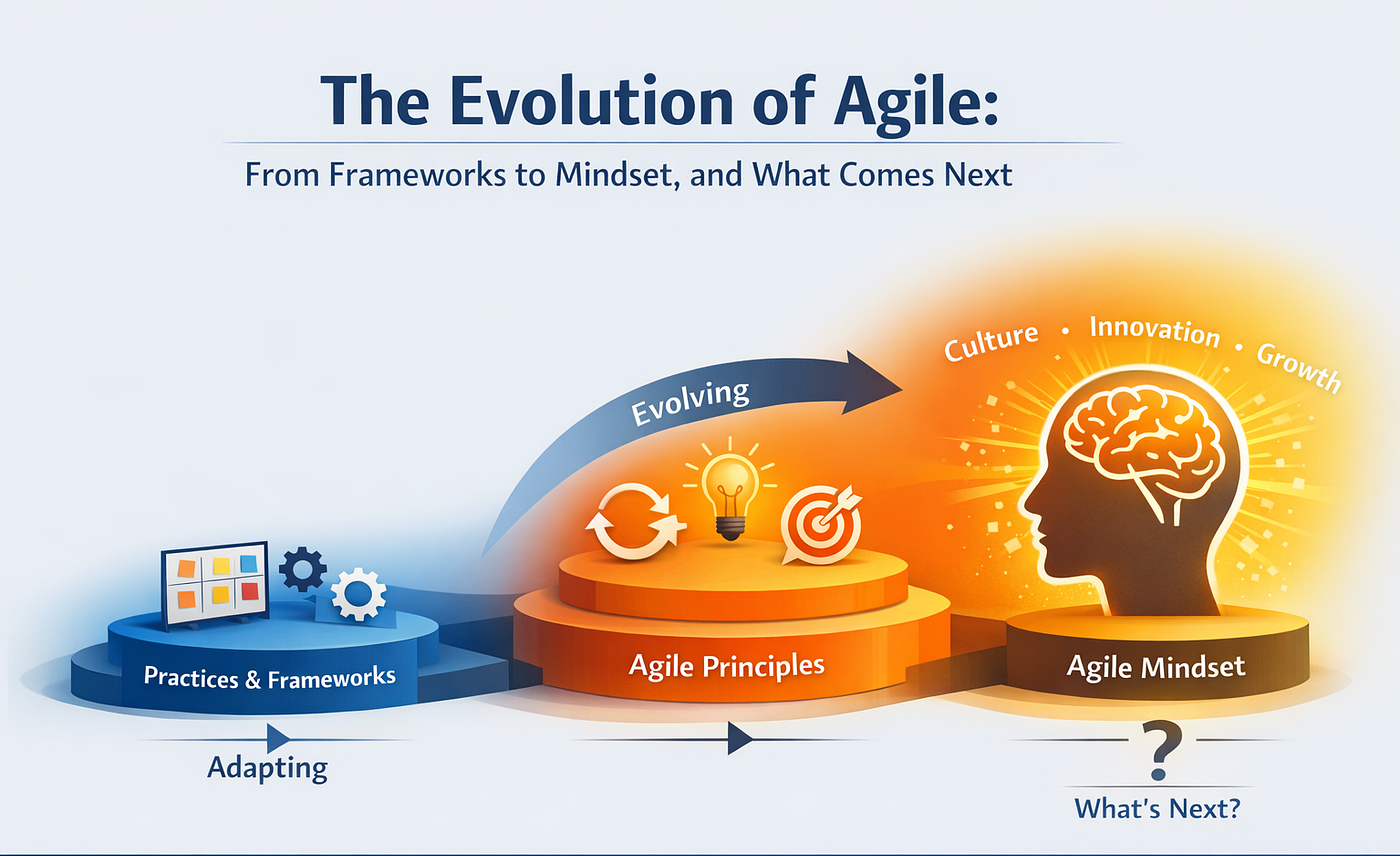
The Evolution of Agile: From Framework to Mindset, & What Comes Next
The Agile movement, once a radical departure from traditional project management, is now considered an effective framework, and some consider a “global standard”. In recent years, I’ve argued that the future of Agile does not lie not in the frameworks – whether they are less rigid than Waterfall ones – instead, it is in adopting a mindset-first approach.
On the Agile in Action Podcast, they have repeatedly discussed how adopting a mindset of adaptability is crucial. Empathy and continuous improvement are also key factors. These actions are a lot more meaningful and impactful than simply adhering to prescribed rituals.
Other guests on this podcast (outside of my talk) have included leaders from tech, finance, and even healthcare. They too have emphasized that the most successful teams live Agile values daily. This is not limited to just stand-ups or sprint reviews. As we navigate the shifting landscape of business and technology here in 2026, it’s clear that Agile is undergoing a significant transformation.
This change is both evolutionary and necessary.
Agile’s Evolution
As I have always maintained, Agile is shifting from prescriptive frameworks to a principles-driven mindset (Agile mindset). This evolution is grounded in several key beliefs, many of which have been explored in my writings, here are some of my key points:
- Mindset Over Methodology: Agile’s true value is not found in ceremonies or artifacts. It lies in fostering adaptability, respect, collaboration, and continuous learning. I have discussed these many time, the teams I have worked with have broken away from rigid processes, and discovered new ways to solve problems. These teams always out perform those who stick strictly to the rule book.
- AI as an Enhancer, not a Replacement: On the Agile in Action Podcast, I discussed how AI could enhance Agile practices. I firmly belive that AI helps to streamline workflows, for example AI helps surface surface valuable insights. But, and I strongly hold this view…
AI cannot replace the uniquely human qualities of creativity and problem-solving.
- I have also stressed how Agile is not dying, but evolving, or what I like to consider it as “maturing” — becoming more adaptive, human-centered, and principle-driven. Key takeaway from me, is to pursue ongoing learning and progress rather than blindly following rituals (artfacts and ceremonies).
- Empowering Teams Is Still the Future: I continue to advocate for the importance of empowered, autonomous teams. Agile’s future, as I see it, belongs to self-organizing groups. These groups learn continuously, own their outcomes, and collaborate closely with customers. Not to mention leveraging any automation tools as they evolve, it can only make your job easier, to focus on what is important, the outcomes!
These themes consistently emerge in my writing. They reinforce the idea that Agile’s future is evolutionary. It is more about mindset, adaptability, and empowered teams. AI serves as an enhancer rather than a replacement for human-centred delivery.
Agile: The Current State
As I am writing this, I find that Agile is everywhere. A total of 97% of organizations claim to use it. Yet, this ubiquity has led to standardization and, in some cases, stagnant.
Large-scale frameworks like SAFe and LeSS are used to coordinate thousands, but often at the expense of Agility itself. Many teams are trapped in a cycle of “fake agile”. In this cycle, sprints are merely rebranded long-term plans. The original spirit of adaptability has disappeared. This is where the danger of “checkbox Agile” arises. When process takes precedence over principle, it can be dangerous. This approach can be destructive to innovation. Rigid execution can lead to diminished creativity and a lowering of team morale.
Here is a list of checkbox agile anti-patterns that we know about, and should (with my best endeavours) aim to avoid (a check-box approach):
- Ubiquitous but Standardized: Agile has shifted from a niche philosophy to mainstream practice. However, many organizations have sometimes reduced it to a checklist of Scrum roles and artifacts. This is where some widespread adoption has sometimes diluted Agile’s original intent, leading to box-ticking rather than genuine transformation.
- Scaled Complexity: Frameworks like SAFe and LeSS offer consistency. But, they can introduce bureaucracy when it may not be needed. Along with other unintended consequences of added complexity. So use sparingly, if at all!
- Rigid Execution: The risk of “doing Agile” rather than “being Agile” is real — many organizations focus on process over principle. Instead, it is important to find practical ways. Teams should refocus on the values and outcomes. They should do so instead of focusing on the procedures themselves.
- Focus on Delivery: Scrum Masters, backlogs, and sprints dominate the conversation, with continuous delivery often prioritized over meaningful outcomes. Instead, the true success lies in customer satisfaction and business impact, not just the volume of stories delivered. So, always think about customer and business value in everything you do!
- Agile as a Toolbox: Increasingly, Agile is seen as a set of pragmatic tools (e.g., Kanban, Scrum) rather than a holistic philosophy. Many organisations now use Agile tools, and are often adapted to fit unique organisational needs. They often blend in with other management approaches, use with caution.
What Agile Can Become
Academic and industry voices alike are now calling for a “post-Agile” or “Modern Agile” era. This vision aligns with my own. I envision a future where principles, not process, drive value. In this future, AI supports, but does not subsume, human ingenuity.
Teams are trusted to define their own ways of working.
The Agile mindset includes several significant elements. In my view, it is crucial to focus on psychological safety. Diversity and continuous learning are also highly important. I have experienced that many organizations that will thrive if they focus on moving away from rigidity of the frameworks, and instead adopt an Agile mindset by building cultures of trust and innovation.
With that in mind, I recommend focusing on the following:
- AI-Enabled Speed: Artificial intelligence will automate routine work, freeing teams to focus on creative problem-solving and strategic outcomes.
- “Grown-Up” Agile: The movement is shifting toward what some call “Agile 2” or “Modern Agile.” This approach emphasizes psychological safety, continuous learning, and value creation. It moves away from strict adherence to roles or rituals. I believe that this shift has led and will continue to do so — to healthier team dynamics and more effective results.
- Truly Self-Directed Teams: The future lies in autonomy and trust, with teams empowered to shape their own processes and metrics. I believe that autonomy fosters innovation and accountability.
- Business Agility: Agile is moving beyond IT, extending its reach into HR, finance, and executive leadership. Many organizations are now applying the Agile principles in strategic planning, talent management, and portfolio governance.
- Outcomes Over Output: The emphasis is shifting from delivering stories to delivering measurable business value and impact. Data is more important than ever now. We must embrace how customer feedback and data-driven decision-making are becoming central to Agile success.
The core evolution is a shift.
It moves from “doing Agile” — following prescribed processes — to “being Agile.”
This means building a culture of adaptability, trust, and continuous improvement. This view is reinforced by stories and research shared in my articles. These stories and research show that teams who internalize Agile values consistently outperform those who focus on process alone.
The Road Ahead
Agile’s journey is maturing. The future belongs to organizations and teams that embrace a mindset of adaptability. They leverage AI as a supportive tool. They value outcomes over output and empower their people to lead from within.
As we move forward, let’s remember:
“Agile is not about frameworks. It’s about fostering a culture where people, principles, and purpose drive success. It is about culture and empowerment.”
Those who focus on these aspects are best positioned for what lies ahead.
See also:
[embed]
메타데이터
- post_id
- 0e47c466647a
- slug
- the-evolution-of-agile-from-frameworks-to-mindset-and-what-comes-next-0e47c466647a
- url
- https://medium.com/agile-adapt/the-evolution-of-agile-from-frameworks-to-mindset-and-what-comes-next-0e47c466647a
- canonical_url
- https://medium.com/agile-adapt/the-evolution-of-agile-from-frameworks-to-mindset-and-what-comes-next-0e47c466647a
- author_url
- https://medium.com/@lukepivac
- status
- ok
- fetched_at
- 2026-06-11 05:11:55