When Victims Become a Shopping List for Criminals
After losing everything to a romance scam, my friend became the target of an even crueler fraud
CYBERSECURITY|PERSONAL FINANCE
When Victims Become a Shopping List for Criminals
After losing everything to a romance scam, my friend became the target of an even crueler fraud
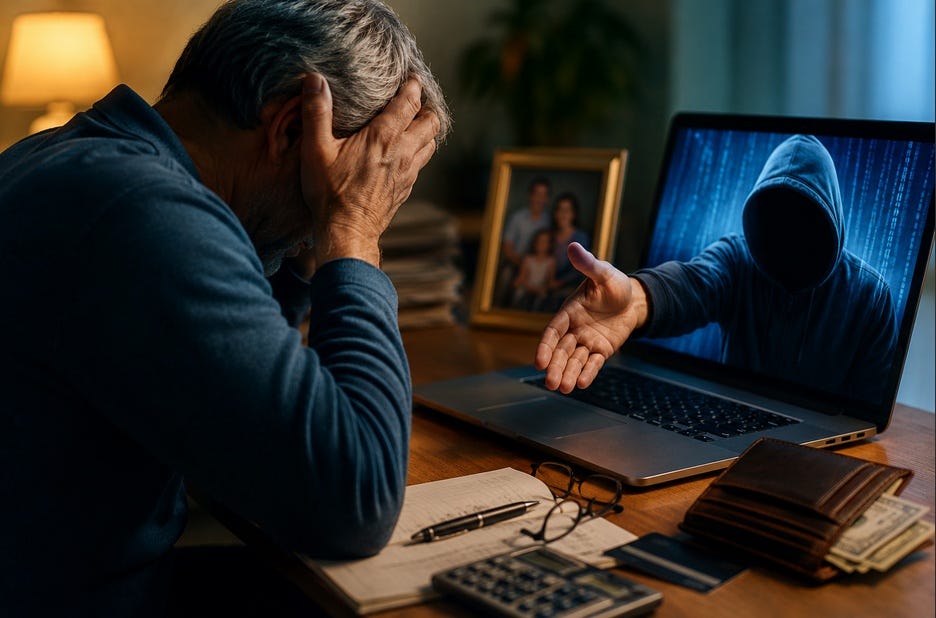
Recovery scammers prey on people who have already lost everything — ChatGPT
Most people think the scam ends when the money is gone. Sadly, it doesn’t. In many cases, that’s when the second scam begins.
A few years ago, a friend of mine named Craig lost everything to a romance scam. His savings disappeared then his retirement account was drained.
The condo he had spent years paying for was eventually repossessed along with his car. What happened next shocked me even more than the original fraud.
Craig became the target of a recovery scam, a particularly cruel scheme that preys on people who have already been financially and emotionally devastated by another scam.
When Losing Money Isn’t the End
Imagine losing your retirement savings or draining your bank accounts, cashing out investments, borrowing money from family members, and watching years of hard work disappear into the pockets of criminals.
Now imagine that just when you are at your lowest point, someone contacts you and says they can get all of your money back.
That’s how the recovery scam works.
The Promise of a Miracle
The fraudster may claim to be an attorney, an expert private investigator, a cybersecurity guru, a cryptocurrency specialist, or even a former law enforcement officer.
They often have professional websites, business cards, legal-looking documents, and convincing credentials. Some use names that sound like legitimate law firms.
Others claim to work with government agencies or international fraud investigators. The message is always the same and may range from “We found your money” to “We know who stole it.”
Ultimately the bottom line is that they promise you that they can help you recover your money lost in the previous scam.
For someone like Craig who had lost everything, those words sounded like a miracle. Unfortunately, they are usually the opening lines of another scam.
Why Scam Victims Become Targets
What makes recovery scams particularly evil is that the criminals know exactly who they are targeting. They’re not randomly casting a net and hoping someone responds.
Many victims of romance scams like my friend, cryptocurrency fraud, investment scams, and other schemes find their names circulating on lists shared among criminal networks.
Think about that for a moment. The very fact that someone was scammed once makes them a valuable target for another scammer. The criminals know these victims are desperate.
They understand only too well that many are embarrassed and reluctant to discuss their losses with family members. Most importantly, they know these victims are searching for hope. Recovery scammers are selling that.
The Fee That Never Ends
The victim is told that investigators have tracked the missing funds. Perhaps a bank account has been located. Maybe cryptocurrency wallets have been identified. Sometimes the scammer claims a court has frozen the assets and all that remains is a final legal step.
Then comes the catch. The victim must pay an upfront fee. Maybe it will be described as a legal retainer or court filing fees. Sometimes the upfront costs may be claimed to be an insurance bond, a tax payment, or an administrative charge.
The excuse changes, but the objective remains the same. The scammer wants money before any recovery takes place. Then once the payment is made, additional fees usually appear.
There is always one more document that must be filed. One more agency that requires payment. One more obstacle standing between the victim and their supposedly recovered funds.
The money never arrives. When you stop paying them, they disappear. At that point their contact information is no longer valid and you won’t hear from them again. When you are out of money, they no longer will deal with you. They don’t have an incentive.
This Isn’t About Greed
What is especially disturbing is that many victims of recovery scams are not gullible. They’re often intelligent, educated professionals like my friend Craig who have experienced a major personal crisis.
They may be grieving a death, struggling with illness, recovering from a divorce, facing unemployment, or dealing with financial hardship.
Scammers understand human psychology far better than most people realize. A person who is lonely, grieving, or desperate is often far more vulnerable than someone who simply lacks financial knowledge. That is why these schemes continue to succeed.
Recovery victims aren’t motivated by greed. They’re driven by loss. They aren’t chasing easy money they just want to recover what was taken from them in the first place.
How to Spot a Recovery Scam
Anyone who has lost money to fraud needs to understand that no legitimate attorney can guarantee the recovery of stolen funds. Neither can any law enforcement agency. Even if they can help, they never charge victims upfront fees to investigate crimes.
Taking this one step further, it’s important to know that no legitimate investigator will randomly contact a victim and promise to recover all of their money.
Therefore, if someone unexpectedly reaches out claiming they have found your missing funds, skepticism should be your first response.
What Can You Do To Protect Yourself?
Start by being extremely suspicious of people who randomly contact you. If you think there is a remote possibility that someone could help you, take the time to verify their credentials independently.
It’s highly unlikely that people you don’t know will suddenly appear to help you. But if you must check it out, contact government agencies directly using publicly listed phone numbers. Ask lots of questions and do as much research as you can.
Most importantly, never send money to recover money. If someone wants to help you and they are legitimate, they will not charge you any fees.
The Second Theft
The recovery scam industry thrives because victims desperately want to believe there is still a way to undo the damage. The criminals understand that hope can be more powerful than greed.
That is what makes this scam so dangerous. The first scam steals your money. The second scam steals your last chance to recover emotionally from the first one.
Financial losses can often be rebuilt over time. Hope is much harder to replace once it has been exploited.
That’s why recovery scams may be among the most disgusting frauds operating today. They specifically target people who are already wounded and convince them that help has arrived when, in reality, another predator is simply waiting to take whatever remains.
If there is one thing people should remember, it’s that anyone who demands money upfront in exchange for recovering money you already lost is almost certainly not your rescuer.
They are just the next scammer in line like a vulture waiting to take whatever is left.
메타데이터
- post_id
- 0e5144940fde
- slug
- when-the-victim-list-becomes-a-shopping-list-for-criminals-0e5144940fde
- url
- https://medium.com/bouncin-and-behavin-blogs/when-the-victim-list-becomes-a-shopping-list-for-criminals-0e5144940fde
- canonical_url
- https://medium.com/bouncin-and-behavin-blogs/when-the-victim-list-becomes-a-shopping-list-for-criminals-0e5144940fde
- author_url
- https://medium.com/@kelly.carmichael
- status
- ok
- fetched_at
- 2026-06-20 20:29:01