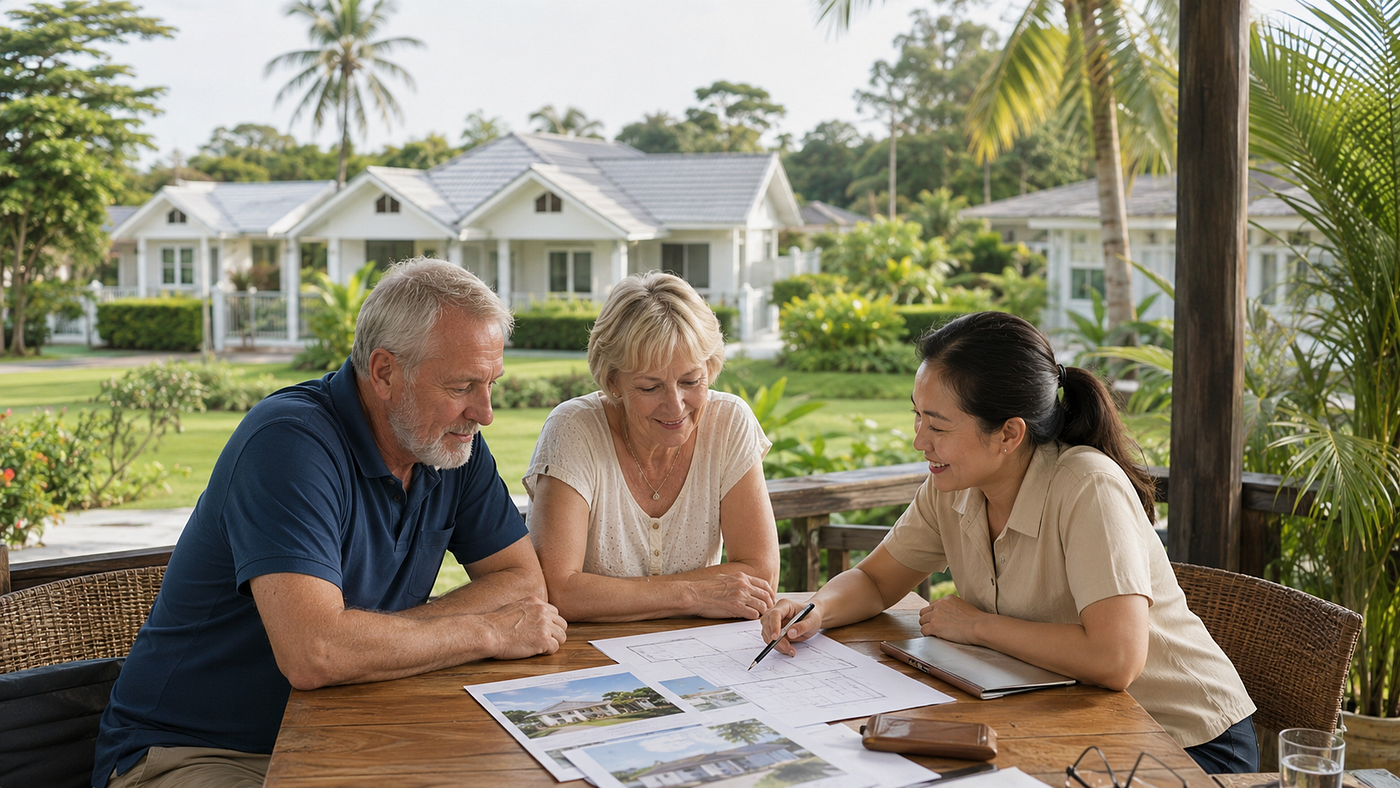
An international retired couple relaxes on their private terrace near Hua Hin with shared community…
Two retirees can look at the same home near Hua Hin and make completely different decisions for perfectly sensible reasons. One expects to…
An international retired couple relaxes on their private terrace near Hua Hin with shared community space visible in the distance.Part-Time Retirement in Thailand: Should Your Home Work for Six Months a Year or Twelve?
Two retirees can look at the same home near Hua Hin and make completely different decisions for perfectly sensible reasons. One expects to spend every winter in Thailand and return to Europe for the rest of the year. The other expects Thailand to become the main home, with only occasional trips abroad.
The building may be identical. The ownership pattern is not.
That difference affects more than travel dates. It changes how much house feels useful, how much outdoor space you want to manage, what storage matters, how community facilities fit into your week, which costs continue when you are away, and how much flexibility you may need later.
A six-month retirement home is not simply a twelve-month home used half as often. A home chosen for one pattern can become awkward when your retirement pattern changes.

For a part-time owner, arrival day is part of the home test: how quickly does the property feel usable again after time away?
Start with your calendar, not the floor plan
Before comparing bedrooms, terraces or pools, sketch the year you actually expect to live. Which months are likely to be in Thailand? Which months are likely to be in your home country? How much regional travel do you expect? When might children or friends visit?
This simple calendar separates three very different buyers.
A seasonal owner may arrive for several months, settle into a comfortable routine, then close the home again for a long absence. A full-time resident needs the property to work through ordinary weekdays, rainy periods, quiet months and the times when nothing feels like a holiday. A hybrid owner may start seasonally and gradually spend more of the year in Thailand.
That third pattern deserves special attention because retirement plans often evolve. The home you buy for your first two winters may later become the place where you spend nine months, or almost the whole year.
So the first question is not, “How large a home can I buy?” It is, “What will this home be asked to do across my year?”
Full-time living makes ordinary space more important
If Thailand will be your main base, the home has to support ordinary repetition. You need places for groceries, paperwork, hobbies, laundry, tools, luggage and the things that accumulate when a property becomes a real home rather than a seasonal base.
You also begin to notice whether rooms have a daily purpose. A spare bedroom may be useful for guests, but perhaps it also needs to work as a reading room or hobby space. A terrace may look attractive at a viewing, but full-time living asks whether you would use it in a normal week. A garden may feel generous, but the relevant question is how much of it you actually want around you every day.
The same applies to community facilities. A pool, terrace, fitness area or games space can add variety to a full-time routine, but it should remain an option rather than something the private home depends on.
The rooms and outdoor areas need enough purpose to justify being part of your normal week.
Part-time living changes what “enough house” means
For a seasonal owner, unused space can create more work without creating more enjoyment. A room that sits empty for most of the year still needs to be cleaned, checked and maintained. A larger garden or private pool may be exactly what you want during your months in Thailand, but it also creates questions about care during the months you are elsewhere.
That does not mean part-time buyers should always choose the smallest property. It means every extra area should earn its place in your six-month life.
Ask what you want to find on arrival. Do you want to unpack one suitcase and feel settled within an hour? Do you expect sports equipment, clothing and personal items to remain in Thailand between visits? Will family arrive soon after you do? Would you prefer a private pool because swimming is central to your routine, or would a shared pool meet the same need with less private equipment to think about?

A useful part-time home should become comfortable quickly when you return, without needing a complicated reset.
Current Leo Resort pages show a range of home, land and private-pool choices. Use those choices to compare workload and routine, not simply to move upward through a list of bigger options.
For a part-time home, simplicity can be a feature. The useful property is the one that becomes comfortable quickly when you arrive and does not feel unnecessarily complicated when you leave.
Costs do not automatically stop when you leave
Part-time living can reduce some day-to-day spending because you are not using the home every month. But it is a mistake to assume that ownership costs fall in the same proportion as occupancy.
Depending on the property and arrangement, recurring community or service charges, insurance, basic utility connections, pest control, garden care, pool care and maintenance may continue while you are away. A repair can also appear during a month when you are not in Thailand.
Do not build a retirement budget around the idea that “six months in Thailand” means “half the annual home cost.” Ask which costs continue throughout the year, which depend on actual use, which are optional, and which are paid directly to outside providers.
Leo Resort’s current public pages refer to managed garden, pool, exterior and security support, while its pricing and clubhouse pages describe service or contribution arrangements. Those pages are useful starting points, but the current published material also contains different monthly figures and different descriptions of access. This article therefore does not quote a fixed recurring fee.
For the home you are considering, request the current recurring charges, scope and exclusions in writing. The amount matters, but the more important question for a part-time owner is what still applies when the house is unoccupied.
Community feels different when you arrive seasonally
A full-time resident may build habits around the same walking route, pool, terrace or fitness space throughout the year. A seasonal resident experiences the community differently: you arrive, reconnect, build a routine for several months, then leave again.
That makes low-friction shared space useful, but it also makes independence important. You should not need a busy event calendar to make the home feel worthwhile after returning from abroad.
The current Club House Options page lists a communal pool, terrace and gardens, fitness options, BBQ, badminton, jeux de boules and games. If you are a part-time owner, ask which one or two of those would help you restart an ordinary routine after arrival.
Then ask the opposite question: if you used the shared facilities less than expected, would the private home still feel complete?

For seasonal owners, nearby shared space can help restart a familiar routine without making community the centre of every day.
This is the same private-home-first principle explored in the related guide How a Clubhouse Can Support Social Retirement Without Giving Up Privacy. Part-time living adds another layer: your relationship with the community may pause and restart several times over the years.
Plan for the possibility that six months becomes twelve
Many retirement decisions are made while working life, family obligations and long-haul travel still shape the calendar. A few years later, the balance may change.
You may discover that you prefer spending more of the year in Thailand. A partner may want a different schedule. Family visits may become longer but less frequent. Travel back to your home country may feel less important, or more important, than you expected.
This is why a seasonal home should not be designed only around arrival and departure. Test it as a potential full-time home as well.
Would there be enough everyday storage if most of your belongings moved to Thailand? Would the kitchen and living areas still feel practical after six continuous months? Would a room that works as a guest room also give you useful private space when nobody is visiting? Would the outdoor area feel enjoyable if you were responsible for thinking about it all year?
You do not need to predict the future perfectly. You need enough flexibility that a change in your calendar does not immediately make the property feel wrong.
Absence changes ownership even before you discuss lock-and-leave services
Once you know that long absences will be normal, several ownership questions become more important. Who may need access if something requires attention? How will you receive information from abroad? What happens to garden or pool care? How are non-routine repairs approved? Which bills or service arrangements continue?
Those questions belong in your decision even if you do not yet know the detailed procedure for every trip.
We covered the practical after-handover side in After Handover: Maintenance, Services and Support at a Hua Hin Retirement Home, including contacts, responsibilities, approvals and planning for time away. The purpose here is different: to decide whether the property itself fits a life in which absence is normal.
A private pool may be a strong reason to choose one home over another, but ask how its care works during your absence. A larger garden may be part of the lifestyle you want, but ask who is responsible when you are abroad. Extra rooms may be useful for family, but ask whether they are still useful during the months when only one or two people live there.
Those are not reasons to reject part-time ownership; they are reasons to choose the home with absence in mind.
Do not confuse managed living with an automatic away-home plan
Leo Resort currently presents its broader model as managed retirement living and says that garden, pool, exterior and security are handled within that concept. Its clubhouse and home-options pages also refer to office or reception support and access arrangements.
For a buyer who plans to leave Thailand for months at a time, those statements should lead to questions, not assumptions.
Does the arrangement for your exact home include private garden care? What about a private pool? Is anyone expected to enter the house while you are away? Is there a separate process for access, inspections or contractor visits? Who contacts you if a decision is needed? Which services are included, optional or performed by outside providers?
Do not assume that “managed” means automatic interior checks, key holding, unlimited maintenance, or approval of repairs on your behalf. Those are specific operational arrangements and should be confirmed in writing if they matter to your plan.
The same caution applies if rental use is part of your idea. A part-time retirement home and a rental property are not automatically the same product. Ask separately about current eligibility, management, access, costs, responsibilities and contract terms rather than assuming that an empty season can simply become a rental season.
Run the same home through four different scenes
One of the best ways to compare homes is to stop imagining a single ideal day. Run the same property through four scenes instead.
- Arrival after four months away: You have luggage, groceries and perhaps a little cleaning or resetting to do. How quickly does the home become comfortable again?
- An ordinary Tuesday in your third month: There is no visitor and no special activity. Are the rooms, terrace, garden and nearby facilities still useful?
- A family visit: Can one or two guests fit without turning the whole house into temporary accommodation?
- A long absence: Which parts of the property still need care, access, payment or decisions while you are in another country?
A home that works in all four scenes is more flexible than one that looks perfect only on arrival day.
During a viewing, this can also reveal what you do not need. Perhaps a larger plot is attractive but adds little to your actual routine. Perhaps an extra room has a clear second purpose and is worth keeping. Perhaps a private pool is central to the reason you want to live in Thailand. The answer should come from your year, not from a generic idea of what a retirement property should include.
Choose the calendar first, then choose the house
Leo Resort currently presents several home types, plot sizes and private-pool choices near Hua Hin and Cha-Am. That variety is most useful when you have already decided what kind of year the property needs to support.
If you expect to live in Thailand part time, compare ease of arrival, storage, private outdoor workload, recurring responsibilities and what continues during an absence. If Thailand is likely to become your main home, put more weight on ordinary weekday comfort, room purpose, community routines and whether the property still feels practical after the novelty wears off.
If you are not sure which future is more likely, choose for flexibility rather than for the most optimistic version of either one.
For current project information, review the Leo Resort home-options page, the Bungalows page and the Club House Options page. Because access, services, recurring costs and responsibilities can change, use the contact page to request the current written arrangement for the exact home you are considering.
The most useful question may be the simplest one: are you buying a home for six months a year, twelve months a year, or a retirement life that may gradually become both?
메타데이터
- post_id
- 0e69121d2bf2
- slug
- part-time-retirement-thailand-six-months-or-twelve-0e69121d2bf2
- url
- https://medium.com/@technician_87713/part-time-retirement-thailand-six-months-or-twelve-0e69121d2bf2
- canonical_url
- https://medium.com/@technician_87713/part-time-retirement-thailand-six-months-or-twelve-0e69121d2bf2
- author_url
- https://medium.com/@technician_87713
- status
- ok
- fetched_at
- 2026-09-04 07:43:03