Experiments in Negative RoR by Coffee Roast Phase
Is Negative RoR bad?
Coffee Data Science
Experiments in Negative RoR by Coffee Roast Phase
Is Negative RoR bad?
The prevailing notion in coffee roasting is that the bean Rate of Rise (RoR) should not go negative otherwise the roast will become baked. This is more clear for the development phase, but I’m unsure about earlier in the roast profile. My experiments with pulsing heat suggest that maybe going negative some times isn’t too bad.
My previous BT/IT profile had inlet temperature driven by bean temperature, so if I caused the RoR to go negative, the profile would just get stuck at that temperature. The profile requires the bean temperature to continue to increase continuously. With my Slope V2.2 profile, I do not have that problem.
To make negative RoR (NROR) by phase, I inserted 90 seconds of flat or slightly negative temperatures for the inlet:
- Baseline
- NROR Dry Phase (Dry NROR)
- NROR Maillard Phase (Maillard NROR)
- NROR Development Phase (Dev NROR)
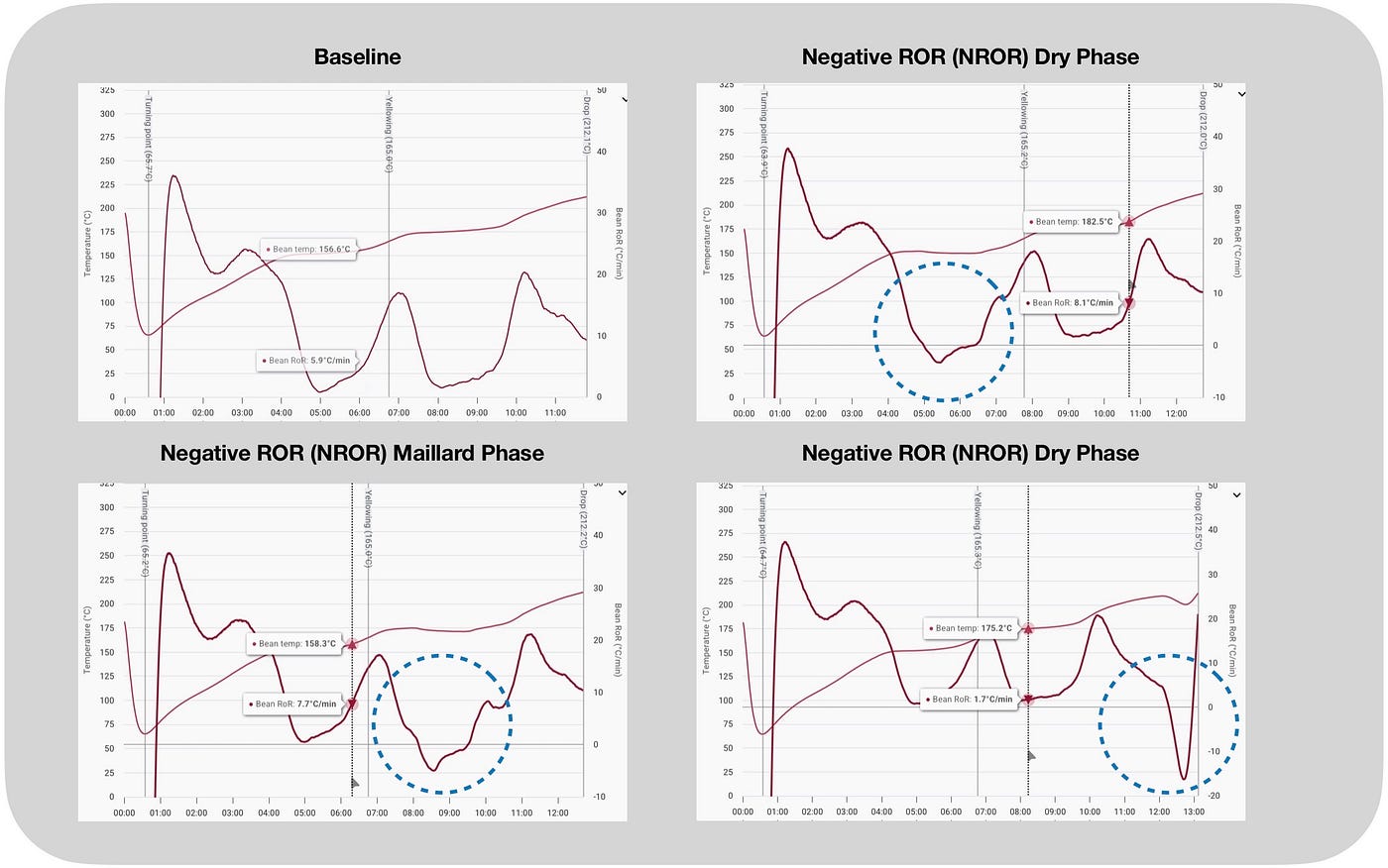
In all the roasts, I was able to get the RoR to go negative.
Post-Roast Metrics
All the roasts but the Dev NROR had similar metrics.


Dev NROR had a longer development time and as a result, the color was quite different.


Metrics of Performance
I used two sets of metrics for evaluating the differences between techniques: Final Score and Coffee Extraction.
**Final score **is the average of a scorecard of 7 metrics (Sharp, Rich, Syrup, Sweet, Sour, Bitter, and Aftertaste). These scores were subjective, of course, but they were calibrated to my tastes and helped me improve my shots. There is some variation in the scores. My aim was to be consistent for each metric, but some times the granularity was difficult.
**Total Dissolved Solids (TDS) is measured using a refractometer, and this number combined with the output weight of the shot and the input weight of the coffee is used to determine the percentage of coffee extracted into the cup, called Extraction Yield (EY)**.
Shot Data
I pulled four shots per roast, and things got interesting. Maillard NROR was better in all cases. Dev NROR was better in two cases. Dry NROR was only better in one.


Average across four shots, Maillard NROR was the clear winner.

EY was unaffected.

These results suggest a few things:
- NROR may not be good for the Dry phase, but another feasibility would be interesting to tease that out.
- NROR for Maillard was better, so I want to know how negative for how long would be beneficial?
- NROR for Development is tricky because it also conflates with development time. The color was 15 points darker (lower) than the baseline, so that easily could have had an effect. This also should be revisited.
If you like, follow me on YouTube and Instagram where I post videos of espresso shots on different machines and espresso related stuff. You can also find me on LinkedIn. You can also follow me on Medium and Subscribe.
Further readings of mine:
My Second Book: Advanced Espresso
My First Book: Engineering Better Espresso
메타데이터
- post_id
- 0e7f86d55c84
- slug
- experiments-in-negative-ror-by-coffee-roast-phase-0e7f86d55c84
- url
- https://medium.com/@rmckeon/experiments-in-negative-ror-by-coffee-roast-phase-0e7f86d55c84
- canonical_url
- https://medium.com/@rmckeon/experiments-in-negative-ror-by-coffee-roast-phase-0e7f86d55c84
- author_url
- https://medium.com/@rmckeon
- status
- ok
- fetched_at
- 2026-06-09 15:37:30