China Just Had Its Best Trade Year in History.
Trump’s Tariff War Was Supposed to Crush China.
China Just Had Its Best Trade Year in History.
Trump’s Tariff War Was Supposed to Crush China.
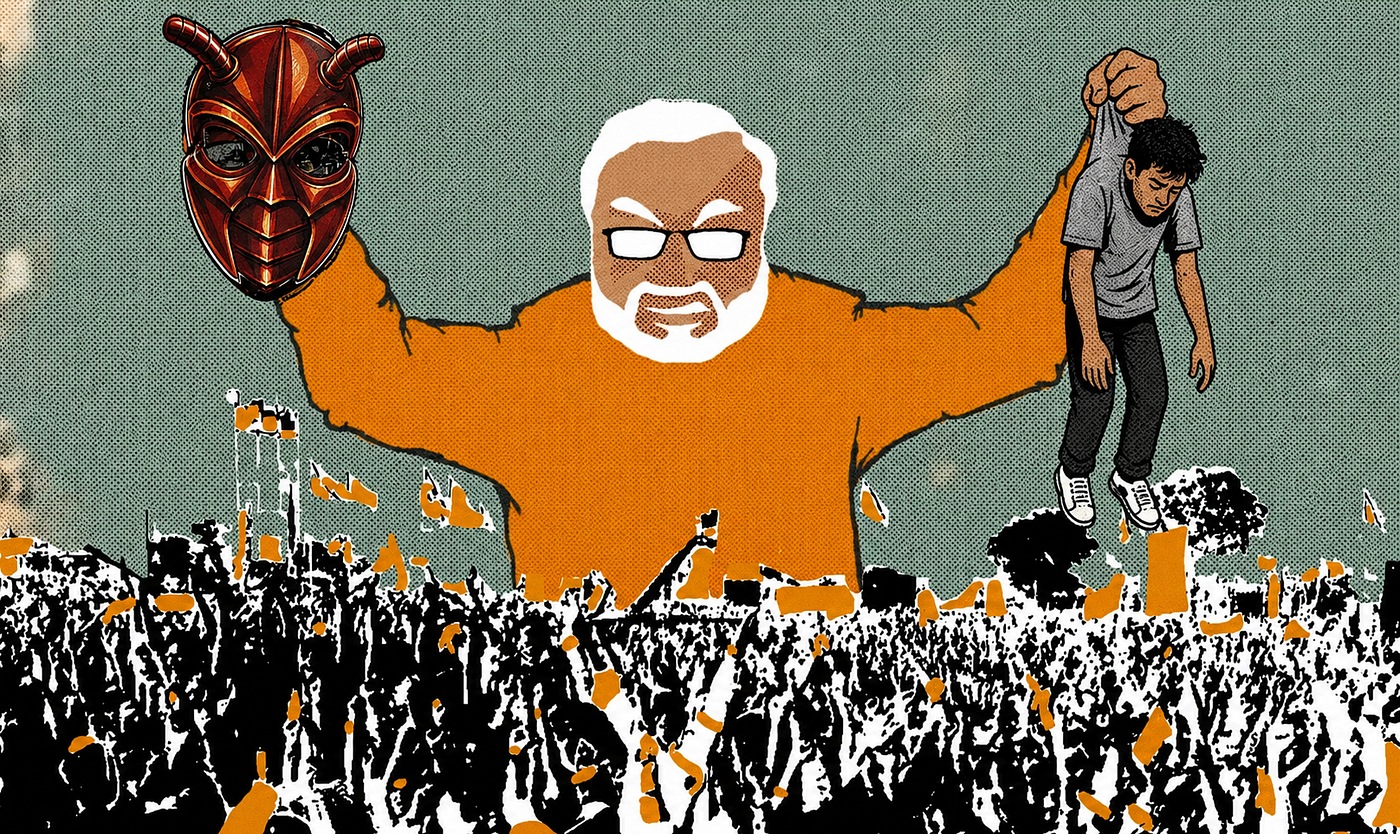
Cartoon from: Drew Sheneman (Hope he stays awake)
Let me show you what the most aggressive trade war the United States has launched since the 1930s actually achieved.
In April 2025, Trump imposed tariffs on Chinese goods that eventually climbed to 145 per cent — a level so extreme it effectively amounted to a ban on most US-China trade.
The goal was explicit: force China to the negotiating table, bring manufacturing back to America, and demonstrate that economic pressure could do what diplomacy could not.
This was not a bluff or a bargaining chip.
It was a full escalation, backed by years of bipartisan consensus that China needed to be confronted.
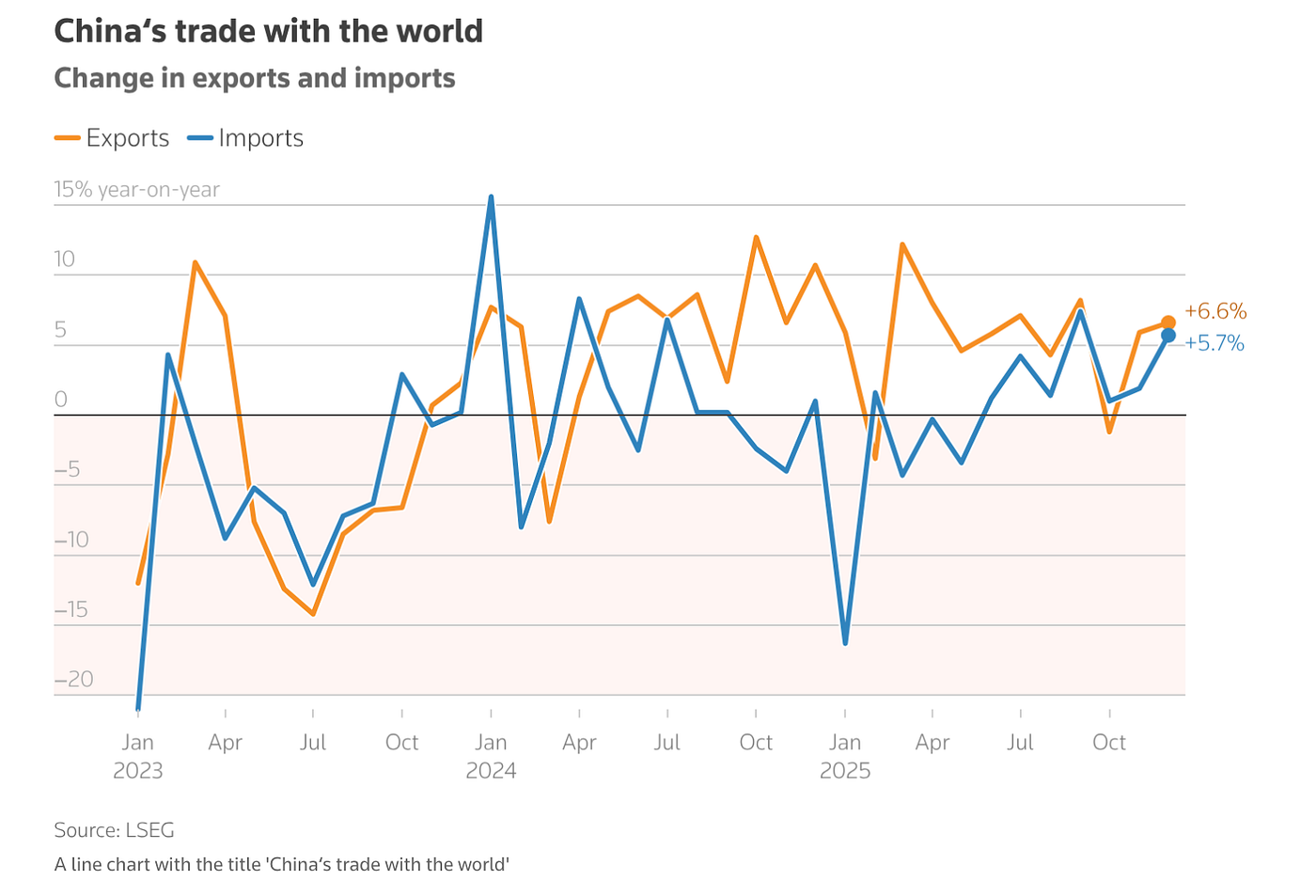
Image from: reuters, LSEG
Chinese exports for the year totalled $3.77 trillion — the highest ever recorded by any country in history. While the tariff war was raging, China was having the best year its exporters had ever seen.
That outcome requires an explanation. Because it runs directly against what the architects of the tariff policy said would happen.
China Did Not Fight the Tariffs. It Walked Around Them.
The assumption behind the tariff strategy was that the United States was so important to China as an export market that cutting off access would force Beijing to make concessions.
The assumption was not wrong about the importance of the US market. It was wrong about China’s ability to find alternatives.
When American tariffs made Chinese goods prohibitively expensive for US importers, Chinese exporters did not sit idle.
They went looking for customers elsewhere -and they found them.
In 2025, Chinese exports to Africa surged 26 per cent, exports to Southeast Asian countries jumped 13 per cent, exports to the European Union rose 8 per cent, and exports to Latin America grew 7 per cent.
[embed]
Trade with Belt and Road Initiative partners rose 6.3 per cent and now represents more than half of China’s total foreign trade.
The Global South, as a destination for Chinese exports, grew from 37 per cent of China’s total in 2020 to over 44 per cent in 2025.
Yes, Chinese exports to the United States fell sharply, down roughly 20 per cent across 2025.
But sales to the rest of the world more than compensated. The US had convinced itself that it was the irreplaceable buyer. In 2025, China proved it was not.
This should not be entirely surprising. China has spent the past decade building economic relationships across Africa, Asia, the Middle East, and Latin America through its Belt and Road Initiative- projects dismissed in Washington as vanity infrastructure or debt traps.
What those relationships built, among other things, was commercial goodwill and logistical infrastructure to quickly redirect trade flows when a major market closed.
The tariff war did not catch China unprepared. It activated a backup plan that had been years in the making.
The People Who Actually Paid For This Were American
The tariff story that gets buried beneath the geopolitical commentary. Tariffs are not paid by the country being targeted.
They are paid by the domestic businesses that import those goods, and they are passed along, as quickly as those businesses can manage, to consumers.
Goldman Sachs calculated that tariffs added half a percentage point to inflation in 2025, accounting for the entirety of the overshoot above the Fed’s 2 per cent target.
The goods that got more expensive were not luxury items.
Toys went up. Small appliances — air fryers, coffee machines — went up. Personal care products went up. These are the things that ordinary American households buy regularly, and the price increases hit lower-income families hardest, since they spend a larger share of their income on consumer goods.
A policy sold as getting tough on China functioned, in practice, as a tax on American consumers that Beijing did not pay.
[embed]
And then, in May 2025, the US and China sat down and cut a deal.
The two sides agreed to reduce tariffs from 145 per cent back to 10 per cent, roughly where they had been before the escalation, for a 90-day period extended through late 2026.
The escalation that had been described as a defining confrontation of the twenty-first century was quietly wound back in exchange for a vague set of commitments. The tariffs stayed on paper. The prices American consumers paid did not come back down. And China’s trade surplus stayed at a record high.
The Country That Nobody Expected to Get Hurt: Europe
The strangest victim of the US-China tariff war is one that had no part in starting it.
While the United States and China were escalating against each other, Chinese manufacturers were flooding European markets with goods they could no longer sell in America — at prices European competitors simply could not match.
European car manufacturers, already under pressure from the transition to electric vehicles, found themselves competing with Chinese EVs that arrived cheaper and better-specified than anything European factories could produce.
Europe had not started a trade war with anyone. It was caught in the middle of someone else’s, and it paid for it.
Brussels spent 2025 desperately seeking exemptions from American tariffs while simultaneously trying to erect its own barriers against Chinese imports. Both efforts were only partially successful.
The EU, which holds more political and economic weight than almost any other actor in global trade, found itself with limited leverage against both Washington and Beijing simultaneously, a situation that would have seemed barely plausible five years ago.
This is what a trade war between the two largest economies in the world actually looks like from the outside. You do not get to stay neutral. The disruptions spread.
The redirected goods arrive in your market. The tariffs intended for someone else land on your industries. And the two countries actually fighting have far more capacity to absorb the damage than the bystanders caught between them.
$1.2 Trillion Surplus
The 1.2 trillion surplus did not mean that China did not have any problems; it has its own problems.
In China, the domestic market is facing its own risk. The property sector is still recovering from the Evergrande collapse.
Youth unemployment has been persistently high. Beijing’s growth model is under stress in ways that cannot be solved simply by redirecting exports.
But the tariff war was not supposed to be judged by China’s internal economic health. It was supposed to pressure China externally — cut off its access o markets, weaken its export machine, and force concessions on trade practices and technology policy. By that specific measure, 2025 was a failure.
The lesson in that $1.2 trillion number is not just about trade. It is about the limits of economic coercion against a country that has spent fifteen years systematically building alternatives to dependence on any single trading partner — including the United States.
Every Belt and Road project, every bilateral currency agreement, every port investment in Africa and Southeast Asia was also, quietly, a hedge against exactly this scenario.
Washington spent years watching those investments happen and largely dismissing them.
The 2025 trade data is what it looks like when the hedge pays off. American households paid more for their groceries and appliances. Europe was squeezed from both sides. China posted a record surplus. And by May, the US was already negotiating its way back toward the tariff levels it had started from.
Therefore, there is no need for you to believe that China is winning the broader competition between the two countries to acknowledge what the numbers from last year clearly show: in this particular battle, fought on this particular ground, the outcome was not what the tariff architects promised.
메타데이터
- post_id
- 0ea5ffb15cc8
- slug
- china-just-had-its-best-trade-year-in-history-0ea5ffb15cc8
- url
- https://medium.com/the-geopolitical-economist/china-just-had-its-best-trade-year-in-history-0ea5ffb15cc8
- canonical_url
- https://medium.com/the-geopolitical-economist/china-just-had-its-best-trade-year-in-history-0ea5ffb15cc8
- author_url
- https://medium.com/@vikas162202
- status
- ok
- fetched_at
- 2026-07-08 23:08:13