Invisible Victim: How armed conflicts steal the childhoods across the world
Children are not born into war, but war is often born into their childhoods. Across conflict zone worldwide, millions of children grow up…
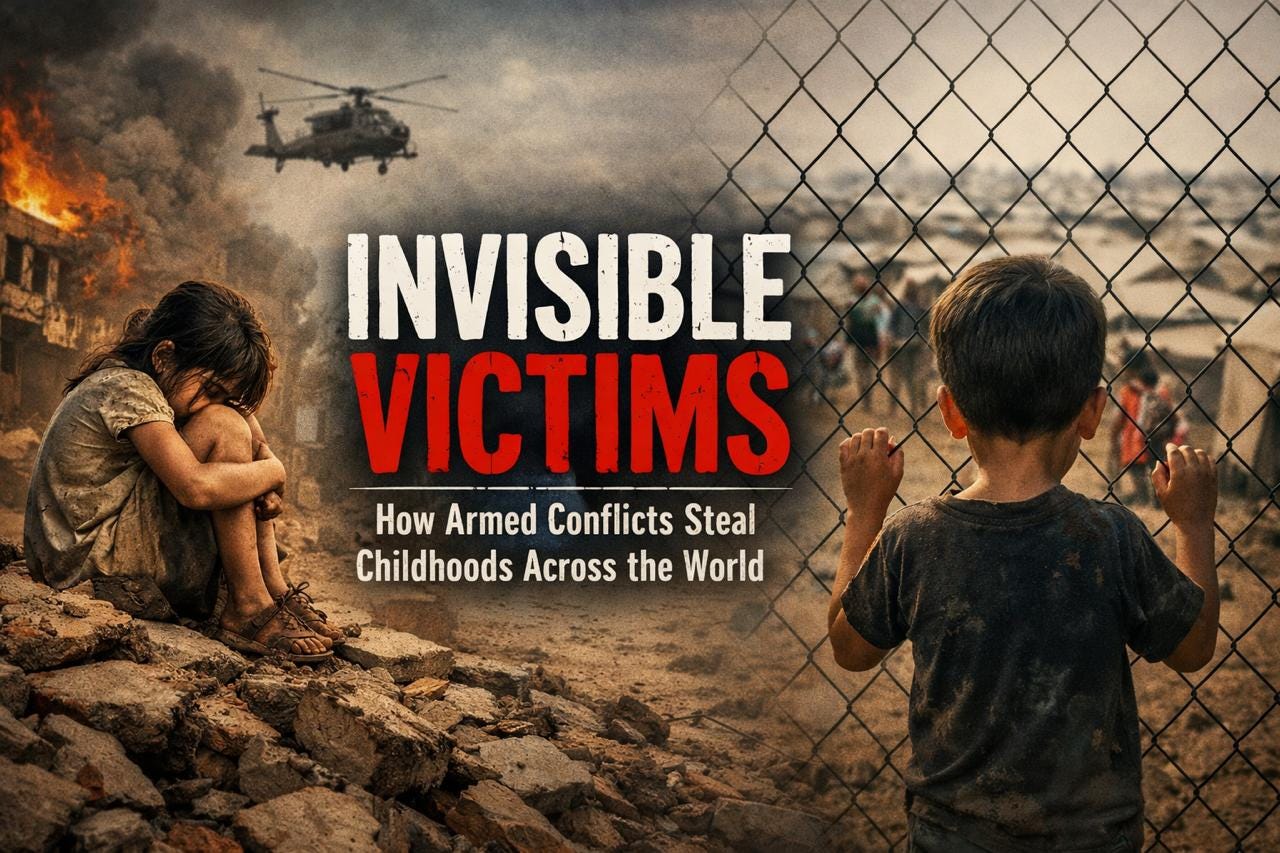
Invisible Victim: How armed conflicts steal the childhoods across the world
Children are not born into war, but war is often born into their childhoods. Across conflict zone worldwide, millions of children grow up surrounded by violence, hunger, displacement and fear. While armed forces are debated in political chambers and analysed through military strategies, the youngest victim remains largely invisible. These children do not choose sides, carry weapons by choice or understand borders, yet they pay the highest price.
📌 UNICEF overview of children affected by war This UNICEF page outlines how millions of children worldwide now live in conflict zones and face direct violence, loss of education, disruption of services, and grave violations simply because they are children.
CHILDHOOD INTERRUPTED BY WAR
A childhood shaped by conflict is a childhood without certainty, in war-torn regions, schools are bombed, playgrounds turn into refugee camps and homes become temporary shelters. According to global humanitarian reports, children in conflict zones are more likely to be malnourished. uneducated and psychologically scarred for life.
For many, education becomes a distant dream. Schools are either destroyed, occupied by armed forces, or deemed unsafe by families. Without access to learning, children are pushed into labour, early marriage or forced recruitment by militant groups. The loss of education doesn’t just affect one child it weakens entire generations and delays development for decades.
The Psychological Cost of Violence
The wounds of war are not always visible. Children exposed to violence often suffer from severe psychological trauma, including anxiety, depression and post-traumatic stress disorder (PTSD). Witnessing death, losing family members or living under constant threat alters their emotional development.
Unlike adults, children lack the tools to process such trauma. Silence becomes their coping mechanism. Many humanitarian systems fail to provide adequate mental health support, allowing emotional scars to deepen with time. These untreated traumas often resurface later as aggression, withdrawal or self-harm, turning victims into lifelong sufferers.
Forced to Grow Up Too Soon
Conflict steals more than safety, it steals innocence. In many regions, children are forced into adult roles far too early. Boys are recruited as child soldiers or forced labourers, while girls are subjected to early marriage, domestic servitude or sexual violence. These practices are not cultural inevitabilities; they are survival responses to conflict-driven poverty and lawlessness. Child marriage, in particular, rises sharply during conflicts. Families, fearing sexual violence or economic collapse, marry off their daughters believing it offers protection. Instead, it traps girls in cycles of abuse, health risks and lost opportunities, another childhood erased by war.
Displacement and the Loss of Identity
War displaces millions of children, turning them into refugees or internally displaced persons. In refugee camps, children often grow up without nationality, documentation or access to basic rights. This loss of legal identity makes them vulnerable to exploitation, trafficking and long-term statelessness. Displacement also strips children of cultural stability the language they speak, the traditions they follow and the sense of belonging they need to form identity. When children grow up without roots, rebuilding societies becomes far more difficult.
Children as Collateral Damage
International laws clearly prohibit violence against children during armed conflicts. Yet violations continue daily unchecked and unpunished. Hospitals are bombed, humanitarian aid is blocked and starvation is used as a weapon of war. Children become collateral damage in political power struggles they neither understand nor influence
The failure to hold perpetrators accountable sends a dangerous message: that children’s lives are negotiable. When justice systems collapse during conflict, impunity thrives and children suffer in silence.
Why the World Must Pay Attention?
Ignoring children in conflict zones is not just a moral failure, it is a global one. Today’s traumatised children are tomorrow’s adults. Without intervention, cycles of violence, poverty, and instability continue across generations.
https://apnews.com/article/sudan-war-military-rsf-darfur-el-fasher-a1fa65cfd28c716a625bd4687c84eec6
Protecting children during conflict is not charity; it is a human rights obligation. Access to education, healthcare, nutrition and psychological support must be prioritised even during war. More importantly, children’s voices must be included in peace-building processes. They are not merely victims; they are survivors with the right to dignity and hope.
Conclusion
Armed conflicts may end on paper, but for children, the war often never truly ends. The invisible victims carry its weight long after ceasefires are declared. If the world truly believes in human rights, then children must no longer remain unseen, unheard or unprotected. A society that allows its children to suffer in silence is not just losing a generation. it is losing its humanity.
메타데이터
- post_id
- 0ea92ef93a4d
- slug
- invisible-victim-how-armed-conflicts-steal-the-childhoods-across-the-world-0ea92ef93a4d
- url
- https://medium.com/@fatimaaminn/invisible-victim-how-armed-conflicts-steal-the-childhoods-across-the-world-0ea92ef93a4d
- canonical_url
- https://medium.com/@fatimaaminn/invisible-victim-how-armed-conflicts-steal-the-childhoods-across-the-world-0ea92ef93a4d
- author_url
- https://medium.com/@fatimaaminn
- status
- ok
- fetched_at
- 2026-07-18 13:52:20




