Gratitude: The Forgotten Power That Transforms Life
Why Gratitude Is the Beginning of Spiritual Growth, Inner Healing, and a Living Relationship with Life
Gratitude: The Forgotten Power That Transforms Life
Why Gratitude Is the Beginning of Spiritual Growth, Inner Healing, and a Living Relationship with Life
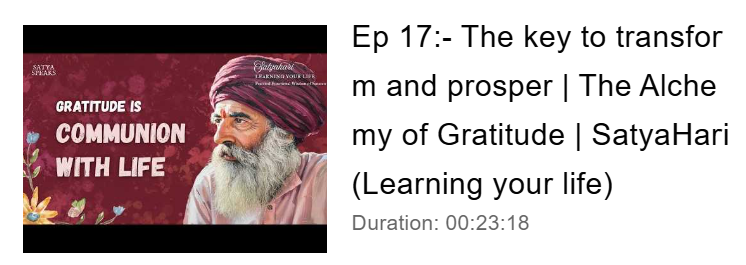
link: https://www.youtube.com/watch?v=_ViXzZJMlDU
Introduction
Modern life has taught us to become efficient, ambitious, and constantly occupied with fulfilling desires. We are trained to compare ourselves with others, chase future goals, and measure success through achievements. While these pursuits have their place, they often cause us to overlook one of the most powerful qualities available to us.
There is an emotion that is frequently spoken about but rarely understood in its true depth. Most people consider it a simple social courtesy — a polite “thank you.” Yet in reality, it is far more than good manners. It is the foundation of both spiritual and material growth. It is the beginning of a living relationship with life itself.
That quality is gratitude.
According to the speaker, gratitude is not merely an emotion. It is an inner alchemy that transforms the body, mind, emotions, and ultimately our relationship with existence. When gratitude awakens, meditation changes, healing begins, relationships deepen, and life itself starts responding differently.
The Forgotten Emotion
Many people assume that the highest human emotion is love.
The speaker challenges this assumption.
Love itself is often the result of something even more fundamental. Before genuine love can blossom, there must first be gratitude.
Gratitude is the doorway through which love, devotion, joy, healing, and wisdom naturally emerge.
Unfortunately, modern living gradually disconnects us from this quality.
How We Lose Our Natural Connection with Life
When we are born, our relationship with existence is immediate.
We see. We hear. We feel.
Awareness naturally connects us with everything around us.
Through this awareness, we gradually become conscious of our own existence in the present moment.
However, as life progresses, something changes.
Instead of remaining connected with the present, we become absorbed in:
- Constant thinking
- Comparisons
- Desires
- Judgements
- Social conditioning
- Mental ambitions
Slowly, our attention shifts away from the living reality of the present and becomes trapped inside the stories created by the mind.
Instead of appreciating what is already here, we become occupied with what is missing.
The result is a life lived in thought rather than in direct experience.
Gratitude Opens the Door to Surrender
The speaker describes gratitude as a deeply humbling quality.
It naturally opens the door to surrender.
However, surrender is often misunderstood.
Many people associate surrender with defeat or failure.
The speaker explains that true surrender is not giving up.
Failure belongs to the ego.
Surrender belongs to expansion.
When gratitude is present, surrender becomes a joyful participation with life rather than an admission of weakness.
Instead of resisting existence, we begin cooperating with it.
Gratitude Changes Our Relationship with Life
One of the central ideas presented is that life is not something happening outside us.
The external world reflects the emotional state we continuously radiate.
Our relationship with life is therefore not mechanical.
It is deeply personal.
Life constantly mirrors our inner attitude.
If our dominant emotional state is complaint, comparison, or lack, that becomes the quality of our relationship with existence.
If our dominant state is gratitude, openness, and appreciation, life responds differently.
This shift affects every dimension of our existence.
According to the speaker, gratitude can influence:
- Physical health
- Emotional healing
- Relationships
- Prosperity
- Spiritual growth
- Our ability to receive wisdom
Why Gratitude Is More Than Positive Thinking
Many people hear about gratitude and assume they already understand it.
The speaker suggests otherwise.
Gratitude is not merely thinking positively.
Nor is it forcing ourselves to say “thank you.”
Instead, gratitude is an energetic state that changes the chemistry of the body, the functioning of the mind, and our openness toward life.
It is an alchemy.
When this alchemy begins, the body becomes receptive.
The mind becomes less defensive.
The heart becomes available.
Life is no longer experienced as something separate from us.
Instead, it becomes an intimate relationship.
Life Is a Relationship, Not a Business Transaction
The speaker illustrates this with a simple example.
Imagine giving someone a meaningful gift.
They acknowledge receiving it but immediately begin complaining about everything else they lack.
Instead of appreciation, they demand more.
Most people would naturally feel less inclined to continue giving to such a person.
The same principle applies to our relationship with life.
Life constantly gives.
Yet instead of recognizing what we have already received, we often focus exclusively on what is still missing.
Over time, our relationship with life begins to resemble a business transaction.
We unconsciously ask:
- “What more can I get?”
- “Why haven’t I received enough?”
- “When will life finally give me what I want?”
The speaker suggests that this attitude destroys intimacy with existence.
Life is not merely a system for fulfilling demands.
It is a living relationship.
Gratitude Awakens Intimacy with Life
The speaker describes life as a living being rather than an impersonal mechanism.
Life reflects what we feel and think.
Although life gives to everyone, some people appear to receive more.
Why?
Not because life is unfair.
But because they relate to life differently.
They cultivate intimacy rather than transaction.
Gratitude becomes the bridge between the individual and the cosmos.
It awakens a living dialogue with existence.
This dialogue gradually opens the door to deeper wisdom, greater receptivity, and a profound sense of connection.
Gratitude: The Beginning of Devotion and Joy
The speaker calls gratitude the doorway to devotion.
It is also the beginning of joy.
Gratitude is fundamentally a “yes” to life.
Ego, on the other hand, constantly says “no.”
Gratitude softens resistance.
It opens blocked energies.
It creates movement where stagnation previously existed.
Just as breathing is a continual exchange between ourselves and the atmosphere, gratitude becomes a continual exchange between ourselves and life.
Instead of existing in isolation, we begin participating in the living flow of existence.
This participation becomes the foundation upon which meditation, healing, love, and spiritual growth naturally unfold.
Part 1 Conclusion
Gratitude is far more than polite appreciation.
It is the foundation of an intimate relationship with life.
Rather than treating life as a marketplace where every experience is judged according to personal gain or loss, gratitude invites us into participation with existence itself.
From this perspective, surrender is no longer weakness but expansion, meditation becomes a celebration rather than a technique, and life transforms from a problem to be solved into a mystery to be lived.
The journey begins not with acquiring something new, but with learning to deeply recognize and appreciate what has already been given.
Part 2: Gratitude as the Foundation of a Living Relationship with Life
Gratitude Is Needed Most When You Feel You Have Nothing
One of the greatest misconceptions about gratitude is the belief that it can only arise when life is going well.
Many people say:
“How can I be grateful when my life isn’t the way I want it to be?”
The speaker compares this attitude to refusing medicine because one is sick.
The very condition that requires healing becomes the reason for rejecting the healing.
Gratitude is not the reward for a successful life.
It is the medicine that transforms our relationship with life.
Waiting for circumstances to improve before becoming grateful only strengthens the habit of dissatisfaction.
Instead, gratitude must become a conscious practice, especially during difficult times.
Gratitude Is Not Counting Blessings — It Is Feeling Grace
Gratitude is often reduced to making a list of things we possess.
The speaker offers a much deeper understanding.
True gratitude is not about counting possessions.
It is about feeling the grace that is continuously flowing through life.
At every moment, the entire cosmos is serving us.
The sun provides warmth and energy.
The earth supports every step we take.
Air sustains every breath.
Water nourishes every cell.
Countless visible and invisible forces are working together every second to keep us alive.
Life is constantly caring for us.
This care is unconditional.
Life Serves Without Conditions
One of the profound observations in the discourse is that life does not discriminate.
Life does not ask whether we believe in God.
It does not ask whether we are spiritual.
It does not decide to provide air, sunlight, or breath only to good people.
Existence serves everyone equally.
Even those who ignore life continue to receive its support.
Yet human beings often reverse this relationship.
Instead of appreciating life’s unconditional nature, we place conditions upon it.
We silently declare:
“Only if life fulfills my desires will I appreciate it.”
This transforms our relationship with existence into a business negotiation.
The speaker reminds us that life itself is unconditional.
It comes before every ambition, belief, identity, and achievement.
Without life, none of our desires could ever be fulfilled.
Desire Is Not the Problem
The discourse makes an important distinction.
Desire itself is not wrong.
Human growth naturally involves aspirations, creativity, and expansion.
The problem begins when desire becomes the condition for our happiness.
When we believe:
“I can appreciate life only after I achieve what I want,”
we disconnect ourselves from the very source that makes achievement possible.
Instead, desire should become an expansion of life rather than a complaint against life.
Our goals should arise from fullness rather than from rejection of the present.
Rather than trying to correct what we imagine to be life’s mistakes, desire should become an invitation to grow, explore, and participate more deeply in existence.
The Great Mother Is Already Supporting You
The speaker invokes the image of Durga, the Divine Mother, as a symbol of the nurturing intelligence of the cosmos.
From the smallest cells within our body to the vast galaxies, existence is continuously sustaining life.
Every heartbeat.
Every breath.
Every moment of awareness.
All are gifts already being offered.
The essential question is not whether life is supporting us.
The question is:
How are we responding to that support?
A Daily Practice of Contemplation
The speaker recommends developing gratitude through conscious contemplation.
Spend a few quiet moments in the morning.
Spend a few moments again before going to sleep.
Reflect deeply on simple facts that are often overlooked:
- Your breath continues effortlessly.
- Your heart beats without your command.
- Life has carried you through countless situations.
- Even after difficulties and disappointments, life continues to sustain you.
Allow this understanding to move beyond intellectual thought.
Let it become a feeling.
Gradually, gratitude shifts from being an idea into a lived experience.
Gratitude Includes Every Experience
Many people are willing to appreciate pleasant experiences.
Few can appreciate difficult ones.
The speaker suggests that true spiritual maturity begins when gratitude expands beyond success.
No matter what tragedies have occurred, gratitude for life itself should never disappear.
Every breath remains a gift.
Every experience contributes to our growth.
This does not mean celebrating suffering or denying pain.
Rather, it means recognizing that even suffering becomes part of life’s teaching.
According to the speaker:
The day you become grateful even for your suffering is the day you transcend ordinary human conditioning.
In that moment, suffering is no longer experienced merely as punishment.
It becomes transformation.
From Begging to Inner Royalty
The discourse presents a striking contrast between two inner states.
The Begging Mind
The begging mind is always asking.
It complains.
It waits.
It demands.
It believes happiness exists somewhere in the future.
Its attention remains fixed on what is absent.
The Royal Mind
Gratitude creates an entirely different psychology.
Instead of asking,
it acknowledges.
Instead of complaining,
it appreciates.
Instead of feeling poor,
it recognizes its inner richness.
The speaker describes this as true royalty — not material wealth, but an awareness of the abundance already present in life.
Nothing Is Greater Than This Moment
Another central insight of the discourse is that spirituality begins with honoring life itself.
No spiritual experience…
No mystical vision…
No enlightenment…
No future achievement…
is more important than this living moment.
Life comes first.
The present moment is not merely a stepping stone toward something greater.
It is already complete.
Recognizing this completeness is itself gratitude.
Gratitude Creates a Personal Connection with Life
The speaker returns to an earlier theme.
Life gives to everyone.
Yet some people appear to receive more.
Not because existence is partial.
But because they have cultivated intimacy with life.
Just as we naturally wish to give more to someone who genuinely appreciates our presence, life responds differently to those who develop a living relationship with it.
This relationship is not mechanical.
It cannot be reduced to formulas or techniques.
It is deeply personal.
As gratitude deepens, people often experience meaningful coincidences, healing, guidance, and a sense that life is communicating with them.
The speaker refers to these as expressions of life’s intimate response.
Devotion in Modern Language
Many people feel uncomfortable with words such as devotion.
The speaker therefore offers another expression.
Devotion is simply intimacy with life.
Not devotion to an abstract world beyond us.
Not blind belief.
But an intimate relationship with the living reality in which we already exist.
This intimacy cannot be fully understood through philosophy alone.
It must be experienced.
As gratitude grows, life begins to feel less like an object we use and more like a friend with whom we are constantly in dialogue.
Part 2 Conclusion
Gratitude is not dependent upon success, comfort, or favorable circumstances.
It is a way of seeing.
It is the recognition that life has already given us infinitely more than we usually notice.
When gratitude becomes independent of conditions, desire is transformed from complaint into creative participation, suffering becomes a teacher rather than an enemy, and the present moment reveals itself as the greatest gift already available.
The journey of gratitude is ultimately the journey from transaction to relationship — from asking life for more to discovering the immeasurable abundance that has always been present.
Part 3: Gratitude, Healing, Meditation, and the Transformation of the Ego
Gratitude Must Become a Way of Being
Simply hearing about gratitude is not enough.
Reading books, listening to talks, or agreeing intellectually with the idea does not create transformation.
The speaker emphasizes that gratitude must become an attitude woven into one’s character.
It requires a conscious shift in the way we perceive life.
Only when gratitude becomes our natural response do we begin to notice profound changes — not only in our inner world but also in our relationships, decisions, and experiences.
Gratitude is not something we occasionally practice.
It is something we gradually become.
The Deepest Love Is Acknowledgement
The speaker offers a beautiful insight into the nature of love.
Deep love is not primarily expressed through words.
Nor is it measured by gifts or techniques.
Real love begins with acknowledgement.
Sometimes another person feels deeply loved simply through the way they are seen.
A look.
A gesture.
A quiet presence.
These forms of acknowledgement often heal wounds that words cannot reach.
Gratitude is the foundation of such acknowledgement.
When we truly appreciate another person’s existence, they feel received.
This silent appreciation becomes more nourishing than elaborate expressions.
Different Ways People Approach Life
According to the discourse, people relate to life in very different ways.
Some seek liberation.
Some seek wealth.
Some seek the fulfillment of personal desires.
These motivations are natural.
Yet there is another kind of person.
There are those who simply come to be with life.
They are not constantly demanding.
They learn to sit quietly with existence.
These are the meditators.
There are also those who sing in gratitude for life itself.
Their attention is not centered on themselves.
Their joy arises from appreciation rather than acquisition.
Such people become especially dear to life because they have learned friendship with existence.
The Wisdom of Listening
The discourse introduces the beautiful Hindi word Shravan, which means listening.
The speaker explains that all wisdom begins with listening.
Not merely listening to words.
Listening to life itself.
Listening to silence.
Listening to nature.
Listening to the breath.
Listening without immediately judging, comparing, or reacting.
Most people remain occupied talking about themselves.
They complain.
They boast.
They defend.
Their minds continuously narrate personal stories.
The listener is different.
The listener allows life to speak.
And only in that silence can deeper wisdom emerge.
Complaint and Appreciation Reveal Our Inner State
Whether we complain about life or praise it, we often imagine we are speaking about the world.
The speaker points out something subtle.
Most of the time we are actually speaking about ourselves.
Our likes.
Our dislikes.
Our expectations.
Our disappointments.
Even our complaints reveal the condition of our own consciousness.
Gratitude changes this orientation.
Instead of remaining trapped in self-concern, consciousness expands into relationship.
The attention shifts from “What am I getting?” to “What has already been given?”
Gratitude Anchors Us in the Present
One of the most practical teachings in the discourse concerns presence.
Desire continually projects consciousness into an imagined future.
The mind keeps saying:
“When this happens… then I will be happy.”
Gratitude works in the opposite direction.
It brings awareness back to this moment.
Instead of chasing an imaginary future, gratitude reveals the richness already present.
The speaker describes life as a song.
When gratitude awakens, we begin hearing that song.
Instead of rushing toward the future, we quietly participate in the music of the present.
This participation naturally becomes meditation.
Meditation Begins Before Closing the Eyes
Many people think meditation starts when they sit on a cushion.
The speaker challenges this understanding.
Long before meditation techniques become meaningful, we must develop intimacy with life.
If we sit to meditate while carrying an attitude of complaint, demand, and dissatisfaction, meditation becomes another attempt to acquire something.
We begin meditation with thoughts such as:
- I must solve my problems.
- I must heal myself.
- I must become enlightened.
- I must gain special experiences.
In this state, meditation becomes another business transaction.
The speaker suggests an entirely different approach.
Sit in meditation with gratitude simply because you exist.
Because you have breath.
Because life has already given you the opportunity to sit quietly.
From this perspective, meditation is no longer a means to an end.
It becomes a celebration of what already is.
Meditation itself becomes an ornament added to an already complete life.
Gratitude Opens the Energy Channels
According to the speaker, gratitude is not merely psychological.
It works energetically.
Ego creates contraction.
It repeatedly says “No.”
This resistance blocks the natural flow of energy.
Gratitude says “Yes.”
That simple inner “yes” relaxes the system.
Energy begins to move freely.
Communication with life resumes.
The speaker describes gratitude as opening energetic channels that had been closed through resistance and negativity.
It is not passive acceptance.
It is active participation.
Healing Through Gratitude
The discourse then turns toward healing.
Most people attempt to heal emotional pain by fighting it.
They resist suffering.
They try to eliminate uncomfortable emotions.
The speaker offers another possibility.
Healing begins when suffering is approached with gratitude and understanding rather than resistance.
This does not mean enjoying pain.
It means becoming willing to learn from it.
Looking at suffering with openness gradually dissolves the energetic knots that sustain it.
The struggle itself often keeps suffering alive.
Gratitude softens that struggle.
Acceptance allows blocked energy to move once again.
Healing therefore becomes an unfolding rather than a battle.
The Ego Is Not the Enemy
One of the most balanced teachings in the discourse concerns the ego.
The speaker does not argue that ego must be destroyed.
Instead, ego must be transformed.
Left to itself, ego becomes disconnected from life.
It complains.
It competes.
It creates unnecessary conflict.
It lives as though it exists independently of everything else.
But the same ego can undergo a profound transformation.
When touched by gratitude, it begins cooperating with life.
The speaker refers to this as a divine ego.
Not because ego disappears.
But because it stops revolving exclusively around itself.
Instead of opposing life, it becomes an instrument working with life.
The issue is therefore not ego versus egolessness.
The real question is whether the ego is anti-life or pro-life.
Meditation Is Friendship with Life
The speaker reminds us that meditation is not merely a technique.
Nor is it a psychological exercise.
Meditation is sitting quietly with one’s oldest friend — life itself.
The breath.
The body.
The present moment.
When meditation arises from gratitude, something beautiful happens.
Creativity begins to flow.
Love naturally appears.
Blessings are no longer ideas but living experiences.
Meditation becomes the heart’s response to existence.
Not something forced.
But something that blossoms.
Gratitude Is a Song for the Song of Life
One of the most poetic images in the discourse is this:
Life itself is already singing.
Our existence is part of that song.
Gratitude is our response.
It is a song offered back to life.
When we say “thank you,” we are acknowledging that we have heard the music.
That we recognize the beauty of being alive.
Gratitude is therefore not obligation.
It is participation.
It is appreciation.
It is our answer to the gift of existence.
Part 3 Conclusion
Gratitude transforms far more than emotions.
It changes the way we meditate, the way we heal, and even the way the ego functions.
Instead of approaching life as a series of problems to solve, gratitude allows us to experience it as a living friendship.
Meditation then ceases to be another technique for self-improvement and becomes an intimate meeting with life itself.
In this meeting, healing happens naturally, creativity awakens, and our relationship with existence shifts from resistance to cooperation.
Part 4: Gratitude, Presence, the Body, and the Alchemy of Transformation
Breathing Gratitude into Life
The speaker concludes the discourse with a simple yet profound meditation.
For a few moments, become aware of your breath.
As you breathe in, feel that life itself is pouring its energy into you.
Every inhalation becomes a reminder that existence is continuously nourishing you.
The speaker describes this as the consciousness of Shiva entering and expressing itself through your very form.
Then, as you breathe out, allow gratitude to flow back toward life.
The exhalation becomes an offering.
A silent expression of thankfulness.
A heartfelt acknowledgement of the gift of existence.
This simple practice transforms breathing from an unconscious biological process into a living dialogue with life.
From a Serious Body to a Smiling Body
The speaker makes a remarkable observation.
When gratitude becomes genuine, the body itself changes.
It no longer carries the heaviness created by constant complaint, resistance, and anxiety.
Instead, the body becomes relaxed, open, and joyful.
He describes this beautifully by saying that the body becomes a smiling body.
This smile is not merely on the face.
It is present throughout one’s entire being.
The body begins to feel lighter.
More alive.
More responsive.
More receptive.
Gratitude softens not only the mind but also the physiology through which we experience life.
When Life Begins Speaking Back
At first, we believe that we are the ones communicating with life.
But the speaker suggests something extraordinary.
As gratitude deepens, life begins responding.
Insights arise.
Unexpected understanding appears.
Meaningful coincidences occur.
Healing unfolds.
Guidance seems to emerge naturally.
In spiritual traditions, such experiences are often described as visions, intuition, or higher guidance.
The speaker emphasizes that these are not supernatural gifts reserved for a select few.
They are the songs of life that have always been present.
We simply become capable of hearing them.
Gratitude tunes our perception to what was already there.
Appreciating the Beauty of Existence
Gratitude develops what the speaker calls an aesthetic sensitivity.
Life is no longer experienced merely as a collection of problems to solve.
Its beauty begins to reveal itself.
The complexity of nature.
The mystery of existence.
The miracle of awareness.
The rhythm of breath.
The silence between thoughts.
All become objects of appreciation.
Instead of moving through life mechanically, we begin participating in its wonder.
Life Is Not a Business Deal
Throughout the discourse, one central warning is repeated.
Never allow meditation, devotion, or spirituality to become business transactions with life.
Much of society operates through exchange.
People naturally ask:
- What will I gain?
- What is the benefit?
- What is in it for me?
While such questions may be useful in commerce, they become destructive when applied to life itself.
Life is not a marketplace.
It is a gift.
The present moment is not a means to obtain another result.
The present moment is already the result.
To experience this directly is the beginning of devotion.
The Present Moment Is Complete
The speaker reminds us that we constantly postpone living.
We imagine fulfillment lies somewhere ahead.
After one more achievement.
One more success.
One more experience.
Gratitude interrupts this endless postponement.
It reveals that this moment is already complete.
The present is not merely a point in time.
It is a state of being.
When we stop measuring this moment against an imagined future, we discover its richness.
This recognition itself is gratitude.
Let Your Relationship with Life Be Unconditional
The speaker encourages us to relate to life as nature relates to us.
The sun shines without demanding recognition.
The earth supports every step without asking for repayment.
Air enters our lungs without conditions.
Life itself gives continuously.
Our response should reflect that same unconditional spirit.
Rather than demanding from life before appreciating it, we learn to appreciate life first.
This transforms our relationship from negotiation into communion.
Gratitude Changes Your Inner Chemistry
One of the practical aspects emphasized in the discourse is that gratitude affects the body itself.
When we continually complain, compare ourselves with others, and focus on lack, our body reflects that emotional environment.
The chemistry of stress becomes familiar.
The nervous system remains contracted.
Energy becomes restricted.
Gratitude creates the opposite movement.
When we appreciate simple pleasures…
When we genuinely enjoy ordinary moments…
When thankfulness becomes natural…
our inner chemistry begins to change.
The body relaxes.
Positive emotions become easier to access.
The speaker suggests that we begin radiating a different quality of energy.
Whether one understands this scientifically, psychologically, or spiritually, the essential message remains the same:
Our habitual emotional state profoundly influences the way we experience life.
Gratitude Makes Meditation Stable
The discourse also offers an important caution for spiritual practitioners.
Many people begin meditation techniques while continuing to live with a deeply negative attitude.
As a result, they experience conflict.
During meditation they may feel peaceful.
Outside meditation they return to complaint, anger, resentment, or fear.
The speaker describes this as creating a split within oneself.
One part seeks spiritual growth.
Another part continually reinforces negativity.
This inner contradiction prevents lasting transformation.
Gratitude resolves this conflict.
Instead of trying to suppress negativity, gratitude gradually transforms it.
The negative ego is not rejected.
It is gently invited into a healthier relationship with life.
Meditation and daily living begin supporting each other rather than moving in opposite directions.
Becoming Aware of the Body
One of the final insights of the discourse concerns embodiment.
The speaker says something deeply significant:
You truly have a body only when you are present in it.
Otherwise, you live almost entirely inside thought.
This explains why people often feel disconnected from themselves.
The body loses its vitality because awareness rarely rests within it.
Gratitude naturally brings consciousness back into the body.
As presence deepens, the body regains its sensitivity, vitality, and quiet intelligence.
The magic of embodied living returns.
Presence Is a Way of Being
The present moment is not simply a point on a clock.
Nor is it merely a concept.
The speaker describes the present as a state of being.
Our relationship with that state is created through recognition.
And recognition naturally flowers into gratitude.
The more deeply we recognize that we exist, breathe, feel, and participate in life, the more gratitude becomes spontaneous rather than intentional.
Gratitude Is the Key to Transformation
The discourse closes by returning to its central message.
Transformation does not begin somewhere in the future.
It begins exactly where we are.
Not by acquiring extraordinary experiences.
Not by escaping ordinary life.
But by recognizing the extraordinary nature of ordinary existence.
Gratitude becomes the bridge.
It reconnects us with the body.
It reconnects us with the present.
It reconnects us with meditation.
Most importantly, it reconnects us with life itself.
When this relationship is restored, the speaker suggests that everything else begins to unfold naturally.
Part 4 Conclusion
Gratitude is far more than an emotion — it is a way of inhabiting life.
It changes the chemistry of the body, steadies meditation, dissolves the habit of complaint, and anchors awareness in the present moment.
Through gratitude, breathing becomes prayer, the body becomes alive, meditation becomes friendship, and life is no longer experienced as something to conquer but as something to participate in.
The deepest transformation begins not with extraordinary experiences but with the simple recognition that existence itself is already an immeasurable gift.
Part 5: Living Gratitude — Practical Application, Key Lessons, and Final Reflections
Gratitude Is Not a Technique — It Is a Relationship
The central message of the discourse is simple yet profound:
Gratitude is not merely a positive habit.
It is not a motivational exercise.
It is not a technique for obtaining better results from life.
Gratitude is the awakening of a relationship.
A relationship with existence itself.
Most people live as if life is happening around them.
The speaker invites us to discover that life is constantly communicating with us, supporting us, and participating in our journey.
The more consciously we acknowledge this relationship, the more alive it becomes.
A Simple Daily Gratitude Practice
The discourse repeatedly emphasizes contemplation rather than complicated methods.
Morning Practice
Before beginning the day:
- Sit quietly for a few moments.
- Become aware of your breath.
- Feel that life has given you another day.
- Acknowledge the gift of being alive.
- Notice your body, your heartbeat, your awareness.
Do not rush immediately into plans, worries, or goals.
Begin the day with recognition.
Evening Practice
Before sleeping:
- Reflect on the day.
- Remember moments when life supported you.
- Recall lessons, experiences, and encounters.
- Appreciate not only pleasant moments but also challenges that taught you something.
Allow gratitude to become the final emotional tone before sleep.
Gratitude Through Breathing
A practice directly suggested in the discourse:
As you breathe in:
Feel life entering you.
As you breathe out:
Offer gratitude back to life.
Breathing becomes a continuous exchange between yourself and existence.
This simple practice can be done anywhere.
Practical Ways to Bring Gratitude into Daily Life
1. Appreciate Before Asking
Before focusing on what is missing, consciously notice what is already present.
Before wanting more:
Recognize what has already been given.
2. Replace Complaint with Observation
Whenever you catch yourself complaining:
Pause.
Observe.
Ask:
“What am I refusing to acknowledge right now?”
Very often, gratitude is hidden behind the complaint.
3. Appreciate Small Experiences
The discourse repeatedly points toward ordinary life.
A cup of tea.
Fresh air.
A conversation.
A quiet morning.
A moment of silence.
Small experiences become profound when they are received consciously.
4. Bring Gratitude into Meditation
Before beginning meditation:
Do not sit as a seeker demanding results.
Sit as someone already blessed by life.
Meditation then becomes appreciation rather than acquisition.
5. Learn to Listen
Practice Shravan — the art of listening.
Listen to:
- Nature
- Silence
- Breath
- Your body
- Other people
Wisdom often arrives quietly.
Only a listening mind can receive it.
6. Become Present in the Body
Several times each day:
Pause.
Feel your feet.
Feel your breathing.
Feel your body from within.
Remember the speaker’s insight:
When you are present in the body, only then do you truly have a body.
7. Treat Life as a Friend, Not a Transaction
Stop asking only:
“What can I get?”
Begin asking:
“How can I participate?”
This simple shift transforms the entire quality of one’s existence.
Key Principles from the Discourse
Life Reflects Your Inner State
The outer world mirrors the emotions and attitudes you continuously radiate.
Gratitude Is the Foundation of Love
Love emerges naturally when gratitude is present.
Without gratitude, relationships often become expectations and demands.
Gratitude Opens the Door to Surrender
True surrender is not defeat.
It is cooperation with life.
Gratitude Anchors Awareness in the Present
Desire pushes consciousness into the future.
Gratitude brings it back to now.
Gratitude Is Essential for Healing
Resistance strengthens suffering.
Understanding and gratitude dissolve inner knots.
Gratitude Transforms the Ego
The goal is not to destroy the ego.
The goal is to transform it from anti-life to pro-life.
Gratitude Makes Meditation Alive
Without gratitude, meditation can become another self-improvement project.
With gratitude, meditation becomes communion.
Gratitude Changes the Body
The body responds to emotional states.
Gratitude creates openness, relaxation, and vitality.
Gratitude Creates Intimacy with Life
Life ceases to be an abstract concept.
It becomes a living relationship.
Gratitude Is a Song for the Song of Life
Life is already expressing itself through us.
Gratitude is our acknowledgement that we have heard its music.
Final Reflection
According to the speaker, the deepest spiritual realization is not hidden in distant philosophies, extraordinary experiences, or future achievements.
It begins with something astonishingly simple.
The recognition that life is already here.
Breath is already flowing.
Awareness is already present.
Existence is already supporting us.
When this recognition becomes heartfelt appreciation, gratitude is born.
And from gratitude emerge love, devotion, healing, wisdom, meditation, joy, and a profound intimacy with life itself.
The speaker’s invitation is therefore not to become something else.
It is to awaken to what has always been available.
To stop relating to life as a business deal.
To stop waiting for the future to justify happiness.
To sit with life.
To listen.
To appreciate.
To participate.
And to remember that perhaps the greatest prayer is not asking for more, but simply saying:
“Thank you.”
Two-Line Summary
Gratitude is not merely an emotion but a living relationship with existence that transforms the body, mind, meditation, healing, and our connection with life. By shifting from complaint to appreciation, we move from separation to intimacy, from seeking to receiving, and from surviving to truly living.
Gratitude #Meditation #SpiritualGrowth #Mindfulness #SelfAwareness #PersonalDevelopment #InnerTransformation #Presence #Healing #ConsciousLiving #Wisdom #Devotion #LifeLessons #MentalWellbeing #Spirituality
메타데이터
- post_id
- 0ebd8dda40f5
- slug
- gratitude-the-forgotten-power-that-transforms-life-0ebd8dda40f5
- url
- https://medium.com/@navneetsmaini/gratitude-the-forgotten-power-that-transforms-life-0ebd8dda40f5
- canonical_url
- https://medium.com/@navneetsmaini/gratitude-the-forgotten-power-that-transforms-life-0ebd8dda40f5
- author_url
- https://medium.com/@navneetsmaini
- status
- ok
- fetched_at
- 2026-07-07 15:45:26