The Overnight Success Was Ten Years in The Making. Here’s What Those Years Actually Look Like
We celebrate the moment. We ignore the decade that made it possible.
The Overnight Success Was Ten Years in The Making. Here’s What Those Years Actually Look Like
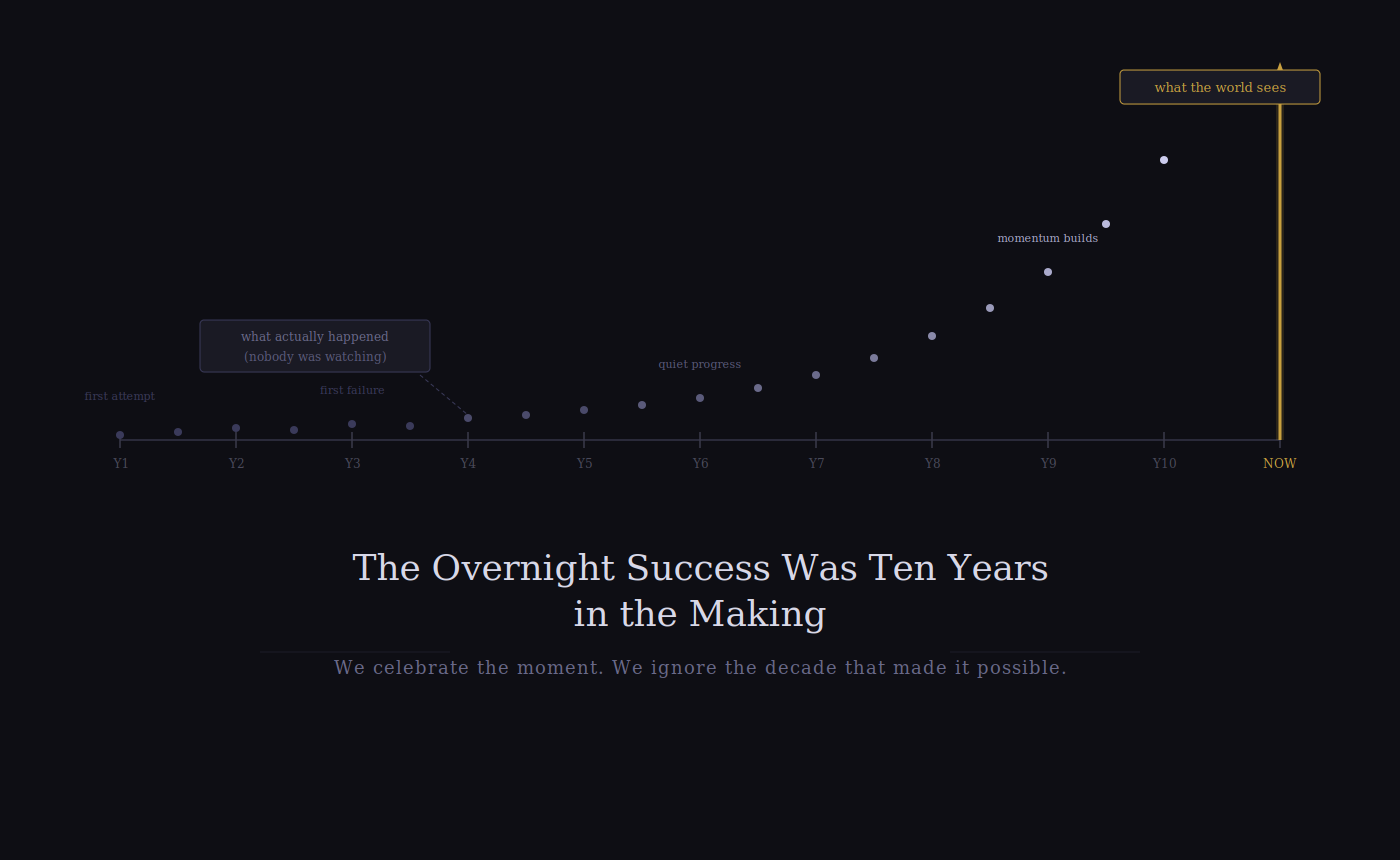
We celebrate the moment. We ignore the decade that made it possible.
There is a story that gets told about successful people.
It usually begins near the end. The product launch that went viral. The book deal. The acquisition. The moment when everything changed. The story is told from that moment backward just far enough to establish context — enough struggle to make the success feel earned, not so much that the audience loses the thread of the narrative arc.
What gets left out is the decade before the context. The years of work that produced no visible result. The iterations nobody saw. The quiet, grinding accumulation of skill and judgment and failure and adjustment that made the visible moment possible.
We tell these stories badly. And the way we tell them has consequences — for how people think about their own trajectories, for how long they’re willing to stay in the work before giving up, for the unrealistic timeline expectations that cause capable people to abandon things that were just beginning to compound.
I want to tell the story differently.
What the Research Shows About Long Timelines
The 10,000-hour framework — popularised by Malcolm Gladwell’s reading of Anders Ericsson’s research — has been oversimplified into a number and a promise. What the underlying research actually shows is more nuanced and more interesting.
Ericsson’s work on deliberate practice found that world-class performance in almost every domain requires not just time but a specific kind of time: structured practice at the edge of current ability, with immediate feedback and conscious adjustment. The hours matter, but the quality of the hours matters more.
What the research also shows — less frequently cited — is that even with deliberate practice, the development curve is non-linear. Progress in the early years is often invisible from the outside, sometimes invisible even from the inside. The competence is building. The results aren’t yet there. The external signal that would confirm you’re on the right track is absent.
This gap — between internal development and external recognition — is where most people quit.
Not because they stopped improving. Because they couldn’t see that they were improving. Because the feedback environment didn’t yet reflect what they were building. Because the story they told themselves about what progress was supposed to look like didn’t match the slow, accumulative reality of how it actually happens.
The Years Nobody Talks About
Before the breakthrough there are the years.
Every person whose success looks sudden has them. The author who published a celebrated debut novel after twelve years of unpublished manuscripts. The founder whose third company succeeded after two quiet failures. The designer whose work became recognisable after years of output nobody remembers. The musician whose first mainstream hit came after a decade of club shows to thin crowds.
These years are not aberrations. They are the standard. They are how almost every durable success gets built.
What happens in them?
Skill compounds. Not linearly — in bursts and plateaus, with long flat stretches that feel like stagnation and occasional leaps that feel like finally. The leaps are never actually sudden. They are the visible manifestation of invisible accumulation.
Taste develops. This is the thing that takes longest and gets talked about least. The ability to know what good looks like in your domain — to feel the gap between what you’re currently producing and what you’re capable of — develops only through years of exposure and output. You cannot rush it. You can only show up long enough for it to develop.
Network deepens. The relationships that produce opportunities — introductions, collaborations, referrals, the right conversation at the right moment — almost never come from a single interaction. They come from years of genuine engagement, showing up in the same spaces, building trust through repeated contact. The overnight connection that produced the big break usually had a five-year backstory.
Judgment sharpens. This is perhaps the most undervalued development of the long years. The ability to read a situation accurately, to know which opportunities are worth pursuing and which aren’t, to make decisions with incomplete information and be right more often than wrong — this is not a talent. It is an accumulated capability. It builds through thousands of decisions and their consequences, most of which were never visible to anyone but the person making them.
Why We Tell the Story From the End
The midnight-success narrative persists not because it’s accurate but because it’s satisfying.
It compresses the timeline to a length that feels inspiring rather than daunting. It locates the causality in a moment — the decision, the product, the launch — rather than in the years of patient accumulation that created the conditions for that moment to matter. It makes success feel like something that happens to people rather than something people build, slowly, through choices made in private over long periods of time.
This narrative serves a purpose. It sells books and motivates audiences and generates the kind of aspirational energy that conference keynotes require.
It also misleads the people most likely to act on it. The first-time founder who expects her company to take off in year two. The writer who abandons his newsletter after eight months of slow growth. The professional trying to build a new capability who gives up after six months of feeling like a beginner.
These are not people who lacked the ability to succeed. They are people who had a timeline expectation — absorbed from the stories they’d been told — that didn’t match the reality of how things actually develop. They quit before the compounding had time to produce something visible.
What the Long Game Actually Requires
The qualities that the long game demands are not the ones most celebrated in the culture of achievement.
Patience is underrated to the point of being invisible. The ability to stay in the work without external validation — to keep showing up when nothing visible is happening, when the feedback is thin and the gap between where you are and where you want to be is still large — this is a rare capability. It is also, consistently, the one that separates the people who build something durable from the ones who almost did.
Resistance to the comparison trap is essential. The ten-year development curve is survivable if you are watching your own progress. It becomes unbearable if you are watching someone else’s highlight reel simultaneously. The person two years ahead of you in a public-facing career is showing you their visible output, not their comparable starting point. The comparison is structurally unfair and motivationally toxic.
The ability to find meaning in the process rather than the outcome is not a philosophical luxury. It is a practical requirement. If the only thing that sustains you is external recognition, you will not survive the years before the recognition arrives. The people who make it through the long middle are almost uniformly the ones who found ways to care about the work itself — the daily practice, the incremental improvement, the craft — independently of what it was producing in the world.
The Reframe That Changes Things
The question most people ask when they’re in the long middle is: is this working?
It is the wrong question. At the point when you’re asking it, the feedback environment is too thin to give a reliable answer. Too many things haven’t happened yet. The compounding hasn’t had time to produce visible results. The judgment of “working” or “not working” is being applied to a timeline too short for the evidence to be meaningful.
The more useful question is: am I getting better?
This is a question you can usually answer honestly, even when external results are absent. Is the work improving? Is the judgment sharpening? Is the understanding deepening? Are you making mistakes you didn’t used to make — which means you’ve moved past the old ones? Are you asking questions you couldn’t have asked two years ago — which means you’ve developed enough to see what you didn’t know before?
If the answer is yes, you are building something. It may not be visible yet. It will be. The compounding is happening. Stay.
If the answer is no — if genuine, honest reflection reveals stagnation rather than growth — that is worth examining. Not as a signal to quit, but as a signal to change the approach, the environment, the practice. Staying in the work without improving is not the long game. It is just waiting.
The long game is patient and it is committed. It is not passive.
What the Decade Before the Moment Actually Produces
The person who succeeds visibly after ten years of invisible work is not the same person who started.
The capability is different. The judgment is different. The network is different. The taste is different. The resilience is different — built through years of setbacks absorbed and recovered from in private.
The overnight success didn’t happen overnight. It happened over ten years, in rooms nobody was watching, in conversations nobody reported on, in the daily decision to show up and do the work even when the work wasn’t producing anything visible yet.
That is the story worth telling. Not because it is more inspiring than the highlight-reel version — in the short run, it isn’t. But because it is true. And because the people who most need to hear it are the ones currently in the middle of it, wondering if it’s working, thinking about quitting.
It is working. Stay.
메타데이터
- post_id
- 0ecd5cb5dfdc
- slug
- the-overnight-success-was-ten-years-in-the-making-heres-what-those-years-actually-look-like-0ecd5cb5dfdc
- url
- https://blog.startupstash.com/the-overnight-success-was-ten-years-in-the-making-heres-what-those-years-actually-look-like-0ecd5cb5dfdc
- canonical_url
- https://blog.startupstash.com/the-overnight-success-was-ten-years-in-the-making-heres-what-those-years-actually-look-like-0ecd5cb5dfdc
- author_url
- https://medium.com/@kalpiprasad
- status
- ok
- fetched_at
- 2026-06-20 20:29:01