Book Review — “Destiny Disrupted” by Tamim Ansary
When the Berlin Wall came down, conservative historian Francis Fukuyama famously declared the “end of history” in his book, “The End of…
Book Review — “Destiny Disrupted” by Tamim Ansary
When the Berlin Wall came down, conservative historian Francis Fukuyama famously declared the “end of history” in his book, “The End of History and the Last Man”. His thesis was that the collapse of the Soviet Union marked the absolute triumph of liberal capitalist democracy. No ideology could challenge it anymore. The West assumed that the rest of the world would simply board the train headed toward this singular, universal truth, leaving nothing behind but minor cleanup work around the edges.
Then came September 11, 2001. For millions of people outside the Middle East, it was a sudden, violent wake-up call. Global spectators were left asking fundamental questions like, Who were these people? What motivated them to give their lives for something so terrible? Who supported this senseless violence? And why do they hate us?
We soon learned that the nineteen hijackers who destroyed thousands of lives were self-proclaimed Muslims acting under the banner of radical Islam rather than any single nation-state. In response, the Western world scrambled to understand if this violence was rooted in the core tenets of the faith or if it merely represented a lunatic fringe.
President George W. Bush attempted to reassure the public by stating, “These acts of violence against innocents violate the fundamental tenets of the Islamic faith.” But many observers weren’t so sure, instead pointing to Harvard professor Samuel P. Huntington’s 1996 book, “The Clash of Civilizations”, which argued that the Western and Islamic worlds were inherently at odds, drawing the “battle lines of the future.”
So, who was right?
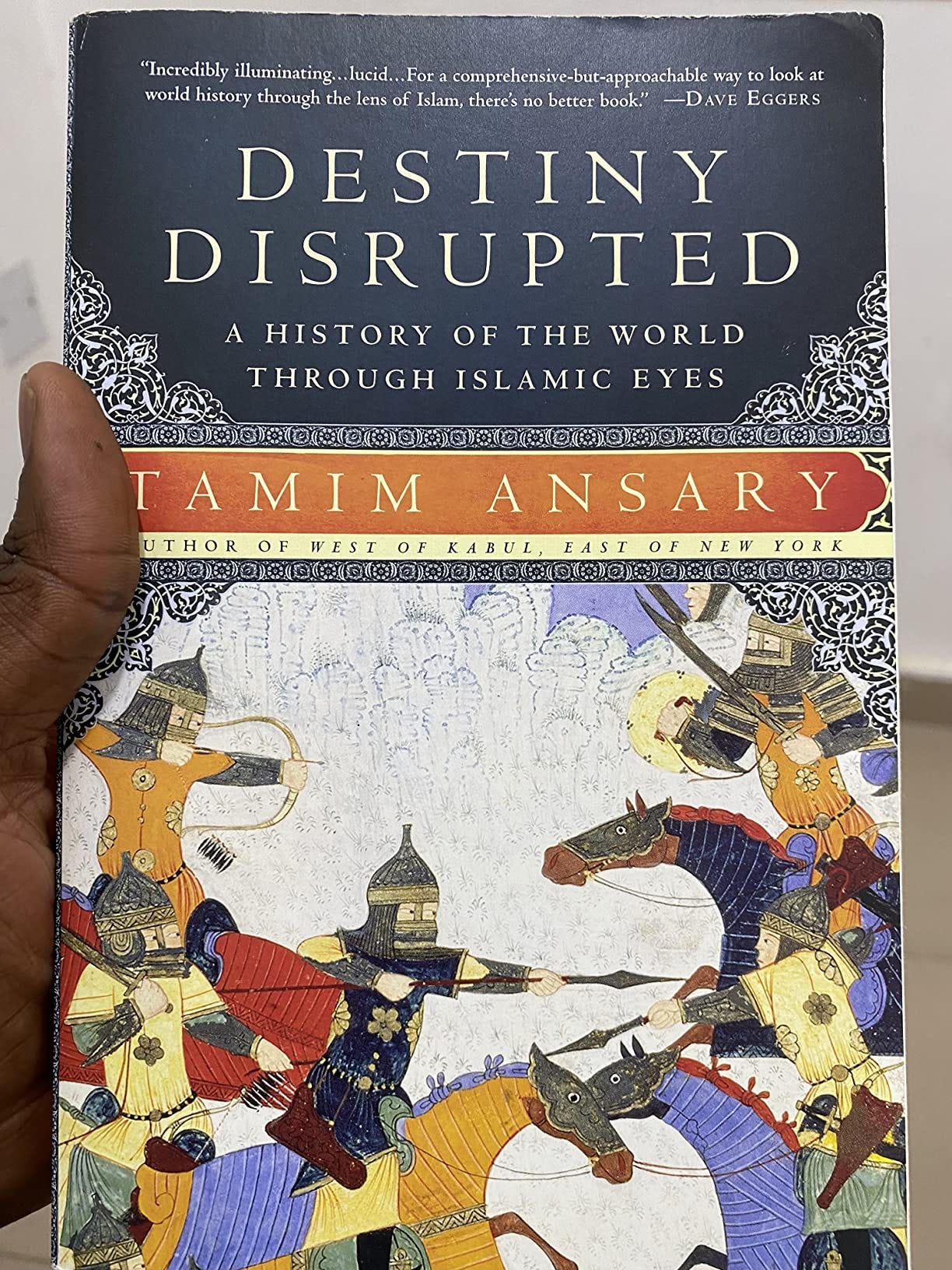
Enter Tamim Ansary’s “Destiny Disrupted”. As with so many contemporary nonfiction books, the title hooks you, but the subtitle delivers the premise: A History of the World Through Islamic Eyes.
Ansary is uniquely qualified to bridge this gap. Born in Kabul, Afghanistan, in 1948, his paternal lineage traces back to the companions of the Prophet Muhammad, while his mother was American. He moved to the United States at sixteen, graduated from Reed College in 1970, and traveled extensively throughout the Islamic world before settling on the American West Coast. Not only does he intimately understand both hemispheres, but he also approaches the subject from a “resolutely secular” perspective.
Ansary’s core argument is that the relationship between the Islamic East and the Christian West will never be simple because their parallel histories are complicated and deeply tangled. As he brilliantly puts it:
“Throughout much of history, the West and the core of what is now the Islamic world have been like two separate universes, each preoccupied with its own internal affairs, each assuming itself to be the center of human history, each living out a different narrative — until the late seventeenth century when the two narratives began to intersect. At that point, one or the other had to give way because the two narratives were crosscurrents to each other. The West being more powerful, its current prevailed and churned the other one under.
But the superseded history never really ended. It kept on flowing beneath the surface, like a riptide, and it is flowing down there still. When you chart the hot spots of the world — Kashmir, Iraq, Chechnya, the Balkans, Israel and Palestine — you’re staking out the borders of some entity that has vanished from the maps but still thrashes and flails in its effort not to die.”
Ansary does not offer neat, easy answers. Instead, he does something far more valuable. He provides a masterful, highly engaging overview of Islamic history, stretching from the civilizations of ancient Mesopotamia right up to 9/11. He covers the life of Muhammad, the early Caliphates, the Crusades, the Mongol invasions, the rise and fall of the Ottoman Empire, and the friction between modern secularism and conservative fundamentalism. More importantly, he shows how the Muslim story alters our understanding of global history.
Five key insights stand out from his narrative:
-
The Erasure of Islamic Innovation Any credible account of world history must give proper weight to the Islamic world. Most Westerners would be astonished to learn that in the 13th century, Muslim armies halted the Mongol advance using a prototype “hand cannon,” or that when William Shakespeare was writing his plays, the world’s reigning superpowers were three massive Muslim empires. Even the steam engine was conceptualized in the Islamic world three centuries before its industrial refinement and development in the West.
-
The Intersecting Intellectual Currents Knowledge of Muslim history routinely illuminates the standard Western historical narrative. A prime example is the great 11th-century Islamic scholar Al-Ghazali. A towering academic, Al-Ghazali wrote a book masterfully outlining the Greek philosophical tradition, particularly Aristotle, intending to systematically dismantle it in a second volume. Ironically, the first book traveled widely across borders without the refutation, sparking an Aristotelian revival wherever it was read. More than a century later, when Thomas Aquinas set out to square Catholic theology with Aristotelian philosophy, he drew immense, unrecognized inspiration from Al-Ghazali’s work.
-
The Reality Behind the Rhetoric The conventional American notion that Islamic terrorists simply “hate Western freedom” is fundamentally flawed. Contrary to post-9/11 political rhetoric, those waging literal jihad do not resent American liberty; rather, their rage is directed at what they perceive as boundless Western moral decadence and aggressive imperialism.
To illustrate this, Ansary highlights one of the great geopolitical tragedies of the 20th century: the August 1953 CIA-backed coup that violently ousted Mohammed Mosaddeq, the democratically elected prime minister of Iran. Mosaddeq was a secular modernist, the exact kind of leader the West claimed to want in the region. However, when he nationalized Iran’s oil and canceled British Petroleum’s lease, the U.S. intervened. As Ansary dryly notes, “Nice try.” The subsequent bloody coup sent a permanent shudder of anger through the Muslim world, cementing the conviction that Western foreign policy is hopelessly predatory.
-
A Cross-Cultural Non-Sequitur When the West and the Muslim world attempt to communicate, they consistently talk past one another because each frames the other as a villain in their own story. Ansary notes: “One side charges ‘You are decadent.’ The other side retorts, ‘We are free.’ These are not opposing contentions; they’re non-sequiturs.” In the 1980s, Ayatollah Khomeini labeled America “the Great Satan,” while Western academics frequently characterize radical Islamists as mere historical re-runs of the Nazis. Both sides rely on comfortable, insular reductions.
-
Islam is More Than a Faith While Islam is undoubtedly a religion, it functions as much more. It is a comprehensive “social project” occupying the same ideological category as communism, fascism, or parliamentary democracy. It is a distinct civilization on par with Chinese or Western traditions — a unique world history unfolding simultaneously alongside our own, incorporating the rest of the globe into its own framework.
For me, the societal role of women in modern Islamic republics deserves far more critical attention from moderate Muslims. As Ansary notes, the West diverges fundamentally from the conservative Middle East by rejecting a strict separation of gender spheres. In a rigorous Islamic framework, women are largely restricted to the private domain, with few avenues for public aspiration.
The West, by contrast, operates on the premise that both genders share the same public and professional spaces. This structural divergence creates an existential tension: because these two worldviews govern shared space with fundamentally opposing rules, coexistence is remarkably difficult. Ultimately, one framework will always attempt to assert dominance over the other.
In Destiny Disrupted, Tamim Ansary provides the English-speaking world with a vital cognitive shift. By re-centering the global narrative through an Islamic lens, he opens a door toward genuine, well-informed mutual understanding, and maybe tolerance. For anyone seeking to understand the deep historical currents shaping our modern geopolitical landscape, this book is non-negotiable reading.
메타데이터
- post_id
- 0ee6fa91f6c3
- slug
- book-review-destiny-disrupted-by-tamim-ansary-0ee6fa91f6c3
- url
- https://medium.com/measured-voices/book-review-destiny-disrupted-by-tamim-ansary-0ee6fa91f6c3
- canonical_url
- https://medium.com/measured-voices/book-review-destiny-disrupted-by-tamim-ansary-0ee6fa91f6c3
- author_url
- https://medium.com/@tosinadeoti
- status
- ok
- fetched_at
- 2026-07-09 01:30:37