The Pahalgam Massacre: Anatomy of a Terror Attack and India’s Multi-Front Response
An Intel failure and a watershed moment for Indian security, diplomacy, and domestic unity.
The Pahalgam Massacre: Anatomy of a Terror Attack and India’s Multi-Front Response
An Intel failure and a watershed moment for Indian security, diplomacy, and domestic unity.
Introduction:
On April 22, 2025, all hell broke loose in the scenic Baisaran Valley in Pahalgam, Kashmir, India, when what was supposed to be a normal day turned into a massacre of visiting tourists at the hands of terrorists. This was a major intelligence failure, but it is important to note a few things. The GoI might successfully ward off and thwart 1000 attacks — and yet, the terrorists need to succeed only once to cause instability. The Security Apparutus has probably thwarted hundreds of attacks in the past few years and will not reveal it publicly to prevent copy-cat style attacks. The Indian State needs to succeed every single time, but the terrorists need to succeed only once. Then there are some attacks for whom there is no electronic intelligence available. The attackers and their handlers may have decided the modus operandi and the targets when meeting in-person. Since at least one of the attackers was known to have exfiltrated to Pakistan in 2018, the attack might have been planned outside India within a small group of people, possibly even a year ago. Where the chances of picking it up are next to zero. India has its sources of intelligence in Pakistan, including Satellite tracking and electronic surveillance, but no security system is fool-proof.
Coming back to the attacks, a bunch of tourists were taken hostage, Male non-Muslim Tourists were singled out after identity checks and shot. They were asked about their religion, and asked to recite the Kalma, and if they failed, they were shot. The women and children were left. When a female survivor asked the terrorists to gun her down too, they replied by saying that she was spared so that she could go tell Modi about the attack. There are multiple such cases documented where the terrorist asked survivors to “go tell Modi”. A local Kashmiri Muslim pony handler, Adil Hussain Shah, was also killed while attempting to snatch one of the terrorist’s guns and protecting the tourists. While the attack was religiously motivated, collective blame on one community is neither just, nor fair. According to Parliamentarian and AIMIM President Assaduddin Owaisi, this was a two-pronged attempt to stoke up Hindu-Muslim riots in India and send a message that non-Muslims cannot come to Kashmir. He appealed all Indians to keep political differences aside. He also cautioned against targetting Kashmiris living in other parts of India, saying that Kashmiri civilians have suffered the most at the hands of terrorists. At least one of the terrorists was an Indian citizen who exfiltrated to Pakistan in 2018 for training and returned to India a few weeks before the attack. The tactics are like those of Pakistani SSG Commandos. The Pakistani Defence Minister, in a fit of stupidity, admitted that Pakistan has been harbouring, fundung and training terrorist organizations for decades, thus ruining his own country’s case. Hamas also met Pakistani terrorist groups in PoK, according to Israel’s Embassador to India.
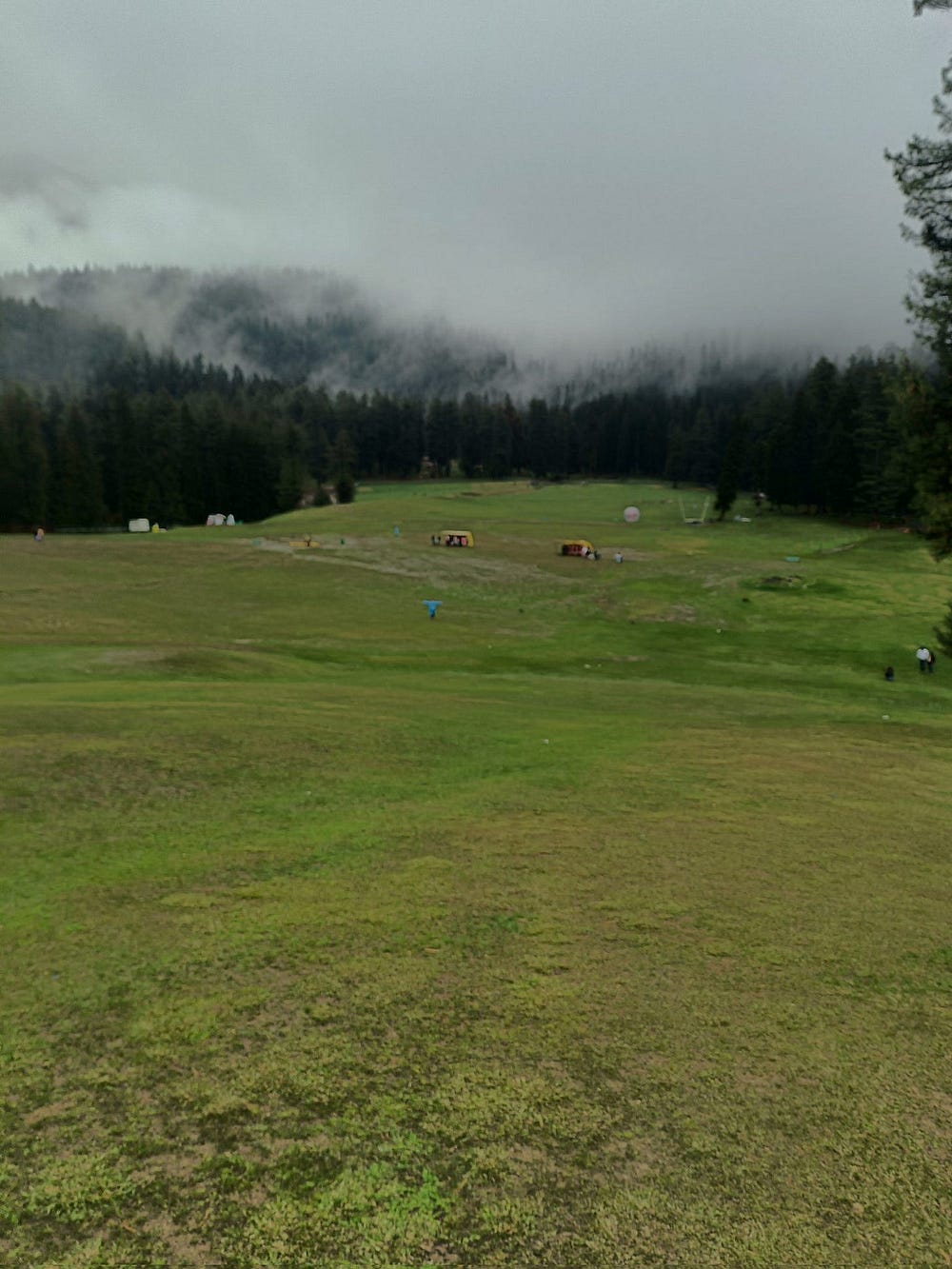
Baisaran Valley, 19th April, 2025. Source
The Immediate Aftermath:
A Quick Action Team (QAT) from the CRPF arrived at the scene within an hour of the attack. This may seem a lot, but it is not. An unarmed Israeli Heron drone, deployed 200 kilometres away, was immediately diverted to scan the approach route for potential ambushes. This response time is not bad by any stretch of imagination. It is in a relatively remote area of Pahalgam when accessed by road. It is about 35 minutes from the closest hospital, and about 30 minutes from the closest motorable road according to Google Maps.

The easiest access route to Baisaran from Pahalgam. Source
Responses from across the world:
By and large, most major political parties of India, irrespective of alliance, havestood by the Government of India in its response. Owaisi demanded that Pakistan be put on the FATF Grey list and called Pakistan “the successor to ISIS”. He also said that a naval and aerial blockade of Pakistan was not out of question. Leader of Opposition, Rahul Gandhi, wrote to PM Modi and asked for a Special Session of both Houses of Parliament for a show of unity, determination, and resolve. He also declared full support to the Central Government in its actions against the terrorists and their handlers. Prime Minister Modi, who was on an official visit to the Kingdom of Saudi Arabia, cut his trip short. Home Minister Amit Shah flew to the affected area and met with the survivors and the families of those who were slaughtered. A meeting of the Cabinet Committee of Sceurity (CCS) was convened the day after the attack. Countries from all over the world and their leaders condemned the attack and offered India full support in bringing justice to the victims and survivors.
India’s immediate response to Pakistan:
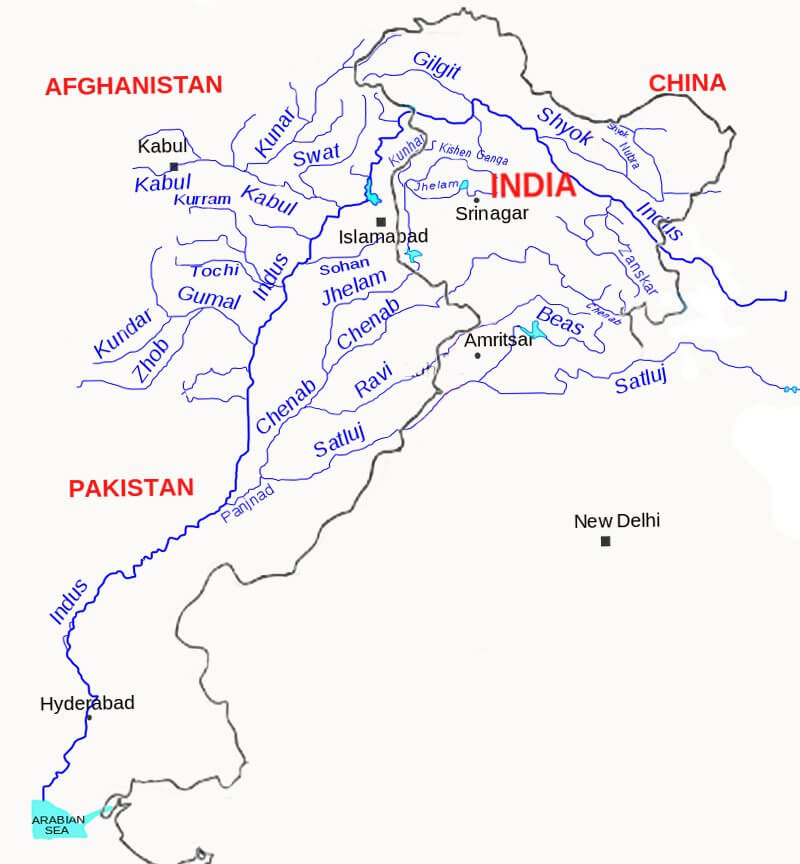
India’s response to Pakistan was to hold the Indus Water Treaty in abeyance, ie, suspend the IWT immediately. The IWT, negotiated between India and Pakistan in 1960, granted Pakistan exclusive use to the waters of the three Wesern Rivers — Indus, Jhelum, and Chenab and India exclusive access to the three Eastern Rivers — Sutlej, Beas, and Ravi. This was one of the most lopsided deals of the century, which granted Pakistan 80% of the water and India only 20%. Pakistan held a veto even on Indian hydroelectric projects on the three Western rivers. Now that the Treaty has been put in abeyance, India now can construct water storage dams and reservoirs in addition to Hydroelectric power plants. Pakistan had constantly hobbled Indian Hydroelectric plants by raising objections, preventing India from developing a capacity of up to 18.21 GW of electric capacity. These three rivers and their tributaries alone are greater than the current combined capacity of J&K, Himachal Pradesh, and Ladakh (approx 3.7 GW, 4.5 GW, and 3.6 GW respectively). This doesn’t include other hydro and solar projects in these states, which have a very, very high potential renewable capacity (potentially 50 GW). Building of new reservoirs on the Indus and its tributaries will do two things — provide an alternate source for water for Northern India, which is projected to suffer from water shortages in the near future, and assist India in putting pressure on Pakistan for its habit of sponsoring terrorists. India also has allegedly engaged with the Taliban to build dams, barrages, and reservoirs in Afghanistan to apply further pressure on another side. The Taliban is anyway very ill-disposed towards Pakistan, refusing to recognize the Durand Line. By damming the Kabul River among others, Afghanistan can provide access to clean drinking water to 2 million of its people.

Indus River and its tributaries. Source
Deportations of all Pakistanis:
India asked almost all Pakistanis in India to leave. The diplomatic presence was also downsized with all military attaches and advisors declared persona non-grata. The Attari Border was closed off. Pakistanis travel to India in large numbers for medical treatment. There are also some here for work and many on spousal visas. Apart from long-term visa holders, the rest are persona non-grata. This has brought out cases of several people living lives in India who were actually Pakistani. This includes a constable from Jammu and Kashmir, and the wives and children of several former militants. It is quite surprising to see the number of Pakistanis who were residing in a place as sensitive as Jammu and Kashmir. Some 500 Pakistani Nationals have left India via the Attari border. Many appealed to stay back, but actions have far-reaching consequences. There are still thousands on short term visas who are supposed to leave, and who need to be deported as soon as possible. What this demonstrates is the unwillingness or inability of india’s authorities to proactively identify foreign nationals who were living lives in India.
India’s next moves:
To understand India’s next actions, it is important to acknowledge one thing — Pakistan is a nuclear country. It does not have much to lose, and hence, has a very low threshold for all-out nuclear war. It has four thresholds for the use of nukes:
-
Spatial threshold: If Pakistan is unable to stop a large scale Indian Military intervention, it will elicit a massive nuclear retaliation.
-
Political threshold: The political destabilization of Pakistan by an outside power exceeding an unspecified limit would elicit a nuclear response.
-
Military Threshold: The complete destruction of a large part of Pakistan’s military capabilities may elicit a nuclear response if it was on the brink if imminent defeat.
-
Economic Threshold: This explicitly refers to the blockade of Pakistan’s seaports and reduction of Pakistan’s share from the Western Rivers of the IWT. These moves would drastically harm its economy, and together form the economic threshold.
This is why India’s response to the Pahalgam attack will not be like Israel’s response to October 7.
India will respond with missile and drone strikes on a few main targets — certain military bases and terrorists’ training camps. This is a good opportunity for Indian Drone startups to demonstrate their products to the world. Pakistan is a country that survives on attention from the rest of the world — and the only way to stop its adventurism is to humiliate the country. That is what India did in 1971 — the Bangladesh Liberation War. India forced Pakistan to sign the Instrument of Surrender and assisted Bangladesh in its declaration of independence under the leadership of Sheikh Mujibur Rahman. The Pakistani Air Force conducted pre-emptive airstrikes on IAF Bases along the Western Border of India and dragged its rival into the war. The Instrument of Surrender was a public, in-your-face humiliation of Pakistan. It took Islamabad 12 years to attempt another geoplolitical potshot to destabilize India, which is the Punjab and the Kashmir Insurgencies and the exodus of the Kashmiri Pandits. Even this was because of a lot of Western support in response to the Soviet invasion of Afghanistan in the case of Kashmir, and the Indian National Congress propping up Jarnail Singh Bhindraanwaale to weaken the Akali Dal. This sparked the insurgency in Punjab and Pakistan was more than happy to support it with weapons. After the Soviet withdrawal from Afghanistan in 1989, the Pakistan diverted elements of the Mujahideen and American equipment to the Kashmir front, leading to a peak in insurgent activities in the Kashmir Valley. The terrorists also forcefully deported the Kashmiri Pandit Community from their homes. not dissimilar to the Deportation of the Chechen and the Ingush of 1944, the difference being that this deportation was not government-sanctioned, but took place because of the complete breakdown of government machinery. Nevertheless, the result was the same.
Hence, it is safe to assume that unlike previous responses to terror attacks, like the Pulwama bombings and the Uri Terrorist Attacks, where the response was striking terrrorist camps, either by air or by Special Forces.
Turkiye’s meddling and support to Pakistan:
6 Turkish Air Force planes landed at airports across Pakistan, most likely carrying equipment like the Bayraktar Drones.

A Turkish Air Force C-130J taking off from Ankara, bound for Karachi. Source
Turkiye’s support for Pakistan comes in the midst of large numbers of Indian tourists travelling to the country, and even more using Turkiye as a transit hub. IndiGo, India’s largest airline, has a codeshare with Turkish Airlines, which disporportionately benefits Turkiye. The Government of India needs to take IndiGo to task and end this codeshare, forcefully and unceremoniously. IndiGo acts as a feeder to Turkish Airlines’ network and cutting them off from the third largest aviation market will hit them where it hurts the most. The viability of many routes will be drastically reduced. IndiGo feeding into the network of Greek airlines will be much better and helpful for Greece, while defanging Turkiye’s biggest source of influence. India and Greece have had ties dating back thousands of years and the country can be one of India’s gateways to the EU. It is also a major hub in the India-Middle East Economic Corridor. India should also make enticing military equipment offers to GCC countries, Egypt, and Iraq, who have cold ties with Turkiye, but have to buy Turkish equipment due to the no-strings-attached deals. It gives India the opportunity to accelerate its industrialization, diversify defence partners, and dive into new niches of military equipment.Turkiye relies a lot on foreign buyers to fund its arms industry, and this will pinch them quite hard.

TB-2 Bayraktar Drones. The UAE purchased 20 of these in 2017. Source
Drones are the next big revolution in military circles, bringing a disproportionate benefit to the modern battlefield. India too has a promising cohort of drone startups and the Government of India should assist them with military and civilian contracts. It should also entice other countries to buy Indian equipment. It should be noted that the assets of any Indian-based private company are also India’s assets. Spain, France and Greece have reportedly considered the Indian Pinaka MLRS. Geostrategika has made a good case for that already. France is anyway a close defence partner for India and this is another opportunity for the country to deepen co-operation and imbibe new technologies from the French. India has, very cleverly used the Russia-Ukraine war to further build up its artillery shell production capacity. In a protracted war, India will truimph over Pakistan unless the latter receives massive aid from other countries. India won the Kargil War in spite of Indian aircraft being strictly ordered not to cross the Line Of Control. India and Pakistan were at a much more equal economic and diplomatic footing in those days, and it had only been a year since both countries had conducted nuclear tests. An India-Pakistan War will be heavily air and artillery-centric, like the Kargil War of 1999. It also provides a rare opportunity to learn from past mistakes and rectify them in the LCA Tejas and the AMCA.
The Baloch Insurgency and the Afghan Taliban:
This is the prime time for India to go forward and fuel the fire that is the Balochistan insurgency. India should fund the BLA and other organizations to create havoc in Pakistan’s Western regions. In addition to the BLA, supporting the Taliban with arms is also important to destabilize the FATA and Khyber Pakhtunkhwa regions. This will force the Pakistani military to spread its resources thin. A destabilized, poor, isolated, and de-nuclearized Pakistan is the best outcome for all its neighbours, as long as it keeps fomenting terrorism. India will respond to Pakistan in kind. The response will take time. but it will arrive.
Conclusions:
The Pahalgam massacre has not only shaken the conscience of a nation but has also laid bare the long-standing and deeply entrenched threat that cross-border terrorism poses to India’s national security and civil harmony. It exposed the complex challenges faced by the Indian intelligence apparatus and the painful reality that a single failure, despite a thousand successes, can leave behind a trail of blood and trauma. Yet, the Indian response highlights a shift in its approach — from restraint to calibrated retaliation. While India must remain mindful of the nuclear thresholds that constrain direct escalation, it now finds itself in a position to strike with precision — militarily, diplomatically, and economically. It has laid bare the rivals that India has to contend with in addition to Pakistan. The potential responses are highlighted above. While there was a loss of life, there are also opportunities here to protect the country for the next few years. Pakistan’s long flirtation with terror has not only eroded its own global standing but now risks igniting a regional firestorm it can no longer control.
Pakistan thought it could open Pandora’s Box, but actions have consequences. It is India’s duty to unleash the hell that was within.
메타데이터
- post_id
- 0ef2db4c92bb
- slug
- the-pahalgam-massacre-anatomy-of-a-terror-attack-and-indias-multi-front-response-0ef2db4c92bb
- url
- https://medium.com/@parvh123/the-pahalgam-massacre-anatomy-of-a-terror-attack-and-indias-multi-front-response-0ef2db4c92bb
- canonical_url
- https://medium.com/@parvh123/the-pahalgam-massacre-anatomy-of-a-terror-attack-and-indias-multi-front-response-0ef2db4c92bb
- author_url
- https://medium.com/@parvh123
- status
- ok
- fetched_at
- 2026-07-18 09:48:19