In praise of low technology
Or, why ‘shoddy and rugged’ is best
In praise of low technology
Or, why ‘shoddy and rugged’ is best
I’ve written about household appliances before: my terrible Beko washer-dryer, its workshy approach to drying clothes, and its surprisingly sophisticated contribution to the philosophy of measurement.
Now I’m writing about appliances again, this time with praise, for that marvel of low-tech, the Gaggia Classic RI8161 espresso machine.

I’ve had it for well over a decade. I imagine it will long outlive me.
And that’s not because the Gaggia Classic is particularly reliable — it’s not — but because it’s unreliable in a fundamentally different way to most tech you can buy today.
A tale of two hardware failures
The Beko washer-dryer is made of moulded plastic. Many of its parts are glued or bonded together. It is controlled through an electronic control panel whose command of the various valves, pumps, heaters and motors is mediated by a computer that makes the decisions on which to fire up and when.
I have no idea how it works, though I am pretty sure it involves software of some kind and, probably, more raw computing power than propelled Neil Armstrong to the Sea of Tranquility.
More importantly, I don’t really know how it doesn’t work either.
Its drying ability, mediocre even when I bought it, gradually got worse with time. Figuring out why, and whether there was anything I could do about it, was surprisingly hard.
I unscrewed as many panels as I could. I poked around inside. I disconnected the hoses and prodded around inside. Nothing helped.
I think the condensing unit — that’s the bit that cools the warm, moist air that’s just come out of the wet clothes to draw the water out of it — was blocked with fluff, but I don’t know for sure as I couldn’t get it open.
It’s equally possible that a moisture sensor was faulty, or a heating coil broken, or a software fault. Or something else. The screen wasn’t throwing up any error codes, I just wasn’t getting dry clothes.
Then, a few months ago, the seal holding the whole front of the washing drum in place popped off. Here I could see exactly what was wrong, but that didn’t help either: you need a specialised tool that they have in the factory to get it back on.
I gave up in frustration. I bought a new machine — not from Beko.
It works, for now, but it’s even more complicated. It bleeps at unpredictable times. Where I hope to hear the resassuring whirrs and clicks of motors and solenoids I’m concerned to hear unfamiliar electronic warbling. It pesters me for access to my wifi network. It sometimes tells me it’s doing an “artificial intelligence wash”. It wants me to download an app.
Absolutely not.
I imagine this new washer-dryer will also fail at some point, and I will be even less equipped to do anything about it.
But the Gaggia: that’s a different story.
It’s an amazingly retro piece of kit — I bought it in the 2010s and it seems to have been released in 1991, but it must be based on designs from decades earlier. No moulded plastic, no glue, no electronics: the chassis is a thick sheet of steel folded into the shape of a coffee machine. You can unscrew the panel at the top and peer inside. And all the innards — of which there aren’t many — are user-serviceable.
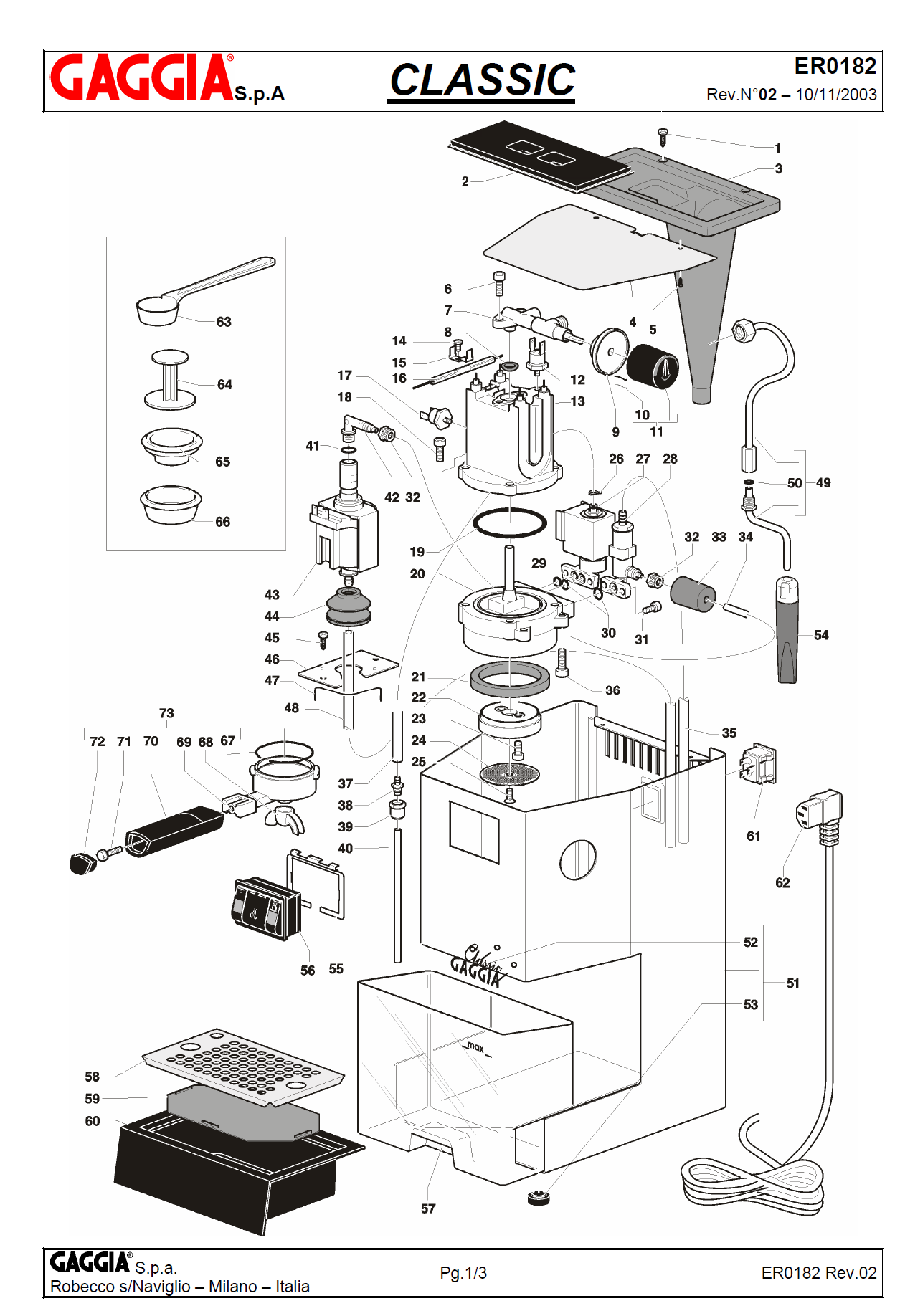
I know exactly how it works: water starts in a tank, a pump pushes it into a boiler that heats it up, and then through either the filter into a cup, or through the steamer into your milk, if cappuccino is your thing.
It has three switches: one that switches the boiler on to heat up your water, one that runs the pump, pushing hot water through the coffee grounds, and one to switch the thermostat between coffee brewing temperature and milk steaming temperature. It has a single knob — to redirect the contents of the boiler away from the filter and instead through the steaming wand to froth milk.
There is no computer. These are old-school switches, that click into one position or another. Not buttons that send an electronic ping to a digital brain. They are wired directly to the components they control.
I know this because, like with the Beko washer-dryer, things go wrong with the Gaggia Classic. The difference is, I can do something about it. Not only is it obvious how it works, it’s also obvious how it doesn’t work, when it doesn’t work.
A couple of years ago, my Gaggia stopped pumping. “That must be a faulty pump,” I thought. The pump is a completely standard part. I ordered one on Amazon. It cost £13.96. I took out the old one and plugged in the new one. The only tool I needed was a standard screwdriver. The Gaggia was reborn and the espresso flowed forth once again.
More recently, it has started leaking from its steam valve. That must be a faulty valve. I looked online — and was only briefly held up by trying to figure out what it was called. (It is called a ‘complete cock’. No laughing at the back.) This one is a proprietary part, so it’s a bit more expensive — a princely £35.30 — but you can order it on eBay and — yes — you just need a screwdriver to fit it.
Shoddy and rugged
I once read a review of the Lada Niva offroad vehicle by an American motoring journalist. He had similar praise for that “shoddy and rugged at the same time” ’70s throwback of thick steel, rattly screws and poor manufacturing tolerances.

Because shoddy matters a lot less when things are easy to fix; and fixing is much more worthwhile when things, like the Lada, like the Gaggia, are rugged.
It’s a virtuous circle.
Technology for grown-ups
So much of the technology we deal with day to day now is like Beko washing machines rather than like Gaggia espresso machines.
Smartphones, tablets and even computers that hide the file system.
Cars that replace knobs and buttons with touchscreens.
TVs — like mine — where the remote control is a 767 Mb iPhone app.
And I think this is a problem.
No of course we shouldn’t expect everyone to fix everything themselves. And nor should people have to understand how their kit works. (If you want to make cappuccino and don’t care what’s inside the metal box, that’s fine.)
But technology simple enough to be understood by a smart layperson who can tinker if they want to… that isn’t just a way to reduce e-waste, it’s a way to treat us like the grown ups we hopefully are.
Postscript
Gaggia no longer makes the RI8161.
You can still buy something called a Gaggia Classic. It has the same retro steel chassis of my machine.
But energy efficiency regulations have swept through the white goods sector. If you look closely, where mine has switches connected directly to the components they control, the new one has electronic buttons, connected to a circuit board. It’s clever enough to switch itself off when it thinks it’s not being used.
I have no idea how it works.
The sales listing ominously promises it has a “new internal platform with pre-assembled components simplifying after-sales work”.
I’m pretty sure that means I couldn’t fix it.
And I think that’s a shame.
메타데이터
- post_id
- 0f00a097383d
- slug
- in-praise-of-low-technology-0f00a097383d
- url
- https://medium.com/@ojusher/in-praise-of-low-technology-0f00a097383d
- canonical_url
- https://medium.com/@ojusher/in-praise-of-low-technology-0f00a097383d
- author_url
- https://medium.com/@ojusher
- status
- ok
- fetched_at
- 2026-06-20 20:29:01