🛡 Graceful Degradation: Designing Features That Can Die Safely
Because not everything deserves to survive an outage
🛡 Graceful Degradation: Designing Features That Can Die Safely
🛡 Graceful Degradation: Designing Features That Can Die Safely
Because not everything deserves to survive an outage
SEO keywords: graceful degradation microservices, fallback design patterns, circuit breaker fallback example, microservices reliability design, Spring Boot resilience patterns, partial outage handling
😌 The Dangerous Myth
Most teams design systems assuming:
All features must always work.
That sounds user-friendly.
It’s also how cascading failures happen.
Because when everything is critical…
Everything competes for survival.
And everything dies together.
🧨 What Is Graceful Degradation?
Graceful degradation means:
When parts of the system fail, the core functionality continues operating.
Not perfect.
Not feature-rich.
Just alive.
It’s controlled damage.
🎬 The Netflix Example
When recommendation services fail at Netflix:
- Streaming still works
- Users can still search
- Playback continues
Recommendations are degraded.
Revenue path survives.
That’s not accidental.
That’s intentional architectural prioritization.
🧠 Step 1: Define Your “Revenue Path”
Before writing code, answer this:
If 70% of your system must shut down…
What 30% absolutely must survive?
For an e-commerce app:
- Browsing: optional
- Recommendations: optional
- Reviews: optional
- Checkout: critical
- Payments: critical
If checkout fails because recommendations are slow…
You designed it wrong.
💥 Why Systems Collapse Instead of Degrading
Because of shared resources.
Common mistakes:
- One global thread pool
- One shared DB connection pool
- Long timeouts
- Blind retries
- No circuit breakers
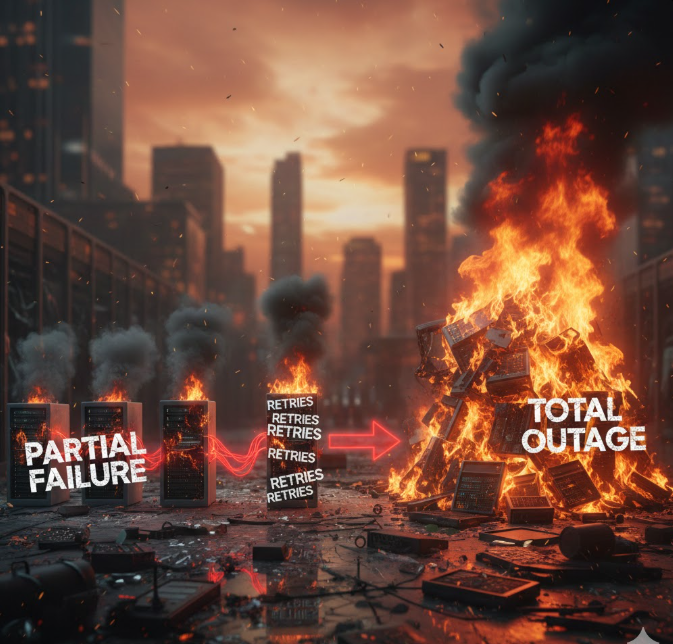
So when one dependency slows…
It consumes shared capacity.
Everything starves.
🧱 Design Rule #1: Isolation (Bulkheads)
Separate resources per dependency.
In Spring Boot:
Instead of one executor:
@Bean
public Executor defaultExecutor() {
    return Executors.newFixedThreadPool(200);
}
Use isolated pools:
@Bean("recommendationExecutor")
public Executor recommendationExecutor() {
    return Executors.newFixedThreadPool(20);
}
@Bean("paymentExecutor")
public Executor paymentExecutor() {
    return Executors.newFixedThreadPool(50);
}
Now if recommendations hang…
Payments still have threads.
Isolation enables degradation.
⚡ Design Rule #2: Aggressive Timeouts
Slow calls kill systems.
If timeout is 30 seconds:
- Threads block
- Pools exhaust
- Cascades begin
Instead:
- 300ms
- 500ms
- 1s max (depending on SLA)
Fail fast.
Degrade fast.
Protect capacity.
🔥 Design Rule #3: Fallbacks Are Mandatory
Circuit breakers without fallbacks just fail faster.
You need controlled responses.
Using Resilience4j:
@CircuitBreaker(name = "recommendationService", fallbackMethod = "fallbackRecommendations")
public List<Movie> getRecommendations(String userId) {
    return recommendationClient.fetch(userId);
}
public List<Movie> fallbackRecommendations(String userId, Throwable ex) {
    return trendingService.getTrendingMovies();
}
Now when recommendation service fails:
Users see trending content.
Not a 500 error.
💣 Design Rule #4: Prioritize Features Explicitly
Not all features deserve equal protection.
Ask:
- Is this feature revenue-generating?
- Is this feature user-retention critical?
- Can this feature temporarily return default data?
Create tiers:
Tier 1 — Core (must survive) Tier 2 — Important (degrade gracefully) Tier 3 — Optional (can be disabled)
This forces architectural clarity.
🧠 Design Rule #5: Feature Flags as Kill Switches
During outages, sometimes the best degradation is:
Turn it off.
Feature flags allow you to:
- Disable personalization
- Disable analytics calls
- Disable heavy enrichment
- Reduce request fan-out
Without redeploying.
Graceful degradation often starts with:
Removing optional work.
🔁 Design Rule #6: Reduce Fan-Out
Fan-out increases fragility.
Example:
Checkout →
    Inventory Service
    Pricing Service
    Recommendation Service
    Analytics Service
    Notification Service
Why is checkout calling recommendations?
Every extra dependency is a failure vector.
Critical paths should be thin.
Optional calls should be asynchronous.
🚨 Design Rule #7: Load Shedding
When system is overloaded:
- Drop optional requests
- Reject low-priority traffic
- Return partial responses
Better to serve 70% of functionality to 100% of users…
Than 100% of functionality to 0%.
📉 What Degradation Looks Like in Practice
Bad design:
- Recommendation slow
- Checkout waits
- Thread pools exhausted
- Payment fails
- Entire system down
Good design:
- Recommendation slow
- Circuit opens
- Fallback used
- Checkout unaffected
- Revenue continues
That’s the difference between outage and inconvenience.
🧩 Graceful Degradation vs High Availability
High availability tries to keep everything running.
Graceful degradation decides what is allowed to stop.
You need both.
But degradation thinking prevents cascades.
🧠 The Psychological Shift
Engineers often resist degradation.
It feels like:
“We’re accepting failure.”
But degradation is disciplined survival.
Perfection is fragile.
Prioritization is resilient.
🔥 Real-World Failure Pattern
Many systems fail because:
- Observability calls block requests
- Logging systems slow down
- Analytics endpoints timeout
- Non-critical calls share main thread pool
Then:
Core features collapse because optional features misbehaved.
That’s architectural negligence.
🛠 Practical Degradation Checklist
✅ Identify critical vs optional features
✅ Separate thread pools per dependency
✅ Set short timeouts
✅ Add circuit breakers + fallbacks
✅ Add feature flags
✅ Reduce synchronous fan-out
✅ Monitor dependency latency separately
If you implement just 3 of these…
You prevent most cascading failures.
🧠 Final Takeaway (Viral Ending)
Graceful degradation is not about keeping everything alive.
It’s about deciding what deserves to live.
When outages happen, your architecture reveals your priorities.
If optional features can kill your core flow…
You didn’t design for survival.
And in distributed systems,
Survival > perfection.
메타데이터
- post_id
- 0f2f8dc7ad3c
- slug
- graceful-degradation-designing-features-that-can-die-safely-0f2f8dc7ad3c
- url
- https://systemweakness.com/graceful-degradation-designing-features-that-can-die-safely-0f2f8dc7ad3c
- canonical_url
- https://systemweakness.com/graceful-degradation-designing-features-that-can-die-safely-0f2f8dc7ad3c
- author_url
- https://medium.com/@gangoladeepa
- status
- ok
- fetched_at
- 2026-07-13 18:54:59