The Composer Who Made the Cold War Sound Like the Future
There is a sound near the start of "Ikarie XB 1": the engine hum of a starship bound for Alpha Centauri, built from a chord slowed and…
The Composer Who Made the Cold War Sound Like the Future
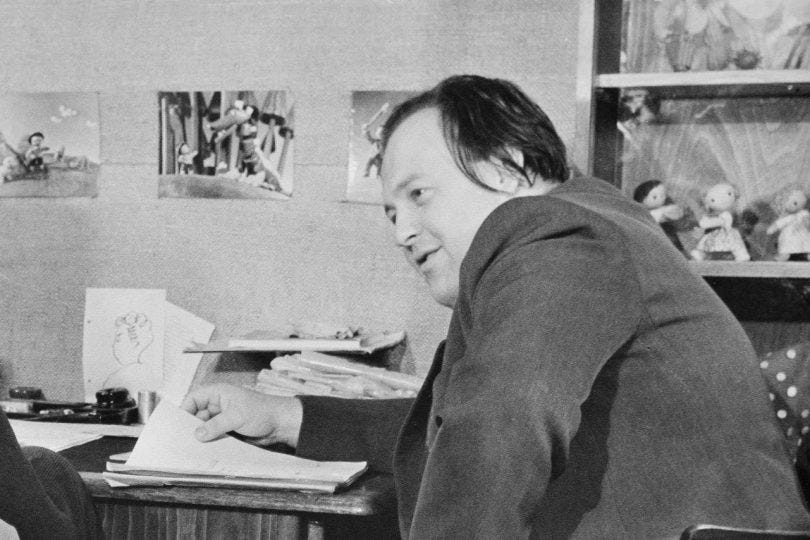
There is a sound near the start of Ikarie XB 1: the engine hum of a starship bound for Alpha Centauri, built from a chord slowed and smeared until pitch and noise stop being different categories. Czechoslovakia made this film in 1963, three years before Star Trek, and it sounds less dated than almost anything Hollywood was doing with space at the time. The reason has a name that almost nobody outside the Czech Republic knows: Zdeněk Liška, a composer who spent three decades treating the orchestra, the tape splice, the human choir, and the oscillator as a single undifferentiated toolkit, then used that toolkit to make Eastern Bloc cinema sound like it was arriving from several decades in the future.
Liška worked steadily from the early 1950s until his death in 1983, scoring well over a hundred films. The range is almost absurd to list in one sentence: the village tragicomedy of The Shop on Main Street (1965), the deadpan atrocity of The Cremator (1969), the medieval brutality of Marketa Lazarová (1967), the interstellar optimism of Ikarie XB 1, and later the puppet nightmares of Jan Švankmajer. Few composers anywhere have written convincingly across that range while also functioning as one of the more advanced electroacoustic experimenters of their generation, working quietly inside a national film industry with no particular ideological investment in the avant-garde and no real mechanism for exporting one. He built a body of work that anticipates ambient music, drone, and modern horror scoring by a decade or more, in relative obscurity. Rediscovering him now feels less like nostalgia and more like correcting the record.
Start with Marketa Lazarová. Everyone who has tried to rehabilitate Liška’s reputation starts there, for good reason. František Vláčil’s 1967 film is routinely named the greatest Czech film ever made, a brutal, hallucinatory account of two feuding medieval clans, shot in black-and-white that looks less like cinematography than weather. Liška’s score carries real structural weight in that reputation. He builds the music from plainchant-adjacent vocal writing, voices stacked in close, dissonant clusters that owe more to Penderecki than to anything liturgical, then pulled into slow glissandi that never settle on a pitch long enough to resolve. Against this he layers percussion that lands somewhere between tribal drumming and machine clatter, low drum strikes answered by metallic scraping, as though the thirteenth century and a synthesizer lab had collided in the same room. The effect is devotional music with the certainty bled out of it, sacred in shape and broken in execution. The score has had a second life as a concert and oratorio reconstruction, performed outside the context of the film entirely [Likely], a useful test of whether film music can stand as music, full stop. Liška’s passes that test in a way very little Golden Age scoring does.
Ikarie XB 1, four years earlier, solves the inverse problem with the same toolkit. The medieval sacred needed close vocal dissonance and clattering percussion. The technological sublime needed something colder, and Liška reached for electronic manipulation that Radio Prague has identified as integral to the film’s identity [Likely]. Tones are stretched past their natural decay, filtered until the attack disappears and only a held, breathing drone remains, then layered under or against orchestral writing rather than replacing it outright. There were no synthesizers in the modern sense available to him. This is tape work, filtered and layered orchestral sound, the studio itself treated as an instrument, built alongside the film rather than added on top of a finished picture. The result still sounds less like a prediction than a transmission, a signal caught from somewhere the rest of 1963 hadn’t reached yet.
A small set of operations carries across the comic, the historical, the cosmic, and eventually the surreal: voices stacked into mass rather than melody, rhythm built from non-orchestral or processed sound rather than a conventional rhythm section, harmony that clusters and holds instead of resolving toward a cadence. Liška applied those operations to whatever the image in front of him demanded. The later Švankmajer collaborations stand as a logical endpoint rather than a late-career swerve, because stop-motion animation, with its uncanny near-life movement, needed a sound that refuses to behave like conventional underscoring, something that could sit under a twitching puppet without explaining the twitch away. He had been building toward exactly that since the 1950s.
The obscurity is not a mystery. Czechoslovak cinema operated behind a political and linguistic barrier that limited circulation regardless of quality, and a composer’s international reputation in the twentieth century depended heavily on circulation: touring orchestras, published scores, critics who could actually see the films. Liška had none of the infrastructure that turned contemporaries like Ennio Morricone into global brands. He also worked, for most of his career, under a system that prized productivity over personal mythology. The result is a filmography instead of a legend, no tantrum stories, no genius performed for the press, just an enormous and strange catalogue of work that mostly exists only inside the films it was written for. Specialist labels have begun reissuing his soundtracks. Archivists and ensembles have staged reconstructions like the Marketa Lazarová oratorio. Critics have started revisiting Czechoslovak New Wave cinema as a major and under-translated chapter of Cold War art rather than a regional curiosity. The reassessment is doing, decades late, the work that geography and politics prevented from happening in real time.
Liška’s career complicates a comfortable story about where sonic experimentation happened during the Cold War. The canonical version runs through state institutions: Stockhausen at the electronic music studio in Cologne, Eduard Artemyev building Soviet film and synthesizer work inside official channels, composers with institutional backing, manifestos, and a clear claim on the avant-garde label. Liška had none of that cover. He ran his experiments inside commercial film contracts, under deadline, accountable to directors rather than to any movement, and the results stand up against work produced in research labs with better funding and a clearer ideological mandate. He was unfairly ignored. The deeper problem is that the place everyone agreed to look for radical Cold War sound was incomplete the entire time. The missing piece had been sitting in a Barrandov screening room since 1967, attached to a film about two warring medieval clans, waiting for someone to separate the music from the picture and listen to it on its own.
메타데이터
- post_id
- 0f45f9518d55
- slug
- the-composer-who-made-the-cold-war-sound-like-the-future-0f45f9518d55
- url
- https://medium.com/its-only-a-movie/the-composer-who-made-the-cold-war-sound-like-the-future-0f45f9518d55
- canonical_url
- https://medium.com/its-only-a-movie/the-composer-who-made-the-cold-war-sound-like-the-future-0f45f9518d55
- author_url
- https://medium.com/@michael.landmankarny
- status
- ok
- fetched_at
- 2026-06-23 17:05:31





