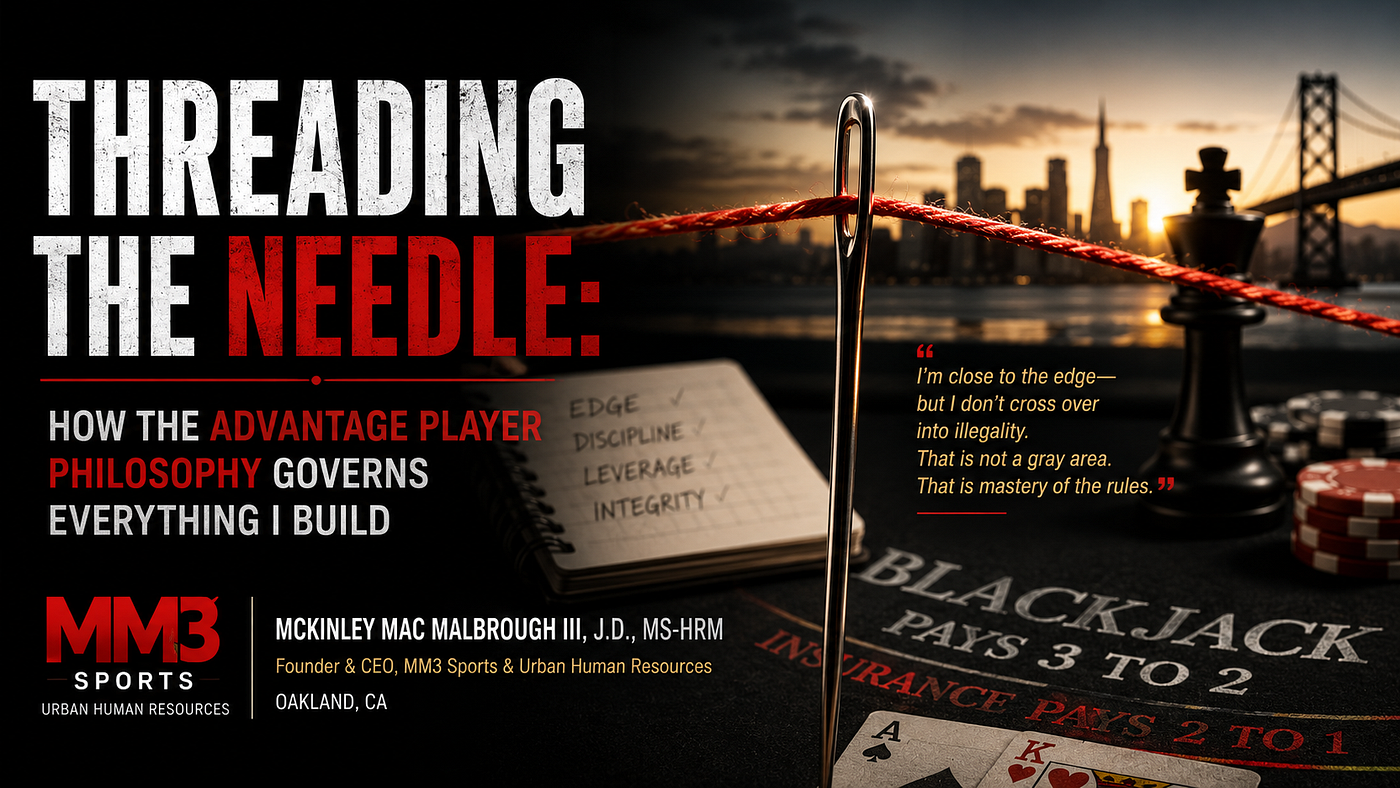
Turning the Odds on the Casino: Blackjack Advantage Play and the New Architecture of Sports Agency
McKinley Malbrough III , J.D., MS-HRM Founder & CEO, MM3 Sports & Urban Human Resources | Oakland, CA
Turning the Odds on the Casino: Blackjack Advantage Play and the New Architecture of Sports Agency

McKinley Malbrough III , J.D., MS-HRM Founder & CEO, MM3 Sports & Urban Human Resources | Oakland, CA
“Don’t focus on winning or losing. Focus on perfect decisions, perfect counting, and perfect betting.” — Colin Jones, Co-Founder, Blackjack Apprenticeship | How to Learn Card Counting: A Practical Guide | YouTube
The House Always Wins — Until You Change the Game
Most people who sit down at a blackjack table are playing the casino’s game. They are making decisions based on intuition, superstition, and short-term emotional response to outcomes that are, over any meaningful volume of hands, mathematically predetermined to favor the house. The casino built the table, set the rules, controls the environment, and has been running the numbers longer than any individual player ever will.
The traditional sports agency industry operates on the same architecture. Franchises set the parameters. Legacy agents work within them. Players accept whatever deal gets put on the table, filtered through representatives whose business model rewards speed of closing over quality of outcome. The house wins — not because the house is smarter, but because most players never learn to count the cards.
At MM3 Sports, we learned to count. And the approach that taught us how comes from one of the most disciplined mathematical training systems in the world of advantage play.
The Mathematics of the Edge
In 1962, mathematician Edward O. Thorp published Beat the Dealer, the first book to mathematically prove that the house advantage in blackjack could be overcome by card counting. What Thorp demonstrated was not a trick or a cheat — it was a systematic application of probability theory to a game the casino had assumed was structurally unbeatable. The implications extended well beyond the casino floor. Thorp later applied the same framework to financial markets, capitalizing on mispriced opportunities within securities markets through his hedge fund. The principle was identical in both domains: find the mathematical edge, size your bets accordingly, and execute with discipline over volume. Hootsuite Blog
The mechanics of that edge in blackjack are precise. Under the Hi-Lo card counting system, every card in the deck is assigned a value: low cards (2–6) carry a +1 count, neutral cards (7–9) carry a 0, and high cards (10–Ace) carry a -1. As the shoe depletes, the running count tracks the composition of remaining cards. But a raw running count is functionally incomplete without one additional calculation. The player takes the running count and divides it by the number of decks remaining in the shoe — converting the running count into the True Count, which provides the actual mathematical advantage at any given moment in the game. Repcap
When the True Count is high, the player is more likely to receive blackjack or the dealer is more likely to bust — the player’s expected value becomes positive. When the count is low, the expected value turns negative. The advantage player does not bet the same amount on every hand. They bet minimum when the house has the edge and scale exponentially when the math shifts in their favor. This is not gambling. By correctly employing optimal blackjack strategy and the Hi-Lo count, an advantage player can expect long-term positive returns from the game. It is the execution of a mathematically locked positive expected value system. RosicaSports Management Worldwide
The Training Standard That Separates Winners From Everyone Else
Understanding the theory is not enough. Colin Jones, co-founder of Blackjack Apprenticeship — a training platform responsible for producing card counters who have won five, six, and seven figures — is direct about what separates professional advantage players from the amateurs who lose their bankrolls convinced they have the system figured out:
“Don’t focus on winning or losing. Focus on perfect decisions, perfect counting, and perfect betting.” — Colin Jones, Co-Founder, Blackjack Apprenticeship | How to Learn Card Counting: A Practical Guide | YouTube
Jones identifies the critical failure point precisely: most aspiring card counters evaluate their progress by looking at short-term chip stacks rather than the quality of their decision-making process. They go to the casino before they can count through a deck in under 30 seconds. They play hands before they can execute perfect basic strategy on every single combination without error. They mistake variance — short-term fluctuation that can produce wins even with a flawed system — for validated competence.
“A 95% card counter is going to have all the downsides of card counting — the heat, the back-offs, the variance — but not the profits. Only a perfect counter will get the long-term profits that come with the skill.” — Colin Jones, Co-Founder, Blackjack Apprenticeship | How to Learn Card Counting: A Practical Guide | YouTube
This principle maps directly onto sports agency. A representative who understands cap mechanics at 95% accuracy is carrying all the risk of a sophisticated negotiation with none of the upside that comes from complete mastery. Contract clauses that seem minor — luxury tax trigger structures, team option language, non-guaranteed protections — are the soft 18 hands that amateurs misplay. In a high-stakes negotiation, one misplayed hand can cost an athlete millions. The margin for error is the same as it is at a high-limit blackjack table: effectively zero.
Mapping the Environment: Tribal Casinos vs. Cardroom Traps
Elite advantage players understand that executing flawless mathematics is meaningless if the table environment is structurally toxic. In the Northern California casino market, this distinction is decisive and immediate.
Tribal casinos — Graton, River Rock, Cache Creek — offer house-banked blackjack with clean 3:2 payout structures and dealer standing on soft 17 in high-limit rooms. The mathematical edge an advantage player has earned through training can be fully deployed because the rules allow it.
California cardrooms operate under state law through a Player-Dealer system. The critical structural difference is a per-hand collection fee — typically $1 per hand regardless of outcome. To most casual players, a dollar per hand feels trivial. To an advantage player operating on a carefully calculated edge of less than 1%, a flat fee applied to every hand regardless of count represents an insurmountable negative expectation. The mathematical advantage disappears entirely. Additionally, main floor tables at many commercial casinos have quietly shifted from 3:2 blackjack payouts to 6:5 — a rule change that adds approximately 1.4% to the house edge and makes the game structurally unbeatable for any advantage player regardless of counting accuracy.
The sports agency parallel is exact. Most traditional representation models walk athletes straight onto a 6:5 table: contracts with hidden clawback provisions, non-guaranteed luxury tax triggers, and option clauses that look like athlete protections but function as franchise leverage mechanisms. The athlete signs what appears to be a fair deal and then watches the house edge compound over the life of the contract.
The MM3 Sports Advantage Player Checklist
At MM3 Sports, every contract analysis runs through the same verification framework that an elite card counter applies before sitting down at any table:
- Verify the Payout Structure — Confirm that the contract guarantees absolute enterprise value conversion at the athlete’s actual market rate — a true 3:2 equivalent — rather than incentive-heavy structures that water down guaranteed money with performance escalators that benefit the franchise’s risk management more than the athlete’s security.
- Eliminate Transactional Friction — Identify and remove every per-hand fee hidden in the contract architecture: agency compliance clauses, institutional dependencies, revenue share structures that bleed the athlete’s long-term capital independence. Every dollar of hidden friction is a dollar the advantage player cannot deploy when the count is favorable.
- Track the True Count — Monitor the shifting landscape of team salary cap position, luxury tax exposure, roster distribution, and organizational desperation in real time. The True Count of a negotiation changes throughout a season and throughout a player’s career. The agent who understands where the count stands at the moment of maximum leverage is the one who gets the exponential bet on the table at exactly the right time.
The Bottom Line
The casino has never been afraid of players who try harder. They are afraid of players who think differently — who strip away the emotional noise, study the mathematics underneath the game, and execute with the kind of discipline that makes variance irrelevant over the long run.
The sports agency industry has spent decades operating on the assumption that athletes and their representatives will play the institutional game as designed: accept the standard offer, work within the franchise’s preferred timeline, and defer to the house on the terms that matter most. Legacy representation has largely obliged.
MM3 Sports was not built to play that game better. It was built to count the cards — to track the True Count of every negotiation, identify the moment when the math shifts decisively in the athlete’s favor, and scale the bet accordingly. The house edge only holds when the player accepts it. We do not accept it.
The odds have been permanently turned.
Disclaimer: This article uses blackjack advantage play as an analytical and strategic metaphor for sports agency contract negotiation and athlete representation. It does not constitute endorsement, promotion, or instruction in gambling activities. All referenced casino environments are used for illustrative comparison purposes only.
References
Jensen, K. (2014). The expected value of an advantage blackjack player. Utah State University Digital Commons, Graduate Reports, №524. https://digitalcommons.usu.edu/gradreports/524
Jones, C. (n.d.). How to learn card counting: A practical guide [Video]. Blackjack Apprenticeship. https://www.youtube.com/watch/nucXpdPClHg
Thorp, E. O. (1962). Beat the dealer: A winning strategy for the game of twenty-one. Vintage Books.
Follow McKinley on Instagram @agentmckinleymalbroughiii | X @mmalbrough | TikTok @agentmckinleymalbrough
메타데이터
- post_id
- 0f53a4366fa0
- slug
- turning-the-odds-on-the-casino-blackjack-advantage-play-and-the-new-architecture-of-sports-agency-0f53a4366fa0
- url
- https://medium.com/@mmalbroughiii/turning-the-odds-on-the-casino-blackjack-advantage-play-and-the-new-architecture-of-sports-agency-0f53a4366fa0
- canonical_url
- https://medium.com/@mmalbroughiii/turning-the-odds-on-the-casino-blackjack-advantage-play-and-the-new-architecture-of-sports-agency-0f53a4366fa0
- author_url
- https://medium.com/@mmalbroughiii
- status
- ok
- fetched_at
- 2026-08-02 15:37:01