Computing the Incomputable: Four Classes of Spatial Appraisal
In my previous article, I explored a question that sits at the intersection of architecture, computation, and human experience:
Computing the Incomputable: Four Classes of Spatial Appraisal
In my previous article, I explored a question that sits at the intersection of architecture, computation, and human experience:
Can architecture fully compute how a space is perceived?
The discussion drew on concepts from computability theory and hypercomputation to argue that not all aspects of spatial experience are equally computable. While algorithms excel at optimising measurable performance criteria, architectural appraisal — the way occupants interpret, feel, and judge space — contains dimensions that resist complete formalisation.
This raises a practical question.
If some aspects of architectural experience are computable while others are not, can we identify where these boundaries lie?
Rather than treating appraisal as a single phenomenon, I propose a framework of four classes. Inspired by Stephen Wolfram’s classification of computational systems, these classes describe different layers of spatial appraisal and their relationship to computation.
The framework is not intended to reduce human experience to data. Instead, it provides a way to understand where computational methods are effective, where they become probabilistic, and where they encounter fundamental limits.
What Is Spatial Appraisal?
Appraisal is the process through which an occupant evaluates a space.
This evaluation occurs across multiple registers simultaneously:
- Physical comfort
- Environmental conditions
- Cultural interpretation
- Personal memory
- Emotional response
- Embodied experience
When we walk into a room, we do not simply observe dimensions and materials. We interpret them through our bodies, our histories, and our expectations.
The challenge for computational design is that these dimensions do not all behave in the same way.
Some can be measured directly.
Some can only be estimated.
Some may never be fully computable at all.
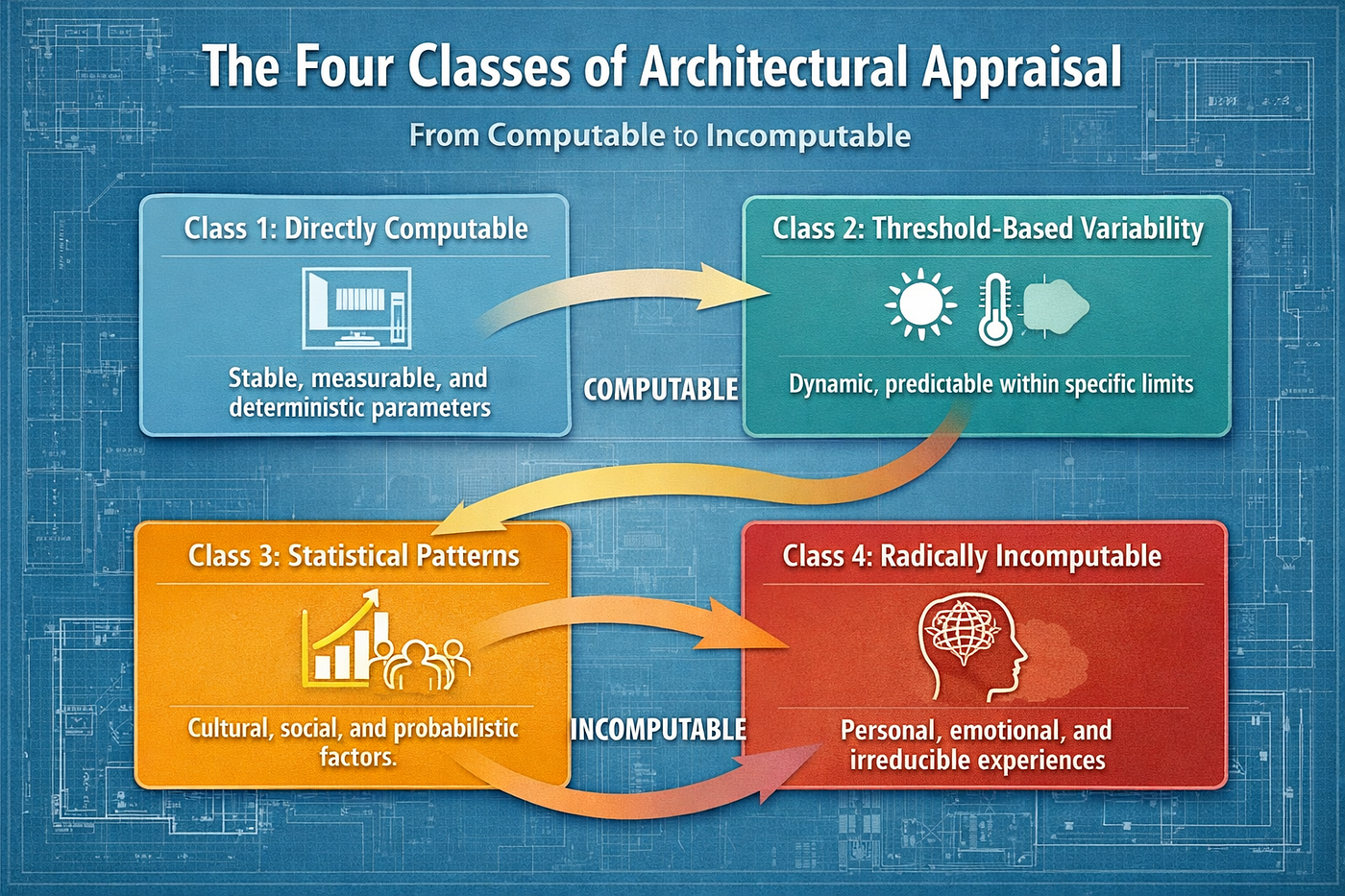
Class 1: Directly Computable and Temporally Stable Parameters
The first class consists of parameters that are measurable, predictable, and largely independent of individual interpretation.
Examples include:
- Room dimensions
- Ceiling heights
- Accessibility clearances
- Circulation widths
- Ergonomic relationships
These parameters function as deterministic constraints. Once defined, they can be evaluated repeatedly and produce consistent results.
For computational design, this is familiar territory. Parametric modelling, optimisation algorithms, and rule-based systems perform exceptionally well when working with Class 1 parameters.
The relationship between input and output is relatively stable.
Change the dimensions and the outcome changes predictably.
In Wolfram’s terminology, these resemble Class 1 systems: computational processes that rapidly settle into stable and predictable states.
Class 2: Threshold-Based Parameters with Computable Variability
The second class introduces change and variability while remaining computationally tractable.
Examples include:
- Daylight conditions
- Thermal comfort
- Acoustic performance
- Air movement
- Material ageing
Unlike Class 1 parameters, these conditions fluctuate over time. Sunlight changes throughout the day. Temperatures shift across seasons. Materials weather and deteriorate.
Yet these variables remain partially computable because they can be modelled against known thresholds.
A daylight simulation cannot determine whether a space feels inspiring, but it can predict whether illuminance levels fall within acceptable ranges.
Similarly, thermal analysis cannot guarantee comfort for every individual, but it can identify conditions likely to support it.
Computation here produces tendencies rather than certainties.
This aligns with Wolfram’s Class 2 systems, which generate predictable patterns while still allowing variation.
Class 3: Statistically Computable but Non-Deterministic Patterns
The third class moves beyond environmental performance and into collective human perception.
Examples include:
- Cultural preferences
- Social behaviours
- Geographic influences
- Shared symbolic meanings
- Collective aesthetic tendencies
These parameters are difficult to compute directly because they emerge from groups rather than physical systems.
However, they often reveal patterns when examined at scale.
Behavioural studies, surveys, machine learning models, and large datasets can identify recurring tendencies within populations. Architects routinely rely on these patterns when making assumptions about how spaces may be used or interpreted.
The crucial distinction is that these predictions remain probabilistic.
They may describe a population but not necessarily an individual.
A public square that feels welcoming to one cultural group may feel uncomfortable to another.
A material associated with luxury in one context may signify something entirely different elsewhere.
These parameters resemble Wolfram’s Class 3 systems: structured yet non-repeating, statistical yet unpredictable at the level of individual outcomes.
Class 4: Radically Incomputable and Irreducible Parameters
The fourth class represents the deepest layer of spatial appraisal.
Here we encounter factors such as:
- Personal memory
- Nostalgia
- Trauma
- Emotional association
- Embodied perception
- Individual lived experience
These dimensions are fundamentally personal.
Two occupants may stand in exactly the same space and experience entirely different emotions because the meaning of that space is filtered through unique life histories.
A particular smell may trigger childhood memories.
A material may evoke loss.
A spatial configuration may generate comfort for one person and anxiety for another.
Unlike previous classes, these responses cannot be generalised through shared rules.
Even if future technologies could capture increasingly detailed behavioural and physiological data, the subjective meaning attached to experience would remain difficult to formalise completely.
This is the point where architectural appraisal approaches incomputability.
In Wolfram’s framework, this corresponds most closely to Class 4 systems, operating at the edge of order and unpredictability.
Interestingly, this is also the richest informational layer.
As higher classes become aggregated into patterns, information is compressed.
Class 4 behaves differently.
Every new experience, memory, or association adds further complexity. Rather than converging toward a stable pattern, the dataset continually expands.
The individual becomes increasingly unique.
Why This Classification Matters
The significance of this framework lies not in categorising experience for its own sake, but in understanding how computational design should engage with different forms of knowledge.
Class 1 parameters can be optimised.
Class 2 parameters can be simulated.
Class 3 parameters can be predicted probabilistically.
Class 4 parameters can only be interpreted.
This distinction suggests that the future of architectural computation is not a journey toward total automation. Instead, it is a process of recognising where different forms of intelligence are required.
Algorithms are powerful tools for exploring measurable performance and identifying hidden patterns.
Human judgement remains essential when engaging with meaning, memory, and lived experience.
The goal is therefore not to compute everything.
The goal is to understand what kind of computation is appropriate for each layer of appraisal.
Only then can computational design move beyond optimisation and begin engaging with the full complexity of human experience.
메타데이터
- post_id
- 0f55d9464fbd
- slug
- computing-the-incomputable-four-classes-of-spatial-appraisal-0f55d9464fbd
- url
- https://medium.com/@p.nishitha1708/computing-the-incomputable-four-classes-of-spatial-appraisal-0f55d9464fbd
- canonical_url
- https://medium.com/@p.nishitha1708/computing-the-incomputable-four-classes-of-spatial-appraisal-0f55d9464fbd
- author_url
- https://medium.com/@p.nishitha1708
- status
- ok
- fetched_at
- 2026-06-09 15:37:30